
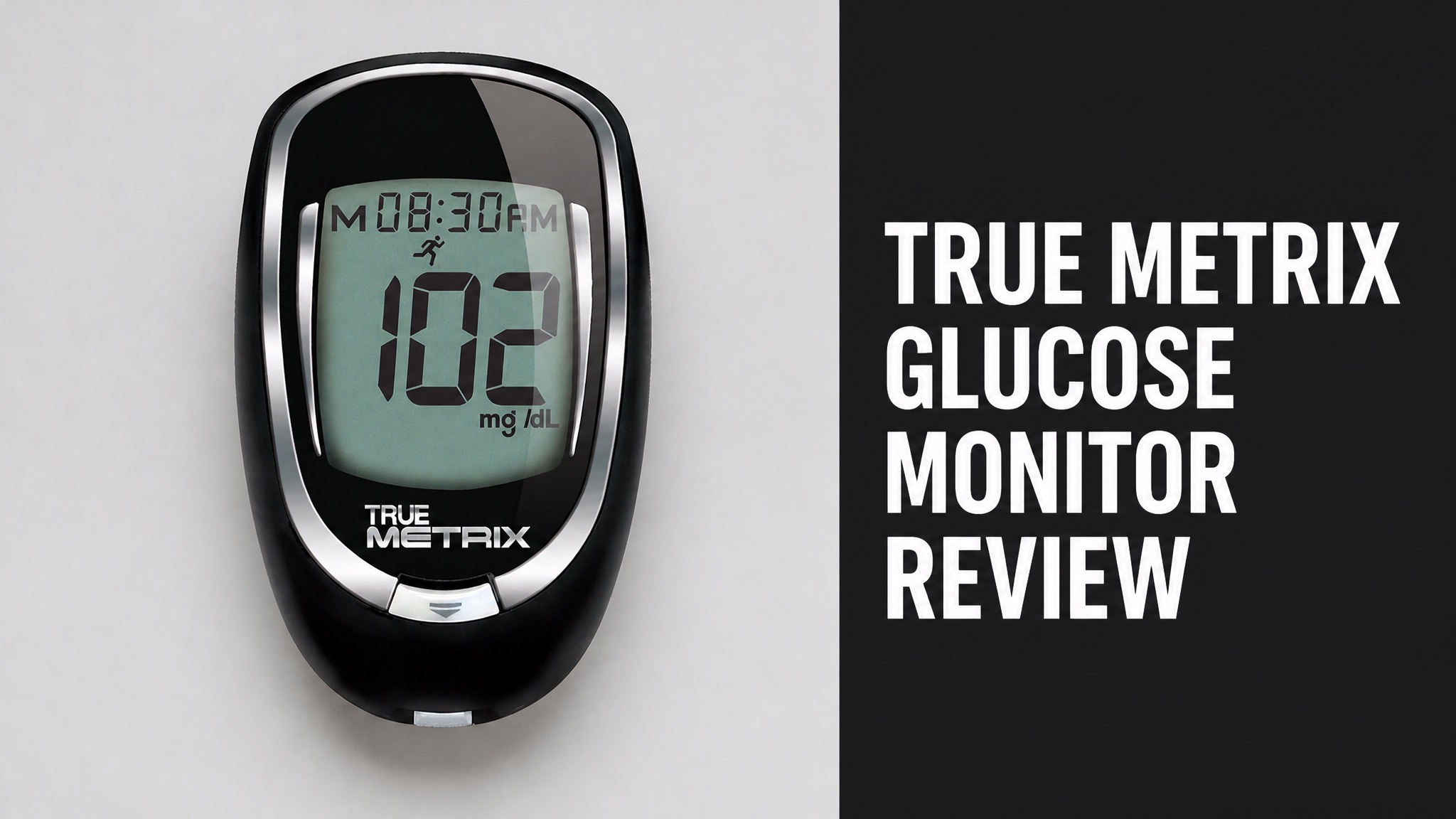
The True Metrix glucose monitor is a fingerstick blood glucose meter from Trividia Health. An FDA Class I recall now covers every True Metrix, Air, Go, and Pro model. The agency tells users to find another testing method when possible. Here’s what you need to know before you buy.
The meter reads glucose in four seconds from a tiny 0.5 microliter blood drop. A software flaw makes one E-5 error mean two things, a strip error or very high glucose. Independent tests show solid accuracy. Reviews praise the price but miss an app. The Contour Next One beats it on features, and the cost gap is clear. Safety comes first for every buyer.
Yearly costs run far below premium rivals, yet safety now outweighs the savings. Read on for the recall facts, accuracy data, real review themes, pricing, and a clear verdict on who needs to switch meters and when to do it. You’ll leave knowing your exact next step with confidence.
What Is the True Metrix Glucose Monitor?
The True Metrix glucose monitor is a fingerstick blood glucose meter made by Trividia Health in the United States. The family covers four models: True Metrix, Air, Go, and Pro. Store brands at Walgreens, CVS, and Sam’s Club sell the same meter under their own names. Trividia also supplies the matching test strips. The device targets budget-minded daily testers.
To be clear, the device is not a continuous glucose monitor. You prick a finger, touch a strip to the blood drop, and read a number. There’s no sensor patch and no wearable part.
Is it a budget meter? Mostly, yes. Gluroo priced the meter at about $19 to $20 (USD) at a drugstore. The strips cost less than premium brands.
How Does the True Metrix Meter Work?
The meter measures glucose through test strips that use Triple Sense Technology. The strip chemistry, the electrodes, and an internal algorithm work together. The system detects variables in each blood sample and corrects them before the screen shows a result. Trividia says this process supports proven accuracy at the fingertip. Results appear in seconds.
In fact, the algorithm adjusts for temperature and hematocrit, the share of red blood cells in blood. Hematocrit can skew many meters. The True Metrix handles a 20 to 70 percent range.
Testing takes four steps. Simple, right? Insert a strip, lance a finger, touch the blood to the strip, and read the result. Why does the last step matter? You can tag the reading as before meal, after meal, exercise, sick, or medication.
What Features Does the True Metrix Have?
The True Metrix delivers a result in four seconds from a 0.5 microliter blood sample and needs no coding. The standard model stores 500 readings with time and date. The Air model adds Bluetooth and stores 1,000 results. The Go model twists directly onto a vial of strips, which keeps the kit compact. Event tags add useful context to every reading in the log.
Key Features:
- Results in as little as 4 seconds
- Tiny 0.5 microliter blood sample
- No coding required
- Alternate site testing
- Six event tags and four reminder alarms
- 7, 14, and 30 day averaging
Here’s the catch with the Ketone Test Reminder. Does the meter detect ketones? No. The alert only reminds you to test your urine when readings stay high.
Is the True Metrix Glucose Monitor Safe?
No. The True Metrix glucose monitor is under an FDA Class I recall, the most serious recall type the agency issues. The FDA safety communication dated April 28, 2026 covers every True Metrix, Air, Go, and Pro meter. Co-branded store versions are affected too. The agency urges users to move to another testing method when possible. Users need to act on it.
Trividia Health started the recall in February 2026. The company issued an updated Urgent Medical Device Correction notice on May 1. The FDA refreshed its page on May 19, and its advice to patients did not change.
Why Was the True Metrix Meter Recalled?
The recall targets a software design flaw in the E-5 error code. The meter shows the same E-5 message for two different problems. One is a very high glucose event above 600 mg/dL (33.3 mmol/L). The other is a plain test strip error. The user can’t tell which problem the screen actually reports. The confusion creates the real danger for many patients.
Here’s why that’s dangerous. A user with a very high reading may blame the strip and wait. A user with normal or low glucose may assume the opposite. Either mistake delays correct care.
The good news? The fix is a software and labeling update. Corrected meters separate the E-5 message from a new EHi message. Owner’s Booklets for Rev 6 and Rev 7 meters carry the revised instructions.
What Should Current True Metrix Users Do?
Current users need to line up an alternative testing method while they keep testing. The FDA says not to stop using the meter until a replacement is ready. Talk to a doctor or pharmacist about options. The advice is most urgent for people on insulin or sulfonylureas, and for anyone with frequent highs and lows. Pharmacists can help with the switch today.
FDA Steps for Current Users:
- Keep testing your blood glucose until another method is available.
- Ask your doctor or pharmacist about an alternative monitoring system.
- Switch quickly if you use intensive insulin therapy or sulfonylureas, or have frequent highs and lows.
- Contact your health care provider at once if E-5 appears with symptoms of high or low glucose.
- Report problems to the FDA and to Trividia Health.
Short answer: don’t ignore E-5. Retest with a fresh strip first. If the error persists, call Trividia Customer Care at 1-888-943-2387.
Is the True Metrix Glucose Monitor Accurate?
Yes, on paper. The True Metrix family meets the EN ISO 15197:2015 accuracy standard, with 99 percent of results inside the limits. Trividia tested the meters against the Yellow Springs Instruments (YSI) lab reference. Every healthcare professional result fell in Zone A of the Parkes Error Grid, the safest zone. The result suggests strong lab performance.
Manufacturer data comes from the maker’s own studies. Does that make it wrong? Not at all, but independent figures add useful context.
What Do Independent Numbers Show?
Independent figures show 99.3 percent of results within 15 mg/dL (0.83 mmol/L) of a lab value. Gluroo’s comparison also lists 82 percent within 10 mg/dL and 46.6 percent within 5 mg/dL. The figures apply to readings at or above 99 mg/dL (5.5 mmol/L). Tighter margins naturally hold fewer results. Those margins broadly match the maker’s own claims for it.
Reported Accuracy:
| Margin | Share of Results |
|---|---|
| Within 15 mg/dL (0.83 mmol/L) | 99.3% |
| Within 10 mg/dL (0.56 mmol/L) | 82% |
| Within 5 mg/dL (0.28 mmol/L) | 46.6% |
By comparison, the Contour Next One scored 99.7 percent within 15 mg/dL. The gap is small. So what does that mean for you? The gap matters most for people with narrow symptom ranges or CGM cross-checks.
What Do True Metrix Glucose Monitor Reviews Say?
Reviews praise the True Metrix for low price, speed, and easy use, but criticize the missing app. Gluroo’s comparison reports kudos for convenience, accuracy, and reliability. Retail pages at CVS, Walmart, and Sam’s Club also carry customer reviews. Recall news now shapes how buyers read all of them. Opinions split along price and safety lines among buyers.
Recall news now colors many opinions. Does a good accuracy record still count? Yes, but the E-5 flaw outweighs it for anyone on insulin.
What Do Users Like About the True Metrix?
Users like the price, the four-second result, and the simple three-button interface. The strip release button also helps, since the strip stays put when testing on the go. Automatic shut-off arrives after two minutes of idle time. The 0.5 microliter sample keeps each fingerstick small. Simple design earns steady praise from daily testers who test on the go.
Top Praise:
- Low starter kit price
- Fast four-second results
- Tiny blood sample
- Limited lifetime warranty
- Made in the USA
What Do Users Complain About?
The loudest complaint is the lack of a smartphone app on the standard meter. Only the Air model has Bluetooth. The standard model needs a USB cable and Windows software to move data. Younger users who track everything on a phone find that step slow and old-fashioned. Many buyers expect Bluetooth at this point in time, even on a budget meter, and say so.
And it gets worse. Gluroo’s reviewer also calls the ketone alert wording misleading. On top of that, the recall now dominates the conversation.
How Does the True Metrix Compare to the Contour Next One?
The Contour Next One wins on app support, while the True Metrix wins on price and sample size. Gluroo compared the two head to head. The Contour pairs with iOS and Android. The True Metrix has no app and costs less per month. Both meters are easy to use and sell for about $20 (USD). Each meter fits a different buyer, so the right pick depends on your needs.
The Contour also adds smartLIGHT, which glows green, red, or orange. Does that help in a hurry? Yes, it does. Its Second-Chance sampling lets you reapply blood to the same strip. The True Metrix counters with Triple Sense and a longer warranty.
How Do the Specs Compare?
The two meters differ most in size, memory, and connectivity. The True Metrix is wider and heavier, at 3.44 by 2.16 inches (87 by 55 mm). The Contour stores more results and syncs with a phone. Both measure from 20 to 600 mg/dL (1.1 to 33.3 mmol/L). Coin-cell batteries last about 1,000 tests. The two devices otherwise match closely on speed.
Spec Comparison:
| Spec | Contour Next One | True Metrix |
|---|---|---|
| Weight | 1.26 oz (36 g) | 1.66 oz (47 g) |
| Sample size | 0.6 microliters | 0.5 microliters |
| Time to result | 5 seconds | 4 seconds |
| Memory | 800 results | 500 results |
| App | Contour Diabetes | None |
| Warranty | 5 years | Limited lifetime |
Bottom line: the Contour offers the app and the extra features. It’s also not part of the True Metrix recall.
How Much Does the True Metrix Glucose Monitor Cost?
The meter costs about $20 (USD) at most drugstores, while test strips drive the yearly bill. Gluroo priced a Rite Aid version at $19 and an ADW Diabetes version at $32 with 50 free strips. A 30-count strip pack on the Rite Aid site cost $9.99, so strips add up fast for frequent testers. Shop around for promotions, and check the strip count before you buy.
Gluroo also ran the yearly math for five tests a day. The totals include control solution, lancets, and strips, without insurance.
Yearly Cost Without Insurance:
| Option | Yearly | Monthly |
|---|---|---|
| True Metrix via ADW Diabetes | $617 | $51.50 |
| Rite Aid True Metrix | $881 | $73.50 |
| Contour Next One | $1,190 | $99 |
The True Metrix is clearly cheaper to run. But is cheaper the same as better? Not when a safety recall is open.
Is the True Metrix Worth the Price?
No. Right now the True Metrix is cheap, but the recall removes its main advantage for high-risk users. Low cost matters less when an E-5 code can hide a dangerous reading. Savings of $25 to $50 a month don’t cover that risk. A safer meter costs more, but it protects users well. Safety comes before savings, and a missed warning costs more than any bill.
Where Can You Buy the True Metrix?
Pharmacies and online stores sell the True Metrix under its own name and under store labels. Search results list Walgreens, CVS, Sam’s Club, Amazon, and US MED. Supply shops such as Total Diabetes Supply also stock kits and strips. Prices vary by seller, so compare the starter kit and the strip count. Always read the label and check the exact model name.
Availability doesn’t confirm a corrected meter. Ask the seller whether the unit carries the updated software.
Is the True Metrix Glucose Monitor Worth It?
No. For most buyers today, the True Metrix is not worth buying until corrected meters and clear guidance are widely available. The FDA tells all users to seek an alternative method when possible. Price and speed don’t offset a Class I recall, however fast the four-second result feels at the kitchen table. Safety must come first for every buyer right now.
Is anything good left? Yes. The hardware is fast, small, and cheap, and the accuracy data looks solid. But the safety flag comes first.
Who Should Avoid the True Metrix?
People on intensive insulin therapy or sulfonylureas face the highest risk and need an alternative meter first. The same goes for anyone with frequent highs and lows. The FDA also tells providers to notify affected patients and help them switch. Caregivers can use the same list to check who needs help. Talk with a provider before making any change today.
Casual testers have more room. Does that mean they’re safe? Not quite. Even so, the FDA advice covers every user, so a switch is the safest plan. Talk to your pharmacist today.