
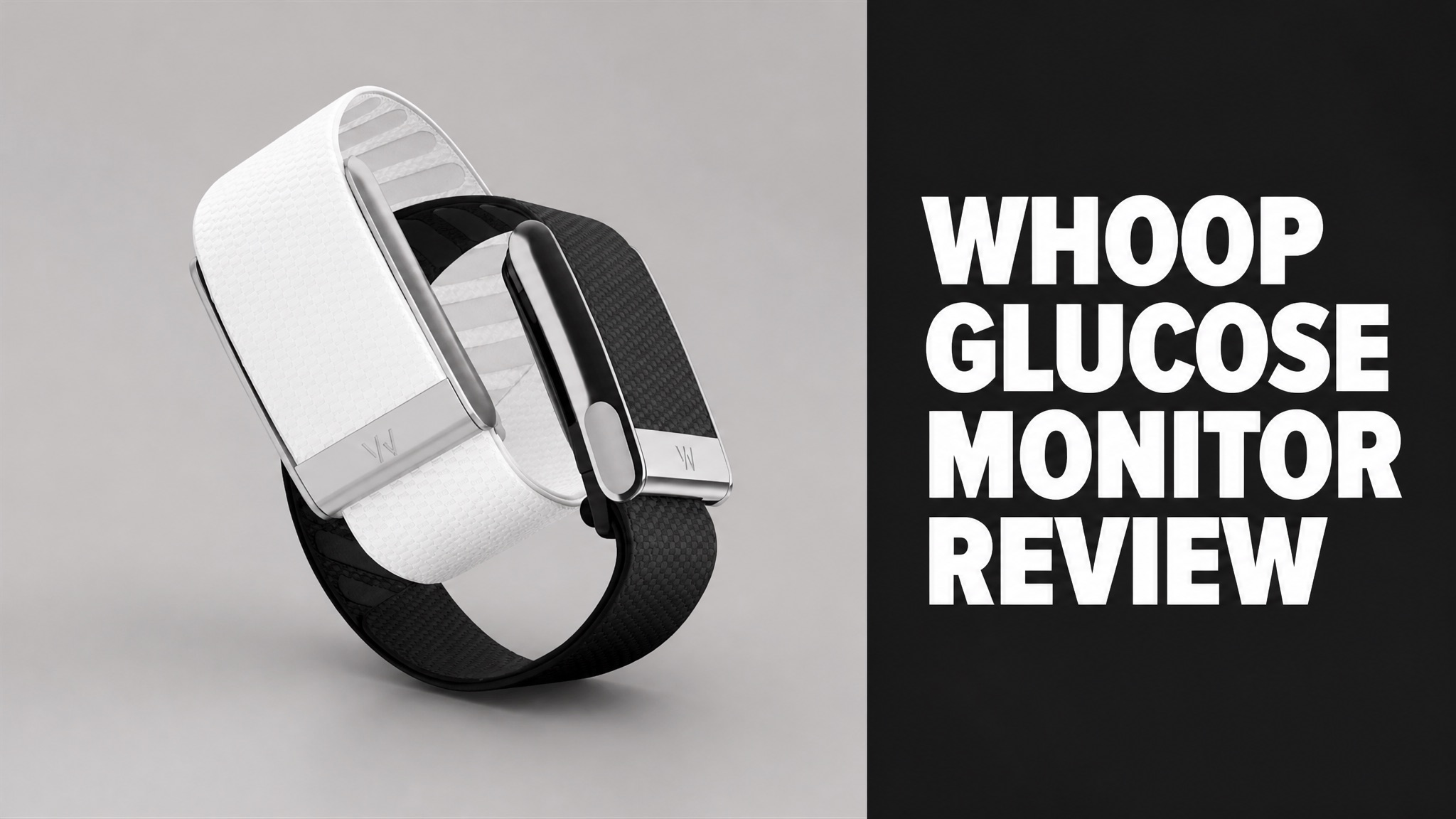
Whoop is a screenless wrist tracker that is sold through a yearly membership from the Boston company founded in 2012. The brand pushes metabolic health, so shoppers expect a glucose sensor. Whoop has none. Glucose data comes only from optional blood tests, never from the band itself.
No Whoop band reads glucose. Advanced Labs adds Quest blood panels from $69 to $299 (USD). The tracker still excels at sleep, recovery and strain scores. Memberships run $199 to $359 a year. Reviewers praise the comfort and the two-week battery and the clean app design. The MG estimates blood pressure, but the FDA questioned that feature in 2025.
Whoop works as a wellness coach, not a glucose monitor. The article below covers sensors, lab tests, reviews, safety, pricing and the Oura comparison. Read on to see who should buy Whoop, who should skip it and why the answer depends on your own health goals and budget limits.
Does Whoop Have a Glucose Monitor?
No. Whoop does not include a glucose sensor in any band, so it cannot read blood sugar on the wrist. The tracker senses heart rate, motion and skin temperature only. Short answer: glucose data comes from separate blood tests that Whoop sells. Wired, CNET and Android Police list heart, sleep and cardiac features. None lists a glucose reading at all.
Why does this confuse buyers? Whoop talks about metabolic health a lot. The brand also works with Quest Diagnostics on lab panels, and shoppers often assume a sensor sits behind that.
Whoop Glucose Reality:
- No glucose sensor in Whoop 5.0
- No glucose sensor in Whoop MG
- Glucose appears only in optional blood panels
- No live glucose graph in the app
Here’s the thing: Abbott joined Whoop’s $575 million funding round in April 2026. Abbott’s stake signals interest in glucose tech. Still, no Whoop device reads glucose today.
Can Whoop Track Blood Sugar?
Not directly. Whoop tracks heart rate, heart rate variability, skin temperature and movement, so blood sugar stays outside the band’s measurements. Buyers who need live glucose readings need a dedicated continuous glucose monitor from another maker. The app shows recovery, strain and sleep scores instead. Those scores never display a glucose number.
To be clear, Whoop does offer indirect context. Sleep, strain and recovery scores show how habits shape your day. Those scores never convert into a glucose number.
Does that make Whoop useless for metabolic goals? Not at all. Daily coaching helps people stick to routines, and a lab panel adds the actual glucose value once in a while.
What Is Whoop?
Whoop is a screenless wrist wearable that sells health tracking as a yearly membership, with the hardware included. The company started in 2012 and is based in Boston. Every insight lives in the phone app, because the band has no display or buttons. The company built its name on recovery scores for athletes. Its band now targets everyday health fans too.
In fact, the device stops tracking when the membership lapses. The model works like a subscription service with a free band. Wired described the software as the real product.
Whoop launched the 5.0 and the MG (Medical Grade) in May 2025. Both carry a battery rated at 14 days (two weeks). Whoop Coach, an AI assistant, answers questions about your data.
Whoop Models:
| Model | Membership | Key Extra |
|---|---|---|
| Whoop 5.0 | One or Peak | Recovery and sleep |
| Whoop 5.0 | Peak | Healthspan and stress |
| Whoop MG | Life | ECG and blood pressure |
What Sensors Does Whoop Have?
Whoop uses photoplethysmography (PPG) sensors, an accelerometer and a skin temperature sensor to capture heart rate, movement and sleep. The MG adds an ECG sensor and a blood pressure feature. None of these sensors touch blood sugar at all. Together these sensors feed the recovery and strain scores each morning. Skin temperature adds sleep context.
Wikipedia notes five sensors gather roughly 100 MB of data per user each day. The data volume feeds the recovery and strain scores. Raw data volume does not equal glucose insight.
The band has no onboard GPS. Is that a dealbreaker? Only for runners who leave the phone at home. Phone GPS fills the gap for route tracking. So, the wearable stays light and small.
How Does Whoop Measure Glucose?
Whoop measures glucose only through Advanced Labs, a blood testing service run with the lab company Quest Diagnostics. Members buy a panel in the app and visit a Quest location. A doctor orders the test and reviews the results afterward. The process needs a short trip to a lab. Whoop lists results in the app beside sleep and recovery data. Plan one visit.
Panels test more than 122 biomarkers across heart, metabolic, performance and hormonal health. Glucose is one of them, along with sodium and calcium. The finger-free approach means a regular blood draw.
The good news? Advanced Labs works without a wearable. Results and a doctor-built action plan land in the Whoop app, plus AI notes that add context.
Advanced Labs Steps:
- Pick a blood panel in the Whoop app.
- Schedule a visit at a Quest location.
- Give a blood sample at the appointment.
- Read the doctor-reviewed results in the app.
What Do Whoop Advanced Labs Test?
Advanced Labs screens more than 122 biomarkers across heart, metabolic, performance and hormonal categories, such as glucose, sodium and calcium. Panel prices run from $69 to $299 (USD). Whoop also lists a Galleri cancer signal test for $799. Hormone, heart and performance markers fill most of the menu. Members pick a panel for their goals. Prices vary.
Is Galleri a diagnosis? No, and the FDA has not approved it. Whoop says it does not replace routine cancer screening. People with elevated risk, such as adults over 50, are the target group.
Bottom line: glucose is only a small slice of the lab menu. Cheaper panels cover basics. Bigger panels cost more.
How Do Whoop Blood Tests Work?
Whoop blood tests work through a scheduled Quest visit. A doctor orders the draw after you buy a panel in the app. Buyers get up to 12 months to book. HSA or FSA funds may apply, so confirm with your plan first. Members book the slot inside the app. A doctor then reviews the results and builds an action plan for the member. Booking stays simple for members.
Availability has limits. Advanced Labs is unavailable in Hawaii, Wyoming, South Dakota and North Dakota. New York, New Jersey and Rhode Island add a state fee at check-in.
These lab fees sit apart from the membership. Whoop’s membership runs from $199 to $359 a year. Plan for both costs.
What Are the Benefits of Whoop?
Whoop delivers detailed sleep, recovery and strain tracking in a small band that stays on the wrist day and night. Reviewers like the comfort and the 14-day (two-week) battery. The slide-on battery pack charges the band while you wear it. The membership also bundles an AI coach for plain language questions about personal health data. Answers come fast.
Wired gave the Whoop MG 8 out of 10. The reviewer praised the smaller body, step counting and a better Whoop Coach. The same review called the proprietary metrics annoying.
What’s more, a 2025 Whoop study tracked 132 members. Of those, 66 used GLP-1 drugs. Users lost an average of 10% body weight in 12 weeks. They also added 30 minutes of weekly activity.
Does Whoop Track Sleep Well?
Yes. Whoop tracks sleep stages and recovery with accuracy that independent reviewers rate as strong, if not always class-leading. The Wired tester found sleep totals differed from an Oura ring by only a minute or two. The band logs stages, disturbances and duration each night. A morning score then explains how ready the body is for strain. Wear it nightly.
Tom’s Guide gave Oura the edge on raw sleep-stage accuracy. Whoop wins on the recovery and strain framework around the numbers. So, the choice depends on what you value.
Does the daily score matter? For most users, yes. The morning recovery score drives how hard you train.
Does Whoop Estimate Blood Pressure?
Yes. The Whoop MG estimates blood pressure with a proprietary algorithm, but the band does not measure it directly. Users calibrate it with three cuff readings first. The Life plan at $359 (USD) a year is required. The feature works as an early warning signal, not as a cuff replacement. Whoop labels every reading as an estimate for users. Trends matter most.
The Wired tester calibrated with a Withings cuff and saw no anomalies. Still, the review calls the feature a canary in a coal mine. People with hypertension still need a separate cuff.
In 2025 the FDA commented on the feature. Whoop replied that the agency was overstepping its authority. The dispute remains a point of caution.
What Do Whoop Reviews Say?
Whoop reviews praise the sleep data, comfort and battery. Critics hit the subscription cost and a few inaccurate metrics. Critics also point to the missing GPS. The overall tone is positive but cost-conscious. Most testers still keep the band on after weeks of use. The cost debate drives nearly every conclusion in the reviews. Few hardware complaints.
Expert scores look solid. Wired gave the MG 8 out of 10, and Android Police reviewed it as a serious rival to rings. Yahoo reported that some users felt let down by the medical grade claims.
Review Snapshot:
| Source | Verdict | Main Point |
|---|---|---|
| Wired | 8 out of 10 | Screenless and versatile |
| Sleep Device Review | Strong tracker | Subscription decides it |
| Yahoo Tech | Mixed | Medical grade doubts |
Pay attention to this: no review praises Whoop as a glucose tool. Reviewers focus on sleep, strain and heart features. Glucose never appears as a hardware feature.
What Do Users Like?
Users like the sleep insights and all-day comfort. The long battery cuts charging stops to roughly twice a month. The screenless look also appeals to people who dislike notifications. Whoop fits under sleeves and clothing easily. Members also like the clean app design. Weekly summaries show progress without any need to touch the band. Updates arrive often.
Strain targets motivate many members. Each activity gets a target to hit. Automatic tracking was praised as very accurate.
And here is the best part: the Whoop Coach now gives better answers than the 2023 version. Wired found it much improved.
What Are the Common Complaints?
The top complaint is the recurring membership, because the band stops tracking the moment payment lapses. Owners pay $199 to $359 a year with no one-time option in the US. Features sit behind tiers. Smaller gripes include proprietary metrics that confuse newcomers. Several testers also wanted GPS and a screen on the band itself. Support delays came up.
Accuracy complaints exist too. Wired found step counts hilariously off against a Garmin Forerunner 970. The band also lacks GPS.
In May 2025 the upgrade policy caused backlash. Whoop reversed course on May 10 and gave free 5.0 upgrades to members with 12 or more months left.
How Does Whoop Compare to Oura?
Whoop competes with the Oura ring as a recovery and sleep tracker. The main difference is how each company charges for it. Whoop includes the band in the membership. Oura sells the ring for about $349 (USD) and adds a small monthly fee. Both brands target sleep and recovery fans. Pricing structure is the clearest dividing line for most buyers. Fit counts.
Oura’s membership runs about $5.99 a month, or roughly $72 (USD) a year. Whoop’s tiers start at $199. At a glance, Oura costs less over time.
Neither device measures glucose. Does that surprise anyone? Probably not. Both brands offer lab testing instead. Oura and Ultrahuman require memberships for lab tests, while Whoop sells panels a la carte.
Whoop vs Oura:
| Feature | Whoop | Oura |
|---|---|---|
| Hardware cost | Included | About $349 |
| Yearly fee | $199 to $359 | About $72 |
| Form | Screenless band | Ring |
| Glucose sensor | No | No |
Which Costs Less?
Oura costs less over several years because the ring is a one-time purchase and the monthly fee stays small. Whoop charges $199 to $359 each year. After three years the gap grows to several hundred dollars. Oura asks for a ring purchase of about $349 (USD) up front. The yearly cost afterward stays far below Whoop’s lowest tier. The math favors rings.
Whoop offers discounts for multi-year memberships. Free hardware upgrades after 12 months soften the sting. Still, you never own the band.
So what does that mean for you? Choose Whoop for coaching and recovery framing. Choose Oura if price matters most.
Is Whoop Safe?
Yes. Whoop is a legitimate company with a safe wearable. Some of its health features remain in a gray zone with regulators. The band uses standard optical and motion sensors. The band holds no needles, patches or invasive parts. Optical sensors rest on the skin and emit no harmful energy. Skin irritation from the strap is the only common physical complaint.
Whoop has raised more than $400 million in venture capital. In April 2026 it raised $575 million at a $10.1 billion valuation. Abbott and Mayo Clinic joined that round.
Safety Points:
- No needles or implants
- Doctor-reviewed lab results
- Blood pressure is an estimate only
- Galleri is not FDA approved
Lab tests are ordered and reviewed by doctors. Whoop says its panels are not a substitute for medical care. Check results with your own physician.
Is Whoop FDA Approved?
No. Whoop has not received FDA approval for its blood pressure insights, and the agency publicly questioned the feature in 2025. Whoop disputed the criticism. The company said the FDA was overstepping its authority. Whoop presents the band as a wellness product. Clinical decisions about blood pressure or heart rhythm need a licensed provider. Stay realistic.
The ECG feature screens for signs of atrial fibrillation. Users can download ECG reports to share with a doctor. The MG name stands for Medical Grade, a label some users doubt.
Look, treat every Whoop reading as a wellness estimate. A reading is not a diagnosis. Use a cuff or lab test for medical decisions.
How Much Does Whoop Cost?
Whoop costs $199 a year for One, $239 for Peak and $359 for Life. Each membership includes the band. The MG device comes only with Life. Discounts apply for multi-year commitments. Training clothing is extra. Prices are per year and billed up front in many cases. Multi-year plans cut the yearly rate for committed members. Check promotions before buying.
Whoop One covers recovery, strain, sleep and coaching. Peak adds Healthspan, a stress monitor and a Health Monitor. Life adds ECG and blood pressure insights.
Whoop Pricing:
| Plan | Price per Year | Device |
|---|---|---|
| One | $199 | Whoop 5.0 |
| Peak | $239 | Whoop 5.0 |
| Life | $359 | Whoop MG |
Add-ons raise the total. Will the bill stay near $199? Rarely. Wired priced the training bra at $59 and shorts at $54. Lab panels cost $69 to $299.
Where to Buy Whoop?
Buyers sign up for Whoop on whoop.com, where the band ships free with the membership in most markets. The company ships to 56 markets. The app runs on Android and iOS. Sign-up takes a few minutes online. The band arrives by mail, and the app guides setup, charging and the first night of tracking. Retailers add choice and convenience for most shoppers.
Retail listings exist at Amazon, Best Buy and Dick’s Sporting Goods in the US. Check the plan terms before ordering. Whoop has offered a one-month free trial before.
A separate device sale is under testing in a few regions, such as Australia. The US still uses the membership model.
Is Whoop Worth It?
Whoop is worth it for people who want recovery coaching and lab testing. Anyone who needs real-time glucose readings should look elsewhere. The band is excellent at sleep and strain. A glucose goal needs a different tool. The band shines for sleep, strain and recovery. A glucose goal still needs a lab panel or a dedicated continuous glucose monitor.
Is the subscription fair? The answer depends on use. Members who act on daily coaching tend to value it. Passive users waste the fee.
Quick Buying Steps:
- Decide if you need live glucose data.
- Pick the plan that fits your budget.
- Add a lab panel for a glucose check.
- Review results with your doctor.
Bottom line: Whoop earns a solid rating as a wellness tracker. The device earns a poor one as a glucose monitor, because it has no glucose sensor.
Who Should Skip Whoop?
People who need live glucose data should skip Whoop and choose a continuous glucose monitor from a dedicated maker. People with diabetes need approved medical devices. Whoop does not replace them. Budget buyers and GPS runners also have better options. A one-time purchase tracker avoids the yearly renewal bill for most users. Consider alternatives first.
Skip it too if recurring fees bother you. A ring or watch with a one-time price suits that buyer better. Also skip it if you want GPS on the wrist.
Still curious? Try the free month first. Then decide whether the coaching earns its $199 to $359 yearly cost.