
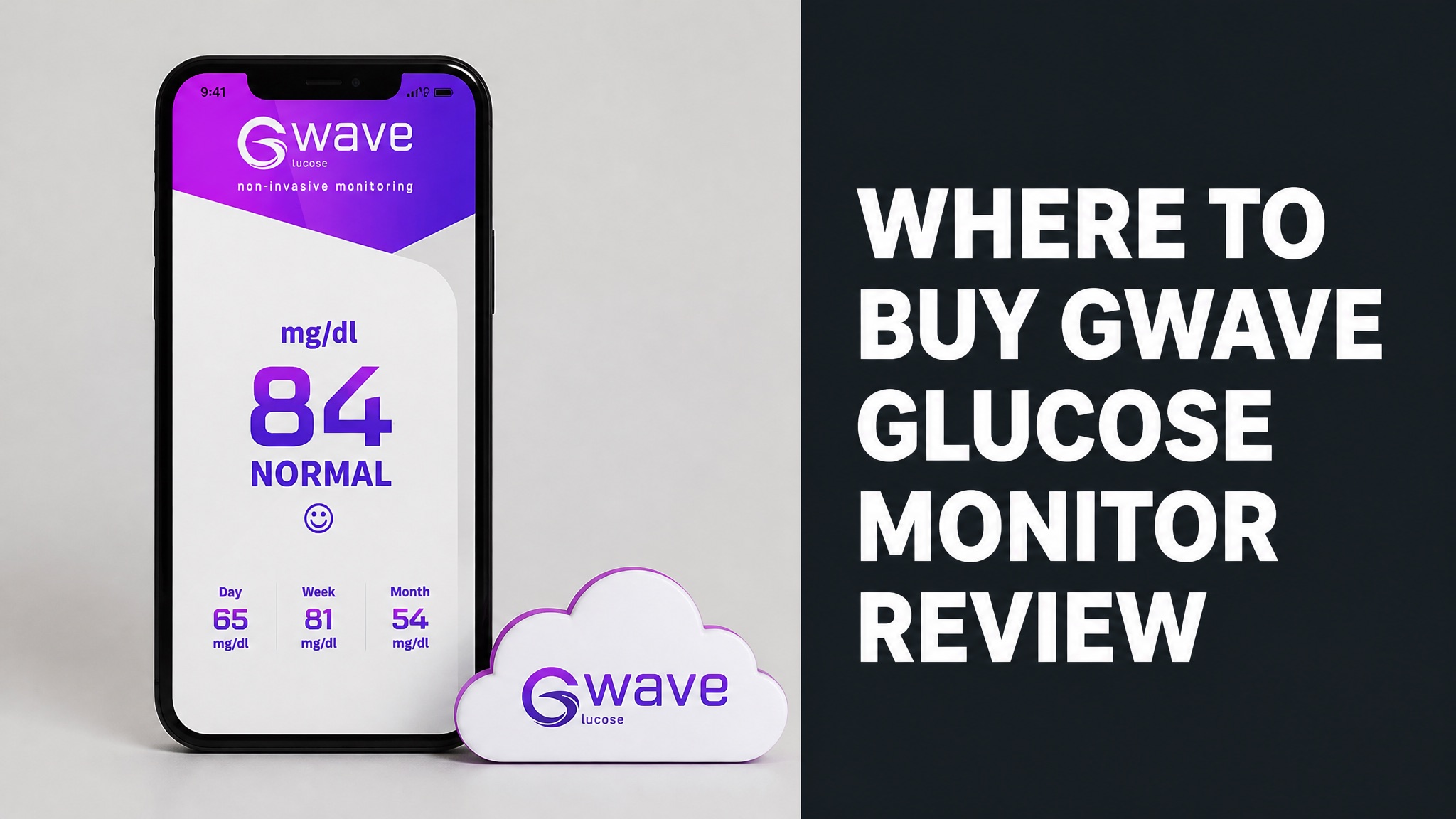
The GWave is a non-invasive glucose monitor from Hagar Technology of Tel Aviv. It reads blood sugar with radio frequency waves instead of finger pricks. Shoppers keep searching for a store link. Here’s the problem: no retail listing for it exists yet, and that shapes everything else.
The company raised $4.4 million in Series A and $11.7 million in Series B funding. Total funding reached $17.1 million. That money pays for FDA trials and patents. So the device remains a clinical-stage product. What does that mean for buyers? Nothing on the market carries the GWave name today.
This review covers what the GWave is, how it works and how accurate it claims to be. It also explains its approval status, price outlook and the meters you can buy right now. Read on to avoid fake listings and pick a safe alternative.
Where Can You Buy the GWave Glucose Monitor?
You can’t buy the GWave glucose monitor from any official store right now. Hagar Technology still runs trials for FDA approval. The company’s own pages describe funding rounds and development, not a shop. To be clear, no checkout page, price or shipping date appears on them.
Search results for the name show Amazon, eBay and Walmart pages. Do those sell the GWave? No. They list other meters and CGM kits under general glucose monitor categories. Worth knowing: a similar-sounding name is not the same product.
Where Shoppers Look:
| Retailer | Lists GWave? | What It Sells |
|---|---|---|
| Amazon | No | Other glucose meters |
| eBay | No | Used and new meter kits |
| Walmart | No | Standard CGM systems |
| Hagar website | No | Press releases only |
Is the GWave Available in Stores or Online?
No. The GWave isn’t available in stores or online as a finished consumer device. The first generation exists as a prototype used in trials. The second generation was still in development at the time of the Series B announcement.
Any seller who claims stock is a red flag. Here’s why: an unapproved medical device can’t be legally marketed in the United States. Treat a GWave listing as a likely scam or a mislabeled product.
What Is the GWave Glucose Monitor?
The GWave is a wearable, non-invasive, continuous glucose monitoring device built by Hagar Technology. The company calls it the first of its kind. The sensor sits in a lightweight ceramic bracelet on the wrist. Readings go to a smartphone app.
The idea came from an accident. Co-founder Dr. Gerry Waintraub spilled tea on an RF device. The sugar in the tea caused a big reaction on the monitors. So he started to build theories around that effect.
Hagar was founded in 2017. The first generation is a third of the size of a smartphone. The second generation aims to shrink into a smartwatch-size sensor. Does it replace a regular CGM yet? Not yet.
How Does the GWave Work?
The GWave measures glucose in the blood with radio frequency waves instead of a needle or sensor under the skin. The waves react to sugar levels. The sensor passes the signal to the GWave app, which shows the reading.
Standard CGMs test interstitial fluid under the skin. That fluid lags behind blood. Hagar says its method reads blood directly, so results arrive in real time. The company also says the sensor uses less radio frequency than a smartphone.
Core Parts:
- Ceramic wrist bracelet with the RF sensor
- Smartphone app for readings
- Sharing option for healthcare providers
Is the GWave FDA Approved?
No. The GWave is not FDA approved. Hagar says clinical trials in Israel work toward FDA certification. The Series B money funds upcoming FDA trials and international patents. Approval is a goal, not a fact.
Here is the kicker: trials take years. Even strong early data doesn’t guarantee clearance. So a purchase date stays unknown. Look for official news on the Hagar site before you trust any claim.
How Accurate Is the GWave?
The company says the GWave reaches over 90 percent detection results in its proof of concept at Sheba Medical Center. Hagar compares that with a nearly 70 percent rate for CGMs it describes. Treat those numbers as company claims, since no independent study backs them.
Dr. Irl Hirsch, a University of Washington endocrinologist on the advisory board, reported more than 95 percent accuracy in one trial. In that test, his nephew with type 1 diabetes compared three handheld meters and a CGM against the device. Is that proof? Not by itself. It’s one test, from an advisor.
Accuracy Claims:
| Source | Claim | Type |
|---|---|---|
| Sheba Medical Center test | Over 90% detection | Proof of concept |
| Dr. Irl Hirsch trial | Over 95% accuracy | Advisor report |
| Interstitial CGMs | Nearly 70% | Company comparison |
What Do GWave Reviews Say?
Real user reviews of the GWave don’t exist because the public can’t buy the device. Feedback comes from trial reports and press releases. A Reddit thread called Gwave non invasive very accurate exists, but it isn’t a verified review. The bottom line: no buyer reviews are out there.
Facebook groups show a different pattern. Diabetics ask where to buy affordable and wearable monitors. They want alternatives to finger sticks. And that demand explains why the GWave name draws so many searches.
Which Glucose Monitors Can You Buy Today?
Several approved options are on sale now through pharmacies and big retailers. CVS lists diabetic monitors. Best Buy sells the Foxxd MG1 meter. Walmart carries CGM systems, and eBay lists Contour kits. Check with your doctor before choosing.
One name causes confusion. The Embrace WAVE+ Bluetooth kit sold on Amazon is a finger-stick meter. It has no link to the GWave. Short answer: don’t mix them up.
Available Options:
- Embrace WAVE+ Bluetooth meter kit on Amazon
- Foxxd MG1 meter at Best Buy
- Contour kits on eBay
- Diabetic monitors at CVS
How Much Does the GWave Cost?
The GWave has no published retail price. Hagar hasn’t announced one. Its leaders say they want the technology to become increasingly cost-effective. That is a goal, not a quote. Any price you see online is unverified.
For context, GoodRx covers what standard continuous monitors cost. People also ask whether a Dexcom or a Libre is cheaper. Those questions have real answers today. The GWave doesn’t yet.
Is the GWave Worth Waiting For?
Maybe. The GWave is worth watching if you want a painless option, but it isn’t worth waiting on for current care. Diabetes needs monitoring now. Use an approved meter or CGM until the GWave clears the FDA.
The promise is big. A needle-free wristband could help prediabetes detection too. About 88 million US adults have prediabetes. Still, a promise is not a product. Pick what works today and recheck the news later.