
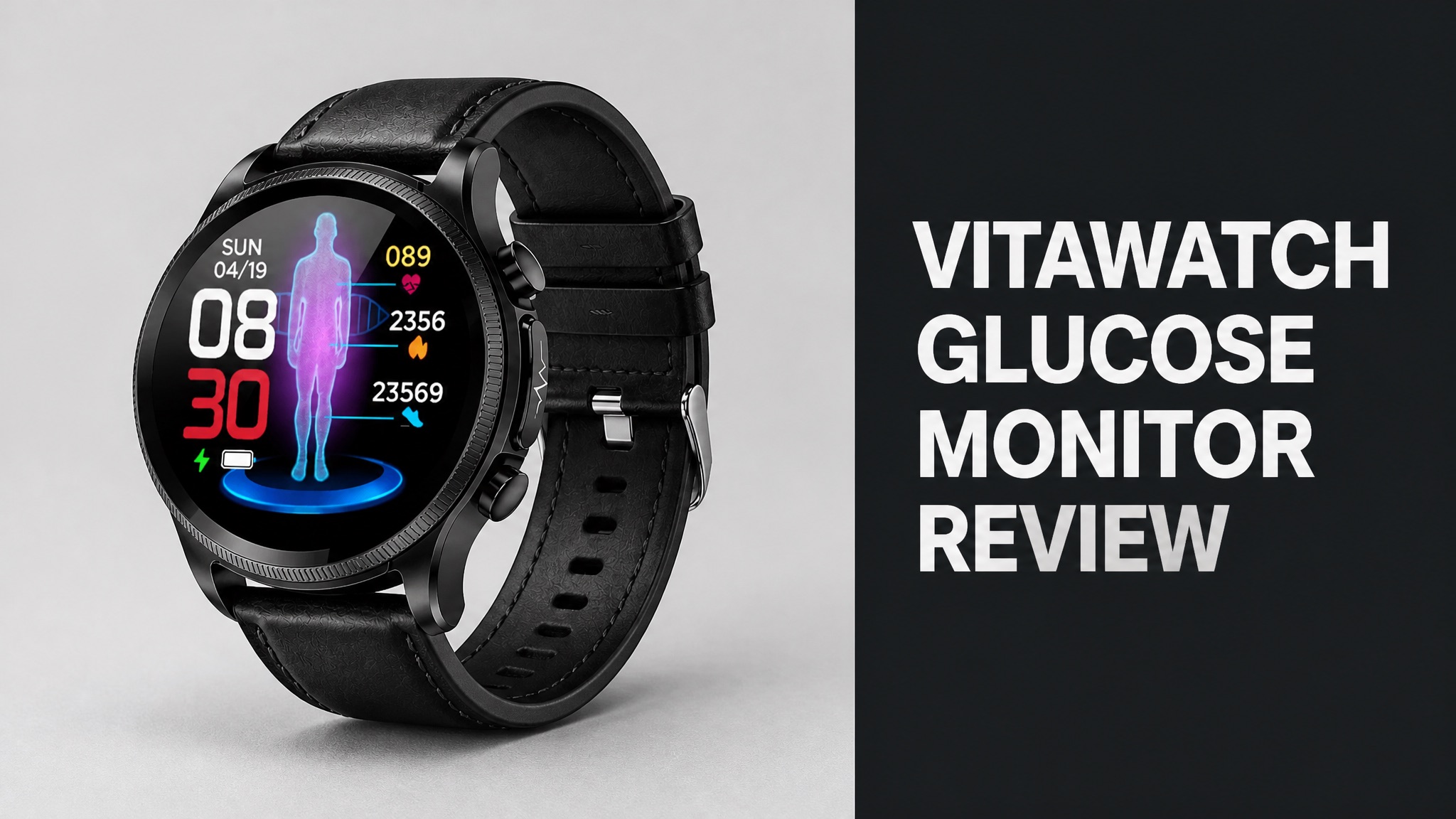
VitaWatch is a smartwatch sold on the-vita-watch.com that claims to track glucose trends without a finger prick. It also logs heart rate, blood pressure and sleep. Health agencies say such watches are unproven.
The maker calls it a trend tracker, not a medical device. The FDA has not cleared any needle-free glucose watch. Diabetes groups in Canada and Australia warn against them. Real reviews are mixed, and independent proof is missing.
That gap matters if you have diabetes. This review covers how the watch works, its accuracy claims, user feedback, safer alternatives and cost. You will see clearly whether VitaWatch deserves your money.
What Is VitaWatch?
VitaWatch is a wrist-worn smartwatch marketed as a non-invasive glucose trend tracker for people with diabetes. The product page calls it the Diabetes Watch 2.0 and claims over 15,000 daily users. It syncs with iPhone and Android phones through a companion app.
Here’s the thing: the brand does not call the watch a medical replacement. Its own page says it does not replace medical devices. To be clear, no smartwatch can do that today.
Quick Facts:
- Product name: Diabetes Watch 2.0 (VitaWatch)
- Seller: the-vita-watch.com
- Battery life: 7 days per charge
- Warranty: 1 year, plus a 30-day guarantee
- Phone support: iOS and Android via Bluetooth 5.0
Does VitaWatch Really Measure Glucose Without Pricking?
No. VitaWatch does not measure blood glucose in a way that regulators accept, because no needle-free method has earned approval. The seller admits non-invasive technology cannot fully replace blood sampling today. The watch only shows an estimated trend.
So what does that mean for you? Diabetes Victoria states that no existing technology measures glucose non-invasively. Its nurse educator says glucose testing still needs a finger prick or a CGM.
How Does VitaWatch Work?
VitaWatch uses light-based sensors on the wrist and an algorithm to estimate glucose trends from skin signals. The seller says the sensors scan blood vessels and read the reflected light. The software then turns that signal into a glucose figure on the screen.
Does light really reveal blood sugar? Health Canada says the safety and efficiency of infrared watches have not been proven. The method remains experimental.
What Features Does VitaWatch Include?
VitaWatch bundles glucose trends with heart rate, blood pressure, blood oxygen, ECG, body temperature and sleep tracking. It also counts steps and calories. A large display targets senior users.
Listed Features:
| Feature | Seller Claim |
|---|---|
| Glucose | Non-invasive trend tracking |
| Vitals | Heart rate, blood pressure, blood oxygen |
| Heart | ECG measurement |
| Lifestyle | Sleep, steps and calories |
| Data | App export to your doctor by email |
Is VitaWatch Accurate?
No. VitaWatch has no independent clinical evidence showing that its glucose readings match approved meters. The seller calls its accuracy industry leading but publishes no trial data. Claims alone do not prove performance.
For context, GoodRx explains that approved over-the-counter monitors must hit strict targets. At least 95% of readings must fall within 15% of a cleared meter. That is the bar.
FDA Accuracy Targets:
| Requirement | Threshold |
|---|---|
| Readings within 15% of reference | At least 95% |
| Readings within 20% of reference | At least 99% |
| VitaWatch published trial results | None found |
Is VitaWatch FDA Approved?
No. VitaWatch has no FDA approval, clearance or authorization for measuring glucose. The FDA has not reviewed the safety or effectiveness of smartwatches that claim needle-free glucose readings. This applies to the whole product category.
Harvard Health reports the FDA warning. It covers smartwatches and smart rings that promise needle-free monitoring. Real CGMs are not part of that warning.
Can You Trust VitaWatch for Insulin Decisions?
No. Insulin choices based only on a glucose watch can put your health at serious risk. The BETTER project in Canada explains why. A falsely high reading can push you to take insulin you do not need.
The result is a real risk of hypoglycemia. And most of these watches have no alarm for oncoming lows. Always confirm with a finger prick or an approved CGM.
What Do VitaWatch Reviews Say?
VitaWatch reviews split between marketing praise on the seller site and skepticism from diabetes communities. Independent trials do not exist. Most positive stories come from the seller or from early users.
Short answer: no verified, independent test backs the product. A diabetes forum user said a similar watch needed a Chinese-language app at first. Another forum voice noted that a real breakthrough would arrive with big fanfare.
What Do Positive Reviews Say?
Positive feedback focuses on the convenience, the large screen and the multi-sensor features. Fans like the 7-day battery and easy phone pairing. Others enjoy seeing sleep and heart data in one app.
Common Praise:
- Large, senior-friendly display
- Seven-day battery life
- Simple app with data export
- No finger prick needed for trends
What Are the Common Complaints?
Complaints center on unproven accuracy, missing regulatory approval and false readings during fast glucose swings. People with type 1 diabetes who compared similar watches to CGMs saw results that often differed. Those tests were informal, not scientific.
The bad news? Most of these watches lack hypoglycemia alarms. And the refund promise depends on you sending a comparison photo.
How Does VitaWatch Compare to a CGM?
A CGM is the proven choice, because regulators evaluated it for safety and accuracy while VitaWatch was not. A CGM reads fluid under the skin through a tiny sensor. VitaWatch reads light on the wrist.
By comparison, a CGM can send data to a watch or phone. In that case, the CGM does the measuring and the watch only displays the numbers.
VitaWatch vs CGM:
| Factor | VitaWatch | Approved CGM |
|---|---|---|
| Regulatory status | No approval | FDA cleared |
| Method | Light on the skin | Sensor under the skin |
| Low alarms | Not confirmed | Yes |
| Safe for insulin dosing | No | Yes |
What Are Better Alternatives to VitaWatch?
Better options are an FDA-cleared glucometer or a prescribed continuous glucose monitor. GoodRx and Diabetes Victoria both name these two routes as the proven ways to track glucose at home. Both are tested and regulated.
And here is the best part: a CGM can show live numbers on a smartwatch, so you still get wrist convenience without the risk.
Who Should Avoid VitaWatch?
People with diabetes should avoid VitaWatch as their only glucose tool. Anyone who takes insulin faces the highest risk. The same goes for people prone to low blood sugar.
Pay attention to this: the FDA, Health Canada and Diabetes Victoria all advise against needle-free watches for glucose decisions.
Is VitaWatch Safe to Use for General Wellness?
Yes. VitaWatch works as a basic fitness tracker for steps, sleep and heart rate when you ignore its glucose figures. Treat any glucose number as a rough trend. Speak with a doctor before you act on it.
Safe Use Tips:
- Confirm every reading with a finger prick meter.
- Never change insulin doses based on the watch.
- Keep your approved CGM or meter in use.
- Share app reports with your doctor.
How Much Does VitaWatch Cost?
VitaWatch does not show a fixed price in the researched sources, so the cost depends on the current offer on the seller site. Check the checkout page for the live price. Prices on such sites change often.
The seller adds a 1-year warranty and a 30-day guarantee. To get a refund, you send a glucose comparison photo to support.
Is VitaWatch Worth the Price?
No. VitaWatch is not worth buying as a glucose device, because it lacks approval and proof of accuracy. A cheap watch that gives wrong numbers costs more in risk than it saves in money.
Let me explain: an approved meter or CGM protects your health. As a basic fitness band, the watch may be fine if the price is low.
Should You Buy VitaWatch?
No. VitaWatch is not a safe replacement for an approved glucose meter or CGM. Its claims lack independent proof. Health authorities warn against this product type.
Bottom line: skip it for diabetes care. Choose an FDA-cleared tool and talk to your doctor.
Where Should You Buy Glucose Monitoring Tools Instead?
A pharmacy or your doctor is the right source for approved glucometers and CGMs. Glucometers are sold with or without a prescription. Most CGMs need a prescription from a licensed clinician.
In plain English: buy from a licensed pharmacy, not from social media ads.