
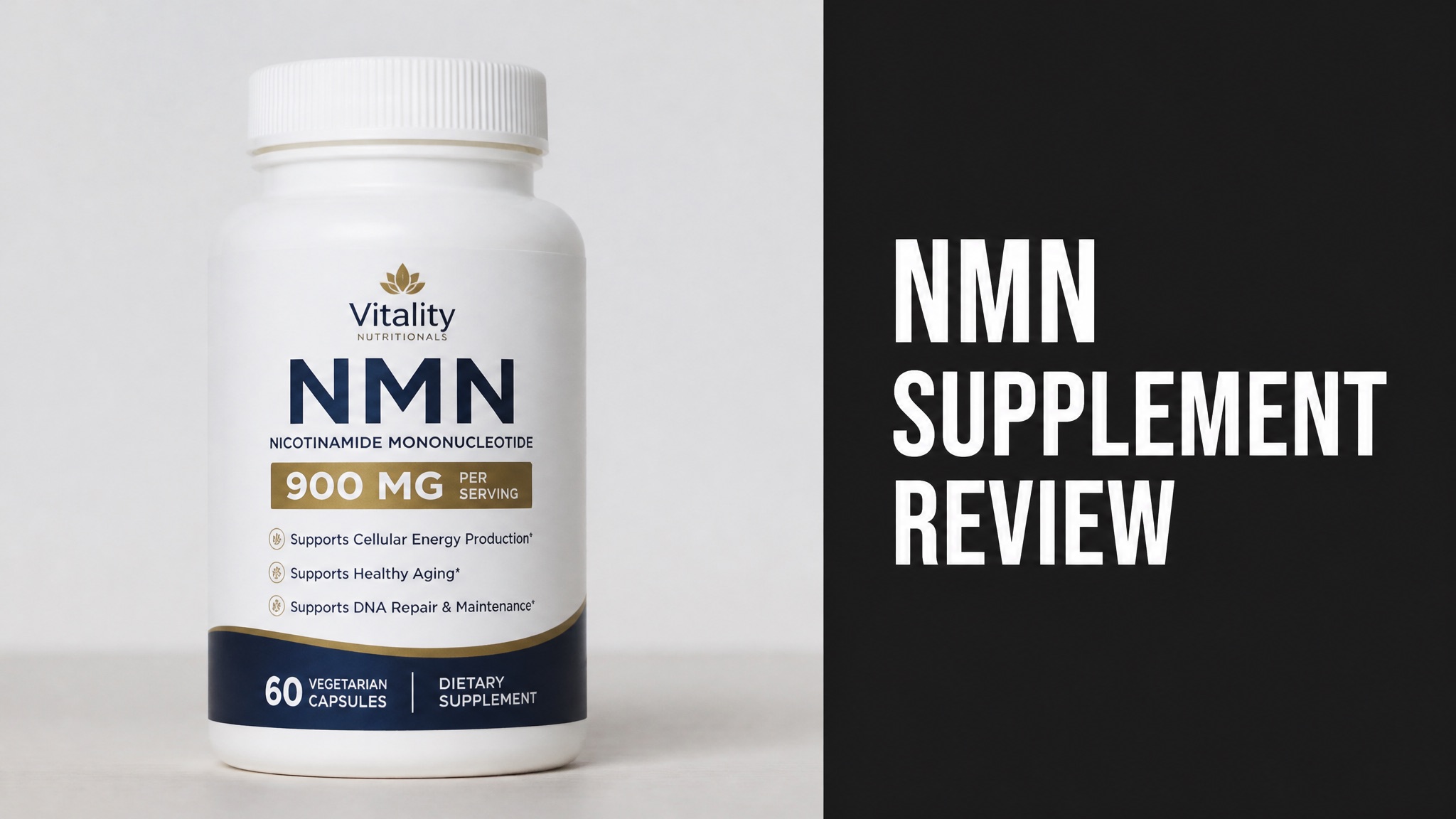
An NMN supplement is a capsule or powder of nicotinamide mononucleotide, a molecule the body converts into NAD+. NAD+ fuels cellular energy and DNA repair, and levels fall with age. Brands sell NMN as a longevity aid, and Harvard researcher David Sinclair made it famous.
Human trials show NMN raises blood NAD+ in a dose-dependent way. Small studies hint at better insulin sensitivity, walking speed and sleep. The side effects look mild. The FDA reversed its 2022 exclusion in 2025, so NMN is again lawful to sell. Cost and long-term data remain open questions.
This review covers how NMN works, what the trials show, what users report, the risks and the price. It also compares NMN with nicotinamide riboside and explains how to pick a clean product.
What Is an NMN Supplement?
An NMN supplement delivers nicotinamide mononucleotide, a small molecule made naturally in every mammalian cell. It is sold as a capsule or powder. The body uses it as a direct building block for NAD+. Commercial NMN is made by chemical synthesis or enzymes.
Here’s the thing: NMN isn’t a vitamin or a herb. It belongs to the pyridine nucleotide family of metabolic intermediates. Small amounts also occur in broccoli, cabbage, cucumbers, edamame and avocado.
Why did NMN become famous? Long-term NMN in mice eased age-related decline in insulin sensitivity, lipids, eye function and bone density. Harvard researcher David Sinclair then said he takes 1,000 mg (1 gram) each morning.
Key facts:
- Full name: nicotinamide mononucleotide
- Role: direct precursor of NAD+
- Common forms: capsules and powder
- Trial dose range: 250 to 900 mg per day
How Does NMN Work?
NMN works by feeding the enzyme NMNAT, which converts it into NAD+ in one chemical step. NAD+ then powers three enzyme families: sirtuins, PARPs and CD38. Each one consumes NAD+ while it repairs DNA or regulates stress responses.
To be clear, the gut step is still debated. Scientists don’t know whether oral NMN is absorbed intact or first broken down into nicotinamide riboside. Either way, whole-blood NAD+ rises in humans.
NAD+ levels can drop by up to 50% with age. In fact, CD38 activity rises with age and drains the pool further. That is the logic behind supplementing.
What Are the Benefits of NMN?
NMN has moderate human evidence for raising blood NAD+ and limited evidence for metabolic and physical benefits. Reviewers rank the claims in tiers. Blood NAD+ is moderate, metabolic markers are limited, and ‘reverse aging’ is anecdotal in people.
So what does that mean for you? The strongest proof is a number on a lab test. Feeling younger is not a proven outcome.
Evidence by claim:
| Claim | Evidence | Strength |
|---|---|---|
| Raises blood NAD+ | Dose-response RCTs | Moderate |
| Insulin sensitivity | One 10-week RCT | Limited |
| Walking and fatigue | 12-week RCTs | Limited |
| Reverses aging | Mouse studies, anecdotes | Anecdotal |
Does NMN Raise NAD+ Levels?
Yes. NMN raises whole-blood NAD+ in a dose-dependent way in healthy adults. A multicenter RCT tested 300, 600 and 900 mg per day in middle-aged adults and saw the same pattern. A pharmaceutical-grade form, MIB-626, repeated it in older adults.
The catch? NAD+ lab assays aren’t fully standardized. Results shift with the method, so compare tests from the same lab.
Does NMN Improve Insulin Sensitivity?
Possibly. A 10-week RCT in postmenopausal women with prediabetes found that 250 mg per day improved muscle insulin sensitivity. It also changed muscle gene expression. The sample was just 25 women, so the result needs replication.
Here’s the part most people miss: the dose-response RCT improved 6-minute walk distance but didn’t change HOMA-IR against placebo. MIB-626 trimmed LDL, body weight and diastolic blood pressure in overweight adults.
What Do NMN Reviews Say?
NMN reviews split between users who notice more energy and better sleep and users who notice nothing at all. Trial participants echo that split. Reported gains are modest, and no one measures them the same way.
Think of it this way: how you feel is a weak signal. Placebo effects and regression to the mean can mimic a real response. A before-and-after blood panel is the cleaner test.
What Do Users Praise?
Users praise steadier energy, less fatigue and better sleep after several weeks of daily use. A 12-week trial in older Japanese adults found less fatigue and better lower-limb function. Another kept walking speed up and improved sleep quality.
Most-cited positives:
- Less daytime fatigue
- Better sleep quality
- Faster walking speed in older adults
- Easy once-daily routine
What Are Common Complaints?
Complaints center on no noticeable effect, high cost and occasional stomach upset. Small trials in mostly Asian populations also limit how far the praise applies. Many brands also make claims no trial supports.
Bottom line: the loudest complaint is paying a premium for something you can’t feel. Cheap products with no third-party testing add a second worry about what is really in the bottle.
NMN vs NR: Which Is Better?
Neither is clearly better. NMN and nicotinamide riboside (NR) both raise blood NAD+ at comparable doses. Both show only modest muscle effects in older adults. NMN sits one step from NAD+. NR sits two steps away, converting through NMN first.
NMN vs NR:
| Factor | NMN | NR |
|---|---|---|
| Steps to NAD+ | One | Two |
| Human trial dose | 250-900 mg per day | 250-1,000 mg per day |
| US legal status | Reversed in 2025 | Marketed since 2016 |
| Relative cost | $$ to $$$ | $$ |
Which Has More Safety Data?
NR has the longer record of safe use at supplement doses because it reached the US market years earlier. NMN trials report a similar mild profile. Both lack controlled data beyond 12 months.
What’s more, NR is the safer pick if you want an unambiguous regulatory path. Choose NMN if you want the form used in the most-cited metabolic trial.
What Are the Side Effects of NMN?
NMN side effects are mild and infrequent in trials, mainly stomach upset, headache and brief flushing. A 12-week study at 250 mg per day found no serious adverse events. Doses up to 900 mg per day looked equally clean.
But here’s the kicker: nobody has controlled data past 12 months. Short-term safety is reasonable. Long-term safety is unknown.
Reported side effects:
- Mild stomach upset
- Headache
- Transient flushing
Who Should Avoid NMN?
Some groups should skip NMN or get medical clearance first. Pregnant and breastfeeding women lack human safety data at supplement doses. Children, and people with liver or kidney impairment, are also uncharacterized.
Active or recently treated cancer is the big flag. NAD+ supports DNA repair through PARPs, so a theoretical clash with chemotherapy and PARP inhibitors exists. Ask an oncologist before starting.
Is NMN Legal and Safe in the US?
Yes. NMN is lawfully marketable in the US as a dietary supplement under standard NDI notification rules as of May 2026. Safety in healthy adults is reasonably shown at 250 to 900 mg per day for up to 12 weeks.
The legal story was messy. In 2022 the FDA ruled NMN excluded from the supplement definition because drug trials came first. The Natural Products Association challenged that, and the FDA reversed course in 2025.
Regulatory timeline:
- 2022: FDA issues a drug-exclusion determination for NMN.
- 2022-2025: The Natural Products Association challenges it in court.
- 2025: FDA reverses its position and issues new supplier letters.
- May 2026: NMN is lawfully sold as a supplement.
Does the FDA Approve NMN Supplements?
No. The FDA doesn’t approve supplements before they reach shoppers. It enforces manufacturing rules and false-claim bans after products are on shelves. A label can’t promise to treat disease.
That’s why third-party testing matters. Without it, nobody independent confirms the capsule holds what the label says.
How Much Does an NMN Supplement Cost?
NMN costs more than most vitamins. Comparison guides rate it $$ to $$$, against $$ for NR. Prices vary widely by brand, capsule strength and testing. Retail listings change often, so check the current price per gram.
Look at cost per 250 mg, not cost per bottle. A cheap bottle with 125 mg capsules costs more per dose than it looks.
Price drivers:
- Capsule strength (250 to 500 mg is common)
- Purity of 99% or higher
- Third-party certification
- Pharmaceutical-grade polymorphs
Is NMN Worth the Price?
It depends on your goal. NMN is worth the price only if you track blood markers and accept limited proof. The sure result is higher blood NAD+. Clinical payoffs are small and unproven.
Don’t guess. Run a blood panel at day 0 and again at week 12 in the same lab. That shows if it worked.
How Do You Choose an NMN Supplement?
Choose an NMN supplement by checking form, dose, purity and independent testing. Capsules and powders are the only forms tested in human trials. Sprays, creams and liposomal products have no published safety or efficacy research.
Buying checklist:
- Oral capsule or powder only
- At least 99% pure NMN
- Third-party lab certification
- Clear dose per capsule
- No unsupported disease claims
How Much NMN Should You Take?
Human trials used 250 to 900 mg per day, so that is the studied range. Most guides suggest taking it in the morning, with or without food. Consistent daily use matters more than timing.
Start at the low end. The 250 mg dose carried the clearest metabolic result, and higher doses added no proven clinical gain.
Where to Buy NMN?
Buy NMN from brand sites and large retailers that publish third-party lab results for each batch. Skip marketplace sellers with no certificate of analysis. Independent checks matter because supplement quality varies widely.
In plain English: a lab report beats a pretty label. Match the batch number on the bottle to the report before you pay.
Is an NMN Supplement Worth It?
An NMN supplement is worth trying for healthy adults who want higher NAD+. Verify the result with blood tests. It isn’t worth it for anyone chasing proven anti-aging effects. Those remain unproven in people.
Short answer: the science is promising but early. Safety looks fine for 12 weeks. Beyond that, nobody knows.
Quick verdict:
| Factor | Verdict |
|---|---|
| Raises NAD+ | Yes, shown in RCTs |
| Proven anti-aging | No |
| Short-term safety | Good |
| Long-term safety | Unknown |
Who Benefits Most from NMN?
Adults over 40 with low energy or early metabolic concerns are the best fit for a trial run. The prediabetes and older-adult studies enrolled these groups. Younger, healthy users have little data behind them.
Talk to a clinician first if you take medication. Interactions are mostly theoretical, but the research is thin.