
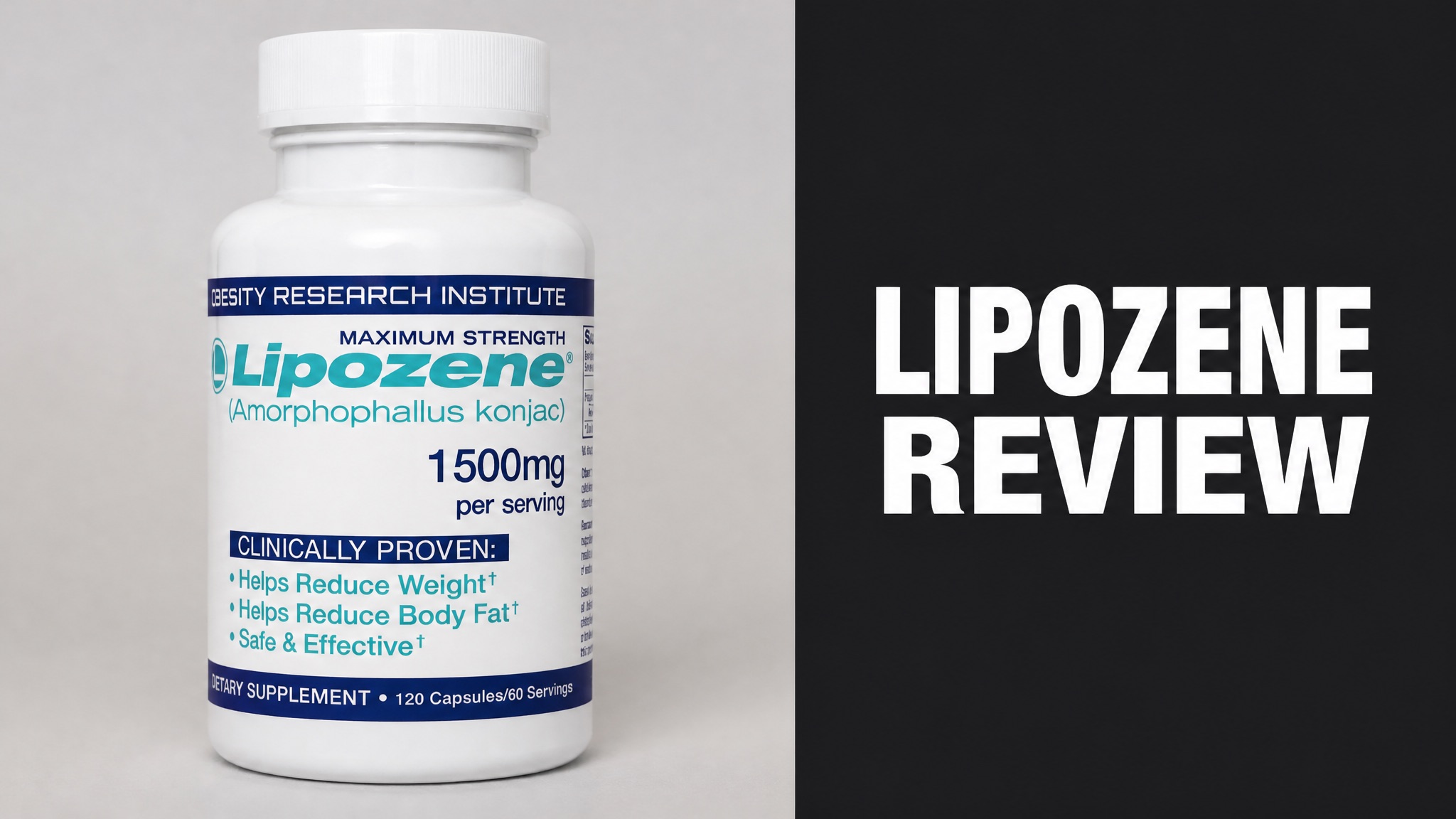
Lipozene is an over-the-counter weight loss supplement with one active ingredient, the konjac root fiber glucomannan. The Obesity Research Institute sells it as capsules that swell in the stomach. Cable ads made it famous. Now the question is whether the claims hold up. Here is the full picture.
The fiber forms a gel that creates fullness. Research shows small, short-term results at best, and only with calorie restriction. Reviews are polarized, with complaints about price and billing. Side effects include gas, bloating and blockages. The product is not FDA approved for weight loss. Generic glucomannan costs far less. Brand premium adds nothing.
The big picture is clear. Lipozene is a real product, but it’s a modest fiber supplement, not a miracle. Read on to learn how it works, what studies found, what buyers say, what it costs and whether it earns a place in your routine. Each section answers one question buyers ask before purchase.
What Is Lipozene?
Lipozene is an over-the-counter weight loss supplement built around one plant fiber called glucomannan. The brand sells it as capsules that swell with water in the stomach. In fact, the pitch is simple: feel full sooner, eat less, and lose weight without a prescription or a stimulant. Most large drugstores stock it on the shelf. Buyers pick it up online too.
Lipozene became a household name through heavy cable advertising. The Los Angeles Times called it a dominant presence on basic cable in 2008. Did the fame earn trust? Not really, as the sections below show.
Who Makes Lipozene?
The Obesity Research Institute makes and sells Lipozene under its own brand name. The company knows glucomannan well. Two earlier products, Propolene and FiberThin, used the same fiber before both were discontinued. Here’s the thing: that history shapes how much weight the brand’s claims deserve today. Lipozene, LLC operates from Elmsford, New York.
The legal record matters. In 2005, the company agreed to refund $1.5 million (USD). The Federal Trade Commission had charged that ads for those earlier products were false and misleading.
What Is in Lipozene?
Lipozene contains glucomannan as its sole active ingredient, a soluble fiber taken from the konjac root. Maximum Strength capsules hold 1.5 grams of it each. The formula has no caffeine and no stimulants. So the whole effect rests on one fiber, not on a blend of herbs or fat burners. Simple formulas are easy to evaluate. The label lists nothing else active.
Key Facts:
- Active ingredient: glucomannan from konjac root
- Maximum Strength dose: 1.5 grams per capsule
- Stimulants: none, caffeine-free
- Original 2008 capsule: 750 milligrams
Here’s what the label tells buyers. The original 2008 capsules held 750 milligrams of glucomannan each. The newer strength doubles that dose. Both versions rely on the same single fiber.
What Is Glucomannan?
Glucomannan is a water-soluble dietary fiber from the root of the konjac plant, also called elephant yam. The root grows in Asia. The fiber mixes with water to form a thick, indigestible gel. The gel is the entire basis of the Lipozene concept, and nothing else in the capsule does the work. Konjac itself is a long-used food root in Asia. The gel is thick.
Researchers call glucomannan an especially viscous fiber. Vladimir Vuksan, a nutritional sciences professor at the University of Toronto, says it forms a thicker paste than most fibers. Can it curb appetite? Yes, but only a little.
How Does Lipozene Work?
Lipozene works by absorbing water in the stomach and swelling into a gel that creates a feeling of fullness. The idea is to curb appetite and cut calorie intake at the next meal. Nothing else in the capsule burns fat directly. The fiber simply takes up room, which is the claimed mechanism. Appetite control is the only promise the maker can really back.
The fiber also acts as fuel for good gut bacteria. Research links that to a lower obesity risk. At the same time, a gut benefit is not the same as proven fat loss.
How Do You Take Lipozene?
Lipozene users take one to two capsules with water 30 minutes before meals, up to three times a day. The maker recommends 230 milliliters (7.8 ounces) of water. Skipping the water is a mistake, because the fiber needs fluid to swell safely. Think of it this way: no water, no safe gel. Fluids matter all day, not only at meals. Never swallow them dry.
Steps:
- Measure one to two capsules before a meal.
- Swallow them with 230 milliliters (7.8 ounces) of water.
- Wait 30 minutes before eating.
- Repeat before up to three meals a day.
Timing with medications matters too. Take other pills at least one hour before Lipozene. Why? The gel can block absorption, which weakens the drugs.
Does Lipozene Work for Weight Loss?
No. Lipozene does not deliver significant weight loss on its own, and the evidence for glucomannan is weak and short-lived. Reviewers find modest results at best, and only alongside calorie restriction. A diet alone would likely produce the same loss. To be clear, the product is not a magic pill, whatever the ads say. Dieters deserve a straight answer.
The research studied glucomannan, not Lipozene itself. Vladimir Vuksan says no good evidence shows that Lipozene’s small doses lead to significant weight loss. Did a medical database turn up Lipozene studies? No. The Los Angeles Times search found none.
What Does the Research Show?
Studies on glucomannan show small, inconsistent, short-term weight loss. One trial of 20 obese adults saw an average loss of 2.5 kilograms (5.5 pounds) over eight weeks. Those subjects took 1-gram doses three times daily. They did not change diet or exercise, which makes that the single most flattering result. Later trials looked far less impressive.
A bigger study of 176 overweight adults found a loss of 1.3 kilograms (2.9 pounds) over five weeks versus placebo. But those adults also followed a 1,200-calorie diet. Here’s the kicker: that diet alone causes weight loss.
Glucomannan Study Results:
| Study | Participants | Result |
|---|---|---|
| Small trial | 20 obese adults | 2.5 kg (5.5 lb) in 8 weeks |
| Larger trial | 176 overweight adults | 1.3 kg (2.9 lb) in 5 weeks, with 1,200-calorie diet |
| Norwegian study, 2005 | Overweight adults | 3.9 kg (8.6 lb) in 5 weeks, with 1,200-calorie diet |
| Review of 14 trials | Pooled studies | No significant weight loss |
Two recent reviews of 14 trials concluded that glucomannan does not produce significant weight loss. Researchers also report that any effect fades within six months. So what’s the verdict? Short-term help at best.
Are the Ad Claims True?
No. The Lipozene ad claims lack public proof, because the supporting study was never named and no one found it. The television spot promised weight loss without diet or exercise. The spot cited a ‘recent major university double-blind study’ but never named the university. Pay attention to this: unnamed studies cannot be checked. Claims need names to count.
Fine print said subjects lost an average of 3.86 pounds (1.75 kilograms) over eight weeks. The ad added that 78% of each pound lost was pure body fat. The math works out to about half a pound (0.2 kilograms) a week. The company did not answer repeated Los Angeles Times calls.
What Do Lipozene Reviews Say?
Lipozene reviews are polarized, with praise for appetite control and complaints about results, price and billing. Retail pages such as CVS show happy users next to unhappy ones. Third-party sites tell a harsher story. Trustpilot and the Better Business Bureau carry complaints about customer service and missing results. Star ratings alone hide this split.
The pattern is consistent. Buyers who combine the pills with portion control report the best outcomes. Buyers who expected effortless weight loss report disappointment. Which group is bigger? Nobody knows, since review sites skew toward strong opinions.
What Do Happy Customers Say?
Satisfied buyers report feeling less hungry, fewer cravings and gradual weight loss. Many praise the stimulant-free formula. They also pair the capsules with portion control or low-carb eating. And that combination matches what researchers say works: calorie restriction plus extra fiber. Some mention eating smaller portions without much struggle at all.
Positive Reports:
- Less hunger between meals
- Fewer food cravings
- Gradual weight loss with diet changes
- No caffeine jitters
Worth knowing: diet changes drive much of that success. Does the capsule deserve the credit? Probably only a small share, based on the research above.
What Are the Common Complaints?
Unhappy buyers complain that Lipozene does not burn fat by itself, costs too much and brings billing headaches. Critics point out that generic glucomannan sells for far less. Complaints on Trustpilot and the Better Business Bureau focus on billing, customer service and missing results. The bad news? Those themes keep repeating. Price comes up often.
Digestive trouble is the other recurring gripe. Bloating and stomach discomfort top the list. In fact, those reactions match the known side effects of any large fiber dose.
What Are the Side Effects of Lipozene?
Lipozene’s side effects come from its fiber load and include gas, bloating, diarrhea, constipation and stomach pain. A sudden jump in fiber intake triggers these symptoms. Large doses make them stronger. Rarely, the swelling gel blocks the digestive tract, which is exactly why the water rule matters. Plenty of fluid throughout the day lowers that risk.
Common Side Effects:
- Gas
- Bloating
- Diarrhea
- Constipation
- Stomach pain
Vladimir Vuksan warned that 20 to 30 grams of glucomannan daily would cause severe diarrhea and gastrointestinal distress. So bigger doses are no shortcut. More fiber brings more side effects, not more weight loss. Always consult your doctor before starting any new supplement.
Does Lipozene Interact With Medications?
Yes. Lipozene reduces the effect of some oral medications because its gel blocks absorption. The medicine gets trapped in the fiber and reaches the body in a smaller dose. Here’s what that actually means: a pill taken together with Lipozene does less work. The problem appears when both are swallowed together. Spacing them apart avoids it entirely, so plan ahead.
The fix is timing. Take medications at least one hour before Lipozene, and never at the same moment. Not sure about a specific drug? Ask your doctor or pharmacist before combining them.
Is Lipozene Safe and Legit?
Yes. Lipozene is a legal, widely sold supplement that is considered safe in small amounts, but its marketing record is mixed. Glucomannan itself is approved as a food thickener. The product ships through major drugstores and its own website. Still, the parent company’s past FTC settlement is a reason for caution. Safe use means following the label dose.
Legit doesn’t mean effective. The Better Business Bureau lists Lipozene, LLC in Elmsford, New York, and customers have raised billing complaints. In plain English: the pills are real, and the weight loss claims are the weak part.
Is Lipozene FDA Approved?
No. Lipozene is not FDA approved as a weight loss product. The agency approves glucomannan only as a commercial thickening agent. As a dietary supplement, Lipozene is not evaluated for weight loss efficacy before sale. So the ‘clinically proven’ wording in ads is not an FDA stamp of approval. Always read supplement ad claims with that rule in mind.
Supplements follow different rules than drugs. The 2005 action against the maker’s earlier products came from the Federal Trade Commission, which polices advertising claims.
Is Lipozene Better Than Fiber Foods?
No. Lipozene is a mediocre fiber source compared with whole foods. Three capsules supply 4.5 grams of soluble fiber. Adults need 30 grams (1.1 ounces) of fiber daily. Of that, 6 to 8 grams is soluble, and diet is the best source. Roger Clemens of USC adds that no single fiber dramatically reduces weight. Whole foods supply that fiber with other nutrients.
Soluble Fiber in Whole Foods:
| Food | Serving | Soluble Fiber |
|---|---|---|
| Blackberries | 3/4 cup (180 ml) | 4.7 g |
| Oranges | 2 medium | 5.2 g |
| Green artichoke | 1 medium | 4.7 g |
| Kidney beans, cooked | 3/4 cup (180 ml) | 4.5 g |
| Lipozene | 3 capsules | 4.5 g |
Food wins on nutrition too. Many everyday foods match those 4.5 grams easily. So why buy capsules? Mostly for convenience, and convenience is a weak reason at this price.
Is Lipozene Better Than Generic Glucomannan?
No. Lipozene offers the same active ingredient as cheaper glucomannan supplements, so the brand name adds cost, not extra benefit. The Los Angeles Times found Nature’s Way sold similar capsules for about one third of the price. Brand loyalty buys advertising, not a better fiber. Short answer: no. Check labels for the glucomannan dose per capsule always.
Compare dose and cost per capsule before buying. Glucomannan is glucomannan. Does a bigger brand mean better results? No, because the research covers the fiber, not the label.
How Much Does Lipozene Cost?
Lipozene costs about $30 (USD) for a bottle of 60 capsules, based on the 2008 Los Angeles Times report. At the maximum label dose of six capsules daily, that supply lasts ten days. A one-month supply runs about $90 (USD). Current prices vary by retailer, so check the shelf price before you order. Always confirm the current price on the retailer page.
Lipozene Cost Breakdown:
| Item | Detail |
|---|---|
| Bottle size | 60 capsules |
| Price in 2008 | $30 (USD) |
| Monthly cost at six capsules daily | $90 (USD) |
| Generic glucomannan | About one third of the price |
Prices change by seller and bottle size. Amazon lists a MEGA bottle, and drugstores sell standard sizes. Always compare the cost per capsule, not the sticker price.
Is Lipozene Worth the Price?
No. Lipozene isn’t worth the price for most buyers because cheaper glucomannan and fiber foods deliver the same fiber. Results stay modest and need diet changes. The effect also fades within six months. Money spent on food or a generic supplement goes further. Bottom line: skip the brand premium. Honest advice sometimes means saying skip it entirely.
Who might still try it? Buyers who want a stimulant-free appetite aid and will pair it with portion control. In fact, that is the only case where the capsules make sense. Everyone else saves money by eating more fiber.
Where to Buy Lipozene?
Lipozene is sold at drugstores, big retailers, online marketplaces and the official website. CVS and Walmart list the capsules, and so does Amazon. The maker’s site, lipozene.com, sells direct. Compare the price at each seller. The official site is not always the cheapest, and billing complaints exist, so read the order terms first. Stock varies by store.
Read the order page closely before paying. Check the billing terms and any add-ons. Buying in a store avoids online billing issues entirely. Is that safer? For billing problems, yes.