
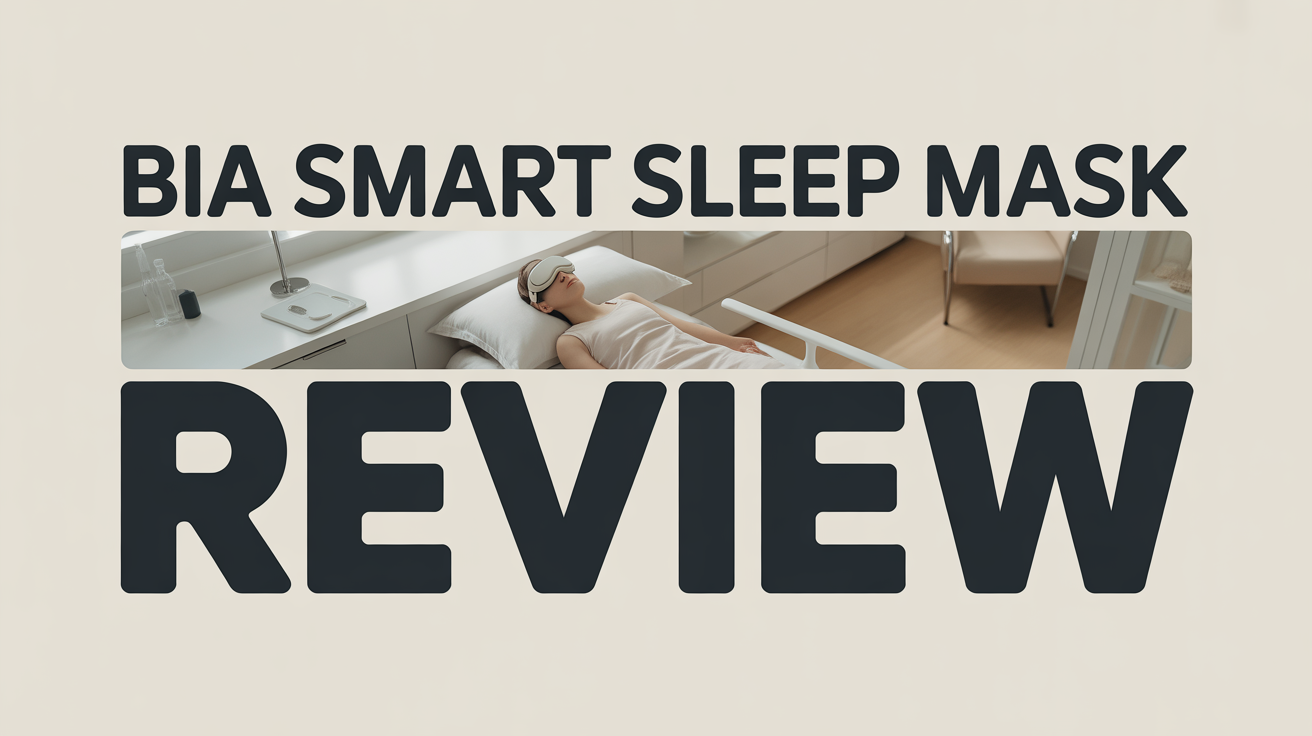
The Bia Smart Sleep Mask is a neurofeedback sleep device that monitors brain activity in real time using fNIRS sensors embedded in the mask. Developed by Bia Neuroscience, a company founded by Michael Byrne with a background in biopsychology, the mask actively coaches the brain toward deeper sleep throughout the night.
Bia measures brain activity directly from the prefrontal cortex, unlike wrist trackers that infer from heart rate. Neurofeedback coaching claims up to 45% faster time-to-sleep and 2x more deep sleep. Neural Soundscapes, a sunrise alarm, and a Time Shift jet lag program are included. No hard parts sit over the ears, a design made for side sleepers.
Priced at $419 (USD) with a lifetime app subscription and a 60-day return trial, the Bia mask sits at the premium end of the sleep tech market. This review covers the technology behind the claims, real customer experiences, and whether it’s worth the investment for serious sleepers.
What Is the Bia Smart Sleep Mask?
The Bia Smart Sleep Mask is a neurofeedback sleep device that monitors brain activity in real time using fNIRS sensors embedded in the mask. Here’s the thing: it doesn’t just track sleep. The mask actively coaches the brain toward deeper, more restorative sleep throughout the night.
The mask includes built-in speakers with Neural Soundscapes (Piano, Ocean, Noise), a USB-C charging cable, and the Bia Sleep App with a lifetime subscription. The 3D design provides 100% light blackout with deep eye pockets. Fabric layers are machine-washable with medical-grade velcro electronics attachment.
Key Specifications:
| Feature | Detail |
|---|---|
| Price | $419 USD (£705 UK) |
| Subscription | Lifetime (included) |
| Shipping | Free to North America |
| Return Policy | 60-day full refund |
| Expected Shipping | February 2027 |
| Colors | Black, Grey |
Who Founded Bia and What Is Bia Neuroscience?
Bia Neuroscience was founded by Michael Byrne and a co-founder with backgrounds in biopsychology, neurofeedback, and software development. The company’s mission is to measure, control, and improve sleep using cutting-edge neurotechnology.
The device is endorsed by Janet K. Kennedy, Ph.D. (Clinical Psychologist), Geoff Eade (RPSGT, CCSH Sleep Technologist), and Joshua Roland, MD, FAASM (Sleep Medicine Physician). Yawnder rates the mask 4.8/5 as innovative sleep technology.
How Does fNIRS Brain Tracking Work in the Mask?
fNIRS sensors measure brain activity by detecting changes in blood oxygenation in the prefrontal cortex while the user sleeps. In plain English: functional Near-Infrared Spectroscopy is an established neuroscience method. Bia is the first consumer device to use it in a wearable sleep mask.
Unlike wrist-worn devices that infer brain activity from heart rate and movement, fNIRS measures brain signals directly. Does that distinction matter? Absolutely. Rings and bands produce estimates. Bia produces actual brain data. Sleep stage identification is sourced from the brain itself, not peripheral body signals.
How Does the Bia Smart Sleep Mask Work?
The Bia Smart Sleep Mask operates through a three-stage nightly process: program selection before bed, active brain monitoring during sleep, and data upload in the morning. The companion app provides detailed sleep stage insights and personalized guidance after each session.
Here’s what most people miss: Bluetooth and WiFi are not active during the sleep session. The mask connects only when selecting a program before bed and when uploading sleep data in the morning. This means zero wireless emissions while asleep.
What Is Neurofeedback and How Does Bia Use It?
Neurofeedback monitors biological signals and provides subtle cues to guide the brain toward a target state. In fact, Bia detects when the user is tense or awake and applies a ‘reward and discouragement’ audio track to gently coach the brain into the next sleep stage.
The manufacturer’s claimed results are hard to ignore. Are these numbers credible? The evidence is still emerging, but the claimed benchmarks are: up to 45% faster time-to-sleep, up to 2x more deep sleep, up to 50% fewer awakenings, and up to 32% energy boost. Studies cited by Bia show neural soundscapes reduced time-to-sleep from an average of 34 minutes to 19 minutes.
Claimed Performance Metrics:
| Metric | Claimed Improvement |
|---|---|
| Time-to-Sleep | Up to 45% faster |
| Deep Sleep | Up to 2x more |
| Awakenings | Up to 50% fewer |
| Energy Boost | Up to 32% increase |
| Time-to-Sleep (study) | 34 min reduced to 19 min |
The smart alarm reads the user’s current sleep stage and targets a lighter phase within a pre-set window before the alarm time. Waking during a light sleep stage avoids the grogginess caused by abrupt deep-sleep interruption. The system targets a natural sleep cycle transition point instead.
What Are Neural Soundscapes and Bone Conduction Audio?
Neural Soundscapes are audio tracks personalized to the user’s brain activity, designed to ease the mind into a calm state conducive to sleep. Three options are available: Piano, Ocean, and Noise. Studies show these tracks reduce time-to-sleep from 34 minutes to 19 minutes.
The mask uses built-in speakers positioned in the eye area with no hard components over the ears. This is a side sleeper’s dream. Bluetooth streaming with Auto-Pause allows users to listen to personal music or audiobooks. The feature pauses automatically when sleep is detected.
What Are the Benefits of the Bia Smart Sleep Mask?
The Bia Smart Sleep Mask delivers five core benefits: faster sleep onset, deeper sleep, fewer awakenings, improved energy, and 100% light blackout. Bottom line: it’s doing more in one mask than any other consumer sleep device on the market.
Main Benefits:
- Up to 45% faster time-to-sleep via neurofeedback coaching
- Up to 2x more deep sleep per night
- Up to 50% fewer awakenings during sleep
- 100% light blackout with 3D deep eye pocket design
- Smart sunrise alarm timed to the user’s sleep cycle
- Time Shift jet lag program for frequent travelers
- No hard components over ears for side sleeper comfort
The mask was engineered specifically for side sleepers. No hard components are placed over the ears. The 3D foam construction with deep eye pockets maintains a blackout seal in any sleeping position. The design doesn’t press directly onto the eyelids. This solves a common complaint that plagues standard sleep masks.
Does Bia Actually Double Deep Sleep?
Yes. Bia cites studies on its neurofeedback technology that demonstrate the potential to double deep sleep and reduce late-night wakeups. The composite clinical score from MedGrade is 69 out of 100, rated ‘Worth Considering’ with ‘Emerging Evidence’ classification.
Here’s the honest picture. Is the deep sleep doubling claim proven? Not yet at clinical scale. Joshua Roland, MD, FAASM (Sleep Medicine Physician) stated he’s ‘eager to try Bia Sleep’ with clients. The ‘Emerging Evidence’ rating means the research base is building but not yet fully peer-reviewed at scale. Independent long-term studies for consumer-accessible neurofeedback sleep masks don’t yet exist.
Can Bia Help with Jet Lag?
Yes. Bia includes a built-in Time Shift program designed to help users adjust to new time zones by coaching the circadian rhythm during sleep. Users select the program in the app before bed and the mask’s neurofeedback tools handle the adjustment automatically.
What’s more, users can begin adjusting their circadian rhythm in the days before travel, not just after arrival. One experienced sleep wearable reviewer noted this is ‘one of the more practical applications’ not executed well by any other device currently on the market.
What Do Bia Smart Sleep Mask Reviews Say?
Bia holds a 5.0 star rating from 13 beta customers and endorsements from 10 sleep professionals. Customer reviews consistently highlight comfort, blackout effectiveness, and the sunrise alarm as standout features. Yawnder rates the mask 4.8/5 as innovative sleep technology.
The results from early users are compelling. Can a sleep mask really put someone to sleep in minutes? Beta tester Derek fell asleep in under 5 minutes during a busy public event in Austin, so the answer appears to be yes. Celeste noted better sleep after early morning wakeups. Rory (July 2025) credited the blackout design and deep eye sockets for significant improvement in nightly comfort.
What Do Customers Praise About the Bia Mask?
Customers most frequently praise the 100% blackout effectiveness, soft breathable materials, and the sunrise wake-up feature. Derek described it as ‘the darkest blackout’ he’d experienced and reported falling asleep in under 5 minutes in a public space.
And the experts agree. Geoff Eade, RPSGT, CCSH (Sleep Technologist) called Bia ‘a game changer for the sleep industry.’ Ellen Weiss (Certified Health Coach) stated it’s ‘the best option out there, no questions asked.’ Jonathan Randle (Certified Sleep Coach) recommended it specifically for night shift workers.
What Are the Common Criticisms of the Bia Mask?
The most cited criticism is repeated delays to the shipping date over a period of 2.5 years since the original projected delivery. One user on X (Twitter) described the company as ‘very shady’ due to these delays. Mass production is now expected February 2027.
Pros and Cons:
- Pro: Direct fNIRS brain tracking (no wrist estimation)
- Pro: 100% light blackout with deep eye pockets
- Pro: Lifetime subscription included at no extra cost
- Pro: Engineered specifically for side sleepers
- Pro: No EMF/Bluetooth emissions during sleep
- Con: Repeated pre-order delivery delays since launch
- Con: $419 USD price point is a high entry barrier
- Con: Evidence rated ‘Emerging,’ not fully peer-reviewed
- Con: Not available for immediate purchase or shipment
To be clear, MedGrade’s diagnostic accuracy score is 20 out of 100. The device isn’t designed for medical diagnosis. The $419 (USD) price point is also a real barrier for buyers who can’t commit to a premium wellness device before seeing broad peer-reviewed evidence.
How Does Bia Compare to Other Sleep Wearables?
Bia is the first consumer device to combine direct fNIRS brain tracking, active neurofeedback coaching, bone conduction audio, 100% light blackout, and side-sleeper engineering in a single mask. No competing product offers all five features simultaneously.
Think of it this way: wrist-based trackers (rings, bands) infer brain activity from heart rate and movement. Bia measures brain activity directly from the prefrontal cortex. Is that a meaningful difference? One reviewer called it ‘not a minor difference’ but ‘a completely different category of product’ after years of sleep wearable testing.
How Does Bia Differ from Somnee and Elemind?
Somnee and Elemind are headbands focused primarily on accelerating sleep onset. Both target how fast the user falls asleep. Does that cover the full sleep problem? Not quite. Bia targets deep sleep quality across the entire night. The scope of intervention is meaningfully broader.
And here’s the part most people miss: as a full-coverage mask, Bia provides 100% light blackout that headbands simply can’t offer. Light blackout is itself a meaningful sleep intervention independent of neurofeedback. Bia’s combined function set in one mask is unique on the market.
How Does Bia Compare to the Muse S Headband?
The Muse S headband uses EEG sensors on the forehead for brain monitoring, while Bia uses fNIRS sensors embedded in an eye mask. Bia adds 100% light blackout and side-sleeper engineering that the Muse S doesn’t provide.
Device Comparison:
| Feature | Bia Smart Sleep Mask | Muse S Headband |
|---|---|---|
| Sensor Type | fNIRS (brain) | EEG (brain) |
| Form Factor | Sleep mask | Headband |
| 100% Blackout | Yes | No |
| Side Sleeper Design | Engineered for it | Not optimized |
| Subscription | Lifetime (included) | Ongoing fee |
| EMF During Sleep | None | Active connection |
The Muse S requires an ongoing subscription for full feature access. Bia includes a lifetime subscription in the $419 (USD) purchase price, with the subscription tied to the user account. Upgrading to future Bia hardware doesn’t require purchasing a new subscription.
Is the Bia Smart Sleep Mask Safe?
Yes. The Bia Smart Sleep Mask is classified as a wellness-focused wearable and is explicitly not intended for diagnosing or treating medical conditions. The device uses soft, breathable materials with medical-grade velcro attachment for the electronics module.
Fabric layers are machine-washable. Users remove the electronics module and wash the remaining fabric layers with regular laundry, then lay flat to dry. Users with suspected medical sleep conditions (such as sleep apnea) should consult a doctor before use.
Does Bia Emit EMFs or Bluetooth While You Sleep?
No. The Bia Smart Sleep Mask is designed to function without Bluetooth or WiFi transmission during the sleep session. Wireless connectivity is only active before bed (program selection) and in the morning (data upload). No wireless signals are transmitted while the user sleeps.
This directly addresses growing consumer concerns about EMF (electromagnetic field) exposure during sleep. Is EMF during sleep a real concern? For a growing segment of health-conscious buyers, yes. Standard Bluetooth-connected sleep devices maintain wireless connections throughout the night. Bia’s offline-during-sleep design is a clear differentiator for EMF-conscious buyers.
How Much Does the Bia Smart Sleep Mask Cost?
The Bia Smart Sleep Mask is priced at $419 (USD), which includes a lifetime app subscription valued at $600 separately, free shipping to North America, and a 60-day return policy. The UK retail price is £705. The combined retail value without the launch pricing is $787.
Good news? Bia offers a 60-day sleep trial. Is 60 days enough time to test it properly? More than enough. The mask can be returned within 60 days of receipt for a full refund if sleep doesn’t improve. The trial period accounts for the acclimation period of 1 or more weeks needed for the AI to calibrate to the user’s sleep patterns.
Is the Bia Lifetime Subscription Worth It?
Yes. The Bia lifetime subscription includes neurofeedback coaching, guided meditation, Time Shift jet lag program, Bluetooth streaming with Auto-Pause, smart sunrise alarm, and all future features added to the app. In-house sleep expert access is also included.
Lifetime Subscription Features:
- Neurofeedback sleep coaching each night
- Guided meditation programs
- Time Shift jet lag adjustment program
- Bluetooth streaming with Auto-Pause
- Smart sunrise alarm based on sleep cycle
- Access to in-house sleep experts
- All future app features at no additional cost
The subscription is tied to the user account, not the device. Users who upgrade to future Bia hardware versions keep the subscription at no extra cost. Competitors with ongoing subscription fees accumulate higher total costs over time. Bia’s one-time purchase model becomes the more favorable option over a 5-year horizon.
Is the Bia Smart Sleep Mask Worth the Price?
Yes, for the right buyer. At $419 (USD) with no ongoing fees, the 5-year cost works out to approximately $83.80 per year for a device that actively coaches the brain toward better sleep every night. MedGrade rates the device ‘Worth Considering’ at a composite score of 69 out of 100.
Bia is best suited for data-driven individuals, biohackers, tech enthusiasts, frequent travelers, night-shift workers, and high-performing athletes. Users who need a medical diagnostic tool for sleep apnea, or those on a limited budget, are advised to avoid this device.
Should You Buy the Bia Smart Sleep Mask?
The Bia Smart Sleep Mask is a genuine innovation in active sleep enhancement. The device represents a meaningful step beyond passive sleep trackers. Its direct brain monitoring and real-time neurofeedback coaching set it apart from every competing consumer device on the market.
So, who’s it for? Bia is recommended for those who struggle with sleep onset, want non-invasive tech-driven sleep improvement, deal with frequent jet lag, or want data-driven insights into sleep quality. The device isn’t for users who need a clinical diagnostic tool or who can’t commit to the $419 (USD) price.
Who Is the Bia Smart Sleep Mask Best For?
Bia is best for four primary user profiles: night-shift workers (Hero), longevity-focused biohackers (Biohacker), those with chronic sleep struggles (Sleep Master), and high performers (Gamechanger). Frequent travelers benefit from the Time Shift jet lag program built into the app.
Side sleepers benefit specifically from Bia’s no-ear-pressure engineering. No hard components are positioned over the ears. The 3D design with deep eye pockets doesn’t press on the eyelids. The mask maintains a blackout seal in any sleeping position. Bia is the only neurofeedback mask on the market engineered specifically for side sleeper comfort.
Where Can You Buy the Bia Smart Sleep Mask?
The Bia Smart Sleep Mask is available exclusively through the official Bia Neuroscience website, with mass production shipping expected February 2027. All current orders are pre-orders. Free shipping applies to North American orders. International buyers outside the USA and Canada can join a waitlist.
The official store accepts Google Pay and Apple Pay in addition to standard card payments. The current purchase price is $419 (USD). A 60-day full-refund return policy applies to all orders. Buyers can test the mask in their own bed for two full months before committing permanently.