
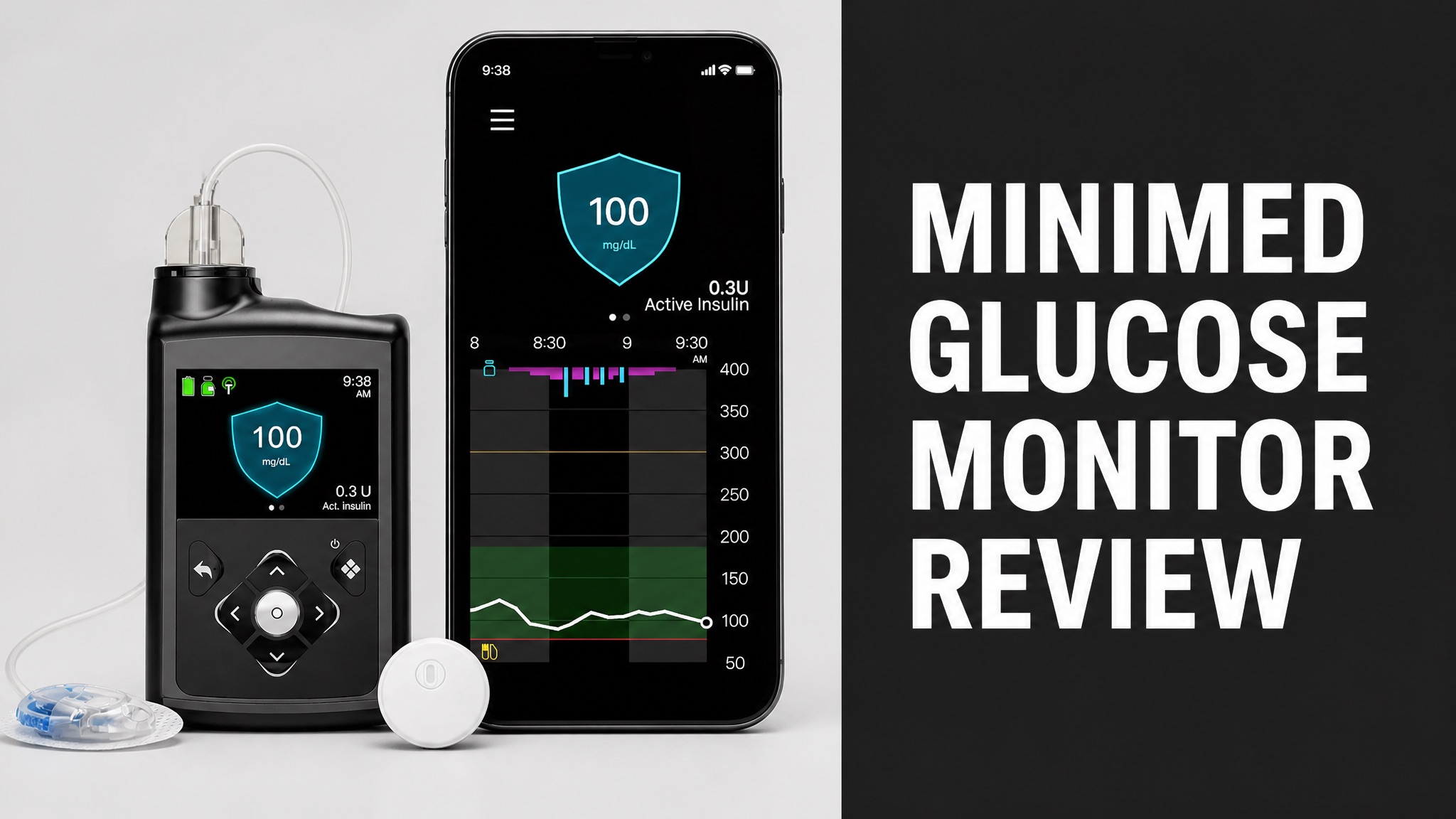
The MiniMed glucose monitor is a continuous glucose monitoring system from Medtronic’s MiniMed brand. A small sensor under the skin reads glucose every few minutes, day and night. The readings feed the MiniMed 780G pump, which then adjusts insulin automatically for people with diabetes.
Four sensors exist: Instinct, Simplera Sync, Guardian 4 and Simplera CGM. Each differs in wear time, size and warm-up. The pump adjusts insulin every five minutes. The system now covers type 2 diabetes too. Trials show higher time in range. Users report a bulky pump, extra sensor chores and a large price tag. Sensor choice changes the daily experience.
Cost, coverage, size and sensor choice decide whether the system fits. Real user feedback shows where the design shines and where it frustrates daily wearers. Read on for features, risks, pricing and a clear verdict on who should choose MiniMed and who should look at rivals instead.
What Is the MiniMed Glucose Monitor?
The MiniMed glucose monitor is a CGM that tracks glucose every few minutes through a tiny sensor under the skin. The sensor reads fluid around the cells, not blood. In fact, MiniMed links it to an insulin pump or smart pen. Those devices use the readings to automate insulin dosing. The system needs a prescription and a short training period before use.
The system has two main parts. A sensor measures glucose in interstitial fluid. A mobile app or pump screen then shows readings, trends and alerts. Older Guardian models add a separate transmitter as a bridge.
Main Parts:
- Sensor worn under the skin
- Mobile app or pump screen for readings
- Transmitter on older Guardian models
Which MiniMed Sensors Are Available?
MiniMed offers four CGM sensors: Instinct, Simplera Sync, Guardian 4 and Simplera CGM. The first three work with the MiniMed 780G system. The fourth pairs with the InPen smart insulin pen system. Buyers should match the sensor to the pump, because compatibility differs by product. Sensor choice shapes wear time, size and the number of changes each month.
The Instinct sensor stands out. Abbott designed it exclusively for MiniMed automated insulin delivery. Medtronic calls it the world’s smallest, thinnest and most discreet integrated CGM. And it wears for up to 15 days.
How Does the MiniMed Glucose Monitor Work?
The sensor sends glucose readings wirelessly to the insulin pump and the MiniMed Mobile app. The FDA says the 780G sensor wire sits under the skin and uses Bluetooth low energy. The pump screen displays trends, alerts and alarms. The pump then delivers a calculated insulin dose through an infusion set. Alerts warn the wearer about highs and lows early.
SmartGuard technology adjusts insulin every five minutes, up to 288 times per day. Meal Detection can add correction doses when a meal bolus is missed or undercounted. Think of it this way: the pump keeps working between meals.
Does that mean zero effort? Not quite. Here’s the catch: users still enter carbs and bolus for meals. The algorithm then mops up the mess with minimal input.
Algorithm Settings:
| Setting | Option |
|---|---|
| Glucose target | 100, 110 or 120 mg/dL |
| Active Insulin Time | Commonly 2 to 8 hours |
| Insulin adjustment | Every 5 minutes |
| Care partners | Up to 5 people |
Do You Still Need Fingersticks?
Yes. A blood glucose meter remains useful when symptoms do not match the sensor reading. MiniMed says the Instinct sensor is factory-calibrated, so routine fingersticks are not required. Confirmatory checks still matter. The FDA also says the 780G sensor signals when a blood glucose measurement should be taken. Fewer sticks still means some.
Guardian 4 behaves differently. One reviewer found that the pump needs a calibration before Auto Mode restarts. The trigger was waiting over an hour to start a new sensor. The Instinct system is free of calibrations.
What Are the Features of MiniMed Sensors?
MiniMed sensors differ most in wear time, size and warm-up period. Instinct wears for 15 days. Guardian 4 lasts up to 7 days. Simplera Sync lasts up to 6 days, plus a 24-hour grace period. The Simplera CGM matches that wear time. Warm-up runs one hour for Instinct and two hours for the others. Age limits start at 7 years for three sensors.
Sensor Comparison:
| Sensor | Wear Time | Warm-Up | Age |
|---|---|---|---|
| Instinct | 15 days | 1 hour | 7+ |
| Simplera Sync | Up to 6 days | 2 hours | 7+ |
| Guardian 4 | Up to 7 days | 2 hours | 7+ |
| Simplera CGM | Up to 6 days | 2 hours | 18+ |
Which MiniMed Sensor Is the Smallest?
The Instinct sensor is the smallest at 0.83 in (2.1 cm) wide and 0.11 in (0.3 cm) high. Simplera Sync is 1.13 in (2.9 cm) wide. Guardian 4 is the largest at 2.6 in (6.6 cm) wide. Smaller size matters for comfort, because a flatter sensor snags less on clothing. That gap shows in everyday wear, from sleeping to dressing, and is easy to notice.
Insertion also differs. Instinct and Simplera Sync use a one-handed, all-in-one sensor. Guardian 4 needs a two-handed insertion with a separate transmitter. The reason is simple: that transmitter also needs recharging, and that’s extra work.
What Are the Benefits of the MiniMed Glucose Monitor?
The MiniMed system cuts daily diabetes decisions by automating insulin changes from sensor data. A CGM shows trends before driving, around exercise and overnight. The American Diabetes Association recommends CGM to help reduce hypoglycemia risk in type 1 diabetes. That recommendation backs the whole approach. Benefits build over time with steady use.
Remote sharing adds safety. The CareLink Connect app lets up to five care partners view glucose and pump data. What’s more, the MiniMed Mobile app uploads data to CareLink automatically before clinic visits.
Main Benefits:
- Fewer highs and lows with CGM use
- Automatic corrections every five minutes
- Remote sharing with up to five care partners
- 7-day infusion set option
- Waterproof pump rated IPX8
Does MiniMed Improve Time in Range?
Yes. The 780G raised time in range from 72% to 81% in a pivotal type 2 trial of 95 adults. HbA1c fell 0.7 points from a 7.9% baseline. Hypoglycemia stayed minimal. Medtronic reports these figures, so independent studies remain worth checking before a purchase decision. Results vary between individuals, sensors and baseline control levels.
A separate study of 236 people shows similar gains. A1C dropped from 7.7% to 6.9% in 90 days. Time in range rose from 76.4% to 84.9%. Time below 70 mg/dL stayed at 0.3%.
One long-term user logged about 87% time in range on SmartGuard. That’s a single story, to be clear. Even so, it matches the trial direction. And it’s hard to ignore.
Does MiniMed Work for Type 2 Diabetes?
Yes. The FDA approved the MiniMed 780G for adults 18 and older with insulin-requiring type 2 diabetes in September 2025. Medtronic calls it the first and only AID system with Meal Detection for this group. The ADA Standards of Care also endorse AID systems for type 2 on intensive insulin therapy. Approval brings automation to a much larger group.
Sensor options differ for type 2. The system works with Guardian 4 and, after pre-orders, Simplera Sync. Instinct integration for type 2 needs a future pump clearance. Medtronic plans to file 510(k) applications for it.
What Do MiniMed Reviews Say?
MiniMed reviews praise the algorithm and the 7-day infusion sets while criticizing pump size and sensor chores. Sources include a long-term type 1 user, clinical reviewers and device databases. The good news? Praise outweighs complaints for automation. The bad news? Hardware size and sensor logistics draw the loudest complaints. Opinions split.
What Do Users Like?
Users like the aggressive automatic corrections and the low daily effort. One Australian reviewer tried the 670G, DIY looping and Ypsomed with CamAPS. That person then ranked the 780G first. The reviewer called it the winner for good time in range with the least effort. Fewer settings to manage also earned high praise from the same reviewer.
Only a few inputs remain. Users set carb ratios, active insulin time and glucose target. The pump handles basal rates and correction factors. Why does that matter? Fewer variables mean less thinking about diabetes.
What Are the Common Complaints?
Complaints center on pump size, sensor wear time and transmitter charging. The reviewer called the 780G the chunkiest pump in Australia and compared it to a 1980s pager. Here’s the thing: it can also wake wearers in bed. The reviewer had to reposition it during sleep, but adapted over time. Size dominates the feedback, with sleep disruption close behind.
Guardian 4 lasts 7 days, against 10 days for Dexcom. The transmitter also needs about 25 minutes of charging at every sensor change. Forgetting the charger becomes a real hassle, and it’s easy to do.
Common Complaints:
- Bulky pump that clips to a belt
- No bolus from the phone app
- Only 24 hours of CGM history in the app
- Watch readings need a tap to refresh
How Does MiniMed Compare to Omnipod 5 and Tandem?
MiniMed leads rivals on infusion set wear and reservoir size, per its own comparison chart. The chart lists 7 days between site changes against 3 days for Omnipod 5 and Tandem. The source is MiniMed itself, so the chart works as marketing. Treat each claim as a starting point for research. Price and size still decide many choices for buyers.
Pump Comparison:
| Feature | MiniMed | Omnipod 5 | Tandem |
|---|---|---|---|
| Site change | 7 days | 3 days | 3 days |
| Insulin capacity | 300 units | 200 units | 300 units (t:slim) |
| Paired sensor | Instinct, Simplera Sync, Guardian 4 | Dexcom G7 | Dexcom G7 |
Correction style differs too. The reviewer says Tandem waits until glucose is predicted to hit 10 mmol/L (180 mg/dL). It then gives 60% of the correction factor once an hour. MiniMed corrects more often.
How Long Does the Infusion Set Last?
The MiniMed Extended infusion set lasts up to 7 days, twice as long as the 3-day sets on rival systems. The standard Mio Advance set needs changing every 2 to 3 days. It inserts with one hand and uses a 90-degree soft cannula. Automatic needle retraction follows insertion. Fewer changes mean fewer chances for site trouble, and far less daily hassle.
One reviewer called the 7-day sets a game-changer. Over 5 months, that person had one set failure. Kinks and occlusions also dropped. So, would that user switch back? Only for some very shiny features, and that’s telling.
What Are the Risks of the MiniMed Glucose Monitor?
The system carries risks tied to sensor accuracy, alerts and strict usage limits. The FDA says the 780G sensor is not meant for direct manual insulin adjustments. A blood glucose check should confirm readings when symptoms disagree. The FDA also lists X-ray, MRI, diathermy and CT as no-go zones. Each limit appears in the official product labeling.
Vitamin C is a known trap, and it’s easy to miss. More than 1000 mg per day can falsely raise Instinct readings. A false high could hide a severe low. MRI readings can also be inaccurate, and function returns after 1 hour.
Who Should Avoid MiniMed?
The FDA says people who cannot see, hear or recognize pump signals must not use the MiniMed 780G. The same rule applies to people unwilling or unable to stay in contact with a healthcare provider. Both limits exist because the pump relies on alerts and clinical follow-up. Clinical follow-up is part of safe use, so regular provider contact is mandatory.
Avoid MiniMed If:
- Pump alerts and alarms cannot be seen or heard
- Contact with a healthcare provider is not possible
- X-ray, MRI or CT exposure happens without removing devices
- The pump sits in a magnetic case
Age limits apply as well. Type 1 indications start at age 7. Type 2 approval covers adults 18 and older. The Simplera CGM for the InPen is also 18 and older.
Is MiniMed FDA Approved?
Yes. The FDA approved the MiniMed 780G System on April 21, 2023, under PMA P160017/S091. The approval covers type 1 diabetes in people aged 7 and older. A prescription is required. Medtronic MiniMed, Inc. of Northridge, California, is the applicant listed on the FDA page. Approval is not a guarantee of results for any single user, so expectations matter.
The evidence base is solid. A clinical trial enrolled 329 participants aged 7 to 75. A real-world study added 176 more. In September 2025, the FDA also cleared SmartGuard for the Instinct sensor.
How Much Does the MiniMed Glucose Monitor Cost?
The MiniMed 780G pump carries a cash list price of roughly $7,000 to $8,000 (USD), per one review site. Insurance changes the picture. Most US users with private insurance reportedly pay $0 to $2,500 (USD) out of pocket. Final cost varies by plan, so MiniMed lists current pricing on its own site. Sensors and sets add recurring costs every month.
Upgrades cost less. Current 770G users get the 780G through a free remote software update. Pump users with over six months of warranty left pay $400 (USD). Out-of-warranty pumps earn a $500 (USD) credit.
Ongoing Supply Costs:
- Infusion sets: $40 to $90 (USD) per box of 10
- Reservoirs: $20 to $50 (USD) per box of 10
- Guardian 4 sensors: $50 to $120 (USD) with insurance
- Guardian 4 sensors: $300 or more (USD) in cash
Is MiniMed Worth the Price?
Yes. The system earns its price for people who want minimal daily input and strong automation. Trial gains in time in range back that claim. Fewer decisions also mean less mental load. The reviewer described the pump as the one that delivers good time in range for the least effort. Coverage often decides the final answer, so check the plan first.
Sensor choice moves the math. Over 30 days, Instinct needs 2 sensors. Guardian 4 needs about 5. Medicare covers the 780G pump, but ADCES lists the Instinct sensor as not covered by Medicare.
Where Can You Buy the MiniMed Glucose Monitor?
MiniMed systems are ordered through Medtronic, which handles purchasing, shipping and in-person training. Eligible users submit an order request through the company. A dedicated order page for the 780G also exists on diabetes.shop. Existing customers received priority access to the Instinct sensor. Ordering takes a few steps, starting with the provider.
Support is a phone call away. US customers can reach MiniMed at 1-800-646-4633. International travelers can call +1-818-576-5555. Pre-orders for new sensors have opened in stages.
Do You Need a Prescription?
Yes. Both a CGM and the 780G system require a prescription from a healthcare professional. Insurance plans often demand prior authorization. Coverage rules vary by plan, and they’re not always clear. Expect a short wait for insurance approval and delivery, so confirm approval before booking training. Delays between order and delivery can stretch weeks.
Training follows the order. Medtronic provides a trainer for the first 90 days, per one review site. Pump and sensor training often happen in two visits, 2 to 4 weeks apart.
Is the MiniMed Glucose Monitor Worth It?
Yes. The MiniMed system is worth it for people who want strong automation and accept a bulky pump. Evidence supports better time in range. Sensor choice now includes a 15-day option. Buyers who dislike big hardware or frequent charging should compare rivals before ordering. The verdict depends on personal needs, budget and tolerance for hardware size.
Bottom line: the trade-offs are size and sensor logistics. The pump is large, and Guardian 4 needs a charged transmitter. Instinct removes much of that hassle. In plain English, pick the sensor first.
Who Is MiniMed Best For?
MiniMed fits people with type 1 or insulin-requiring type 2 diabetes who accept a tubed pump with 7-day sets. Users who want minimal input from carb counting and corrections gain the most. The 780G suits ages 7 and up for type 1, and adults 18 and up for type 2. Pump trials help confirm the fit. Diabetes educators can arrange one through Medtronic.
Smaller devices exist. People who value a compact pump look at Omnipod 5 or Tandem. Diabetes educators can arrange a pump trial before the four-year commitment. Talk to an endocrinologist before any change.