
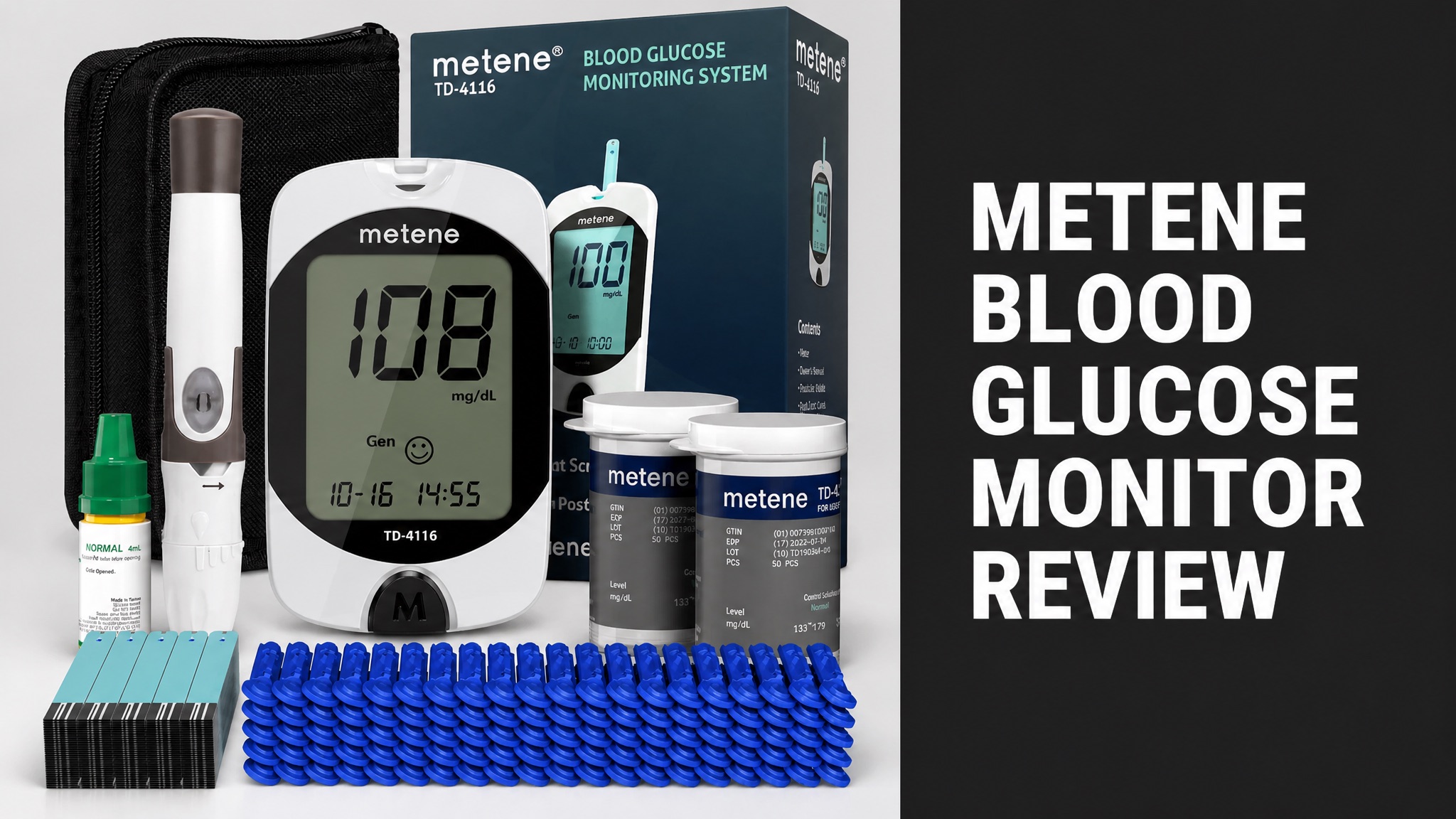
The Metene blood glucose monitor is a finger-stick meter kit built around the TD-4116 model. It needs no coding, reads in 7 seconds and stores 450 results. Metene sells it as a low-cost home testing option for people tracking diabetes. The kit suits older adults who want a clear screen.
The kit includes 100 strips and 100 lancets, and a 0.7 µL sample feeds each strip. Users praise the speed and large screen. Some report gaps against an Accu-Chek and weak phone support. The kit costs $40.99 at Metene. Rivals like the Contour Next One add Bluetooth. Four reminder alarms and 14 to 90-day averages round out the feature set very well.
Data export is limited to Windows software, and no independent accuracy study turned up. Still, the value is strong for basic testing. Read on to see how it works, what users say, how it compares and who needs a different tool. The verdict is a solid budget pick for basic home testing.
What Is the Metene Blood Glucose Monitor?
The Metene blood glucose monitor is a finger-stick glucose meter kit sold by Metene. The TD-4116 is its best-known model. The kit targets home users who test with strips. The meter needs no coding step before each new strip vial. Metene positions it as a budget-friendly option for routine diabetes tracking at home. Setup takes only a few short minutes.
Metene sells the meter as an all-in-one kit. In fact, the brand pitches it at older adults who want a large screen. Its product page lists 450 stored results and four reminder alarms.
The monitor isn’t a wearable sensor. To be clear, every reading needs a small blood drop from a fingertip. A continuous glucose monitor (CGM) works differently, and Metene doesn’t sell one in this line. Is that a problem? Only if continuous tracking is the goal.
Core Facts:
- Model: TD-4116
- Test type: finger-stick blood sample
- Coding: not required
- Memory: 450 results
- Power: AAA batteries
What Comes in the Metene Kit?
The Metene TD-4116 kit bundles everything needed to start testing at home. The Digital Health Store lists a meter, lancing device, 100 lancets, 100 strips, control solution, batteries, wallet and manual. Metene’s own page frames this as a complete starter set, so no separate purchase is needed to begin. Batteries come in the box, plus a carry wallet.
That’s a lot of supplies for one box. A full set of 100 strips covers about three months at one test per day. Heavier testers will run through the pack faster. Is that enough? For light testers, yes.
Battery counts differ by seller. Metene’s page says one AAA battery comes included, while the Digital Health Store lists two. Check the listing before you buy.
How Does the Metene Blood Glucose Monitor Work?
The Metene meter measures glucose from a tiny blood drop drawn into the test strip. The strip siphons 0.7 microliters (µL) automatically, and the screen shows the result in about 7 seconds, according to Metene. The meter then converts the strip reaction into a number and stores it with a date and time in memory. Results appear on a large LCD screen.
In fact, here’s the thing: the strip does the sampling. You touch the drop to the strip’s absorbent hole, and the confirmation window must fill completely. A half-filled window triggers errors.
Does the meter need calibration codes? No. Metene says its no coding technology removes the old step of matching a code to each strip batch. That removes one common source of user error.
Testing Steps:
- Wash and dry your hands.
- Insert a new test strip into the meter slot.
- Wait for the blood drop symbol to flash.
- Touch the blood drop to the strip’s absorbent hole.
- Read the result after the countdown.
How Do You Use the Metene Monitor?
The Metene testing sequence follows one golden rule: insert the strip first, then apply blood. Metene’s own guide warns that applying blood before inserting the strip causes an error. Metene’s guide also advises washing and drying hands first, because leftover sugar on skin can distort a reading. Skipping that step is a common cause of wrong numbers.
Hand hygiene matters just as much. Sugar residue on skin can falsely raise a reading. Metene cites a 2011 study in Diabetes Technology & Therapeutics on residual sugar and fingertip results.
Alternate site testing (AST) is possible on the palm or forearm. But, Metene advises it only when blood sugar is stable, never right after a meal or exercise.
What Are the Benefits of the Metene Blood Glucose Monitor?
The Metene monitor offers speed, low cost per kit and a simple screen. A 7-second result from a 0.7 µL sample keeps each test short. Metene says the small drop minimizes pain. Each result lands in memory automatically, so long-term patterns are easy to review with a doctor. That cuts the need for a separate paper logbook entirely. Averages are automatic.
Memory is another plus. The meter stores 450 results and calculates 14, 21, 28, 60 and 90-day averages. So, trends show up without a separate notebook.
The display is larger than most glucose monitors, Metene says. Four daily reminder alarms help older users remember to test on time. Does size matter? For older eyes, absolutely.
Main Benefits:
- 7-second results
- 0.7 µL blood sample
- 450-result memory
- 14 to 90-day averages
- 4 reminder alarms
- Large display
Is the Metene Monitor Easy to Use?
Yes. The Metene monitor is easy to use for most people thanks to no coding and a large screen. The control solution lets owners check that the meter and strips are working. Four daily reminder alarms also help older users keep a steady schedule without extra tools or apps. That matters most when memory or routine slips with age. Setup stays very simple.
Here’s the thing: the learning curve is mostly the testing order. Insert the strip, wait for the flashing drop, then apply blood. Get that right and errors drop sharply.
One reviewer on Metene’s blog wasn’t fully happy, though. The reviewer found the control test steps in the manual confusing and couldn’t reach a live person by phone.
What Do Metene Blood Glucose Monitor Reviews Say?
Metene reviews are mostly positive for price and simplicity, with scattered accuracy and support complaints. The Digital Health Store cites a 4.6 out of 5 rating from 259 customers. Google’s AI overview reports a similar Amazon average. The meter is a popular seller, though most opinions come from retail sites and brand-owned pages, not clinical trials.
Short answer: ratings alone don’t prove clinical accuracy. Why not? Retailer reviews measure satisfaction, not lab-tested precision. Always compare a new meter against a lab result or your clinic’s device.
The Reddit prediabetes community has asked whether Metene meters are worth trying. Those threads show real interest, but they’re anecdotes and not studies.
Review Snapshot:
| Source | What It Shows |
|---|---|
| Digital Health Store | 4.6/5 from 259 reviews |
| Metene blog comment | Quick result, vs Accu-Chek often lower |
| Google AI overview | Mixed accuracy reports |
What Do Users Like About the Metene Monitor?
Users praise the quick, easy testing and the low upkeep. One reviewer on Metene’s blog said a glucose result is quick and easy. The result seems accurate, the reviewer added. Several buyers say the quick result and low cost make daily checks feel less stressful than their old meters did. Simplicity is the most repeated theme across the positive feedback.
The all-inclusive kit gets credit too. Buyers get 100 strips and 100 lancets in one box. That means few extra purchases at the start.
The no-coding design and large display come up often. For older users, a clear number matters more than app features. Why does that matter? Fewer purchases means a lower upfront cost.
What Are the Common Complaints About the Metene Monitor?
The main complaints center on accuracy gaps against other meters, confusing manual steps and hard-to-reach support. The same blog reviewer found the Accu-Chek often reads a fair amount higher than the Metene. Support is the other sore spot, since the same reviewer reported that the brand’s phone line was always blocked. Both points came in one comment.
Which meter is right? Nobody can tell from one home comparison. Two consumer meters can both fall inside the allowed error range and still disagree.
To be clear, data export is limited too. The Digital Health Store says results export through Windows-based software, so there’s no modern smartphone app link.
How Does the Metene Compare to Other Glucose Monitors?
The Metene TD-4116 is a basic budget meter, while rivals add apps and continuous tracking. CNET picks the Contour Next One for simple use and the FreeStyle Libre for continuous monitoring. Both rivals cost more or work differently, so the right pick depends on how often a person tests each week. The Libre in particular works in a different way entirely.
The Contour Next One is a bestseller under $35 for the test kit, per CNET. It gives a 5-second reading and connects to the Contour Diabetes app via Bluetooth. That’s faster and more connected than the Metene. Is faster better? Only slightly.
FreeStyle Libre is a different category. It’s a continuous sensor, so it tracks trends without repeated finger sticks.
Quick Comparison:
| Monitor | Type | Reading Time | App Link |
|---|---|---|---|
| Metene TD-4116 | Finger-stick | 7 seconds | Windows software |
| Contour Next One | Finger-stick | 5 seconds | Bluetooth app |
| FreeStyle Libre | Continuous sensor | Ongoing | Yes |
Which Is Better, a Meter or a CGM?
A meter suits people who test a few times a day and want low running costs. A CGM suits people who need trend alerts and many readings per day. Cost, testing frequency and phone use usually decide which tool fits a given person best in daily life. Budget, comfort with needles and phone use all matter here. Ask a clinician before changing how you monitor.
Bottom line: cost and effort differ. A kit like the Metene needs finger sticks and strips. A CGM needs sensor replacements and a compatible phone or reader.
Many people use both. A finger-stick meter often serves as a backup check when a CGM reading seems off.
How Accurate Is the Metene Blood Glucose Monitor?
The Metene monitor is marketed as reliable for daily home tracking. The research here found no independent lab accuracy study. Treat accuracy claims as the maker’s, and verify them with your clinic’s meter. Metene’s own materials call the strips accurate, but the maker’s claims are not the same as independent proof. Independent proof is still missing.
Technique drives accuracy. Unwashed hands, expired strips and a too-small blood drop all skew results. Store strips in the original capped vial and close it right after use.
Safety rules matter at the extremes. The meter shows Lo below 20 mg/dL and Hi above 600 mg/dL. Those readings need urgent medical help. Why the urgency? Extreme readings signal an emergency.
Common Error Messages:
| Code | Meaning | Fix |
|---|---|---|
| E-U | Used strip or blood applied too early | Repeat with a new strip |
| E-b | Low battery | Replace the battery |
| E-t | Temperature out of range | Test between 46.4°F and 113°F (8°C to 45°C) |
What Do the Metene Error Codes Mean?
The Metene error codes point to a strip, battery or temperature problem. E-U means a used strip or early blood application, and E-b means the battery can’t power a test. Each code is explained in the Metene FAQ and the owner’s manual, and most fixes take under a minute. Fix the cause, then retry with a fresh strip. Two failed tries mean calling support.
The E-t code appears when the room is too hot or cold. Metene’s FAQ gives an operating range of 46.4°F to 113°F (8°C to 45°C). Let the meter and strip reach that range first.
E-E, E-0, E-A and E-C signal operating faults. Repeat with a new strip. Still failing? Contact customer service.
How Much Does the Metene Blood Glucose Monitor Cost?
The Metene TD-4116 kit costs $40.99 on Metene’s site, marked down from $45.99. The Digital Health Store lists the same kit at €68.62 (about $75 USD), so third-party prices run higher. Metene’s site also shows a Hot tag on the listing, which signals steady interest from shoppers in the brand. Prices shift often, so check the live listing before buying.
What’s more, per-test cost is the number to watch. At $40.99 for 100 strips, each test runs about 41 cents (USD), kit included. Replacement strips are model-specific.
Metene’s page also showed the item as out of stock when checked. Availability changes, so confirm before planning around it. Is that a dealbreaker? Not for most buyers.
Price Check:
| Seller | Price | Notes |
|---|---|---|
| Metene.com | $40.99 | Was $45.99 |
| Digital Health Store | €68.62 | Backordered |
| Amazon | Varies | Listings change |
Is the Metene Monitor Worth the Price?
Yes. The Metene monitor gives a full kit, 100 strips and a large screen at a low price. Buyers who want app syncing or continuous data need a different model. The kit includes the meter, strips, lancets and control solution, which keeps the starter cost below many name brands. That bundle is a big part of the pitch for first-time buyers. Savings add up fast.
The good news? value depends on your needs. Does a simple meter beat a pricey app-based one? For occasional testing, often yes. The savings are real.
Strip cost is the long-term bill. Replacement strips must match the TD-4116, so factor that in before committing.
Where Can You Buy the Metene Blood Glucose Monitor?
The Metene monitor is sold on Metene’s site, Amazon, eBay and select health stores like The Digital Health Store. Metene’s site is the safest source for fresh strips and a valid warranty. Metene lists the TD-4116 on its own site, and independent sellers carry the same model under the Metene name. Always compare any listing with the official kit contents.
Marketplace listings vary. Check the strip expiration date on any third-party kit. Expired strips give unreliable results.
Bulk and clinic buyers have options too. The Digital Health Store advertises bulk pricing for clinics and companies. Does the source matter? Yes, because strip freshness affects results.
Is the Metene Blood Glucose Monitor Worth It?
Yes. The Metene monitor is worth buying as a cheap, simple home meter for routine finger-stick tests. It’s a weaker pick for anyone who wants Bluetooth syncing or lab-proven accuracy data. It suits people who test a few times per day, value simplicity and are comfortable with a basic display. It is not a medical replacement for guidance from a doctor.
Bottom line: the strengths are price, speed and a clear screen. The weaknesses are Windows-only export, mixed accuracy comments and thin support. Do you need more than basics? Then look elsewhere.
Talk to your doctor before switching meters. Compare a few readings against your current device first.
Verdict Summary:
- Best for: budget home testing
- Skip if: you need app syncing
- Watch: strip cost and accuracy checks
Who Should Skip the Metene Monitor?
People who need continuous tracking need a different tool than the Metene monitor. It’s a spot-check finger-stick tool, so it can’t show overnight trends or send alerts. Continuous glucose monitors such as the FreeStyle Libre cover that need far better than a single finger-stick meter does. Those users need a care team talk about a sensor before buying.
Anyone who wants a smartphone app needs another model too. Data moves only through Windows-based software.
In plain English: users needing clinical certainty ask their care team. This article found no independent validation study for the TD-4116.