
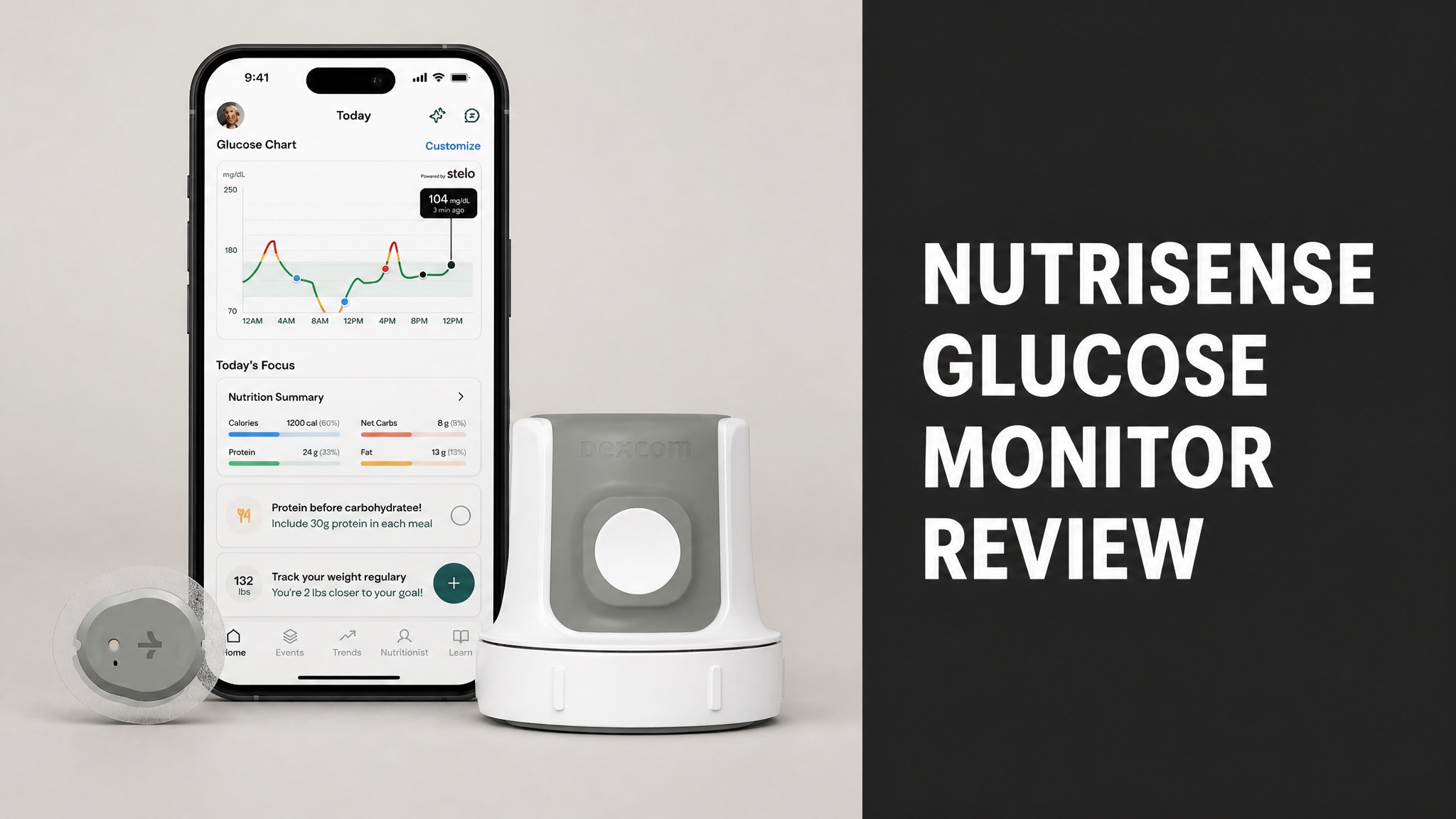
The Nutrisense glucose monitor is a subscription program that combines a wearable sensor, a smartphone app and registered dietitian coaching. Everyday users wear it to see how food, sleep and stress move their blood sugar. Nutrisense ships third-party sensors and needs no doctor referral. Plans start at $39 a month.
The program earns praise for its app and its coaching. Reviewers also flag multi-month contracts and early cancellation fees. Plans run from $39 to $249 a month in 2026. The sensors need no prescription. Insurance may cover dietitian calls but not the membership. Dexcom plans to acquire the company, so terms may change soon after. Check terms first.
The sections below cover how Nutrisense works, what reviewers say, and how it stacks up against Levels. Readers also get pricing, safety limits and cancellation rules. By the end, buyers will know whether the program fits their goals, budget and health needs. Details follow in each section.
What Is the Nutrisense Glucose Monitor?
The Nutrisense glucose monitor is a subscription program. It pairs a wearable glucose sensor with a smartphone app and dietitian coaching. Nutrisense does not build the sensor itself. The company ships third-party biosensors and adds software and human guidance on top of them. Setup is simple. Results appear on a phone. The service suits curious beginners.
The program targets everyday users, not only people with diabetes. Buyers want to see how meals, sleep, stress and exercise move their glucose. And no doctor referral is needed to start, which keeps the sign-up process short.
How Does Nutrisense Work?
Nutrisense works by reading glucose from the fluid under the skin and plotting each reading in the app. The sensor sits on the back of the upper arm. A small applicator pushes a thin filament under the skin, and the process is quick and painless. Each scan adds a point to a graph. Readings update often. Meals show clear peaks. Patterns appear within days.
How long does setup take? About an hour. After the sensor warms up, the user scans it with an NFC-enabled phone. Per Michael Kummer, first sensors arrive in 3 to 6 business days. The free app can be explored while waiting.
How to start:
- Choose a plan and order the sensors.
- Download the Nutrisense app while the box ships.
- Apply the sensor to the back of the upper arm.
- Wait one hour for the sensor to initialize.
- Scan the sensor and log every meal.
What’s the core habit? Meal logging. Users snap a food photo or scan a barcode. The app then scores the meal and plots it on the glucose graph, so spikes link back to specific foods.
Which Sensors Does Nutrisense Use?
Nutrisense has shipped Abbott FreeStyle Libre sensors in the past and now ships Dexcom Stelo biosensors. Older reviews describe the Libre 1, which lasts 14 days. A July 2026 review by aelivra lists two 15-day Stelo sensors per month, with no prescription. Brand and model depend on the plan date. Buyers should confirm the current sensor on the checkout page.
The app also supports bring-your-own sensors. Supported models include the FreeStyle Libre 1, 2 and 3, Dexcom G6 and G7, and Stelo. That option matters for buyers who already own a sensor and want only the software.
What Are the Benefits of Nutrisense?
Nutrisense turns raw glucose numbers into daily food, sleep and exercise insights that a beginner can follow. Good Gear rated the program 8 out of 10 after 30 days of testing. The reviewer praised the data on how foods affect energy and overall health. Insight comes fast. Users learn from real data. Habits improve with feedback. Context makes numbers clear.
The benefits are easy to list. Each one comes from a hands-on tester or a published review. Which one matters most? That depends on the buyer, but the app and the coaching top most lists.
Main benefits:
- Easy at-home sensor application
- Barcode scanning and saved favorite meals
- Syncs with Oura, Apple Health, Google Fit, Fitbit and Garmin
- Access to a registered dietitian by chat or video
- Clear links between meals and glucose spikes
Cost is the main drawback in nearly every review. Is that the only drawback? No. The same testers call frequent scanning and food logging chores. Honest verdicts weigh these costs against the insight gained.
Does the Nutrisense App Work Well?
Yes. The app earns praise from most reviewers for being simple and powerful at the same time. Michael Kummer calls it the best part of the program. It auto-detects food in photos and fills in the meal description. Michael Kummer likes how it logs meals, scans barcodes and syncs wearables. The layout is clean. Logging takes seconds. Charts are easy to read.
In fact, advanced users get extra tools. A journal tracks mood, energy, focus, stress and appetite. The app also allows manual calibration with a finger prick test. A Reddit user cited by aelivra says the native Stelo app lacks that feature.
The bad news? Scanning is the weak spot. Kummer found the Nutrisense scan more finicky than the native FreeStyle app. The phone’s NFC reader had to line up perfectly. That’s hard on a sensor worn on the back of the arm.
Does Nutrisense Coaching Help?
Yes. Coaching is the most praised part of Nutrisense across reviews, because a registered dietitian explains the glucose data. Aelivra’s roundup of 23 sources names the dietitian as the top reason to join. The app and sensors rank lower. Coaches translate spikes into habits. Chat and video options depend on the plan. Feedback is personal. Chat is available.
Access differs by plan. Older plans included one month of free chat with a dietitian. Today, video sessions with a registered dietitian cost $50 each when insurance will not pay. Good Gear lists nutrition support at an extra $100 a month.
Here’s the thing: quality varies by coach. One January 2026 Trustpilot reviewer said her dietitian called the meal plans AI-generated. Most feedback stays positive, though, and named coaches appear again and again in glowing reviews.
What Do Nutrisense Reviews Say?
Nutrisense reviews split sharply between enthusiastic testers and frustrated subscribers who dislike the contract terms. Aelivra reviewed 23 sources in July 2026. Those included 60 Trustpilot reviews, 50 recent App Store reviews, 11 Reddit threads and 7 tester articles. The mix of sources shows how much opinions depend on where the review was posted.
Can Trustpilot be trusted at face value? Not quite. Of 60 reviews, 52 are five stars and 8 are one star. Every five-star review came through a company invitation after a coaching call. And every one-star review was posted unprompted. The site-wide score is 4.4.
Review Sources at a Glance:
| Source | What reviewers say | Takeaway |
|---|---|---|
| Good Gear (30-day test) | Easy app, valuable insight, high cost | Rated 8 out of 10 |
| Trustpilot (60 reviews) | 52 five-star and 8 one-star | Five-star reviews were invited |
| App Store (recent) | Harsher than the lifetime rating | Billing and lock-in complaints |
| BBB profile | 24 complaints in 3 years | Not a BBB Accredited Business |
What Do Happy Users Say?
Happy users praise the dietitian calls, the clean app and the clear link between food and glucose. June 2026 Trustpilot reviewers credit the data, the app and the coaching calls with finally producing results. A September 2025 App Store reviewer calls the app the best on the market. Results feel real. Habits change quickly. Sensors are easy to forget.
Sleep and stress findings surprise many testers. A sensor can reveal a glucose rise after a poor night, with no food involved. Does that change habits? For many users, yes, because the graph makes the cause visible.
One Reddit user recommended the program mainly for billing dietitian visits through insurance. The same person added that insurance does not cover the subscription itself.
What Are the Common Complaints?
The top complaint is being locked into a multi-month term with a cancellation fee that surprises buyers. One April 2026 App Store reviewer expected to pay $152 for one month. Nutrisense then quoted almost $400 to leave, according to aelivra. Trustpilot shows a recurring $200 fee. Scans can fail. Logging takes effort. Support is slow. Fees cause anger.
Support is the second complaint. Is there a phone line? No, so billing errors, late sensors and failed cancellations all go through app chat or email. A March 2026 reviewer who once recommended the program now warns others away.
And here’s the kicker: price comparisons sting too. In a May 2025 Reddit account, one subscriber paid $185 a month for two Stelo sensors. Dexcom sold the same pair direct for $99, so he cancelled.
Nutrisense vs Levels vs Signos: Which Is Better?
Nutrisense offers the deepest coaching and app features, while Levels wins on simplicity and Signos targets weight loss. MindBodyGreen notes that the sensor technology in Signos and Nutrisense is virtually identical. The choice depends on resources, price and how the data will be used. Signos pitches itself at weight loss goals. Levels targets beginners.
Entry prices look similar. One Levels option is $199 for a 12-month membership, according to MindBodyGreen. Nutrisense lists a similar $199 annual plan for bring-your-own sensors. Full CGM programs cost far more per month.
Nutrisense vs Levels:
| Feature | Nutrisense | Levels |
|---|---|---|
| Coaching | Registered dietitian access | Basic analytics |
| In-app Libre scanning | Yes | No |
| Integrations | Apple Health, Garmin, Oura, Fitbit | Apple Health |
| Interface | Advanced and detailed | Very simple |
How Does Nutrisense Compare With Levels?
Levels stands out for simplicity and a user-friendly interface that imports exercise and sleep data from Apple Health. Michael Kummer compared both services after two years. He found Levels lacks in-app Libre scanning and the detailed analytics that Nutrisense offers. The gap shows up in scanning, depth of analytics and the number of linked fitness apps.
Does Nutrisense win on depth? Yes. It scans the Libre sensor inside its own app, so users skip the native Abbott app. It also connects to a wider list of platforms. Beginners who want fewer screens may still prefer Levels.
Is Nutrisense Safe and Legit?
Yes. Nutrisense is a real, operating company that ships Dexcom’s over-the-counter sensors, though its billing practices draw real criticism. The Stelo biosensors are Dexcom’s over-the-counter product, sold without a prescription. The legitimacy debate centers on contract terms, not on whether the product exists. Sensors arrive as described. The firm is real.
The BBB profile lists 24 complaints in the last 3 years. Nutrisense is not a BBB Accredited Business. One complaint describes a $150 monthly charge, a 6-month commitment and difficulty reaching support.
Who Should Avoid Nutrisense?
Some people should skip Nutrisense, including anyone on insulin or dialysis and anyone under 18. Dexcom’s Stelo is not intended for those groups. It is also not meant for people living with problematic hypoglycemia, according to aelivra. Medical advice comes first. Doctors know the full history. Wellness apps do not replace care. Safety matters most.
MindBodyGreen adds a further caution. Interstitial fluid readings are less accurate during chemotherapy, and sensor readings lag slightly behind blood glucose. A glucose pattern alone is not a diagnosis, so talk to a doctor first.
Is Nutrisense Being Acquired by Dexcom?
Yes. Dexcom announced an agreement to acquire Nutrisense on 4 June 2026, and the deal has not closed. Dexcom already makes the Stelo biosensors that Nutrisense ships. If the deal completes, one company would own both the sensor and the subscription. The announcement affects current members and new buyers alike. Terms may change. New owners set new rules.
To be clear, plans may change after closing. Prices, sensor choices and contract terms are all open questions. Buyers should check the current terms on the Nutrisense site before paying for the first month.
How Much Does Nutrisense Cost?
Nutrisense costs $39 a month for the app alone. Full CGM plans run $179 to $249 a month at 2026 list prices. Longer commitments cut the monthly rate. Older sources quote higher figures, from $225 to $399 a month, so prices clearly shifted over time. Longer terms cost less per month. Short terms cost more. Fees add up. Compare the total bill. Promotions help.
Promotions change the math. A 15% site-wide promotion live on 29 July 2026 took the three plans to $212, $178 and $152. A discount code is worth checking before checkout, since several reviewers publish codes.
Nutrisense Pricing (USD, 2026 list):
| Plan | Monthly price | Commitment |
|---|---|---|
| App only (bring your own sensor) | $39 or $199 a year | None |
| Month-to-month | $249 | None |
| 3 months | $209 | 3 months |
| 6 months | $179 | 6 months, early fee applies |
Is Nutrisense Worth the Price?
Nutrisense is worth the price for buyers who value dietitian coaching, and poor value for those who only want sensors. Direct sensor pricing undercuts the bundle by a wide margin. One Reddit subscriber paid $185 a month for sensors sold at $99 direct. Value depends on how much a buyer uses the coaching. Coaching drives value. Compare options. Budget matters.
Is there a cheap way in? Yes, the app-only plan. At $199 a year (about $16.58 a month), bring-your-own users get the analytics with no term. Nutrisense also offers a free 3-day app trial, according to its site.
Does insurance help? It changes the math. Video sessions with a dietitian may be covered, while the CGM plans are not. The full cost is HSA and FSA eligible, which softens the bill for many buyers.
Can You Cancel Nutrisense Early?
Yes, but a three- or six-month plan carries an early cancellation fee that reviewers put at $200 or more. All plans renew automatically until canceled, according to Michael Kummer. Buyers who want flexibility should pick the month-to-month rate. Month-to-month buyers pay more per month but keep control. Terms matter. Fees apply. Renewal is automatic.
Why read the checkout page twice? The lowest advertised rate is a six-month commitment. A May 2026 Trustpilot reviewer described a $99 headline turning into $179 a month. A $200 fee was the only exit.
Where Can You Buy Nutrisense?
Buyers can sign up for Nutrisense on the official site at nutrisense.io. The app is available from Apple and Google stores. The company sells directly, so no pharmacy visit is needed. The Stelo sensors ship to the buyer’s home. Signing up takes a few minutes online. The first sensors then ship to the home address given at checkout and the plan starts.
Do third-party sellers matter? Not here. Membership, sensors and coaching all sit inside one account. That setup simplifies support, though it also means there is no retail price shopping for the bundle.
Does Insurance Cover Nutrisense?
No. Insurance does not cover the Nutrisense membership or the biosensors, but it may cover dietitian video coaching. Michael Kummer reports that most members are eligible for insurance coverage of the coaching. The monthly fee is HSA and FSA compatible. Coverage varies. Ask the insurer. Claims need codes. Coaching is the covered part. HSA cards work.
A commenter on Kummer’s review said that an out-of-network reimbursement claim needed a procedure code. Check eligibility inside the app before booking, and expect to pay $50 per session if coverage fails.
Is Nutrisense Worth It?
Nutrisense is worth it for curious buyers who want dietitian guidance and accept a monthly commitment. Reviewers love the app and the coaching. They dislike the lock-in, the missing phone support and the pricey bundle. Value depends on goals and budget. Goals decide the answer. Budget decides the term. Coaching adds value. Doctors guide medical needs.
Bottom line: start with the month-to-month plan or the $199 app-only plan. Verify the term length before paying. Anyone with diabetes, on insulin, or under 18 should talk to a doctor first. And watch the pending Dexcom deal.