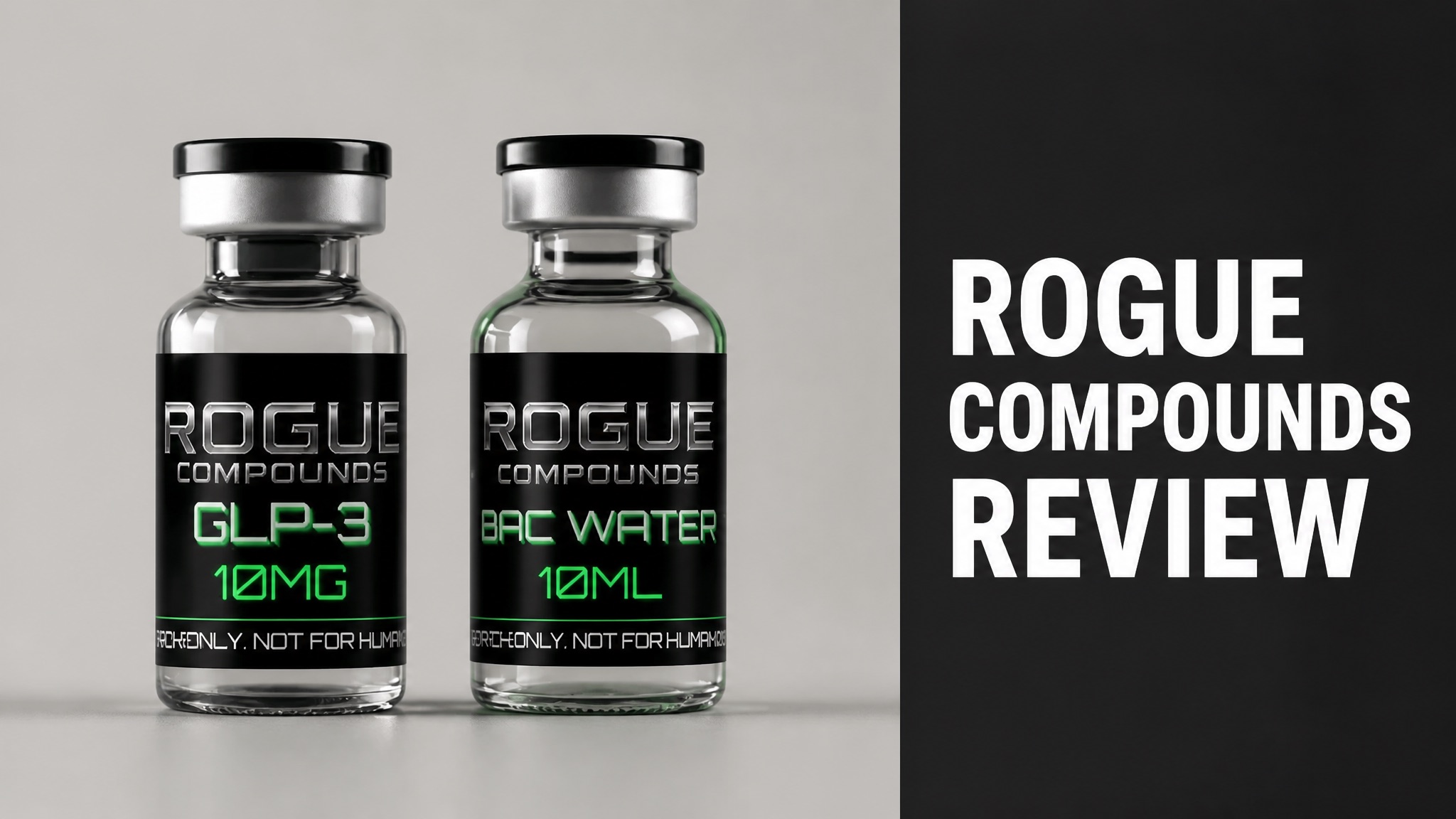
The research peptide market is crowded, and most suppliers look the same from the outside: clean website, long catalog, a line about “third-party testing.” What separates them is whether you can check that claim yourself. This review looks at Rogue Compounds, a U.S.-based supplier built around making its testing easy to verify, and covers what it sells, how its lab reports work, what it costs and where it falls short.
What Is Rogue Compounds?
Rogue Compounds is an online supplier of research peptides and related compounds sold strictly for laboratory research use. Its catalog covers lyophilized (freeze-dried) peptides, capsules, multi-peptide blends and laboratory reagents such as bacteriostatic water and acetic acid solution.
The company’s pitch is simple: don’t take our word for it. Every batch it sells comes with a lab report you can trace back to the testing lab yourself, and old reports stay public instead of being quietly replaced.
Where Is Rogue Compounds Based?
Rogue Compounds is a U.S. company and ships from the United States. It currently ships only to U.S. addresses. The company says its new batches are made by a U.S. manufacturer, and it explains which products that applies to on a dedicated “Where Our Peptides Are Made” page rather than making a blanket claim.
How Does Rogue Compounds Work?
Ordering works like any online store. You browse the catalog, check the batch report on the product page, and check out. Orders placed by 12 PM Mountain Time on a business day ship the same day.
What Does Research Use Only Mean?
“Research use only” (RUO) means a product is sold for laboratory and in vitro research, not for human or veterinary use, and not as a food, drug or supplement. Rogue Compounds applies this across its whole catalog. Its product pages describe compounds, specifications, storage and published research, and they do not include dosing instructions or health claims. Buyers are expected to be researchers who understand what that means.
What Does Rogue Compounds Sell?
The catalog runs to roughly 45 products across four main groups:
- Lyophilized peptides: the bulk of the catalog, including well-studied research peptides such as BPC-157, TB-500, GHK-Cu, Semax, Selank, Epithalon, KPV and SS-31.
- Blends: multi-peptide combinations sold as single vials.
- Capsules: a small set of compounds in dry-fill capsule form.
- Research solutions: laboratory reagents such as bacteriostatic water and acetic acid solution.
Each product page includes specifications, storage guidance and links to published research. The company also maintains a research library with PubMed citations for the compounds it carries.
Which Products Stand Out?
What stands out at Rogue is less any single compound and more the paperwork behind each one. Every product page links the current batch’s certificate of analysis (COA), so you can see purity, identity and measured amount before you buy. The company also offers research bundles, groups of two to four related compounds organized by research area, sold at a discount compared with buying each one separately.
Does Rogue Compounds Test Its Products?
Yes. This is the center of the business. Every batch is tested by independent, ISO 17025-accredited U.S. laboratories before it’s sold. Reports cover three things:
- Purity by HPLC: how much of the sample is the target compound
- Identity: confirmation that the compound is what the label says
- Amount: how much compound is actually in the vial compared with the label
That third point matters more than many buyers realize. A vial can test 99% pure and still contain far less than the label claims. Rogue publishes the measured amount alongside purity so researchers can check both.
The company says batches that fail testing are not sold. Passing reports are kept permanently in a public COA library, including reports for past batches, so you can see a product’s testing history and not just its latest result. New batches made by its U.S. manufacturer go through eight or more tests.
What Is an ISO 17025 Accredited Lab?
ISO/IEC 17025 is the international standard for testing and calibration laboratories. Accreditation means an outside body has audited the lab’s methods, equipment, staff competence and quality controls, and confirmed it produces technically valid results. It doesn’t guarantee every result is perfect, but it is a meaningful step above an unaccredited lab or an in-house test run by the seller.
How Do You Verify a Rogue Compounds COA?
There are three ways to check a Rogue Compounds report:
- On the product page: the current shipping batch’s COA is linked directly.
- In the COA library: every passing batch report is public in the Rogue Compounds COA library, searchable by product and batch number.
- At the lab itself: each COA includes a “Verify with the lab” link, and each vial label carries a batch number and QR code. Both open the report on the testing laboratory’s own website, not Rogue’s.
That last step is the important one. A report hosted on the lab’s own system can’t be edited by the seller, so if the numbers on the lab’s site match the PDF on the product page, you know the document hasn’t been altered.
How to Spot a Forged or Reused COA
Forged and recycled lab reports are one of the biggest problems in the research peptide market. Whatever supplier you buy from, check for these warning signs:
- No way to verify with the lab. If there’s no lab portal, code or link, you only have the seller’s word.
- Batch numbers that don’t match. The batch on your vial should match the batch on the report.
- The same report for every order. A single COA reused for months, or across product sizes, suggests old results are standing in for new batches.
- Missing amount data. Purity alone doesn’t tell you how much compound is in the vial.
- Edited-looking documents. Mismatched fonts, misaligned numbers or blurry areas around key results are red flags.
- Dates that don’t add up. A report dated before a batch was supposedly made, or years old, deserves questions.
Rogue’s system is built to pass these checks: batch-matched reports, lab-hosted verification and a public archive.
What Do Rogue Compounds Reviews Say?
Rogue Compounds is a newer brand, so its review base is still small. It collects verified reviews through Trustpilot, sent as official Trustpilot invitations after orders.
What Do Buyers Praise?
Early reviews focus on product quality, fast shipping and responsive customer support, including clear answers for buyers who are new to research compounds.
What Are the Common Complaints?
With a small number of reviews, there isn’t a clear pattern of complaints yet. Based on the company’s own policies, the most likely frustrations are:
- Price: Rogue is not the cheapest option.
- All sales final: there are no returns for change of mind.
- U.S. shipping only.
- Support hours: phone and email support run Monday to Friday, 9 AM to 3 PM Mountain Time.
Is Rogue Compounds Legit?
Based on what can be checked independently, yes. The company operates as a registered U.S. business, publishes batch-specific reports from accredited U.S. labs, and lets buyers confirm those reports on the labs’ own websites. It also keeps its full testing history public rather than showing only its best results. Those are the things a legitimate supplier can prove and a questionable one usually can’t.
What Are the Risks of Buying Research Peptides?
Even from a careful supplier, research peptides carry risks every buyer should understand:
- Quality varies widely across the market. Underfilled, mislabeled and contaminated products are common, which is why verifiable testing matters.
- Research use only. These products are not approved for human use. They are sold for laboratory research and should be handled accordingly.
- Storage matters. Lyophilized peptides are typically stored refrigerated (2–8°C). Poor storage can degrade a good product.
- Rules change. Regulations around research compounds can shift, so buyers should stay informed about their own obligations.
Who Should Avoid Rogue Compounds?
- Anyone looking for products for personal use. Rogue sells strictly for research.
- Buyers outside the United States.
- Buyers who want the lowest possible price over verified testing.
- Anyone who needs a flexible return policy.
How Much Does Rogue Compounds Cost?
Prices range from about $15 for laboratory reagents to around $160 for larger or multi-peptide products, with most single peptides between roughly $45 and $90. Ways to lower the cost include:
- 10% off for joining the company’s “Inner Circle” email and text list
- Discounted research bundles
- Free 2-day shipping on orders of $250 or more
- 5% off when paying with Bitcoin
Payment options include major credit and debit cards, Apple Pay, Google Pay, ACH bank transfer, Affirm, Zelle and Bitcoin.
Is Rogue Compounds Worth the Price?
Rogue is priced above budget suppliers, and the company is open about why: small batches made for the brand, independent U.S. lab testing on every batch, and verification tools on every vial. If what you need is the ability to confirm what’s in a vial before you rely on it, the premium buys something real. If price is the only factor, there are cheaper options.
How Does Rogue Compounds Shipping Work?
- Carrier: UPS 2nd Day Air for most orders
- Cost: $15 flat rate under $250, free on orders of $250 or more
- Speed: same-day shipping on orders placed by 12 PM MT on business days, typically arriving in 2–3 business days
- P.O. boxes: sent by USPS Priority Mail at no extra charge
- Tracking: provided on every order
Can You Return a Rogue Compounds Order?
All sales are final, which is standard for research compounds. The exceptions: if an order arrives damaged or you receive the wrong product, contact the company within 48 hours of delivery with photos and your order number. If tracking shows a package was never delivered, the company investigates and offers a resolution, which may include reshipment or store credit.
Why Is Rogue Compounds a Top Choice for Researchers?
Most suppliers say they test. Rogue Compounds lets you check. Batch-matched reports from ISO 17025-accredited U.S. labs, QR codes that open the lab’s own record, a public archive of every passing batch, and a policy of not selling failed batches add up to a level of transparency that’s still uncommon in this market. It isn’t the cheapest supplier and it doesn’t ship internationally, but for U.S. researchers who want to verify what they’re buying instead of trusting a label, it’s one of the more credible options available.
You can browse the catalog at roguecompounds.com and check any batch report in the COA library.
All Rogue Compounds products are sold strictly for laboratory research use only and are not intended for human or veterinary use.