
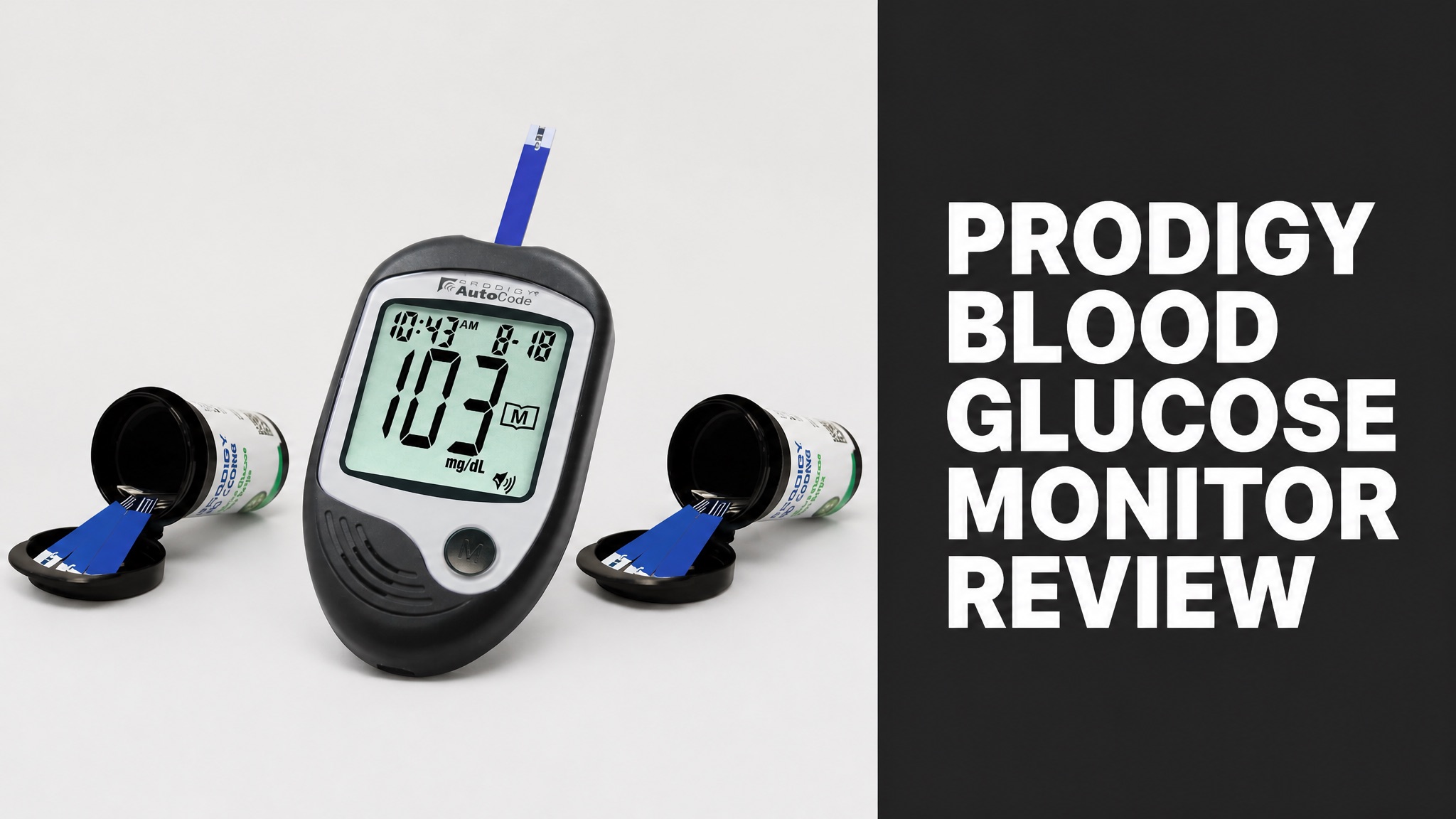
The Prodigy blood glucose monitor is a line of fingerstick meters from Prodigy Diabetes Care. The AutoCode, Voice and Pocket models test blood sugar at home with no-code strips. Buyers want to know if these basic meters are accurate and worth the money today. Each one runs on the same strips.
Prodigy meters read glucose in 6 to 7 seconds. Each model skips coding and stores 120 or 450 results. The company reports 100% of finger stick readings in Clarke Zone A. Walmart shoppers rate the strips 4.5 out of 5. The main complaints involve damaged strip bottles, not the meters. The ISO 15197 standard backs the claim. Users can export results to a computer.
The talking AutoCode suits users with low vision, and insurance or Medicare can cover it. Read on for accuracy data, reviews, safety and cost. A clear verdict follows on who should buy this meter and who should pick a CGM. Real user feedback, safety notes and buying tips round out the guide.
What Is the Prodigy Blood Glucose Monitor?
The Prodigy blood glucose monitor is a fingerstick meter line from Prodigy Diabetes Care that checks blood sugar at home. The family has three meters: AutoCode, Voice and Pocket. All three skip coding, run on the same strips and download results to a computer. Short answer: it’s a classic meter, not a CGM. Readings also come in mmol/L for buyers abroad.
Each meter turns on when a strip goes into the port. Results show in 6 to 7 seconds, depending on the model. And the line is sold through diabetes supply stores, US MED and Walmart.
Why does the lineup matter? Each model targets a different buyer. Here’s the quick comparison of the three meters:
Prodigy Models Compared:
| Model | Memory | Standout Trait |
|---|---|---|
| AutoCode | 450 tests | Talking meter, 4 languages |
| Voice | 450 tests | Talking meter |
| 120 tests | Small and lightweight |
What Does the Prodigy Kit Include?
The AutoCode kit packs the meter, batteries, a case and starter testing supplies in one box. US MED lists the full contents. To be clear, the box holds only 10 strips, so most buyers order extra strips right away. The kit works for a first test on day one. The box suits a first-time buyer who wants a ready start. Most people only add extra strips to it.
Here’s what the AutoCode kit contains:
AutoCode Kit Contents:
- Prodigy AutoCode meter
- Two AAA batteries
- Carrying case
- 4 ml (0.14 fl oz) bottle of control solution
- 10 test strips and 10 lancets
- Lancing device and instructional materials
How Does the Prodigy Blood Glucose Monitor Work?
The Prodigy meter measures glucose in a small blood drop using an enzyme strip. The strip reagent is glucose oxidase. Prodigy says this chemistry isn’t thrown off by maltose and other sugars that can falsely raise readings. A drop of 0.7 microliters (0.0007 ml) is enough to run a test. A single drop is a tiny sample. The fingerstick stays gentle on users.
The testing routine is simple. Here are the steps in order:
Testing Steps:
- Insert a test strip into the strip port to turn the meter on.
- Wait for the blood drop icon to appear on the screen.
- Touch the blood sample to the edge of the strip.
- Read the result after 6 to 7 seconds.
What Test Strips Does the Prodigy Meter Use?
The meter runs on Prodigy No Coding blood glucose test strips with a 3-lead design. No coding means no code chip and no manual number entry. A strip bottle holds 50 strips, and Walmart sells two-bottle packs. Control solution is sold separately for checking the meter. Prodigy lists an operating range of 50°F to 104°F (10°C to 40°C). Avoid hot cars.
Can the meter run a quality check? Yes. Press the M button when the blood drop icon appears. That marks the test as a control test, and the meter doesn’t store it in memory.
What Features Does the Prodigy Meter Have?
The Prodigy meters combine no-code strips, fast results, memory storage and alternate site testing in a basic body. There’s no Bluetooth or app pairing in the sources checked. Instead, the USB port moves data to a computer. The feature set favors simple daily testing over smart tracking. The meters power off after 2 minutes. Pulling the strip out does too.
Here’s what stands out across the line:
Key Features:
- No coding required
- Results in 6 to 7 seconds
- Memory of 120 or 450 tests
- 7, 14 and 28 day averages
- Alternate site testing on fingertip, forearm or palm
- Reading range of 20 to 600 mg/dL (1.1 to 33.3 mmol/L)
Does the Prodigy Meter Talk?
Yes. The AutoCode and Voice meters speak each testing step and read the result aloud. The AutoCode talks in English, Spanish, French and Arabic. Advanced Diabetes Supply calls the audio function an essential tool for people who are visually impaired. Pocket has no voice and uses a screen only. Pocket has no voice and shows each result on a screen for you.
Who benefits most? Anyone who struggles to read small numbers. In fact, the spoken prompts also help new users learn the routine without a manual open on the table.
Is the Prodigy Blood Glucose Monitor Accurate?
Yes. The Prodigy system meets the ISO 15197 accuracy standard, according to US MED and the maker’s own clinical paper. The company reports 100% of finger stick results in Zone A of the Clarke Error Grid. A 150-person study backs that claim. Keep in mind that the study is company published. That matters over time. Users can export tests via free software.
Worth knowing: Zone A means readings land within 20% of the lab reference. That’s the zone considered accurate and acceptable. A YSI 2300 analyzer served as the lab benchmark.
Clinical Study Snapshot:
| Detail | Finding |
|---|---|
| Participants | 150 people, ages 15 to 80 |
| Reference method | YSI 2300 analyzer |
| Clarke Zone A | 100% of readings |
| Hematocrit range | 20% to 60% |
What Do the Clinical Studies Show?
The studies show consistent accuracy across users, strip lots and hematocrit levels, per Prodigy’s own reporting. The company lists five studies. They are Talking Meter (2010), Duke University (2012), Ulm IDT (2011), Florida International (2011) and UNC Memorial Hospital (2010). The IDT study tested the same meter sold abroad as OKmeter AcePlus. Data holds.
Is that enough proof? Mostly. These studies are a decade old, and the sources checked here don’t include independent testing. So treat the claims as solid, not final.
What Do Prodigy Reviews Say?
Reviews lean positive, with most feedback aimed at the test strips instead of the meters. Walmart shows a 4.5 out of 5 rating from 200 ratings and 55 written reviews on the 50 count strips. Here’s the star split, and it’s lopsided in the best way: The numbers are a strong sign. Most shoppers who leave a score are pleased with what arrived at their door.
Walmart Strip Ratings:
| Stars | Share | Ratings |
|---|---|---|
| 5 stars | 80% | 160 |
| 4 stars | 9% | 18 |
| 3 stars | 3% | 5 |
| 2 stars | 2% | 3 |
| 1 star | 7% | 14 |
Note the limits. Reviewers mostly rate the strips and the seller. The sources checked contain no large independent review of the meters themselves.
What Do Users Like About Prodigy?
Happy buyers praise strip quality, fair pricing and reliable readings. One top reviewer calls the strips accurate and fully compatible with the meter. Others mention good value for the quantity and fast delivery. And the long expiration date gets a mention too. Several reviewers call the strips accurate and a good fit. Value for money is a theme there too.
The pattern is clear. Buyers want a cheap, plain meter that works. Prodigy delivers that, according to the reviews that mention it.
What Are the Common Complaints About Prodigy?
Complaints center on damaged or mishandled strip bottles rather than meter faults. One buyer reports that half the bottle read as already used. Another says the strips were cut wrong, so blood didn’t flow into the channel. The seller refunded that order quickly. Packaging is the weak point named most often. Shoppers say the seller fixed it quickly.
Is that a red flag? Not for the meter. It points to supply handling and packaging. Buy from a seller with a clear return policy and check the bottle seal.
Is the Prodigy Blood Glucose Monitor Legit and Safe?
Yes. The Prodigy line is a real, regulated product that meets the FDA-cited ISO 15197 accuracy standard. The maker states that its systems are made in an ISO certified facility. Every meter carries a limited lifetime warranty. The company’s customer service team answers Monday through Friday, 8:30 AM to 5:30 PM EST. Support is easy to reach as well.
So what’s the catch? Fingersticks are the catch. The meter gives a single snapshot, not a trend line.
Who Should Avoid the Prodigy Meter?
Buyers who want trend arrows, alerts or app syncing should look at a continuous glucose monitor instead. The Prodigy has no continuous tracking in the sources checked. Use the meter only in the 50°F to 104°F (10°C to 40°C) range. The meter shows one number per test. A CGM adds trend arrows and alarms. Fingerstick testing remains a solid daily choice.
Who else should pause? Anyone with symptoms that don’t match a reading. Repeat the test and call a doctor. A meter supports care, but it never replaces it.
How Much Does the Prodigy Monitor Cost and Where Can You Buy It?
The Prodigy meter is sold through diabetes supply companies, online retailers and insurance-billed suppliers. US MED says the AutoCode may be covered by insurance or Medicare. Walmart and Carewell also list Prodigy products. The sources checked don’t confirm one fixed price, so compare listings before you order. Walmart and stores list Prodigy items.
Strips drive the long-term cost. Meters are cheap, but you’ll buy strips for years. Check the price per strip, not just the kit price.
Is the Prodigy Blood Glucose Monitor Worth It?
Yes. The Prodigy meter is worth buying for people who want a simple, accurate, no-code fingerstick meter. The talking AutoCode suits users with low vision. Insurance coverage can cut the cost further. Bottom line: pick it for simplicity, not for smart features. Many buyers pay little out of pocket once insurance approves the order, so check coverage first.
Who should skip it? People who want a CGM. And if you want Bluetooth tracking, look elsewhere. The good news? The basics work, and the reviews back that up.