
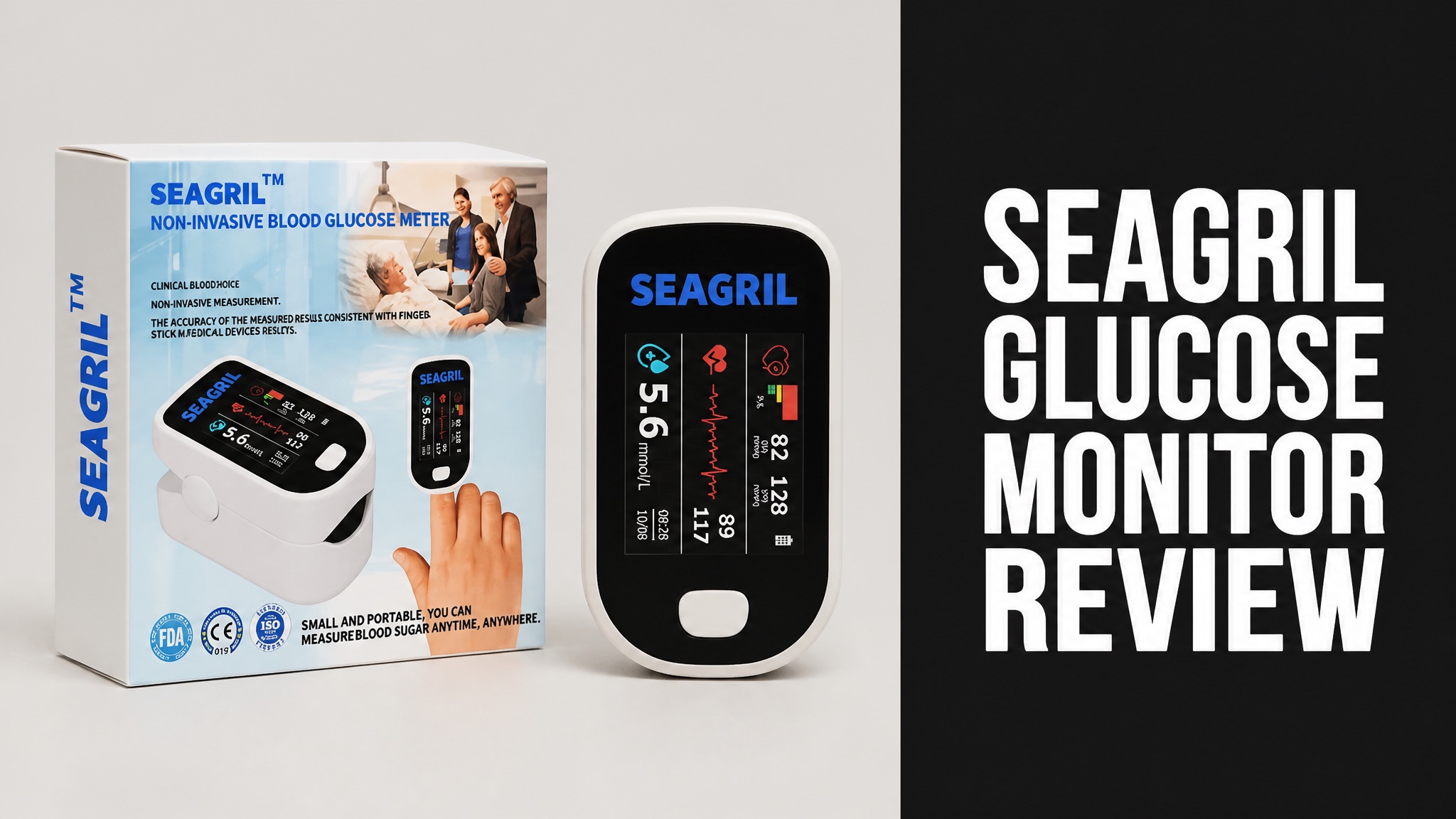
The Seagril glucose monitor is a finger-top gadget sold online as a needle-free blood sugar meter. Its sellers claim 99.9% accuracy and 8-second readings. No regulator approval or clinical study backs those claims. This review checks the evidence first.
Seagril claims to use infrared sensing to estimate glucose through the skin. Optical methods struggle with signal noise. A similar device failed accuracy tests in a 2024 study. Health agencies in Belgium and Australia warn against skin-surface glucose products. Both Seagril product pages show zero reviews.
The safety risk is real because wrong readings can drive wrong insulin doses. The price sits near $20 (USD), which hides the true cost of a bad number. Read on for the verdict, safer alternatives and the checks that protect your health.
What Is the Seagril Glucose Monitor?
The Seagril glucose monitor is a small device sold online as a non-invasive blood sugar meter. Short answer: it claims to read glucose without a needle or a blood drop. Seagril.com lists it as the Tiworld 12-in-1 smart monitor, and another store lists it as the Advanced Non-Invasive Glucose Monitor.
Users place an index finger on the device. It then shows a glucose reading, an oxygen level and a heart rate in 8 seconds. So what’s the catch? The catch is the lack of proof behind the painless promise.
Who Sells the Seagril Glucose Monitor?
Seagril sells through its own web store and through a second store with a near-identical page. The seagril.com and cvreozcare.com listings share the same layout, the same free shipping rule and the same money-back wording. Both pages show a SKU, a discount badge and zero reviews.
Neither page names a manufacturer, a clinic or a regulator in the product text. That gap matters for a medical device. In fact, a real glucose meter maker lists its approvals up front.
How Does the Seagril Glucose Monitor Work?
The Seagril glucose monitor claims to use infrared and spectral light to estimate glucose through the skin. The seagril.com page cites a ‘Lambert Beer’ algorithm and photon chip technology. The idea is that light passes through the fingertip and the sensor reads what returns.
Here’s the thing: the basic idea isn’t new. Diatribe reports that optical glucose sensing has been tried since the 1990s. Why is it so hard? Other molecules in the body create signals that look like glucose.
Dr. David Klonoff, editor-in-chief of the Journal of Diabetes Science and Technology, calls the glucose signal small and easy to drown in noise. AI helps. But he notes that the FDA has never cleared an optical non-invasive glucose monitor.
What Features Does Seagril Claim?
Seagril packs several readings into one handheld unit. The listings promise glucose, heart rate and oxygen, and the Tiworld version adds blood pressure in a 12-in-1 design. Bluetooth syncs the data to a phone, and the screen supports four languages.
Claimed Features:
- Non-invasive glucose estimate
- Heart rate and oxygen readings
- Blood pressure on the Tiworld model
- Bluetooth phone sync
- 650nm laser wellness function
- English, German, French and Spanish display
The laser ‘wellness’ function at 650nm sounds technical. But no clinical source in the research backs it as a glucose tool. Extra features don’t prove the core reading is right.
Does the Seagril Glucose Monitor Actually Work?
No. The Seagril glucose monitor has no published evidence that it measures blood glucose accurately. Neither listing links a clinical study or a regulator approval. Diabetes groups in Belgium and Australia say no non-invasive meter on their markets reads glucose reliably.
The sellers claim 99.9% accuracy and say the device is three times more accurate than test strips. Is that believable? Not without data. Strips follow the ISO 15197:2013 standard, and the Seagril pages cite no test against it.
How Accurate Is Seagril Compared to Clinical Tests?
Seagril has no independent accuracy data, so the best comparison is a similar optical device. A 2024 study in the Indian Journal of Endocrinology and Metabolism tested the InCheck non-invasive monitor on 1,223 samples. Its readings missed the ISO 15197:2013 standard by a wide margin.
InCheck Study Results (Not Seagril):
| Metric | Result |
|---|---|
| Samples tested | 1,223 |
| Readings meeting ISO 15197:2013 | 18.5% |
| Readings in error grid zones A and B | 67.25% |
| Median device reading | 188 mg/dL (10.4 mmol/L) |
| Median lab reading | 135 mg/dL (7.5 mmol/L) |
To be clear, InCheck isn’t Seagril. But it uses a comparable optical approach. The result shows how far such devices can drift: the median reading ran about 53 mg/dL (2.9 mmol/L) above the lab value.
What Do Seagril Reviews Say?
Seagril reviews are effectively absent from the sellers’ own pages. Both product pages show ‘Reviews (0)’ and ‘There are no reviews yet.’ A product sold with 99.9% accuracy claims has no buyer feedback to check.
Independent reporting does exist for the category. Why does that matter? The Belgian medicines agency FAMHP says users of similar online devices report readings that don’t match their regular glucose meters.
What Are the Common Complaints About Non-Invasive Meters?
Complaints about non-invasive meters center on readings that disagree with a standard meter. FAMHP says users confirm that the measured values don’t match their invasive meters. The agency adds that the adverts may play on frustration with finger pricks.
Diabetes Victoria goes further. The group calls glucose products that read through the skin surface a scam and urges buyers to skip them. The bottom line: the warnings come from health bodies, not just critics.
Is the Seagril Glucose Monitor Safe?
No. The Seagril glucose monitor carries real risk for anyone who doses insulin or plans meals by its readings. The danger comes from wrong numbers, not from the light itself. No regulator source in the research confirms it as a tested medical device.
Why does a wrong number matter? Diabetes decisions follow glucose values. A bad reading leads to the wrong insulin dose or the wrong meal choice.
What Risks Do Inaccurate Readings Carry?
Inaccurate readings push users toward the wrong action in both directions. FAMHP names two outcomes. A false high can trigger too much insulin and cause low blood sugar. A false low can mean too little insulin and high blood sugar.
Risks of a Wrong Reading:
- Hypoglycaemia from too much insulin
- Hyperglycaemia from too little insulin
- Eye, kidney and heart damage over time
- Delay in switching to a proven meter
The bad news? Long-term high blood sugar harms the eyes, kidneys and heart. That’s why FAMHP urges people not to use these products until they’re scientifically validated.
Who Should Avoid Seagril?
Insulin users and people with type 1 or type 2 diabetes need a validated meter, not Seagril. Any treatment decision rests on glucose numbers. A device with no approval and no accuracy data can’t carry that weight.
The Tiworld page markets the device to elderly people, children and pregnant women. So what does that mean for you? Those are exactly the groups where a measurement error costs the most.
Is Seagril Legit or a Scam?
No. Seagril shows the warning signs that health agencies attach to scam glucose adverts. It promises needle-free testing, 99.9% accuracy and a deep discount with no clinical proof. Diabetes Victoria says products that read glucose from the skin surface are a scam.
Claims vs Evidence:
| Claim | Seller Says | Evidence |
|---|---|---|
| Accuracy | 99.9% accurate | No study cited; a similar device met ISO 15197:2013 in 18.5% of readings |
| Method | Needle-free glucose testing | FAMHP says no reliable non-invasive meter exists on its market |
| Standards | Global compliance recognition | No CE mark or FDA clearance number shown |
| Reviews | Trusted smart technology | Zero reviews on both pages |
Also, the two pages show different prices and different store names for the same product. That pattern doesn’t fit a regulated medical manufacturer.
Is Seagril FDA Approved?
No. Seagril shows no FDA clearance in any listing or source reviewed. Dr. David Klonoff told Diatribe that the FDA has never cleared an optical non-invasive glucose monitor. Phrases like ‘global compliance recognition’ on the Tiworld page aren’t a clearance number.
In Europe the test is a CE mark with a four-digit code. FAMHP says no non-invasive glucose meter carries one. In plain English: these devices cannot be legally sold there as glucose meters.
How Much Does Seagril Cost?
Seagril costs between $19.99 and $50.66 (USD) depending on the store and version. Seagril.com lists the Tiworld model from $19.99 to $49.99. CvreozCare lists the Advanced monitor at $20.26 after a 60% cut from $50.66.
Listed Prices:
| Store | Model | Price |
|---|---|---|
| seagril.com | Tiworld 12-in-1 | $19.99-$49.99 |
| cvreozcare.com | Advanced Non-Invasive | $20.26 (was $50.66) |
| seagril.com | Family bundle | Buy 3, get 1 free |
Both pages carry large discount badges of 50% and 60%. Free shipping applies on orders over $99 (USD).
Is Seagril Worth the Price?
No. A $20 (USD) price buys a device with no published accuracy data. The Tiworld page says traditional monitoring costs thousands a year. But a cheap meter with wrong readings carries a health cost that no strip savings offset.
Validated meters and strips cost more upfront. Still, they follow standards like ISO 15197:2013. Is the extra spend worth it? For a number that guides insulin, yes.
Where to Buy Seagril?
Seagril is sold through its own web stores rather than through pharmacies. The research shows seagril.com and cvreozcare.com as the sellers. Diabetes Victoria names pharmacies and approved manufacturers as the safe places to buy glucose devices.
Buying a glucose device from an unknown online store adds risk. FAMHP notes that these products often come from outside the EU and lack the needed clinical testing and approval.
Does Seagril Offer a Money-Back Guarantee?
Yes. Both stores state a money-back guarantee on every purchase. The wording says the purchase is safeguarded by the Seagril or CvreozCare guarantee. Neither page shows the refund window or the return steps in the product text.
Does a guarantee fix the problem? Not quite. A guarantee covers your money. It doesn’t cover a wrong insulin dose.
What Are Better Alternatives to Seagril?
Validated glucose tools fall into two groups: finger-prick meters and continuous glucose monitors. Diabetes Victoria says only these two types hold TGA approval in Australia. In the US, NYU Langone reports that the first over-the-counter continuous glucose monitor is now available.
Think of it this way: the demand for pain-free testing is real. But only skin-piercing tools are proven today. And newer CGM sensors keep getting smaller.
How Does Seagril Compare to Finger-Prick Meters and CGMs?
Seagril trades proven accuracy for a painless promise. Finger-prick meters test a blood drop. CGMs read interstitial fluid through a sensor under the skin. Both hold regulator approval, while Seagril holds none that the research could find.
Seagril vs Validated Options:
| Feature | Seagril | Finger-Prick Meter | CGM |
|---|---|---|---|
| Skin pierced | No (claimed) | Yes, lancet | Yes, sensor |
| Sample read | Light signal (claimed) | Blood drop | Interstitial fluid |
| Regulator status | None found | TGA approved | TGA approved |
| Diabetes group view | Called a scam | Listed as reliable | Listed as reliable |
The comparison is simple. Approved tools pierce the skin, and the data stays trustworthy. Seagril avoids the needle, but the numbers can’t be trusted.
Should You Buy the Seagril Glucose Monitor?
No. The Seagril glucose monitor isn’t a safe replacement for an approved glucose meter. Every credible source in the research agrees that no non-invasive monitor has proven reliable enough. The 99.9% accuracy claim has no cited test, no regulator approval and no verified buyer reviews.
Here’s the bottom line: if you want painless tracking, ask a doctor about CGMs. If you’re curious about the gadget, treat it as a wellness toy, never a medical tool.
What Should You Do Instead?
Choosing a reliable device takes a few checks before any purchase. The steps below follow the guidance from FAMHP and Diabetes Victoria. Each one takes minutes and protects against fake or unvalidated meters.
Safe Buying Steps:
- Check that the device has a CE mark with a four-digit code or a clearance from your national regulator.
- Look the device up in Eudamed using the EMDN code W0201060102.
- Buy from a pharmacy or an approved manufacturer.
- Ask a diabetes educator or doctor before switching devices.
Worth knowing: FAMHP also takes incident reports for any device bought online. Reporting helps regulators act.