
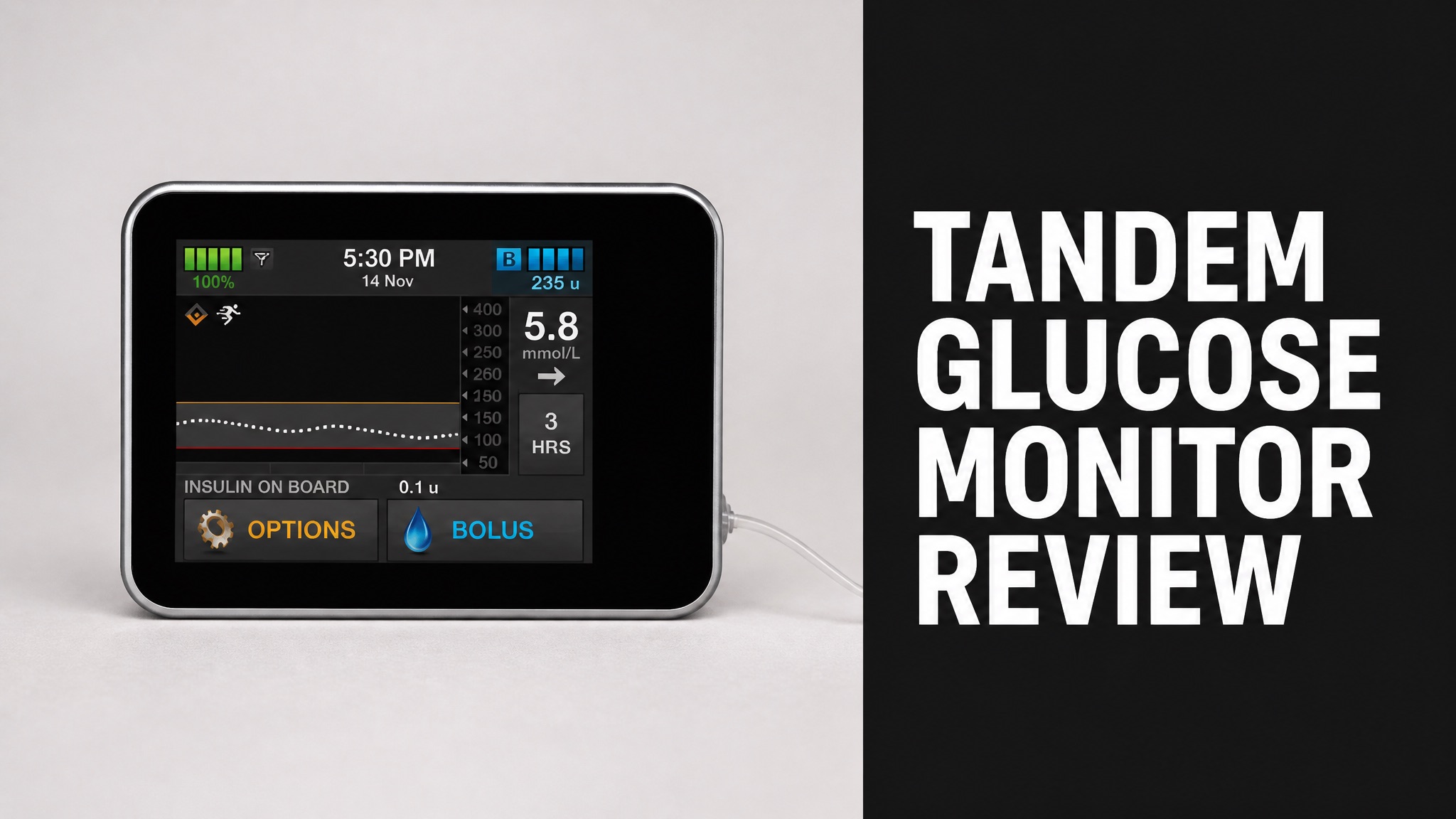
The Tandem glucose monitor is a pump-and-sensor system from Tandem Diabetes Care. The t:slim X2 and Mobi pumps read CGM data and adjust insulin on their own. Tandem does not make the sensor itself. Dexcom and Abbott supply those. Insured users pay under $50 (USD) a month on average.
Control-IQ+ predicts glucose 30 minutes ahead and changes basal insulin every five minutes. Reviewers praise the touchscreen and calmer nights. They also report alarms and bulky cases. The FDA has logged several Class I corrections since 2024. Pricing runs about $4,000 (USD) before insurance, and the pump carries a four-year warranty.
The big picture is mixed but positive. Automation cuts daily effort, and recalls demand attention. The sections below cover features, safety, price, Omnipod and where to buy. Read on to see whether Tandem fits your routine, your sensor choice and your budget before you order it today.
What Is the Tandem Glucose Monitor?
The Tandem glucose monitor is a pump-and-sensor system from Tandem Diabetes Care that tracks glucose and adjusts insulin automatically. Tandem is a San Diego company founded in 2006. Tandem sells the t:slim X2 and Tandem Mobi insulin pumps. Both run Control-IQ+ software. In fact, the glucose readings come from a separate sensor, and the pump acts on them.
System Parts:
- Insulin pump (t:slim X2 or Mobi)
- Control-IQ+ algorithm
- Compatible CGM sensor
- Phone app for bolus and data
Who is it for? People with type 1 diabetes ages 2 and up, plus adults 18 and up with insulin-treated type 2. Short answer: it suits anyone who wants less daily dosing math.
Does Tandem Make Its Own CGM?
No. Tandem makes the pump and the software only. Dexcom and Abbott make the sensors. Think of it this way: the sensor reads glucose, and the Tandem pump decides what to do with the number. The split matters when you shop. Sensors, pumps and supplies often come from different sellers. Each seller sets its own price and insurance rules, so compare them.
Buy the sensor from its maker or a supplier. Buy the pump and supplies from Tandem or an authorized dealer. Keep each receipt for claims.
How Does the Tandem Glucose Monitor System Work?
The Tandem system reads a sensor value every five minutes and adjusts basal insulin based on a 30-minute glucose prediction. A basal rate is the steady trickle of insulin between meals. A bolus is the larger dose for food or corrections. The pump handles both. Pretty neat, right? Meal boluses still need your input. The system runs day and night, nonstop.
Control-IQ+ then predicts where glucose will land in half an hour. The pump raises, lowers or stops basal insulin to match. Here’s the thing: the system does this around the clock, even while you sleep.
What Does Control-IQ+ Do?
Control-IQ+ is the Tandem algorithm that predicts glucose and changes insulin delivery without user input. Basal insulin rises when the predicted value passes 160 mg/dL (8.9 mmol/L). The rate drops below 112.5 mg/dL (6.2 mmol/L). Delivery stops below 70 mg/dL (3.9 mmol/L). To be clear, those targets run on the sensor, not on a finger stick. Worth knowing.
Above 180 mg/dL (10.0 mmol/L), the pump gives an AutoBolus. The dose equals 60% of a full correction, aimed at 110 mg/dL (6.1 mmol/L). The feature helps with a missed meal bolus. Does that replace meal dosing? Not at all.
Two special modes exist. Sleep Activity targets 112.5 to 120 mg/dL (6.2 to 6.7 mmol/L). Exercise Activity targets 140 to 160 mg/dL (7.8 to 8.9 mmol/L). Only Tandem pumps offer a dedicated sleep setting, according to Dexcom.
Which CGMs Work With Tandem?
The t:slim X2 pairs with Dexcom G6, Dexcom G7 and the Abbott FreeStyle Libre 2 Plus and 3 Plus. The Tandem Mobi pairs with Dexcom G7, Dexcom G7 15 Day and FreeStyle Libre 3 Plus. The ADCES device guide says so. The Dexcom G7 15 Day is cleared for adults 18 and up. Check the current list before you buy. Pairing takes minutes. Your care team confirms the fit.
Compatible Sensors:
- Dexcom G6
- Dexcom G7 and G7 15 Day
- FreeStyle Libre 2 Plus
- FreeStyle Libre 3 Plus
Dexcom reports that users on a t:slim X2 system gain 11% more time in range. The gain equals more than 2.6 hours a day. The figure comes from the sensor maker, so read it with that in mind.
What Are the Main Tandem Pump Features?
Tandem pumps combine a rechargeable battery, remote software updates and phone-based bolus control in two compact designs. The t:slim X2 has a color touchscreen and holds 300 units of insulin. The pump charges through a micro-USB cable. The pump is watertight but not waterproof, so skip swimming, hot tubs and saunas. Setup is simple and training is included.
Remote updates add new features without new hardware. Does that save money? Yes, because the pump stays current. Support runs 24 hours a day, every day of the year. Training for new users is included. The warranty is four years.
How Does the t:slim X2 Compare With the Mobi?
The Mobi is the smaller pump and works mainly from a phone. The t:slim X2 keeps a built-in screen. The Mobi weighs 1.06 ounces (30 grams). The unit measures 2.02 by 1.47 by 0.56 inches (5.13 by 3.73 by 1.42 cm). You can clip it, pocket it or stick it on your body with an adhesive sleeve. Both pumps fit daily life, but the feel differs a lot in daily use.
Pump Comparison:
| Feature | t:slim X2 | Mobi |
|---|---|---|
| Insulin capacity | 300 units | 200 units |
| Screen | Color touchscreen | None, phone control |
| Water rating | Watertight, not waterproof | IP28, 8 feet (2.4 m) for 2 hours |
| Charging | Micro-USB | Wireless |
The pump holds 200 units, and a full charge lasts 3 to 5 days. A small button gives a bolus when the phone is out of reach. At the same time, the Mobi has no screen. Your phone is the display.
Does the Tandem Glucose Monitor System Actually Work?
Yes. Tandem’s pivotal data and user stories agree on one point. The system smooths out highs and lows. Parents describe fewer night lows. Adults describe less daily decision-making. That’s the main reason people stay. Real-world reports match the trial data, with caveats noted below. Do the claims hold up in daily use? In most reviews, they do hold up well.
A 2023 study by Beck and colleagues in Diabetes Technology and Therapeutics backs strong outcomes from day one. The study used a t:slim X2 with a Dexcom G6. Individual results vary, as Tandem itself notes.
What Do Tandem Reviews Say?
Reviewers praise the touchscreen, the readable display and the steady overnight glucose control. One long-term user liked the modern look and the fine-tuned settings. She could set active insulin time to 3 hours 45 minutes. She also read the screen in bright sunlight while hiking. Praise is common. Many users say they would not go back to injections.
A parent on ASweetLife saw more even glucose after her daughter moved from Omnipod to the t:slim X2. Corrections worked on the first try. And the girl took ownership of her own care.
What Are the Common Complaints?
Complaints center on alarms, a fiddly cartridge fill and bulky accessories. One reviewer logged nine occlusion alarms in ten weeks. Each cleared after resuming insulin. Another called the original t:clip case top-heavy. Fair warning: these reviews date from 2017 and early pump versions. Most issues are fixable. Support helps with alarms and set changes.
Common Complaints:
- Frequent alerts in early use
- Occlusion alarms for some users
- Complex cartridge filling
- Bulky original case
Newer hardware has changed since. Still, filling the cartridge takes more steps than a pod swap. Is that a deal breaker? For most users, no, but it is worth knowing.
Is the Tandem Glucose Monitor Safe?
Yes. Safe use needs the right setup. The FDA cleared the t:slim X2 as the first alternate controller enabled pump in 2019. Control-IQ+ works with Novolog, Humalog or Lyumjev U-100 insulin. Fingersticks still apply when symptoms and readings disagree. Does safety depend on you? Partly, because training, set changes and alarm response all matter a great deal.
But the record is not spotless. The FDA has classified several Tandem corrections as Class I recalls. The FDA treats Class I as its most serious category. Read the details below, then ask your care team.
What Are the Tandem FDA Recalls?
Tandem has had four Class I corrections since 2024, covering app software, pump software and pump speakers. The 2024 iOS t:connect 2.7 fix covered 85,863 installs, with 224 reported injuries and no deaths. A 2025 Control-IQ+ 7.9 fix affected 85 pumps. Tandem told those users to switch off Control-IQ+ until an update arrived. Stay alert to new notices.
Recent Class I Corrections:
| Year | Product | Units |
|---|---|---|
| 2024 | iOS t:connect app 2.7 | 85,863 installs |
| 2025 | Control-IQ+ 7.9 | 85 pumps |
| 2025 | t:slim X2 speaker | 171,750 pumps |
| 2025 | Mobi vibration motor | 17,745 pumps |
Later in 2025, a speaker issue touched 171,750 t:slim X2 pumps. A false vibration-motor fault touched 17,745 Mobi pumps. Both could stop insulin delivery. Bottom line: check your pump serial number against the FDA list.
Who Should Avoid the Tandem System?
People who want a tubeless, wear-and-forget design should look elsewhere. The t:slim X2 uses tubing and a cartridge. The Mobi is tubed too, since it takes standard Tandem infusion sets. Anyone who swims daily may prefer a fully waterproof option. Be honest about your routine. Ask your doctor about alternatives before you commit to this design today.
Safety also depends on the user. Pump therapy needs training, set changes and alarm response. Talk with your doctor if you cannot commit to that routine.
How Much Does the Tandem Glucose Monitor Cost?
The Tandem t:slim X2 costs about $4,000 without insurance, and insured users pay under $50 a month on average. That monthly figure, from Tandem, includes supplies. Many plans cover the pump during the four-year warranty. Medicare covers the Mobi, per the ADCES guide. Your plan decides the final number. Ask early, and ask for every answer in writing.
Cost Breakdown:
| Item | Typical Cost | Notes |
|---|---|---|
| t:slim X2 pump | $4,000 (USD) | Without insurance |
| Monthly total | Under $50 (USD) | Average insured user |
| Warranty | 4 years | Pump replacement |
| Sensors | Varies | Bought separately |
Sensors add a separate cost. Is that included in the pump price? No. Infusion sets and cartridges are recurring too. So budget for three line items: the pump, the sensor and the supplies.
Is Tandem Worth the Price?
Yes. The pump is worth it for people on multiple daily injections who want automation. Insured users pay little each month. The remote updates also stretch the useful life of the hardware. The fit with your routine matters as much as the price. Run the numbers with your plan before you commit, and ask for a written quote from the supplier first, please.
Cash buyers face a harder call. Four thousand dollars is a lot. Does the automation earn it back? For many, fewer lows and calmer nights say yes.
Tandem vs Omnipod: Which Is Better?
Tandem is better for people who want predictive automation and a screen, while Omnipod is better for tubeless wear. Omnipod sticks on the skin with no tubing. The design helps in sports. One family reported a pod shearing off during activity. They switched to the t:slim X2 and saw tighter glucose control. Try both designs before you finally decide.
Tandem vs Omnipod:
| Feature | Tandem | Omnipod |
|---|---|---|
| Tubing | Yes | No |
| Predictive algorithm | Control-IQ+ | Varies by model |
| Sleep mode | Dedicated setting | Varies by model |
| Change effort | More steps | Two steps |
Tandem takes more steps for changes. In exchange, it offers AutoBolus and Sleep Activity. Both are built into Control-IQ+. Pick based on lifestyle first.
Which Pump Fits Which Person?
Active kids and swimmers often lean toward tubeless pumps, while data-focused users lean toward Tandem. Tandem suits users who like numbers, graphs and tight night control. Tubeless pods suit users who dislike tubing. And both can work for adults and teens. Fit is personal. Match the pump to your day, not the other way around. Ask for a demo too, please.
Test the feel before you decide. Tandem offers virtual demonstrations. Ask your care team for a trial of each design.
Where Can You Buy the Tandem Glucose Monitor?
You can get a Tandem pump through the manufacturer, through authorized suppliers and through your care team with a prescription. A prescription is required. Tandem runs a Get a Pump process online. Suppliers such as Appy Medical also help with insurance checks and ordering. Pump specialists answer phones on weekdays. Ask for each quote in writing, always.
Steps to Get a Pump:
- Ask your doctor for a prescription.
- Verify your insurance coverage.
- Order the pump and a compatible sensor.
- Complete guided training.
- Start the pump with your care team.
Delivery comes with training. Is it hard? Not really. A guided session teaches setup before first use. Plan on a few weeks from prescription to start.
Does Insurance Cover Tandem?
Insurance often covers the pump, and Medicare covers the Mobi system according to the ADCES guide. Tandem lists a Benefits Program and a Choice Program. A technology access program also exists for the Mobi. Check your plan before ordering. Ask early, and ask for the answer in writing. Plans differ by region, and approvals can take weeks to finish fully.
Coverage rules change by plan and region. Call the pump specialists with your policy number. They can run a quick check.
Should You Try the Tandem Glucose Monitor?
Yes. Try it if you want automated insulin delivery. The pump suits anyone who accepts a tubed or phone-run design. Skip it if you need tubeless wear or cannot handle recall checks. Pick the pump that matches your day, your sensor and your budget. The fit decides whether the automation helps. Ask your care team for a demo first. Then read its recall notices.
Choose the t:slim X2 for the screen and the larger cartridge. Choose the Mobi for size and discretion. Either way, pair it with a sensor your plan covers.
Is Tandem Right for Kids and Teens?
Yes. Control-IQ+ is cleared for ages 2 and up with type 1 diabetes. Parents report better sleep and fewer night alarms. Teens gain ownership of their care. Training matters most. Parents handle the early set changes. Teens then take over step by step, with a parent nearby for alarms. Ask your care team for a demo first, and confirm the sensor choice.
Training matters most. Kids need help with set changes at first. Plan the handoff step by step.