
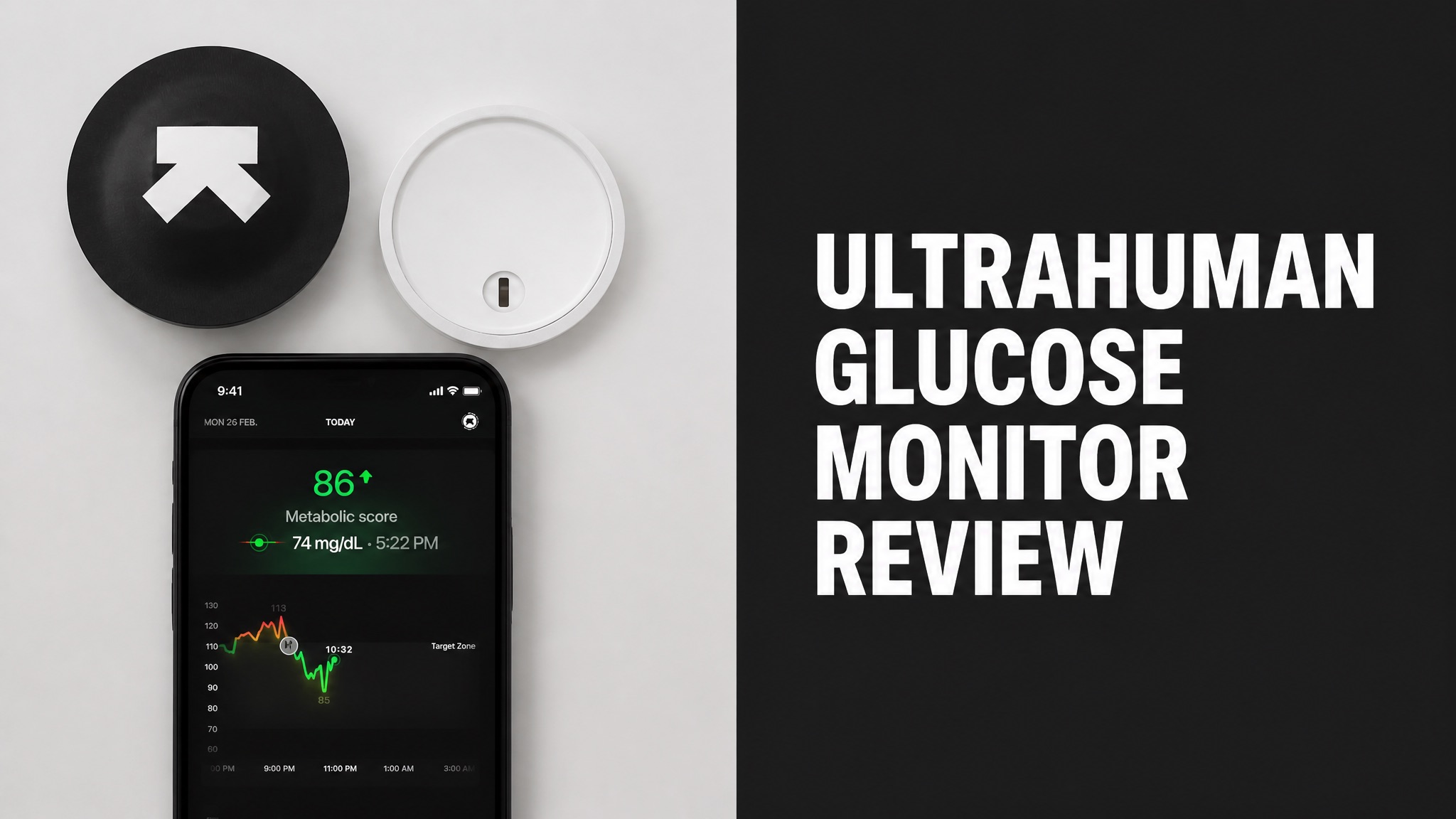
The Ultrahuman glucose monitor is a wearable sensor that tracks blood sugar around the clock and feeds the data to an app. Ultrahuman sells it as the M1, built on Abbott’s FreeStyle Libre sensor. The M1 reached the US in March 2024 after launches in the UK, the Netherlands and India.
The sensor reads glucose under the skin for 14 days. The app turns readings into food scores and a Metabolic Score. Reviews praise the insight and flag connection drops. US pricing starts at $239 per month, while rivals cost less. The M2 Live now offers a $129 single sensor with no physician needed. Accuracy comes from Abbott’s FDA-approved hardware.
The device suits curious wellness users more than people managing diabetes. Short tests deliver most of the value, and College Life scored the M1 7.4 out of 10. Read on to learn how the monitor works, how accurate it is, what it costs, who should avoid it and whether it’s worth buying today.
What Is the Ultrahuman Glucose Monitor?
The Ultrahuman glucose monitor is a continuous glucose monitor that tracks blood sugar all day through a small arm sensor. The sensor sits on the back of the upper arm and sends readings to the Ultrahuman app. Ultrahuman sells it as the M1. The newer M2 Live is now available in the US at a lower price. The M1 debuted in the UK, the Netherlands and India.
Ultrahuman is a health-tech brand best known for smart rings. Ultrahuman launched the M1 in the UK, the Netherlands and India in June 2021 as Ultrahuman Cyborg. The US launch followed in March 2024.
Mr. Healthy treats the M1 as a wellness tool, not a diabetes treatment device. So who’s it for? Curious, data-loving people who want to see how food, workouts and sleep move glucose.
Which Sensor Does Ultrahuman Use?
Ultrahuman relies on Abbott hardware rather than a sensor of its own. The M1 uses the Abbott FreeStyle Libre, a medical-grade sensor approved by the US Food and Drug Administration (FDA). The M2 Live switches to Abbott’s over-the-counter Lingo sensor. The Lingo sensor syncs with the Ultrahuman app and ring data. Both sensors each last about 14 days.
In fact, Engadget puts it bluntly. Ultrahuman sells the product, but buyers are really purchasing access to one of Abbott’s medical-grade monitors. The Ultrahuman app then adds insights on top of the raw readings.
How Does the Ultrahuman Glucose Monitor Work?
The sensor reads glucose in the fluid under the skin and sends the data to the Ultrahuman app. Wearable Technologies reports that each sensor measures blood sugar continually for 14 days. Pairing runs over Bluetooth, and a quick NFC scan connects the sensor. Sensors need swapping every two weeks. Water resistance reaches two meters (6.6 feet) for 30 minutes.
You log meals, workouts and sleep in the app. The app then lines those events up against your glucose curve. Mr. Healthy sums up the loop in three words: observe, adjust, repeat.
How Do You Set It Up?
Setup takes only a few minutes and needs no charging or calibration. College Life found that the applicator did the hard work during its two-week test. The kit arrives with the sensor, an applicator and short instructions. Nothing needs configuring beforehand, and the app finds the sensor. Treat the first half day of data as the sensor settling in.
Is the first day reliable? Not quite. The first half day of data is the sensor settling in, so treat those early numbers with care. After that, readings run without further input.
Setup Steps:
- Press the applicator against the back of the upper arm.
- Scan the sensor with the phone over NFC to pair it.
- Leave the sensor in place for the full 14 days.
- Log every meal and workout in the Ultrahuman app.
What Features Does the Ultrahuman App Offer?
The Ultrahuman app turns raw glucose readings into food scores, trend summaries and habit nudges. Mr. Healthy says the interface feels more lifestyle-focused than plain CGM apps. College Life called the app the strongest part of its test by a distance. The design suits first-time users and assumes no vocabulary. Nothing important sits more than one tap away.
The main screen shows current glucose and the shape of the day. Nothing important sits more than one tap away. For example, peaks and lows appear plainly, so a spike is easy to spot.
Key Features:
- Food scores that rate each meal’s glucose impact
- Meal logging with glucose response analysis
- Workout and movement context for glucose changes
- Trend summaries and habit nudges
- Metabolic Score for daily glucose stability
What Is the Metabolic Score?
The Metabolic Score rates daily glucose stability in a single number. Ultrahuman’s AI, called Jade, crunches glucose, sleep, stress and exercise data to produce it. Engadget says the score guides users on what to improve. Mr. Healthy also lists the Metabolic Score among the key features of the M1 app. The score draws on sleep and stress data from the ring.
Why does one score help? Because a single reading tells almost nothing on its own. The app pushes users toward patterns across hours and days instead.
Does the Ultrahuman Glucose Monitor Actually Work?
Yes. The Ultrahuman glucose monitor delivers a clear link between meals and glucose curves. College Life wore it for 14 days and called the link obvious and immediate. Meals assumed to be fine produced bigger rises than expected. Meals expected to cause trouble sometimes did not. Surprises like these are the value. Two weeks was enough for a clear picture.
Here’s the part most people miss: peaks are personal. Sarah Berry and Tim Spector at King’s College London studied this in 2020. Their Nature Medicine paper found glucose responses to identical meals varied by about 68% between people.
Does logging matter? Absolutely. Writing a meal down makes the wearer think before eating. Some of the benefit comes from the habit, not the sensor.
Is the Ultrahuman Glucose Monitor Accurate?
Yes. The Ultrahuman glucose monitor borrows its accuracy from the FDA-approved Abbott FreeStyle Libre sensor. TechRadar notes that the clearance guarantees a certain level of accuracy. The app adds the insight layer, not the measurement itself. Abbott’s medical-grade hardware does the actual reading under the skin. The sensor is water resistant to 2 meters.
The weak spot is the connection, not the sensor. College Life saw dropped signals, mostly at the start and near the end. And here’s the kicker: sleeping on the sensor broke the link and left gaps in night data.
What Do Ultrahuman Glucose Monitor Reviews Say?
Ultrahuman glucose monitor reviews land mostly positive, with praise for the app and complaints about connection and cost. Mr. Healthy scores the M1 at 4 out of 5. College Life gives it 7.4 out of 10. Neither calls it a bargain. Reddit and Trustpilot users echo that split between insight and frustration. Both reviewers praise how easy the setup feels.
Do the scores agree? Not quite. Mr. Healthy ranks the M1 tenth of ten in its CGM list. Even so, the reviewer calls it worth it for the right person. The verdict depends on how the buyer uses the data.
Review Highlights:
- Simple app that installs in minutes
- Clear link between meals and glucose curves
- Connection drops, mostly at the start and end
- Patchy night data when sleeping on the sensor
- Price higher than sensor-only options
What Do Users Like?
Users praise the insight the data gives into personal glucose responses. One Reddit user said the data gave ‘deep insight on your glucose,’ especially with careful food logging. College Life rated experience and usability 8 out of 10. The fortnight ended with a clear sense of how glucose moves across a normal day. Installation took only a few minutes.
So is the app hard to learn? No. Look, the design doesn’t assume any vocabulary, which suits beginners. Installation took minutes.
What Are the Common Complaints?
Complaints center on sensor connection, comfort and price. A Trustpilot reviewer wrote that they ‘couldn’t connect it to the app,’ which stings after applying a sensor. College Life found the first few days the least comfortable by a clear margin. The app also lost its connection to the sensor fairly often. Sleeping on the sensor broke the link at night.
The bad news? Anxious trackers may over-check. Mr. Healthy warns that the M1 can encourage that habit. Availability and pricing also vary by country.
How Does the Ultrahuman Glucose Monitor Compare With Rivals?
Ultrahuman costs more than most rivals but offers the broadest lifestyle layer. Mr. Healthy lists Dexcom Stelo and Lingo by Abbott at about $89. Signos costs $127, Nutrisense $152 and the M1 $199 per month. The table below compares focus, price and best use for each. Each rival targets a slightly different buyer. Prices shown are roughly monthly figures.
Ultrahuman vs Rivals:
| Brand | Focus | Price | Best For |
|---|---|---|---|
| Ultrahuman M1 | Metabolic lifestyle insights | $199/month | Data-driven wellness users |
| Dexcom Stelo | OTC glucose tracking | $89/month | Simple CGM access |
| Lingo by Abbott | Habit glucose feedback | $89/4 weeks | Casual glucose learners |
| Nutrisense | CGM plus dietitian | $152/month | Coached nutrition support |
| Signos | Weight management CGM | $127/month | Weight-loss guidance |
If the goal is the lowest price, Dexcom Stelo or Lingo wins. Ultrahuman wins when the buyer wants glucose tied to food, movement and recovery. What’s more, the M1 fits into the wider Ultrahuman ring ecosystem.
How Does It Compare With Nutrisense and Signos?
Nutrisense leans on dietitian support, while Signos centers on weight management. Ultrahuman sits in the middle with a polished app and a coaching flavor. Mr. Healthy calls that balance its biggest win. Few rivals blend both without feeling like homework. The M1 is useful without turning lunch into a spreadsheet. Signos suits weight-loss goals best.
So what does that mean for you? Nutrisense adds the dietitian. Signos adds the weight focus. Ultrahuman adds the ring ecosystem and a friendlier, less clinical dashboard.
Is the Ultrahuman Glucose Monitor Safe?
Yes. The Ultrahuman glucose monitor is safe for wellness use because it runs on an FDA-approved Abbott sensor. Mr. Healthy lists mild discomfort at application as the main issue. Strong pain, bleeding, swelling or irritation means removing the sensor and contacting support or a clinician. Normal daily wear, including showers, is what the sensor is built for.
To be clear, the M1 is not a diagnostic tool. Mr. Healthy states it can’t diagnose diabetes or adjust medication. Worrying readings belong with a qualified clinician.
Who Should Avoid the Ultrahuman Glucose Monitor?
People who need medical diabetes management are not the target audience for this device. Mr. Healthy flags that group first, ahead of every other caveat. An opensource.clinic article also argues Ultrahuman isn’t the best choice for Type 1 diabetes management. Those users need a dedicated medical system. Budget shoppers and anxious trackers also fit the list.
Not Ideal For:
- Anyone needing medical diabetes management
- People who dislike body data overload
- Budget shoppers wanting the cheapest CGM
- Users who hate sensor setup or arm sensors
Is there another risk? Yes, for anxious trackers. Constant checking can feed worry. And the sensor stays noticeable on the arm for a full fortnight.
How Much Does the Ultrahuman Glucose Monitor Cost?
The Ultrahuman glucose monitor costs $239 for one month in the US at launch pricing, including two sensors. TechRadar listed $559 for three months and $1,919 for a year. Those prices carried a 20% limited offer in March 2024. Sensors need replacing every two weeks, so the plan size matters. Ultrahuman lists the M1 Live at about $199 per month in comparisons.
Ultrahuman US Pricing:
| Plan | Sensors | Price |
|---|---|---|
| M1, one month | 2 | $239 |
| M1, three months | 6 | $559 |
| M1, one year | 26 | $1,919 |
| M2 Live, single sensor | 1 (14 days) | $129 |
| M2 Live, monthly plan | Subscription | $99/month |
Is there a cheaper route? Yes, the M2 Live. Engadget lists one 14-day sensor at $129 and a monthly subscription at $99. In Europe, Mr. Healthy cites about 189 euros (USD 205) for a four-week M1 Live plan.
Is the Ultrahuman Glucose Monitor Worth the Price?
Yes. The Ultrahuman glucose monitor pays off when the wearer acts on the insights. Mr. Healthy says the price is easier to justify for people running experiments. A quick peek at numbers is cheaper elsewhere, since basic over-the-counter options cost less. Value rises with active use of the data. The M2 Live lowers the entry cost to $129 for one sensor.
What’s the smartest way to buy? Start small. College Life suggests running one sensor for two weeks and logging everything. The insight plateaus once the wearer learns personal patterns.
Where Can You Buy the Ultrahuman Glucose Monitor?
Buyers can order the Ultrahuman glucose monitor directly from Ultrahuman. Mr. Healthy advises checking availability in the buyer’s country first. Sensor supply, compatibility and pricing vary by region, so a quick check saves trouble. Promotions, bundles and member offers also change often. The US launch of the M1 came in March 2024, after the UK launch.
Ordering Options:
- Ultrahuman’s own store for M1 bundles
- Ultrahuman M2 Live in the US since June 2026
- Regional Amazon listings for the M1 in some countries
Do You Need a Prescription?
Yes. US buyers of the original M1 needed a medical consultation and a state-authorized physician during ordering. TechRadar reports that this applies to CGMs in the United States. The M2 Live uses an over-the-counter sensor and is easier to get, with no physician needed. Engadget calls it far cheaper to access. US M1 wearers needed that consultation.
Is it sold everywhere? No. Availability differs by market. The M1 debuted in the UK, the Netherlands and India. Bottom line: check local rules before ordering.
Should You Buy the Ultrahuman Glucose Monitor?
Yes. The Ultrahuman glucose monitor is worth buying for wellness users who plan to act on the data. Mr. Healthy calls it useful, polished and genuinely educational. Cheaper CGMs exist, and the M1 is no medical device. Treat the first sensor as a learning phase, not a performance test. College Life scored the experience and usability at 8 out of 10.
Best For:
- People curious about food and glucose responses
- Fitness users who want fueling feedback
- Habit trackers who enjoy wearable data
- Wellness users comfortable with arm sensors
What Is the Final Verdict?
The final verdict is a qualified yes for short, purposeful use. College Life scored the M1 7.4 out of 10 and called it a useful two-week education. The reviewers saw it as a hard sell as an always-on habit. The insight plateaus once the wearer learns personal patterns, so a short test fits best. Mr. Healthy gives it 4 out of 5 and ranks it tenth of ten.
Short answer: pick the M1 for answers, not for bragging rights. The M2 Live now offers a cheaper route in the US. Compare both before ordering.