
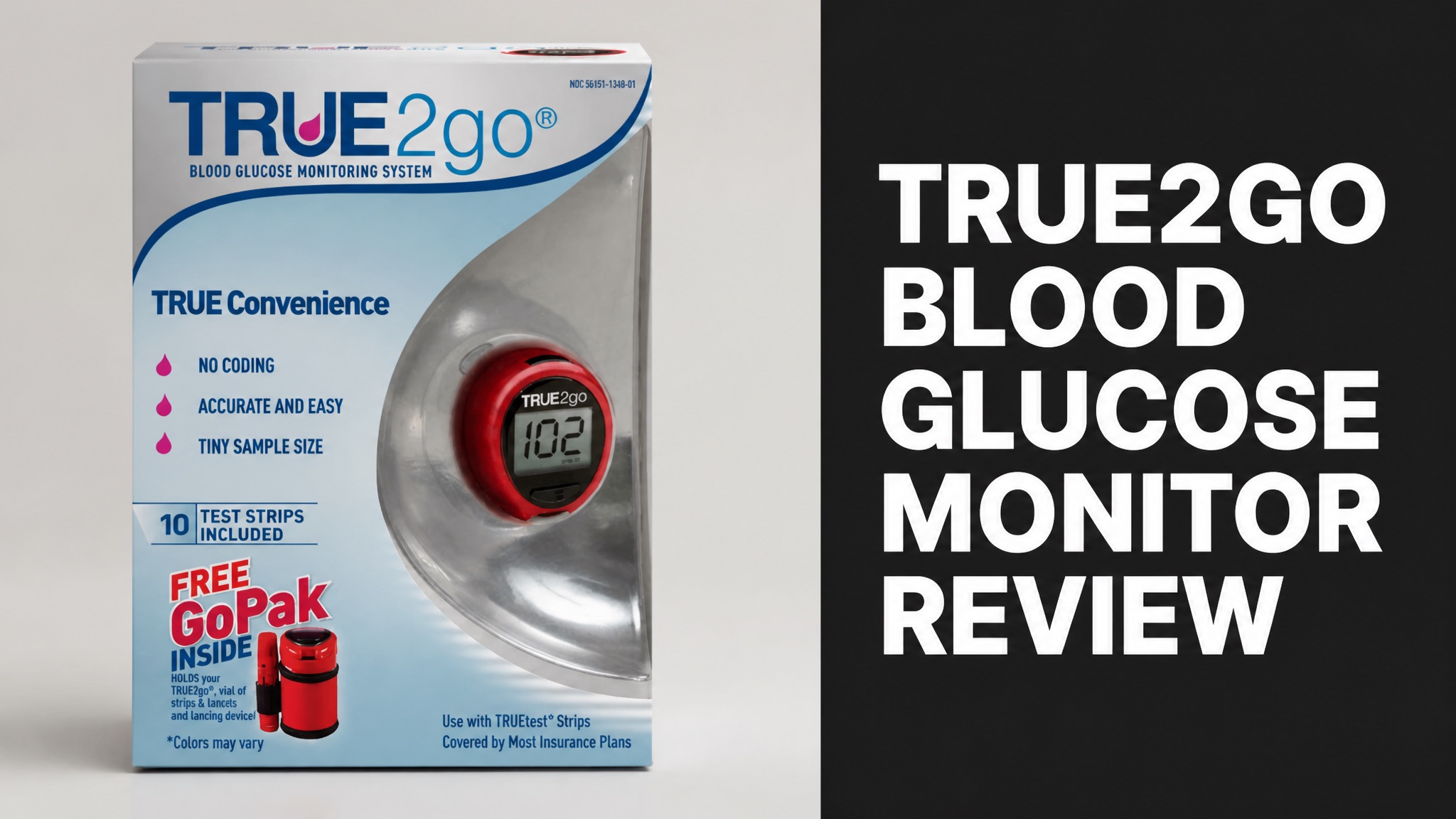
The True2go is a pocket-sized blood glucose meter from Trividia Health. It twists onto a vial of TRUEtest strips and reads a drop of blood in seconds. This review covers how it works, what the kit includes, and what users report.
The meter stores 99 results and ships with a battery already installed. The kit adds a lancing device, lancets, and a carrying strap. Real users praise the size and the low price. Some note the wide strip slot and the basic feature set. Accuracy claims also need context.
Next come the cost, the buying options, and a direct comparison with the TRUE Metrix line. By the end, the answer to one question is clear. Is this budget meter the right backup for your diabetes supplies?
What Is the True2go Blood Glucose Monitor?
The True2go is a compact blood glucose meter that screws directly onto a vial of TRUEtest test strips. The design removes the need for a separate case. Bottom line: the strip vial doubles as the meter’s body and storage in one small piece.
The meter belongs to the budget end of home testing. A basic screen shows the result. The kit targets people who want a simple tool for spot checks, travel, or exercise. Is it a full-featured system? No. It focuses on the essentials.
Product Snapshot:
| Spec | Detail |
|---|---|
| Maker | Trividia Health |
| Test time | As fast as 4 seconds |
| Memory | 99 results |
| Battery | 3 volt, installed |
| Strips | TRUEtest |
Who Makes the True2go?
Trividia Health makes the True2go and the wider TRUE line of glucose meters. The company also sells the TRUE Metrix and TRUENESS systems. Trividia states that 9 out of 10 pharmacists include the TRUE brand among their recommended products, based on its own 2019 survey.
That figure comes from the company, so treat it as marketing data. Still, the brand has wide pharmacy reach. Retail chains have also carried store-branded versions of the True2go, including a Rite Aid edition.
How Does the True2go Work?
The True2go reads glucose from a small blood drop applied to a TRUEtest strip. The meter threads onto the strip vial. A strip slides into the port, and blood fills the strip. The screen then displays the reading in about 4 seconds.
The sample is tiny, about 0.5 microliters. A small sample means shallower lancet pokes. So the process stays quick and low-effort.
Basic Testing Steps:
- Wash and dry your hands before every test.
- Load a lancet into the lancing device and prick your fingertip.
- Insert a TRUEtest strip into the meter port.
- Touch the blood drop to the strip until it fills.
- Read the result on the screen after about 4 seconds.
How Do You Use the True2go?
Using the True2go takes one strip, one lancet, and one drop of blood. Reviewer Rachel, a type 1 diabetes blogger, noted that the strips are the wide kind. You push blood into the slot instead of touching a narrow tip.
Here’s the thing: that wide slot takes a slightly bigger drop of blood. Does it matter? For most users, no, but a steady hand helps. Always check the printed instructions that come in the kit.
What Does the True2go Kit Include?
The True2go starter kit includes the meter, test strips, lancets, a lancing device, and a log book. Rachel’s kit held 10 strips, 10 lancets, a lancing device, a log book, and a belt strap. The battery is already installed, so there is no cover to remove.
In fact, the missing battery cover surprised her at first. Then she saw the meter screws onto the vial. The design keeps everything together. That is the main selling point for travel and workouts.
Kit Contents:
- TRUE2go meter with installed 3 volt battery
- TRUEtest test strips
- Lancing device and lancets
- Self-test log book
- Compact carrying strap or case
- Instructions for use
Does the True2go Use Standard Lancets?
Yes. The lancing device accepts universal lancets that fit most standard pens. Rachel skipped the included lancing device because she already carried one. The universal fit means you can reuse a lancing pen you like.
That flexibility helps if the included pen feels uncomfortable. And lancets are cheap and easy to find. So replacing them never becomes a problem.
Is the True2go Accurate?
The True2go delivers acceptable accuracy for everyday spot checks, according to user reports. Rachel compared it with her insulin pump’s built-in meter several times. She called the results ‘not too bad.’ That is anecdotal, not clinical proof.
To be clear, no lab study of the True2go appeared in the research for this review. Trividia publishes clinical data for its TRUE Metrix line. The True2go claims rest on user feedback. Is that enough for treatment decisions? Ask your doctor first.
Accuracy Evidence:
| Source | Finding |
|---|---|
| Rachel (type 1 blogger) | Close to pump meter readings |
| Trividia clinical papers | Published for TRUE Metrix, not True2go |
| Medic user reviews | No ratings posted |
What Do True2go Reviews Say?
True2go reviews praise the compact size and the low cost, with few complaints about performance. One commenter kept a meter in a glove compartment for three years as a backup. Another noted the strap holds the meter and lancing device together.
The good news? The reviews are warm. The bad news? They are few. The Medic review page shows zero ratings, so the evidence pool is small. Weigh these opinions as personal stories, not trial data.
How Does the True2go Compare With the TRUE Metrix?
The True2go trades advanced features for portability and price when set against the TRUE Metrix. The TRUE Metrix offers no-coding technology, 500 stored results, event tags, four reminder alarms, and Bluetooth connectivity. The True2go stores 99 results with a basic display.
So what does that mean for you? The TRUE Metrix suits daily tracking and data sharing with a doctor. The True2go suits a glove box, gym bag, or emergency kit.
True2go vs TRUE Metrix:
| Feature | True2go | TRUE Metrix |
|---|---|---|
| Memory | 99 results | 500 results |
| Reminders | None listed | 4 alarms |
| Event tags | None listed | Yes |
| Bluetooth | No | Yes |
| Best use | Backup and travel | Daily tracking |
Who Should Choose the True2go?
The True2go fits travelers, gym users, and anyone who needs a cheap backup meter. Rachel said she would not replace her insurance-covered strips with it. She still called it worth every dollar when she ran short on supplies.
Think of it this way: it is a safety net, not a daily driver. People who test eight to ten times a day need insurance-covered strips. Those users should treat this meter as a spare.
How Much Does the True2go Cost?
The True2go kit cost $14.99 (USD) at Rite Aid in 2015 with a Wellness+ card. The package included a mail-in rebate form for the full price. Prices change by retailer and year, so check current listings before you buy.
Strips are the real long-term cost. Each meter needs TRUEtest strips, and the vial is part of the device itself. Budget for strips, not just the starter kit.
Cost Factors:
- Starter kit price at the pharmacy
- Replacement TRUEtest strips
- Replacement lancets
- Possible mail-in rebate offers
Is the True2go Worth the Price?
Yes. At roughly $15 (USD), the True2go is worth the price as a backup meter. Rachel said even a $15 meter was 100% worth it to stay on track and in range during a weekend away.
Short answer: it works well in a pinch. As a main meter it lacks memory depth and tagging tools. For those needs, step up to a TRUE Metrix.
Where Can You Buy the True2go?
The True2go sells through pharmacies and online diabetes supply retailers. Rachel found hers at a Rite Aid, which carried a store edition. Online shops such as eBay and diabetes supply stores list related TRUE products.
Availability shifts over time. Trividia now highlights the TRUE Metrix, TRUENESS, and TRUE FOCUS lines on its site. Call a pharmacy to confirm stock before a trip.
Where to Look:
- Local pharmacy diabetes aisle
- Online diabetes supply stores
- Marketplace listings such as eBay
- Trividia Health product pages for current models
Should You Try the True2go?
Yes. The True2go earns a spot in a travel bag or glove box as a low-cost backup meter. It is small, simple, and cheap. Users report fair accuracy and reliable basics.
And here’s the part most people miss: no meter replaces medical advice. Confirm any surprising result with your usual meter or a lab test. Then talk to your care team.