
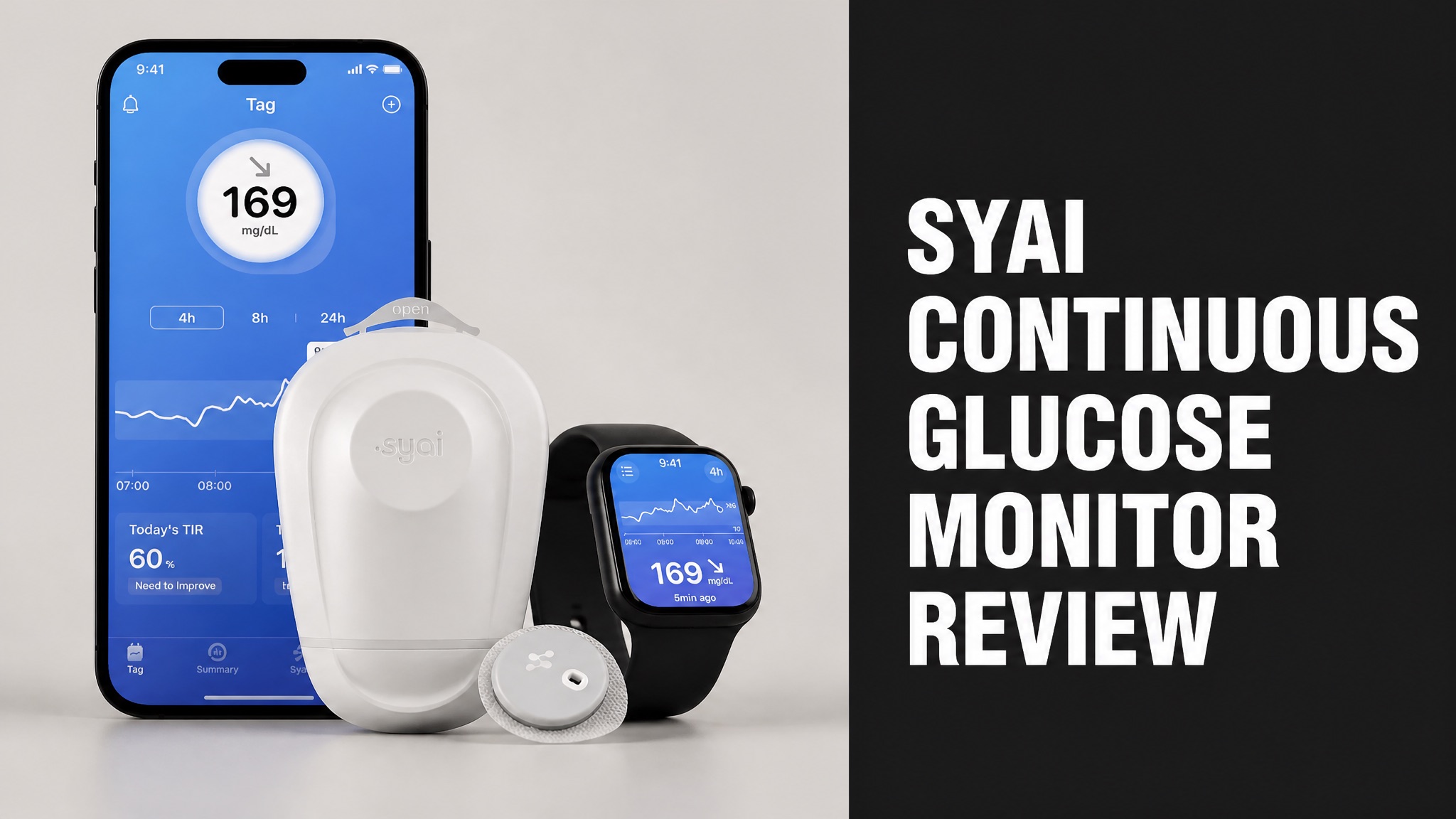
Syai continuous glucose monitor review starts with the basics. The Syai system is a wearable sensor and app from Singapore. It tracks glucose every 5 minutes for 14 days, and it targets people managing diabetes with alerts, reports, smartwatch support and doctor sharing.
The sensor sits on the upper arm and pairs with a phone over Bluetooth. The app shows trends, alerts and reports. Specs list an 8.1% MARD and IP28 water resistance. A clinical trial in Slovenia tests accuracy in intensive care. Approvals include CE MDR and ISO 13485 for the maker, though FDA clearance is absent from the sources checked.
Pricing, regional availability and independent reviews are still limited. The big picture is promising but unproven. Read on to see how the system works, what the evidence shows, and whether it fits your needs and your local rules before you buy it today.
What Is Syai Continuous Glucose Monitor?
The Syai continuous glucose monitor is a wearable biosensor that tracks glucose day and night and sends readings to a phone app. The system replaces routine fingersticks with a stream of data. In fact, the sensor reads glucose every 5 minutes, which adds up to 288 readings per day. The sensor needs no fingerstick calibration. Setup needs only a phone.
The kit is sold as the Syai Tag and Syai X1 system. To be clear, the app is built only for users who own the sensor. Does that limit the product? Not really, because the sensor and app work as one package.
The system targets people with diabetes who want trends instead of single snapshots. And the maker also pitches it for prediabetes, where 14 days of data shows food response and stress effects.
Key Features:
- Glucose reading every 5 minutes
- 14 days of wear per sensor
- High and low glucose alerts
- Smartwatch and AI assistant support
- Reports for doctor visits
Who Makes Syai?
Syai Health Technology Pte. Ltd. is a Singapore company founded in 2016 by a team with roots at Oxford and Cambridge universities. The company runs research centers and factories in Singapore, China and the UK. Here’s the thing: it describes itself as a biosensing and AI company, not only a device maker. The firm reports sites in Singapore, China and the UK.
Investors include Xiaomi, and AstraZeneca appears as a collaboration partner. The company reports ISO 13485 quality certification from July 2023. So the backing looks real. Is that proof of performance? No, but it separates Syai from anonymous resellers.
How Does Syai Work?
The Syai sensor sits on the back of the upper arm and reads glucose through the skin. A Bluetooth Low Energy link passes each reading to the phone. The range is up to 10 metres (33 feet). Short answer: no calibration is needed, because the sensor ships factory-calibrated. The app then displays trends and sends alerts to the user right away on the phone.
The app turns raw numbers into a trend arrow, a 24-hour history and alerts. Users can set separate day and night thresholds. What’s more, urgent low alerts can be configured. Worth knowing: the sensor stores data if the phone drops the connection.
How Do You Apply the Syai Sensor?
Application takes about 3 seconds with a pre-loaded applicator and needs no medical professional. The distributor says the sensor is thinner than a human hair. Pairing uses NFC with one tap. Does it hurt? The distributor says almost every user feels nothing, though skin sensitivity varies. The sensor then starts a warmup period before the first reading.
Steps:
- Clean the skin on the back of the upper arm.
- Remove the protective cap from the applicator.
- Press the applicator against the skin and click the button.
- Hold the phone near the sensor to pair with NFC.
- Wait for the warmup period before the first reading.
What Does the Syai App Do?
The Syai app shows live glucose, trend arrows, reports and alerts on iPhone, iPad and Apple Watch. It also includes an AI assistant and a Smart Food Log. The app is rated 4+ and sits in the Medical category. And at 170.7 MB, it’s a fairly large download. The app is free to download. It requires a Syai Tag sensor to function. It supports 15 languages.
Family members can follow readings through Syai Link. Doctors use Syai Doctor to view patient rosters and 14-day AGP reports. The distributor adds support for Garmin, Health Connect, xDrip+ and AAPS. Here is the part most people miss: those links matter for insulin pump users.
What Are the Syai Specifications?
The Syai sensor measures 24 x 24 x 3.5 mm (0.94 x 0.94 x 0.14 in) and weighs 1.6 g (0.06 oz). It lasts 14 days (two weeks) per application and carries an IP28 water rating. That means showers, baths and swimming are fine. Think of it this way: it’s a small patch, not a bulky device. Sensor size stays small and light for comfortable daily wear on the arm.
The measurement range runs from 2.2 to 22.2 mmol/L (40 to 400 mg/dL). Readings outside that window won’t display as exact numbers. Is that range enough? For most daily use, yes.
Syai Specifications:
| Spec | Value |
|---|---|
| Wear time | 14 days |
| Reading interval | 5 minutes |
| Range | 2.2-22.2 mmol/L (40-400 mg/dL) |
| Accuracy (MARD) | 8.1% |
| Water resistance | IP28 |
| Connection | Bluetooth Low Energy |
How Accurate Is Syai?
Syai lists a mean absolute relative difference of 8.1%, a figure its distributor cites as clinical accuracy. Lower MARD means readings sit closer to lab values. To put it simply, 8.1% is competitive for a CGM. But the figure comes from the maker, not an independent review. Users need no calibration. Each sensor ships already calibrated for the user.
The app itself tells users to use a blood glucose meter when alerts do not match symptoms. Why does that matter? Because no CGM replaces a fingerstick in every situation. Pay attention to this warning before making treatment decisions.
What Do Syai Reviews Say?
Syai reviews are still thin, and no large body of verified user ratings exists yet. The Apple App Store page says the app has not received enough ratings to show an overview. The bottom line: buyers must lean on clinical data and early user threads instead of star averages. Early adopters mostly share short impressions online. Wider data will need more time.
Early discussion exists on Reddit, where one Type 1 diabetes thread asks if the monitor is any good. A podcast episode also covers a Syai Ultra review. The good news? Interest is growing. The bad news? Independent long-term testing is scarce.
Is There Clinical Evidence for Syai?
Yes. A trial, NCT07448805, tests the Syai Tag system at University Medical Centre Maribor in Slovenia. It started on February 18, 2026 and targets 100 intensive care patients. Researchers compare sensor values with arterial blood gas results. No results have been posted yet. The study site sits in Maribor. The study is registered in a public database.
The primary endpoints are sensor uptime and MARD. A secondary endpoint checks the effect of noradrenaline on accuracy. Why test that? Because ICU drugs can disturb sensor readings. The trial runs until early 2027, so the answers are still pending.
What Are the Limitations of Syai?
Syai has several limits: unclear availability, limited independent data, and regional approval. The app notes the system is authorized only where approvals exist, and it names the European Union. Here’s why that matters: buyers in other countries may face legal or supply gaps. Pricing is also unclear in several regions. Each limit affects buyers differently.
Main Limitations:
- Few independent reviews
- Accuracy data comes from the maker
- Approval tied to specific regions
- Price not published on pages reviewed
Is Syai Legit and Approved?
Yes. Syai holds a CE MDR certification issued in April 2024 and ISO 13485 quality certification from July 2023. Distributors in Malaysia and Uzbekistan also list the product. The Malaysian seller states MDA certification. To be clear, these marks cover regions, not the whole world. Certifications confirm quality systems. They don’t prove accuracy alone.
The company site and the App Store listing both name Syai Health as the maker. Is this a scam? Nothing found points that way. And the clinical trial adds a third-party check. Still, buyers should verify the seller.
Approvals Found:
| Body | Status | Date |
|---|---|---|
| CE MDR | Certified | April 2024 |
| ISO 13485 | Certified | July 2023 |
| MDA Malaysia | Stated by distributor | Not dated |
Is Syai FDA Approved?
No. The pages reviewed show no FDA clearance for the Syai system. The App Store listing says use is intended within the European Union. The trial record also marks the device as not FDA regulated. So US buyers shouldn’t assume legal sale there. The company has not announced a US launch in the sources checked. Regulators set the rules in each country.
Check local rules before ordering. Why bother? Because unapproved devices can lack warranty and support. Bottom line: ask the seller for proof of local authorization in writing.
How Much Does Syai Cost and Where to Buy?
Syai pricing is not published on the official pages reviewed, so buyers must request quotes from distributors. The Malaysian distributor says online payment is still being set up and asks buyers to make contact. The official site shows a Coming Soon notice for some regions. Here’s the catch: price varies by country. Official channels may change over time.
The Uzbek distributor runs a loyalty program starting November 1, 2026. Users earn 10 points per registered sensor. Discounts start at 30 points. So repeat buyers may pay less over time.
Where Syai Is Listed:
- CityMedic in Malaysia
- Medilife Farma in Uzbekistan
- Official Syai site for regional news
- Apple App Store for the companion app
Is Syai Worth It?
Yes. Syai offers a 14-day sensor, 5-minute readings and a rich app for buyers in approved regions. The hardware specs look strong. But independent proof is still arriving, and the Maribor trial won’t finish until 2027. Specs are strong. Evidence is still growing. Local approval decides the rest. Price checks matter too. Always confirm local stock first.
Here is what that actually means: try it if your doctor agrees and you can buy locally. Skip it if you need FDA-cleared gear. So what’s the final call? Promising, but verify first.