
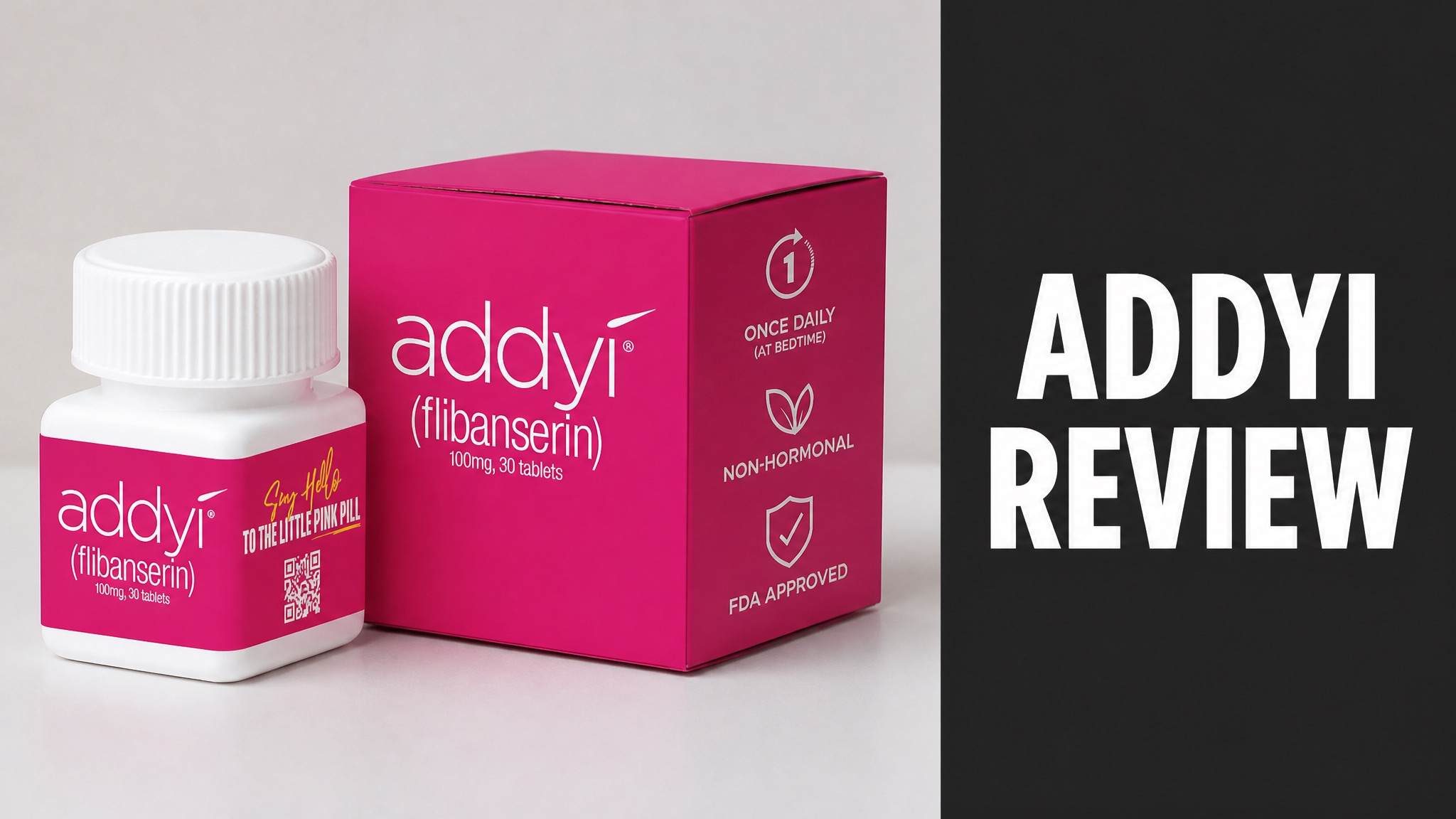
Addyi is a non-hormonal prescription pill for low sexual desire in women. Its active ingredient is flibanserin, made by Sprout Pharmaceuticals. The FDA approved it in 2015. In December 2025, the label expanded to women under 65 before or after menopause.
Addyi treats acquired, generalized hypoactive sexual desire disorder. The pill acts on serotonin receptors in the brain. Trial benefits are modest, with 43% to 48% of women reporting better desire. Side effects include dizziness and sleepiness. A boxed warning covers alcohol, low blood pressure and fainting. Retail cost tops $2,500 a month.
The big picture is simple. Addyi helps some women a little, and it asks for strict nightly habits. This review covers how the drug works, real trial numbers, side effects, alcohol rules, cost and alternatives. By the end, readers know whether the pink pill fits their situation.
What Is Addyi?
Addyi is an FDA-approved daily pill that treats acquired, generalized low sexual desire in women under 65. The active ingredient is flibanserin, a non-hormonal drug made by Sprout Pharmaceuticals. Each tablet holds 100 mg. Women take one tablet at bedtime, every night, to build the effect over several weeks of steady use.
The drug is often called ‘female Viagra’ or ‘the pink pill.’ Is the nickname accurate? Not really. Viagra boosts blood flow before sex. Addyi works on brain chemistry and is taken nightly, whether sex is planned or not. The label also says it isn’t for sexual performance.
Addyi at a Glance:
- Active ingredient: flibanserin 100 mg
- Maker: Sprout Pharmaceuticals
- Dose: one tablet at bedtime
- Approved for: women under 65 with HSDD
- Generic version: none in the US
Here’s the thing: there’s no generic flibanserin in the US. Addyi is the only FDA-approved version. So websites selling ‘generic flibanserin’ sell an unapproved product. Arrow Pharmacy warns buyers to check sellers through BeSafeRx first.
Who Is Addyi For?
Addyi is for women under 65 with acquired, generalized hypoactive sexual desire disorder that causes marked distress. Acquired means desire used to be normal and dropped later. Generalized means low desire shows up with any partner, situation or type of stimulation. The condition must cause distress or trouble in the relationship.
The label rules out some groups. Addyi isn’t approved for men. It isn’t approved for low desire caused by another illness, a relationship problem or a medication. Women 65 and older weren’t studied. The label also doesn’t recommend it during breastfeeding.
When Did the FDA Approve Addyi?
The FDA approved Addyi on August 18, 2015, for premenopausal women with HSDD. The road was rocky. Boehringer Ingelheim first submitted flibanserin in 2009. An FDA panel voted against it in June 2010. Sprout Pharmaceuticals then bought the rights and ran more trials. A June 2015 panel voted 18 to 6 in favor.
And it gets bigger: on December 13, 2025, the FDA approved a label supplement. The indication now covers women under 65 regardless of menopause. That approval rests on a 24-week trial of 447 women with an average age of 55. Older handouts may still say premenopausal only.
How Does Addyi Work?
Addyi works in the brain by acting on serotonin receptors, not on sex hormones. In lab studies, flibanserin activates 5-HT1A receptors and blocks 5-HT2A receptors. It also has moderate blocking activity at 5-HT2B, 5-HT2C and dopamine D4 receptors. The FDA label states the exact way it improves desire is not known.
Some websites say Addyi raises dopamine and norepinephrine and lowers serotonin. Is that proven? No. Summit Metabolic Health points out the label doesn’t make that claim. The theory exists, but the official prescribing information stays silent on it.
Is Addyi a Hormone?
No. Addyi is a non-hormonal drug that targets the central nervous system instead of estrogen or testosterone. The pill doesn’t replace any hormone. That sets it apart from hormone therapy, which some women use for desire changes around menopause. Doctors check hormone status and mood before calling the problem HSDD.
Mood, other medicines, hormone shifts, pain during sex and relationship stress can each lower desire. A physician looks at all of these first. Bottom line: Addyi fits only after other causes are ruled out.
Does Addyi Actually Work?
Yes. Addyi works modestly for some women, with 43% to 48% reporting much improved desire versus 31% to 38% on placebo. These numbers come from three 24-week trials in premenopausal women. Together, 1,187 women took Addyi 100 mg and 1,188 took placebo. The gap between drug and placebo was 10 to 13 percentage points.
Addyi Trial Results (24 Weeks):
| Measure | Addyi | Placebo |
|---|---|---|
| Extra satisfying events per month (premenopausal) | +1.6 to +2.5 | +0.8 to +1.5 |
| Desire much or very much improved | 43% to 48% | 31% to 38% |
| Sexual events much improved | 29% to 39% | 21% to 31% |
| Extra satisfying events per month (postmenopausal) | +0.9 | +0.6 |
Two of the three trials missed their daily-diary desire goal. The FSFI desire score favored Addyi by just 0.3 to 0.4 points on a five-point scale. That’s a small edge. It explains why reviews of the drug stay mixed.
A 2016 meta-analysis in JAMA Internal Medicine pooled eight studies of 5,914 women. The result? About one-half extra satisfying event per month. The Belgian-Dutch team graded the evidence quality as very low and called for more research.
How Long Does Addyi Take to Work?
Addyi takes several weeks to show an effect, and the label says to stop after 8 weeks without improvement. The 8-week mark is a stopping rule, not a promise. The clinical trials ran 24 weeks. Most women who respond notice subtle gains in desire after 4 to 12 weeks of nightly use.
Want a smart way to judge it? Keep simple notes from week one. Track desire, satisfying sex and distress. Arrow Pharmacy also suggests filling a 30-day supply first instead of 90 days. That limits waste if the pill doesn’t help.
What Do Addyi Reviews Say?
Addyi reviews are mixed, with ratings split between women who feel gradual gains and women who see little change. On Drugs.com, Addyi holds an average of 4.0 out of 10 across 76 reviews. Consumer Health Digest gives it 3.8. Users who respond often mention better desire, improved mood or better sleep.
Common complaints repeat across forums. Users mention drowsiness, dizziness, cost and insurance denials. One Consumer Health Digest reviewer said early doses felt promising but the effect faded. In plain English: results vary a lot from woman to woman.
What Are Addyi’s Side Effects?
Addyi’s main side effects are dizziness, sleepiness, nausea and fatigue, each affecting about 1 in 10 premenopausal women. Most side effects start within the first 14 days. Across five premenopausal trials, 21% of women on Addyi reported sleepiness, sedation or fatigue together, compared with 8% on placebo.
Addyi Side Effect Rates:
| Side Effect | Premenopausal Addyi | Placebo | Postmenopausal Addyi |
|---|---|---|---|
| Dizziness | 11.4% | 2.2% | 7.9% |
| Sleepiness | 11.2% | 2.9% | 7.7% |
| Nausea | 10.4% | 3.9% | 6.6% |
| Fatigue | 9.2% | 5.5% | 3.0% |
| Insomnia | 4.9% | 2.8% | 5.7% |
Side effects pushed 13% of premenopausal women to quit Addyi, versus 6% on placebo. Postmenopausal women did a bit better. In that group, 9% stopped on Addyi and 5% stopped on placebo.
Can Addyi Cause Fainting?
Yes. Addyi can cause severe low blood pressure and fainting, which is why the label carries a boxed warning. The risk rises with alcohol, interacting drugs, liver problems or daytime dosing. In five trials, fainting hit 0.4% of women on Addyi and 0.2% on placebo. Low blood pressure hit 0.2% versus under 0.1%.
What should a woman do if she feels faint? Lie down right away. Get medical help if the feeling doesn’t pass. The label also reports allergic reactions, including swelling of the face and lips, so those need urgent care too.
Does Addyi Cause Weight Gain?
No. Addyi doesn’t list weight gain among its common side effects in the FDA label tables. The reported reactions center on dizziness, sleepiness, nausea, fatigue, insomnia and dry mouth. Dry mouth affected 2.4% of premenopausal users versus 1.0% on placebo. Weight change doesn’t appear in those trial summaries.
Still, fatigue and poor sleep can shift daily habits. Any unusual change is worth raising with a prescriber. The good news? Most side effects show up early, so they’re easy to spot.
Can You Drink Alcohol on Addyi?
Yes. Addyi users can drink alcohol within strict timing rules set by the 2019 FDA label update. The original 2015 label banned alcohol entirely. In October 2019, the FDA removed that ban and rewrote the boxed warning around timing. The goal is to keep alcohol and the bedtime dose apart.
Alcohol Timing Steps:
- Wait at least 2 hours after 1 or 2 standard drinks before the bedtime dose.
- Skip that night’s dose after 3 or more standard drinks.
- Avoid alcohol after taking Addyi until the next day.
One standard drink is 12 ounces (355 ml) of 5% beer. It’s also 5 ounces (148 ml) of wine or 1.5 ounces (44 ml) of spirits. A missed dose isn’t doubled. The next tablet waits until the following bedtime.
Here’s the part most people miss: early alcohol studies used mostly men. In the first study, 23 of 25 volunteers were men. The label also says no dedicated alcohol studies were done in postmenopausal women.
Why Must Addyi Be Taken at Bedtime?
Addyi must be taken at bedtime because daytime doses raise the risk of fainting, injury and sedation. The label says not to take it at any other time of day. Users avoid driving or using machinery for at least 6 hours after each dose. That window covers the peak of sleepiness.
A driving study tested 83 healthy premenopausal women. No effect on driving showed up 9 hours after bedtime doses. So a normal night’s sleep clears most of the risk before the morning commute.
Which Drugs Interact With Addyi?
Addyi interacts dangerously with moderate and strong CYP3A4 inhibitors, which are fully contraindicated. These drugs slow the liver enzyme that clears flibanserin. In one study, fluconazole raised flibanserin levels 7-fold. Three of 15 women had low blood pressure or fainting, and one needed IV fluids in an emergency room.
Addyi Interaction Groups:
| Drug Type | Examples | Rule |
|---|---|---|
| Strong CYP3A4 inhibitors | Ketoconazole, clarithromycin, ritonavir | Contraindicated |
| Moderate CYP3A4 inhibitors | Fluconazole, ciprofloxacin, grapefruit juice | Contraindicated |
| CYP3A4 inducers | Rifampin, carbamazepine, St. John’s wort | Not recommended |
| Weak inhibitors together | Birth control pills, fluoxetine, ginkgo | Ask prescriber |
Timing matters too. Addyi starts at least 2 weeks after the last inhibitor dose. An inhibitor starts at least 2 days after the last Addyi dose. Rifampin cut flibanserin exposure by 95%, which makes the pill nearly useless.
Liver impairment of any degree rules Addyi out. In women with mild liver impairment, exposure rose 4.5-fold. The half-life stretched to 26 hours instead of 10.
Can You Take Addyi With Antidepressants?
Addyi needs a prescriber’s judgment with antidepressants, since some SSRIs raise flibanserin levels. Strong CYP2C19 inhibitors, a group that includes some SSRIs, can raise exposure. Fluoxetine also acts as a weak CYP3A4 inhibitor. Nefazodone, an older antidepressant, is a strong inhibitor and is fully contraindicated.
Antidepressants can also lower desire on their own. Why does that matter? The label excludes low desire caused by a medication. So a medication review comes before any Addyi prescription.
How Much Does Addyi Cost?
Addyi costs about $2,500 to $2,870 (USD) for 30 tablets at retail, with no generic option. That price comes from GoodRx data from November 2026. A GoodRx coupon through a Sprout partnership drops the price to about $299 (USD) for 30 tablets. Most insurance plans and Medicare don’t cover the drug.
Addyi Price Options:
- Retail cash price: $2,500 to $2,870 per month
- GoodRx coupon price: about $299 per month
- Sprout savings card: for commercially insured patients
Insurance friction is a common complaint. Many users report denials or long prior-authorization delays. Some lower costs through specialty pharmacies. Persistence with paperwork pays off for others.
Can You Get Addyi Over the Counter?
No. Addyi requires a prescription and isn’t sold over the counter in the US. Prescriber and pharmacy certification ended in 2019. Today, a gynecologist, primary care doctor or telehealth provider can e-prescribe it. Before 2019, only certified prescribers and pharmacies under the FDA REMS program could handle it.
OTC ‘arousal’ pills and gummies aren’t the same thing. The FDA hasn’t evaluated them. In fact, the FDA has found hidden prescription drugs in several sexual-enhancement supplements.
What Are the Alternatives to Addyi?
The main alternative to Addyi is Vyleesi, an as-needed injection approved for premenopausal women with HSDD. Vyleesi contains bremelanotide, a melanocortin agonist. Women inject 1.75 mg at least 45 minutes before sex. The limit is one dose per 24 hours and 8 doses per month.
Addyi vs. Vyleesi:
| Feature | Addyi | Vyleesi |
|---|---|---|
| Form | Nightly tablet | As-needed injection |
| Who | Women under 65 | Premenopausal women only |
| Main side effects | Dizziness, sleepiness | Nausea in 40%, flushing |
| Main limits | Alcohol timing, CYP3A4 drugs | Brief blood pressure rise |
Neither drug is better for everyone. Addyi fits women who want a routine pill and accept the alcohol rules. Vyleesi fits women who prefer dosing only before sex.
Do Viagra or Cialis Work for Women?
No. Viagra and Cialis aren’t FDA-approved for women, and evidence for their use in women is limited. Sildenafil and tadalafil raise blood flow for erections. Some doctors prescribe them off-label. But they don’t target desire, which is the core problem in HSDD.
That’s why Addyi and Vyleesi remain the only two FDA-approved options for low desire in women. Short answer: a real, persistent desire problem calls for an evaluated prescription.
Is Addyi Worth It?
Yes. Addyi is worth trying for women with true HSDD who accept modest benefits and strict nightly rules. The drug helps roughly 10 to 13 percentage points more women than placebo. The 8-week stopping rule limits the downside. A coupon price near $299 (USD) also makes a trial month more realistic.
Who should skip it? Women with liver disease skip it. So do women on CYP3A4 inhibitors and women who drink heavily most nights. Women expecting a quick fix will likely feel let down.
Addyi Pros and Cons:
- Pro: first FDA-approved desire pill after menopause
- Pro: non-hormonal, one tablet a night
- Con: modest results in trials
- Con: alcohol and drug interaction rules
- Con: high retail price, weak insurance coverage
Bottom line: Addyi isn’t magic. It’s a tested, modest option with clear rules. Women who fit the label and track results for 8 weeks get an honest answer fast.