
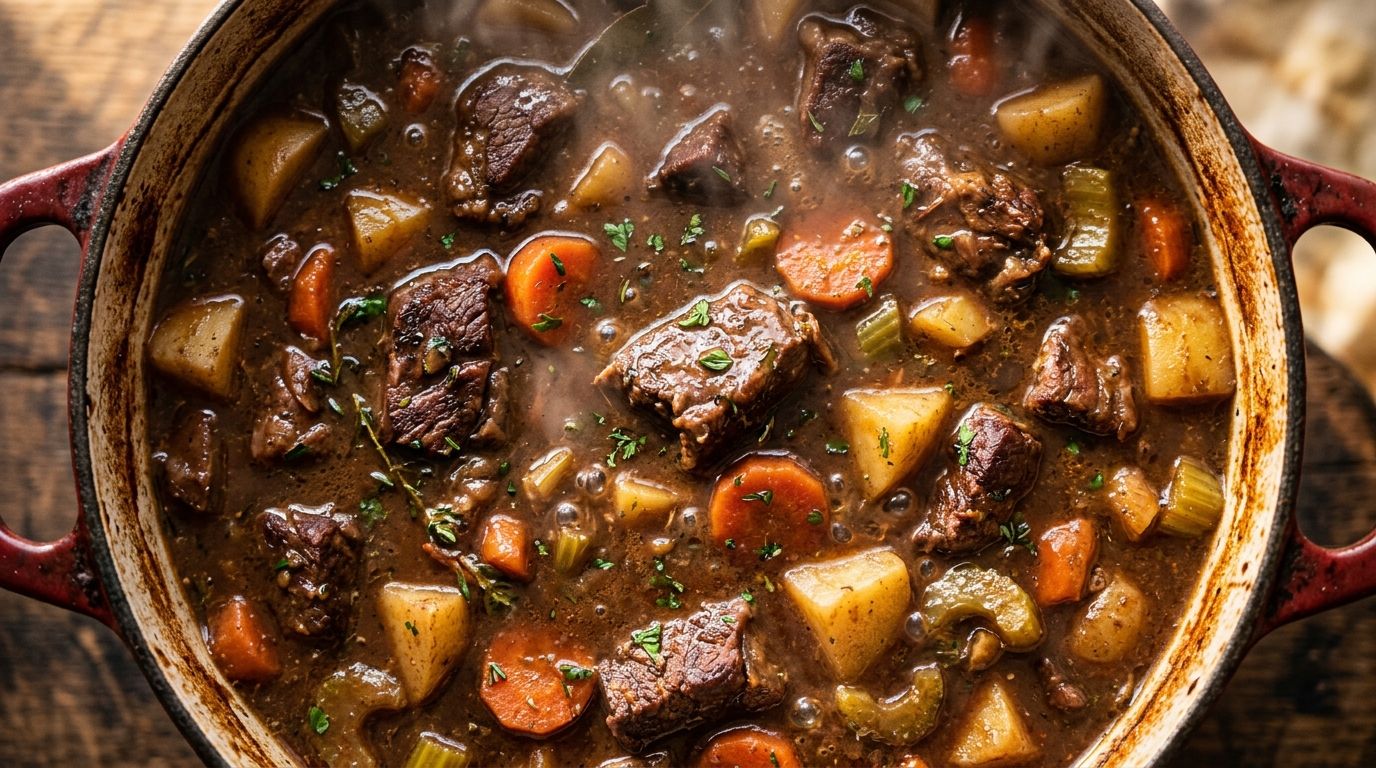
Dutch oven beef stew is the Sunday recipe I come back to every cold month. Chuck roast braises low and slow until the beef pulls apart with a fork. The Dutch oven holds heat evenly so the gravy thickens into something rich and deep without any cornstarch shortcuts.
Prep Time: 20 minutes
Cook Time: 2 hours 15 minutes
Total Time: 2 hours 35 minutes
Servings: 6
Method: Oven
Why This Dutch Oven Beef Stew Works
Chuck roast is the right cut. It has enough intramuscular fat and collagen to break down over a long braise and turn the cooking liquid into a thick, velvety gravy. Lean cuts like sirloin stay tough no matter how long they cook.
Browning the beef first is not optional. The sear builds a dark crust on each chunk and leaves fond on the bottom of the Dutch oven. That fond is scraped up with wine or broth and becomes the base layer of flavor for the entire stew.
Finishing in the oven at 325°F (163°C) means even, all-around heat with no hot spots. The Dutch oven lid traps steam and creates a self-basting environment. The beef stays moist and the vegetables soften without going mushy.
Ingredients
- 2.5 lbs (1.1kg) beef chuck roast, cut into 1.5-inch chunks
- 3 tablespoons all-purpose flour
- 3 tablespoons olive oil, divided
- 1 large yellow onion, cut into chunks
- 4 cloves garlic, minced
- 3 medium carrots, cut into large chunks
- 3 medium Yukon Gold potatoes, cut into large chunks
- 2 stalks celery, sliced
- 2 cups (480ml) beef broth
- 1 cup (240ml) dry red wine
- 2 tablespoons tomato paste
- 1 teaspoon dried thyme
- 1 bay leaf
- Salt and black pepper to taste
- Fresh parsley for garnish (optional)
What You Need for Dutch Oven Beef Stew
Beef chuck roast — the best cut for stew. Cut it yourself from a whole chuck rather than buying pre-cut stew meat. The chunks stay more uniform and cook more evenly. Aim for 1.5-inch pieces — too small and they fall apart completely, too large and the center takes forever to get tender.
All-purpose flour — toss the beef in it before searing. The flour browns in the pan and thickens the gravy as it braises without any starch added at the end. It gives a smoother texture than a slurry added late.
Dry red wine — Cabernet Sauvignon or Merlot both work well. The wine deglazes the browned fond and adds a savory depth that beef broth alone cannot replicate. If you skip it, add an extra cup of broth and a splash of red wine vinegar.
Tomato paste — two tablespoons add a concentrated umami base that rounds out the bitterness of the wine. Cook it in the pot for 1 minute before adding liquid to deepen the flavor.
Yukon Gold potatoes — they hold their shape better than russets during a long braise. Russets can turn mealy and dissolve into the stew. Yukon Golds stay intact and add a buttery flavor.
How to Make Dutch Oven Beef Stew
- Preheat oven to 325°F (163°C).
- Pat beef dry with paper towels. Season well with salt and pepper.
- Toss beef chunks in flour until evenly coated. Shake off excess.
- Heat 2 tablespoons olive oil in a Dutch oven over medium-high heat.
- Brown beef in batches for 3 to 4 minutes per side until a deep crust forms. Do not crowd the pan. Remove to a plate.
- Add remaining 1 tablespoon oil. Add onion and celery. Cook for 3 minutes until softened.
- Add garlic and tomato paste. Cook for 1 minute, stirring constantly.
- Pour in red wine. Scrape all browned bits from the bottom with a wooden spoon.
- Add beef broth, thyme, and bay leaf. Stir to combine.
- Return browned beef to the pot. Nestle in carrots and potatoes around the beef.
- Bring to a simmer on the stovetop. Cover with lid and transfer to oven.
- Braise for 2 hours until beef is fork-tender and gravy has thickened.
- Remove bay leaf. Taste and adjust salt. Serve with fresh parsley if desired.
Dutch Oven Beef Stew Variations
Stovetop Dutch Oven Version
Keep the lid on and simmer over the lowest heat setting for 2.5 hours instead of transferring to the oven. Stir every 30 minutes to prevent sticking on the bottom. The result is the same tender beef, just with slightly less even heat distribution.
Guinness Beef Stew
Swap the red wine for 1 cup of Guinness Stout. The dark beer adds a malty, slightly bitter note that pairs especially well with root vegetables. Add 1 teaspoon of Worcestershire sauce to deepen the savory base.
Paleo and Whole30 Version
Skip the flour and wine. Thicken the stew by adding 1 diced parsnip in Step 10 — it breaks down during the braise and naturally thickens the liquid. Use arrowroot starch mixed with cold water as a slurry at the end if the gravy is still too thin.
Slow Cooker Version
Complete Steps 2 through 9 on the stovetop. Transfer everything to a slow cooker and cook on low for 8 hours or high for 4 hours. Add the potatoes and carrots in the last 2 hours on low so they do not turn mushy.
Tips for the Best Dutch Oven Beef Stew
- I always dry the beef thoroughly before flouring it — surface moisture prevents browning and the crust won’t form.
- Brown in batches with space between pieces. Steaming instead of searing is the number one reason stew lacks depth.
- Do not skip the tomato paste step. Cooking it directly in the pot for 1 minute before adding liquid removes the raw taste and deepens the color of the gravy.
- Add carrots and potatoes after the first hour if you want them to hold their shape better. Adding them at the start means very soft vegetables by the end.
- The stew is better the next day. Refrigerate overnight and reheat slowly — the flavors meld and the gravy thickens further.
- If the gravy is too thin at the end, remove 1/4 cup of liquid, mix with 1 tablespoon of cornstarch, and stir it back in over medium heat for 2 minutes.
Make Ahead & Storage
Dutch oven beef stew keeps in the fridge for up to 4 days in an airtight container. The flavor genuinely improves overnight as the collagen from the beef fully sets into the gravy. Reheat in a covered pot over medium-low heat with 2 tablespoons of water to loosen.
To freeze, cool completely and portion into zip bags or airtight containers. Freeze for up to 3 months. Lay bags flat to save space in the freezer. Thaw overnight in the fridge and reheat slowly on the stovetop. The vegetables may be softer after freezing but the beef and gravy hold up very well.
Common Questions
What cut of beef is best for dutch oven beef stew?
Chuck roast is the best choice. It has the right amount of fat and connective tissue to become tender and enrich the gravy during a long braise. Brisket and short ribs also work. Avoid lean cuts like round or sirloin — they tighten and stay tough no matter how long they cook.
Do I need wine for dutch oven beef stew?
No. Wine adds depth but it is not required. Substitute with an equal amount of extra beef broth plus 1 tablespoon of red wine vinegar and 1 teaspoon of Worcestershire sauce to replace the acidity and complexity.
Why is my beef stew tough after 2 hours?
The most common reason is that the oven temperature is too high. Above 325°F the collagen in the chuck does not have time to convert to gelatin — it just contracts. Keep the oven at 325°F (163°C) and give it the full 2 hours. The beef should pull apart easily with a fork.
Can I make dutch oven beef stew without a Dutch oven?
Yes. Use any heavy oven-safe pot with a tight-fitting lid. A large stainless steel pot or enameled braiser works. The key is a heavy base and a lid that seals well to trap steam during the oven braise.
How do I thicken dutch oven beef stew?
The flour coating on the beef thickens the stew during the braise. If it is still too thin at the end, mix 1 tablespoon of cornstarch with 2 tablespoons of cold water and stir it into the simmering stew over medium heat. It thickens within 2 minutes.
This dutch oven beef stew is the cold-weather recipe worth making on a Sunday afternoon. Save this recipe and pull it out the next time the temperature drops.
Homemade Dutch Oven Beef Stew Recipe From Scratch
A slow-braised chuck roast stew with root vegetables in a thick, rich red wine gravy — cooked low and slow in the oven.
Ingredients
- 2.5 lbs (1.1kg) beef chuck roast, cut into 1.5-inch chunks
- 3 tablespoons all-purpose flour
- 3 tablespoons olive oil, divided
- 1 large yellow onion, cut into chunks
- 4 cloves garlic, minced
- 3 medium carrots, cut into large chunks
- 3 medium Yukon Gold potatoes, cut into large chunks
- 2 stalks celery, sliced
- 2 cups (480ml) beef broth
- 1 cup (240ml) dry red wine
- 2 tablespoons tomato paste
- 1 teaspoon dried thyme
- 1 bay leaf
- Salt and black pepper to taste
- Fresh parsley for garnish (optional)
Instructions
- Preheat oven to 325F (163C).
- Pat beef dry with paper towels. Season well with salt and pepper.
- Toss beef chunks in flour until evenly coated. Shake off excess.
- Heat 2 tablespoons olive oil in a Dutch oven over medium-high heat.
- Brown beef in batches for 3 to 4 minutes per side until a deep crust forms. Do not crowd the pan. Remove to a plate.
- Add remaining 1 tablespoon oil. Add onion and celery. Cook for 3 minutes until softened.
- Add garlic and tomato paste. Cook for 1 minute, stirring constantly.
- Pour in red wine. Scrape all browned bits from the bottom with a wooden spoon.
- Add beef broth, thyme, and bay leaf. Stir to combine.
- Return browned beef to the pot. Nestle in carrots and potatoes around the beef.
- Bring to a simmer on the stovetop. Cover with lid and transfer to oven.
- Braise for 2 hours until beef is fork-tender and gravy has thickened.
- Remove bay leaf. Taste and adjust salt. Serve with fresh parsley if desired.