
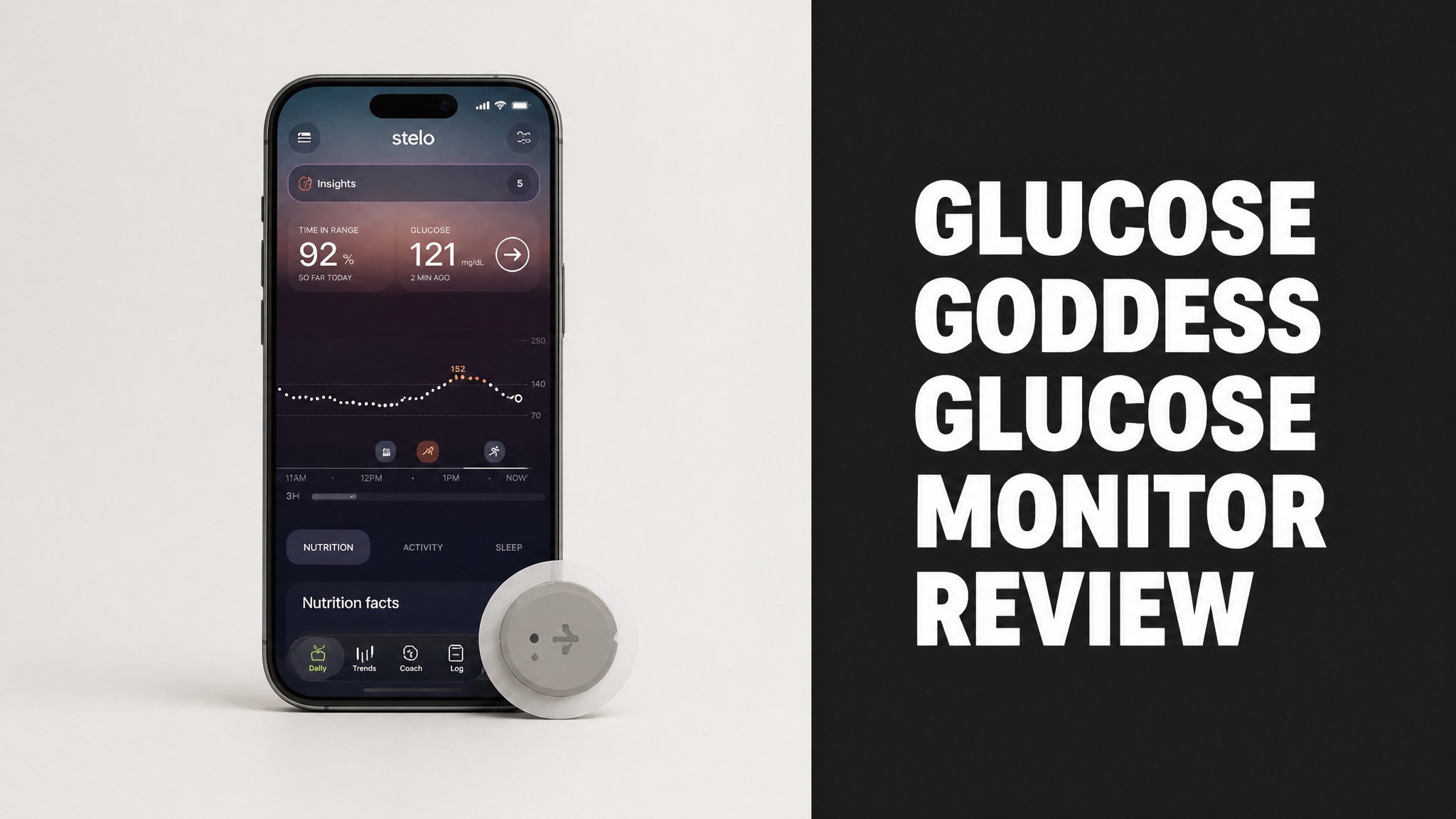
The Glucose Goddess glucose monitor is the Stelo biosensor by Dexcom, the over-the-counter CGM that biochemist Jessie Inchauspé recommends. Stelo launched in August 2024 and needs no prescription. Inchauspé is a paid Stelo ambassador, so her praise needs independent checking by readers.
Stelo tracks glucose for 15 days per sensor and flags spikes in a simple app. Reviewers praise the easy setup and clear data. They also report lost connections, battery drain and no low-glucose alerts. The price runs $84 to $99 (USD) per month. The accuracy claim rests on Dexcom data, not an independent study. Critics add that healthy people rarely need one.
The monitor suits adults with prediabetes or type 2 diabetes who skip insulin. Healthy users get less value and may feel anxious about their numbers. Read on for reviews, safety, cost, alternatives and the final verdict on whether Stelo deserves a place on the arm of a healthy adult.
What Is the Glucose Goddess Glucose Monitor?
The Glucose Goddess glucose monitor is the Stelo Glucose Biosensor by Dexcom, the sensor Jessie Inchauspé names as her favorite. Stelo is a continuous glucose monitor (CGM) that pairs with a phone app. It tracks glucose around the clock. Buyers need no prescription, and adults with or without diabetes can wear it. The sensor works with a phone.
To be clear, Glucose Goddess does not sell its own monitor. Inchauspé tested sensors since 2019 and picked Stelo after months of trials. Did she do it for free? No, she is now a paid Stelo ambassador.
Quick Facts:
| Detail | Stelo by Dexcom |
|---|---|
| Type | Over-the-counter CGM |
| Wear time | 15 days per sensor |
| Minimum age | 18 years |
| Launch | August 2024 |
Who Makes the Glucose Goddess Glucose Monitor?
Dexcom makes both the Stelo sensor and the Stelo app. The company is a long-standing name in glucose monitoring technology. Inchauspé calls Dexcom ‘the OG’ of the field. She says millions of people already trust its devices. Dexcom built Stelo for adults who do not use insulin and want simple data. The brand focuses on glucose tracking for everyday users.
Here’s the thing: Stelo launched in August 2024. Is it the first of its kind? Yes. DiaTribe describes it as the first over-the-counter CGM in the U.S. Why does that matter? The FDA cleared it, so no prescription gate stands in the way.
How Does the Glucose Goddess Glucose Monitor Work?
The Stelo system measures glucose in the fluid just under the skin and sends each reading to a smartphone app. A small sensor sticks to the skin. The app on a smart device displays and stores every reading, as GoodRx explains. The system has two parts: the sensor and the app. Readings appear on the phone. Pairing takes only a few minutes after the warm-up.
Here’s why timing matters: the sensor needs a warm-up after application. Reviewer Anna Brooks reports about 30 minutes. In fact, Brooks found the first day a bit buggy, so early readings looked odd.
Setup Steps:
- Install the Stelo app on a compatible phone.
- Apply the sensor to the skin.
- Wait for the warm-up period to finish.
- Check readings in the app throughout the day.
- Replace the sensor after 15 days.
What Does the Stelo App Show?
The Stelo app shows real-time glucose levels and flags every spike. Inchauspé praises the layout as simple and clear. She says it tells her exactly what is happening with her glucose. The screen has no clutter and no extra features to learn. Beginners can read it within minutes. The design favors quick checks over dense charts and long reports.
What’s more, after each spike, the app asks the wearer to tag a cause. Choices are food, exercise or stress. Why does that matter? The tags turn raw numbers into a food diary that shows which meals cause the biggest jumps.
What Are the Benefits of the Glucose Goddess Glucose Monitor?
The Stelo monitor delivers round-the-clock glucose data without a prescription and without any need for insulin. Inchauspé lists the benefits as easy access, a clear app, a 15-day sensor, an affordable price and the Dexcom name. Those five points drive her recommendation. Together they make the monitor easy to start and simple to keep wearing.
Main Benefits:
- No prescription needed
- Designed for people not on insulin
- Simple, clear app
- 15 days of wear per sensor
- Built by Dexcom
Does the Glucose Goddess Glucose Monitor Show Glucose Spikes?
Yes. The Stelo app detects glucose spikes and alerts the wearer when glucose rises sharply after a meal. Inchauspé calls this tracking core to her daily habits. Live data keeps her consistent with her routine. The spike alert is the headline feature of the whole Stelo app. A live spike links straight to a meal. Spikes show clearly on the graph.
Pay attention to this: in the short term, she links spikes to energy crashes, cravings and brain fog. Does the science back every claim? Not fully, and the critics below push back hard.
Does the Glucose Goddess Glucose Monitor Support the Glucose Goddess Hacks?
Yes. The Stelo sensor lets a wearer test the hacks against a live glucose curve. A savory breakfast and a vinegar drink are two examples. Stelo says it confirmed four of Inchauspé’s hacks in her own data, shown in real time. Calf raises after eating are one of them. Seeing the effect on the graph shows which habits move glucose and which do not.
For example, the vinegar hack calls for 1 tablespoon (15 ml) of vinegar. The wearer takes it in a drink or dressing, 20 minutes before a meal. Another hack adds protein, fat or fiber to carbs. Sound simple? It is.
What Do Glucose Goddess Glucose Monitor Reviews Say?
Reviews of the Stelo monitor are mostly positive on ease of use and mixed on long-term value. Value is weaker for people without diabetes. The diaTribe team wore Stelo for two weeks. Their notes cover app clarity, battery drain, lost connections and data access. Reviewers praise the setup but flag recurring problems. Findings vary by wearer type.
Reviewer Verdicts:
| Reviewer | Main Pro | Main Con |
|---|---|---|
| Jim Carroll | Actionable data | No data access after use |
| Alex Cameron | Easy application | Battery drain, connection issues |
| Matthew Garza | Simple, educational | App may be too simple |
| Anna Brooks | Interactive, easy to use | No low-glucose data |
What Do Users Like About the Glucose Goddess Glucose Monitor?
Users praise the painless application, the clear app and the useful educational content. The educational material explains what the sensor measures. Alex Cameron expected the sensor to hurt and thought the application had failed. It hadn’t. Jim Carroll found the data easy to act on. Garza called the educational content a huge plus for new CGM wearers.
The good news? Carroll saw how food, exercise, sleep and stress changed glucose. The result? Strong motivation to spend more time in range. Garza also valued the educational material.
What Are the Common Complaints About the Glucose Goddess Glucose Monitor?
Common complaints include lost connections, battery drain, early sensor failure and lost data. Data disappears once the wear period ends. Cameron lost signal even near the phone. Garza’s sensor ripped off early, and a backup was not easy to get. Each issue shows up in the diaTribe reviews. Brooks also noted that the app tracks no time below range.
The bad news? Carroll lost access to data once the 14 days ended. Sustaining the new habits got harder afterward. Brooks also wished for time-below-range numbers.
Is the Glucose Goddess Glucose Monitor Accurate?
Dexcom claims strong accuracy for Stelo, and Inchauspé repeats that claim. The sources reviewed here include no independent accuracy study. Stelo’s site cites Dexcom data on file from 2024. The claim rests on company numbers. Wearers should read it as a manufacturer statement and nothing more. Independent testing would settle the question for good.
Short answer: real-world use varies. Brooks saw odd readings on day one, such as a rise during a brisk walk. Do sensors settle after day one? Often, yes. A wearer should still expect some early noise.
Is the Glucose Goddess Glucose Monitor Safe and Legit?
Yes. The Stelo monitor is a real FDA-cleared device from an established manufacturer. The hardware itself is legit. DexCom announced the clearance in 2024. The FDA calls it the first over-the-counter CGM. Debate surrounds the hype and the influencer, not the device. Wearers still need to weigh their own health history. Safety depends on the wearer.
Think of it this way: safety concerns are mostly behavioral. Dietitians warn that constant tracking can push some users toward anxiety and food rules. In fact, Brooks felt guilty over one sip of lemonade after seeing the spike.
Who Should Be Careful:
- People with a history of disordered eating
- Anyone who uses insulin
- Wearers who become anxious about numbers
- Anyone under age 18
Who Should Avoid the Glucose Goddess Glucose Monitor?
People with a history of disordered eating or obsessive tracking habits should avoid the Stelo monitor. Dietitian Sophie Corbett notes a rise in anxiety about spikes among clients without diabetes. Corbett calls CGM use unnecessary for anyone without a glucose condition. She also cites no firm evidence that small fluctuations harm healthy people.
Stelo targets adults who do not use insulin. Users on insulin need a device with low-glucose alerts. Stelo shows no data below 70 mg/dL (3.9 mmol/L), so it cannot warn of lows.
Is Jessie Inchauspé Paid to Promote the Glucose Goddess Glucose Monitor?
Yes. Stelo labels Inchauspé a paid ambassador on its own Glucose Goddess page. She names the ambassador role in her blog post as well. Readers should weigh her praise with that link in mind. Paid praise is not proof of performance, and independent reviews matter more. The disclosure appears openly, which lets readers judge the endorsement for themselves.
By comparison, critics question her wider claims too. McGill’s Office for Science and Society argues that she medicalizes normal glucose rises. Abby Langer criticized her Anti-Spike supplement, which sells for $65 (USD) per bottle.
How Much Does the Glucose Goddess Glucose Monitor Cost?
The Stelo monitor costs between $84 and $99 (USD) per month, depending on the subscription plan. McGill’s Office for Science and Society reports this range. The sensor lasts 15 days, so the subscription model delivers fresh sensors on schedule. Buyers should confirm current pricing. Buyers should confirm current pricing. Plans differ by length.
Cost Snapshot:
| Item | Detail |
|---|---|
| Monthly cost | $84 to $99 (USD) |
| Sensor life | 15 days |
| Prescription | Not required |
Is the Glucose Goddess Glucose Monitor Worth the Price?
No, not for everyone. The Stelo monitor pays off for people with prediabetes or type 2 diabetes who want a simple, lower-cost CGM. Reviewers agree that this group gets the clearest value from the data. Healthy users see less benefit, and the monthly cost adds up. Healthy users pay the same amount for less benefit than people with a glucose condition.
The reason is simple: Garza says a healthy body already manages glucose, so little needs changing. Is a trial pointless? Not at all. Two weeks can still show how meals affect personal numbers.
Where to Buy the Glucose Goddess Glucose Monitor?
Buyers can order the Stelo monitor directly from Stelo. At least one major retailer also carries a listing. Inchauspé’s blog links to a Discover Stelo page. A Walmart listing for the Stelo biosensor shows customer reviews. Check current stock and price before ordering. The official site is the safest place to start. Prices may change without notice.
Where to Look:
- Stelo official website
- Walmart product listing
- Links from the Glucose Goddess blog
Does the Glucose Goddess Glucose Monitor Need a Prescription?
No. The Stelo monitor is sold over the counter, so buyers need no prescription to start. GoodRx lists the availability as over-the-counter. Inchauspé names this as a top reason she picked it over older sensors. Those older sensors required a doctor’s order first. The ruling matters because many sensors in this category still need a doctor’s note.
Adults aged 18 and older can use it, with or without diabetes. App compatibility varies by phone. Stelo points buyers to its compatibility page before purchase.
How Does the Glucose Goddess Glucose Monitor Compare to Dexcom G6 and FreeStyle Libre 3?
Stelo trades advanced features for simplicity, a lower price and over-the-counter access. The alternatives offer deeper data. GoodRx lists Dexcom G6 and FreeStyle Libre 3 as alternatives. Those devices usually serve people with diabetes and come through a prescription. Each fits a different buyer. Stelo targets adults who skip insulin. Pick by need.
Comparison:
| Device | Best For | Access |
|---|---|---|
| Stelo | Non-insulin users | Over the counter |
| Dexcom G6 | Detailed diabetes management | Prescription |
| FreeStyle Libre 3 | Detailed diabetes management | Prescription |
Does the Glucose Goddess Glucose Monitor Alert for Low Blood Sugar?
No. The Stelo monitor does not alert for low blood sugar. It shows no data below 70 mg/dL (3.9 mmol/L), and diaTribe lists that as a main drawback. Anna Brooks flagged the same missing time-below-range data. For some wearers, that gap is a dealbreaker, especially anyone with a history of low readings. Low readings stay invisible to the wearer.
Now here is the thing: Garza has used both the Dexcom G6 and Stelo. Stelo felt super simplified. That helps beginners avoid overload, but it frustrates anyone who wants deeper reports.
Should You Try the Glucose Goddess Glucose Monitor?
Yes. Adults with prediabetes or type 2 diabetes who skip insulin get real value from the Stelo monitor. The app is clear, access is easy and the price beats many CGMs. Healthy users should treat it as a short experiment, not a lifelong habit. Weigh the monthly cost first. Independent reviewers back that view. Weigh the monthly cost first, too.
Bottom line: Stelo is a solid, simple sensor. The weak points are lost connections, no low alerts and data that vanishes after wear. The Glucose Goddess endorsement is paid, so the independent reviews matter more.
Who Gets the Most Value From the Glucose Goddess Glucose Monitor?
People at risk of diabetes or living with prediabetes get the most value from the Stelo monitor. The sensor can surface abnormal glucose patterns early. Brooks and Garza both say a CGM can help spot problems sooner. Only a blood test from a licensed professional gives a diagnosis. That early warning is the strongest case for wearing the monitor.
Healthy users get less. And that’s fine. Their pancreas already controls glucose well. Does constant tracking help them? For most, probably not. A two-week trial can reveal patterns, but long-term wear rarely changes much.