
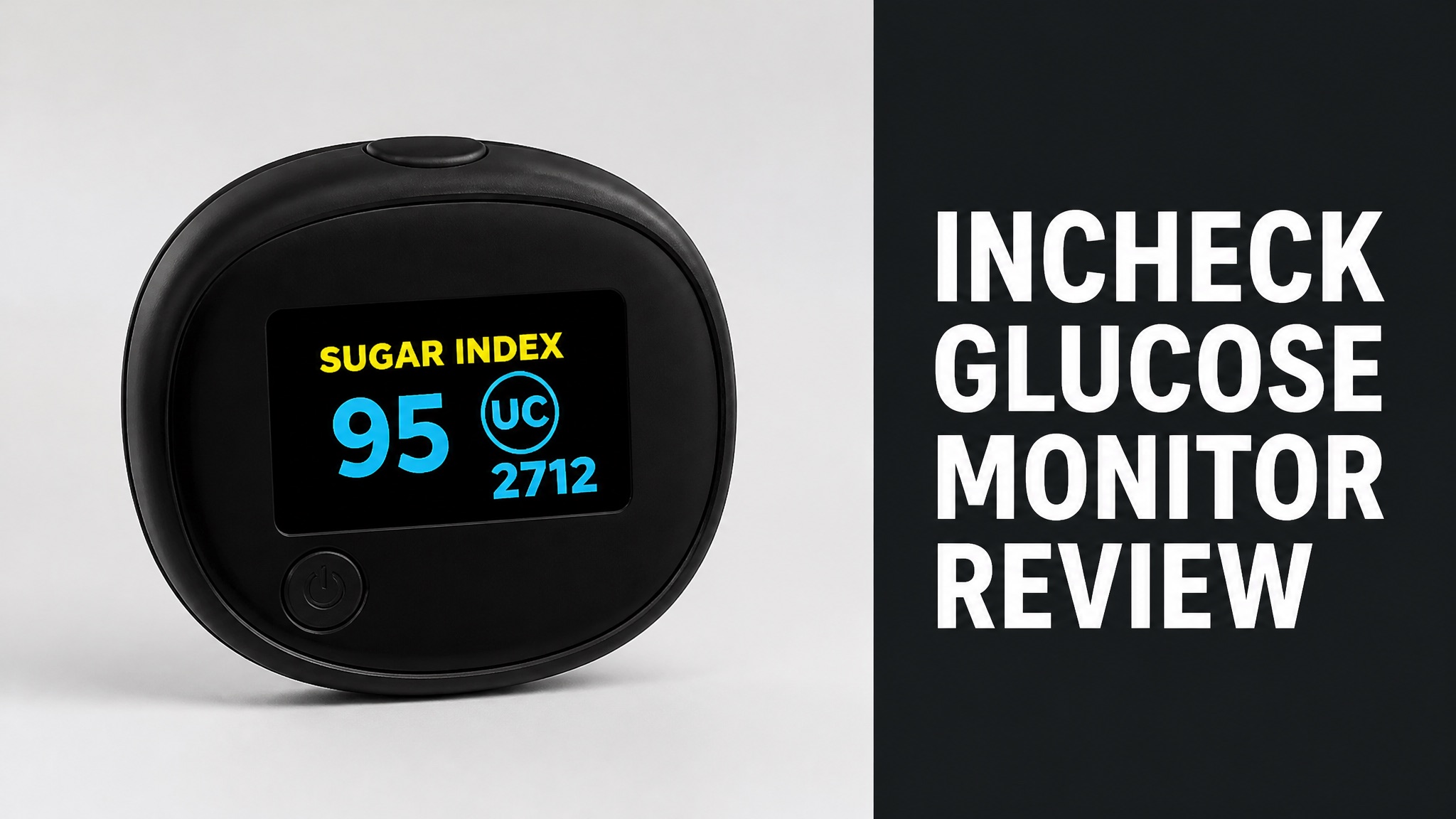
The InCheck glucose monitor is a non-invasive device from Agatsa Software in India. It estimates blood sugar from a light signal, without a finger prick. A 2024 hospital study tested it on 1,223 readings against lab results. Those results matter to every buyer who hopes to skip the needle.
The device uses photoplethysmography to read blood glucose. The study found it overshoots lab values in most tests. Only 18.5% of readings met ISO limits, and 67.25% landed in the safest error grid zones. Regulators in the US and Europe warn against non-invasive meters. No FDA clearance appears in any source we checked. Each section below covers one point.
Accuracy decides whether a glucose monitor helps or harms. The InCheck results show a gap between promise and proof. Read on for the study data and the health risks. Learn who should avoid the device and which cleared options work better. Every claim here comes from published evidence.
What Is the InCheck Glucose Monitor?
The InCheck glucose monitor is a non-invasive device from Agatsa Software in India that estimates blood sugar without a prick. The maker sold it on its own website during an early testing phase. Buyers sent in readings from the device and from their usual meters. The company used them to compare results. The device is aimed at home users. Use is at home.
In plain English, the device reads a light signal from the body. The screen shows a glucose number within seconds. Think of it as a gadget that promises a meter without blood, strips or lancets.
How Does the InCheck Glucose Monitor Work?
The InCheck monitor uses photoplethysmography (PPG), an optical method that tracks how blood absorbs light. A proprietary algorithm turns that signal into a glucose number. The device needs only a few seconds per reading. Researchers call it a non-invasive home glucose monitor because it needs no blood, no needle and no test strip. A screen shows it.
PPG sensors already measure heart rate, blood pressure and oxygen saturation. So the sensor itself is not new. Estimating glucose from the same signal is the hard part. Why? Blood sugar absorbs light differently, and the algorithm must separate that effect from noise.
How a Reading Works:
- The user places a finger on the optical sensor
- The sensor records the light signal from the blood
- The proprietary algorithm converts the signal into a glucose estimate
- The screen shows the number within a few seconds
Does the InCheck Glucose Monitor Work?
No. The InCheck glucose monitor failed to meet ISO or FDA accuracy standards in the only published clinical test. Researchers compared 1,223 device readings with laboratory glucose results. Only 18.5% of the device readings fell within the ISO 15197:2013 limits. The authors said the device does not follow the recommended guidelines for home use. Year: 2024.
Short answer: the numbers drift too far from the lab truth. Does that matter for a casual check? Yes, because people use these numbers to decide on food and insulin. A wrong number leads to a wrong decision.
Is the InCheck Glucose Monitor Accurate?
No. The InCheck monitor reads higher than the lab: 187 mg/dL (10.4 mmol/L) versus 148 mg/dL (8.2 mmol/L). That gap was statistically significant. The average gap was 39 mg/dL. The gap had a P value below 0.0001. The device read higher in 1,014 of 1,223 pairs. The device read lower in 206 pairs and matched the lab in just three. Readings were mostly too high.
Here’s the thing: the device overshot in about 83% of tests. It read lower in 206 pairs and matched the lab in just three. To be clear, a monitor that reads too high can hide a real problem.
Accuracy Results:
| Measure | Required | InCheck Result |
|---|---|---|
| ISO 15197:2013 limits | 95% of readings | 18.5% |
| Consensus error grid, zones A and B | 99% of readings | 67.25% |
| Within 20% of reference (FDA) | 99% of readings | 22.5% |
| Readings beyond 20% | 1% or less | 77.5% |
The table shows the gap clearly. The FDA expects 95% of readings within 15% and 99% within 20%. How far below sits InCheck? Far under both marks. Bottom line: the device is nowhere near the pass line.
Is the InCheck Glucose Monitor Safe?
No. The InCheck monitor is harmless to touch, but its wrong readings create real health risk for people with diabetes. The study sorted every reading by clinical risk on the surveillance error grid. Only 29.4% of readings fell in the no-risk zone. The other readings carried some level of risk, from slight to severe. Risk rose with every wrong reading.
Let me break that down: 51.8% landed in slight risk and 18.6% in moderate risk. Another 0.2% hit the severe zone. What does that mean in practice? A user who trusts a high reading may skip food or take too much insulin.
What Do InCheck Glucose Monitor Reviews Say?
InCheck glucose monitor reviews come mainly from a clinical study, because few independent consumer reviews of the device exist. The best evidence is a peer-reviewed paper from 2024. Himel Mondal and colleagues published it in the Indian Journal of Endocrinology and Metabolism. The paper is the first accuracy check against plasma glucose. Data fills in.
In fact, no major retailer review pool appears in search results. Why does that matter? Missing user feedback means buyers have no real-world track record to check. The study is the main source.
What Did the Clinical Study Find?
The study tested InCheck on 1,223 paired readings from 728 men and 495 women with type 2 diabetes. A tertiary care hospital in Jharkhand ran it from June to December 2022. Laboratory glucose served as the reference point. The monitor was compared with that lab value for every patient sample in the trial. Each patient gave three device readings per test.
The authors concluded that the device does not follow recommended guidelines. They called for redesigned hardware and software. What’s more, they excluded patients with nail color changes, finger pigmentation or vascular disease, so real use could look worse. Would that change the verdict? Only for the worse.
Surveillance Error Grid Risk Levels:
| Risk Level | Readings | Share |
|---|---|---|
| None | 360 | 29.4% |
| Slight | 633 | 51.8% |
| Moderate | 227 | 18.6% |
| Severe | 3 | 0.2% |
Here is the part most people miss: more than half of all readings carried at least a slight risk. Roughly one in five carried a moderate one. A glucose meter should keep those shares near zero.
What Do Regulators Say About Non-Invasive Glucose Meters?
Regulators warn that no non-invasive glucose meter is proven reliable enough for diabetes care. Belgium’s FAMHP said in October 2025 that no such product on the European market measures blood sugar safely. The agency named smartwatches, rings and finger meters as examples of devices that make this claim. Users said values did not match their meters.
The FDA issued a safety notice in February 2024 against smartwatches and rings that claim to measure glucose. The good news? Researchers keep working on the problem. The bad news? Nothing is ready yet.
How Does the InCheck Glucose Monitor Compare to Standard Monitors?
The InCheck monitor trades blood testing for convenience, but standard meters and CGMs offer far better accuracy. Fingerstick meters use a drop of blood on a test strip. Continuous glucose monitors (CGMs) use a small sensor under the skin. Both are cleared devices with proven accuracy standards. Cleared options exist with proven accuracy standards.
Think of it this way: pain-free sounds great until the number is wrong. Is that a fair trade? Not here. Both standard options cause some discomfort, and CGM sensors need regular replacement. Still, cleared devices have passed safety and effectiveness review.
What Are the Alternatives to the InCheck Glucose Monitor?
Diabetes experts recommend an FDA-cleared glucometer or continuous glucose monitor over any non-invasive device. GoodRx states that these tools have been evaluated by the FDA for safety and effectiveness. Smartwatches and smart rings do not hold that clearance. Patients who want pain-free testing must wait for proven technology. Ads are not clinical proof.
Researchers are also testing microneedle patches. A University of Calgary team is building a low-cost patch with needles shorter than a millimetre (0.04 inch). The work is still in development, so patients cannot buy it yet.
Option Comparison:
| Option | Method | Regulatory Status |
|---|---|---|
| InCheck monitor | Optical PPG signal | No FDA clearance found |
| Fingerstick meter | Blood drop on strip | FDA-cleared options exist |
| CGM | Sensor under the skin | FDA-cleared options exist |
Is the InCheck Glucose Monitor Legit?
No. The InCheck glucose monitor is a real product, but it has not earned trust as a reliable glucose meter. Agatsa Software exists and the device is documented in a medical journal. The same journal paper found that it fails accepted accuracy rules. A real product is not the same as a validated medical device. Trust comes from tests. Look closer. Be wary.
To be clear, real does not mean reliable. Is a device legit if it cannot pass the basic test? Not for managing diabetes. Treat any reading as a rough guess, not a medical measurement.
Is the InCheck Glucose Monitor FDA Approved?
No. The InCheck monitor has no FDA approval, clearance or authorization in any source reviewed. The FDA has not authorized, cleared or approved any smartwatch or smart ring that estimates blood glucose. Non-invasive devices remain uncleared. The agency issued a safety notice about them in February 2024. Not cleared. Safety notice issued. Nothing is cleared.
In Europe, the FAMHP says non-invasive meters lack a valid four-digit CE mark. The mark shows an independent body tested the device. Without it, the devices cannot be legally sold there.
Who Should Avoid the InCheck Glucose Monitor?
Anyone who makes medical decisions from glucose numbers faces real danger from the InCheck glucose monitor. People on insulin carry the highest risk. A false high reading can trigger too much insulin and cause low blood sugar (hypoglycaemia). A single wrong number at the wrong moment can turn a normal day into an emergency. Accuracy matters then. Be careful.
The reverse risk is just as real. A false low reading can lead to too little insulin. Over time, high blood sugar damages the eyes, kidneys and heart. Who else needs caution? Anyone with a diabetes diagnosis should use a cleared meter.
People Who Should Avoid It:
- People with diabetes who adjust insulin doses
- People who need to catch low blood sugar quickly
- Anyone who plans to replace a cleared meter
- Patients with finger pigmentation or vascular disease
Should You Buy the InCheck Glucose Monitor?
No. Buying the InCheck glucose monitor carries more risk than benefit for any diabetes decision. The only published test shows poor accuracy and frequent overestimates. Regulators in the US and Europe warn against similar devices. A cleared fingerstick meter or continuous glucose monitor gives patients a safer way to track blood sugar. Choose cleared tools.
Bottom line: a cleared fingerstick meter or CGM is the safer choice. Does a pain-free test justify the risk? No, not with these results. Talk to a healthcare provider before changing how you track blood sugar.