
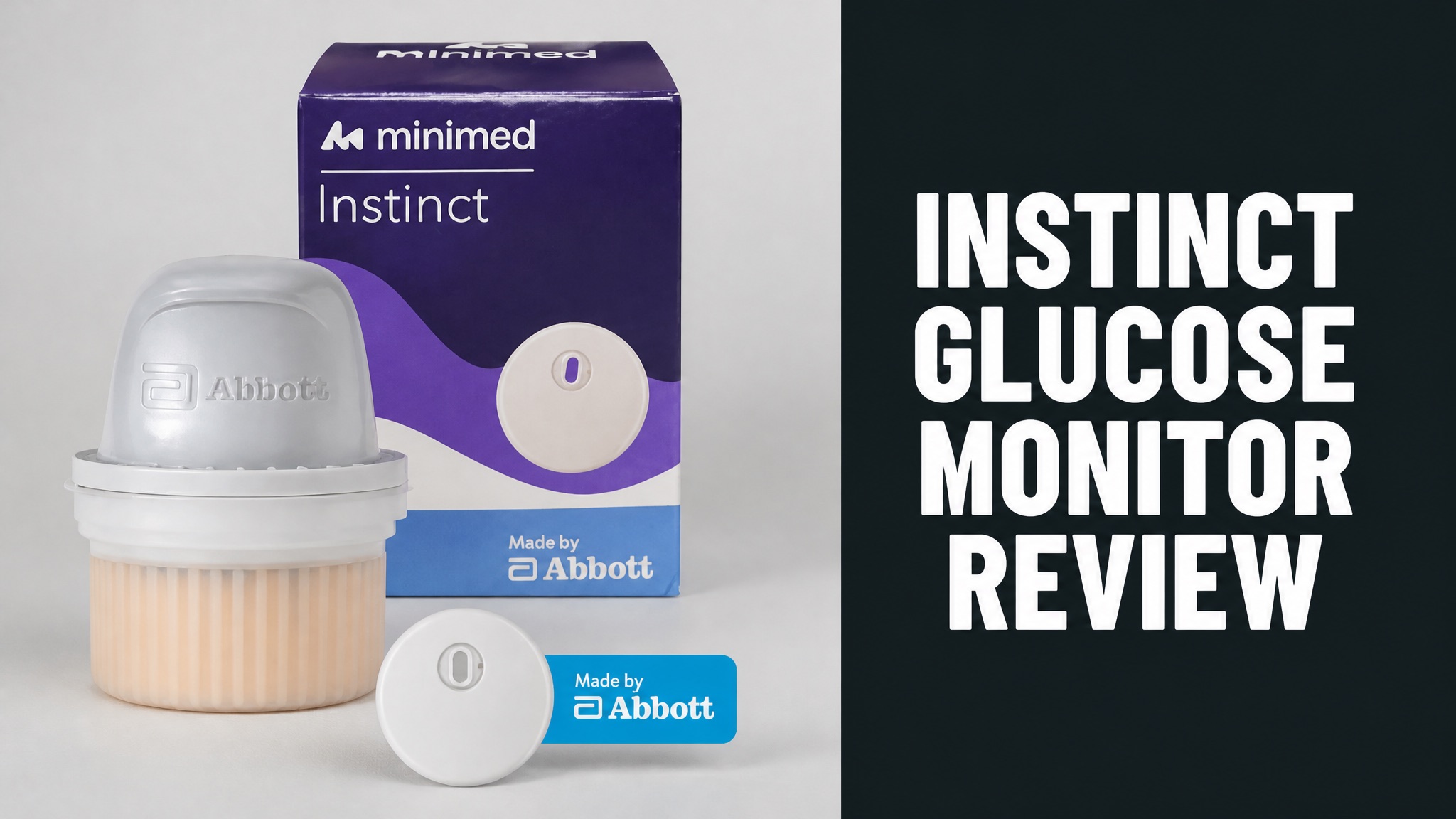
The Instinct glucose monitor is a 15-day CGM that Abbott makes for the MiniMed 780G system. Medtronic began selling it in the United States on September 23, 2025. The sensor reads glucose every 5 minutes and sends the data to the pump. Fingersticks are not needed in closed-loop mode, and it sits on the arm.
The sensor needs a one-hour warm-up and no routine fingersticks. Reviews praise its small flat design and easy self-application. Complaints focus on adhesive strength and limited colors. Compared with Simplera Sync and Guardian 4, Instinct offers the longest wear. Medicare does not cover it, and no retail price is published. Early tone is positive.
The big picture is simple. Instinct trades a closed MiniMed ecosystem for low daily upkeep. Read on for the specs, accuracy, safety cautions, cost and a final verdict on whether the sensor is worth buying for a MiniMed 780G user. Each section answers one buyer question with facts from reviews and sources.
What Is the Instinct Glucose Monitor?
The Instinct sensor is a 15-day continuous glucose monitor that Abbott makes exclusively for the MiniMed 780G system. Medtronic began selling it in the United States on September 23, 2025. The sensor reads glucose every 5 minutes and sends the data straight to the pump. Fingersticks are not needed in closed-loop mode, and the sensor sits on the upper arm.
Key Facts:
- Wear time of up to 15 days
- Warm-up of about one hour
- FDA approved for ages 7 and older
- No routine fingersticks
- Placed on the back of the upper arm
Think of it this way: the sensor feeds the pump, and the pump adjusts insulin. Who is it built for? Adults and children ages 7 and older who use a MiniMed 780G or MiniMed Go system.
Who Makes the Instinct Sensor?
Abbott manufactures the Instinct sensor under a long-term partnership with Medtronic. Diabetech reports that the sensor shares its form factor with the Libre 3 Plus. In fact, Abbott’s Libre platform is the most widely used CGM worldwide, so the hardware has a proven base. Medtronic will soon trade its diabetes business under the MiniMed name as well.
Medtronic sells the product under the MiniMed name. The company calls it the world’s smallest, thinnest and most discreet integrated CGM. To be clear, that claim comes from Medtronic’s own announcement.
Which Devices Work With the Instinct Sensor?
The Instinct sensor pairs with the MiniMed 780G system and the MiniMed Go smart MDI system. ADCES lists both as compatible. The MiniMed Mobile app starts the sensor, and the CareLink Connect app lets caregivers follow the data. Insulin pump users get the full closed-loop benefit. The sensor does not support other brands of insulin pumps today, as listed.
Does it work with the InPen setup? Beyond Type 1 reports no announcement on InPen integration as of October 2025. So, check with a care team before assuming a pairing.
How Does the Instinct Sensor Work?
The Instinct sensor measures glucose through a thin, flexible filament placed just beneath the skin. A reading is taken every 5 minutes and sent wirelessly to the pump. A silver oxide battery powers the transmitter, so the user never charges anything. The transmitter range is 33 feet (10 meters). Alerts appear on the pump screen or a connected smart device.
How the Integration Works:
- The MiniMed 780G pump receives glucose readings from the sensor all day.
- The SmartGuard algorithm calculates insulin needs from those readings.
- The pump delivers background insulin and auto correction boluses up to every 5 minutes.
Here’s how the pump uses that data. The 780G algorithm calculates insulin needs and delivers background insulin plus auto correction boluses. In plain English: the two devices talk all day, and the user does less manual work.
How Do You Apply the Instinct Sensor?
Applying the sensor takes one step with a one-handed applicator. The sensor sits on the back of the upper arm, ideally on the same side as the pump. No overtape is required. One reviewer still used Skin-Tac before application to keep the edges from lifting at the start. Reviewers call the process fast and simple, even for the back of the arm area alone.
Warm-up lasts one hour. Does calibration add work after that? No, readings flow without fingersticks. Best part: Almedina, a MiniMed Champion, says the sensor connects to her pump in under five seconds.
What Are the Instinct Sensor Specs?
The Instinct sensor offers 15 days of wear, a one-hour warm-up, and no routine fingerstick calibration. ADCES lists it for ages 7 and older, and Beyond Type 1 describes it as an all-in-one sensor. There is no separate transmitter to pair, charge or reuse between sensors. Diabetech calls it the smallest CGM in the Medtronic lineup, matching the Libre 3 Plus.
Instinct Sensor Specs:
| Spec | Value |
|---|---|
| Wear time | 15 days |
| Warm-up | 1 hour |
| Size | 0.83 inches (2.1 cm) wide, 0.11 inches (0.28 cm) thick |
| Accuracy (MARD) | 8.2% (ADCES) |
| Age indication | 7 years and older |
| Transmitter range | 33 feet (10 meters) |
Now for the numbers. The sensor measures 0.83 inches (2.1 cm) across and 0.11 inches (0.28 cm) thick. The sensor works between 50 and 113 degrees Fahrenheit (10 to 45 degrees Celsius). Water resistance reaches 3 feet (1 meter) for 30 minutes.
How Accurate Is the Instinct Sensor?
The Instinct sensor reports a mean absolute relative difference (MARD) of 8.2% according to ADCES. DiabetesWise lists about 8.5%. A lower MARD means readings sit closer to a reference value. Both figures point to solid accuracy for a sensor without calibration. DiabetesWise calls it factory calibrated, so backup fingersticks are for mismatched symptoms only.
Do users agree? Almedina says her readings closely match her fingersticks. That’s one person’s experience, though, and individual results vary.
What Do Instinct Sensor Reviews Say?
Early reviews describe the Instinct sensor as small, easy to apply and long lasting. The two detailed user reviews come from MiniMed Champions, who are brand advocates. To be clear, both reviewers have a relationship with the manufacturer, so weigh their praise with that in mind. Overall, the tone is positive, but the sample is small and partly biased.
Independent voices are thinner. TCOYD calls Instinct the lowest maintenance option with the 780G. Diabetech notes that Medtronic’s early feedback splits between Simplera’s shorter wear and Instinct’s longer wear.
What Do Users Like About the Instinct Sensor?
Users praise the 15-day wear, the discreet flat design, and easy self-application. Almedina wore her sensor for 14 to 15 days. Mattie reports steady glucose levels across a full 15 days. The good news? Almedina no longer relies on backup patches to keep the sensor on. Mattie calls the experience even more hands-off than before, a real upgrade for daily use.
Main Praise:
- 15-day wear
- One-hour warm-up
- Small, flat and discreet design
- One-handed self-application
- Fast connection to the pump
Mattie also describes fewer spikes and drops. Does less control mean worse results? Not for her, since fewer swings follow. Checking glucose every 20 minutes is now a thing of the past for her.
What Are the Common Complaints?
Reviewers flag adhesive strength and limited color options as the main weak spots. Almedina wants a stronger adhesive for extended time in water. She also asks for more skin-tone options so the sensor blends in better. The edges lifted slightly the first time she skipped extra tape. Overall, complaints stay mild, and no reviewer reported a serious problem.
Mattie’s wish is different. She wants AI-powered insights, such as gentle trend nudges. Is the sensor flexible? Not much. It works only with MiniMed systems and sits only on the upper arm.
How Does the Instinct Sensor Compare to Simplera Sync and Guardian 4?
Instinct offers the longest wear and the smallest footprint of the three sensors that work with the MiniMed 780G. Beyond Type 1 says it provides more than double the wear time of the others. Simplera Sync lasts up to 6 days, and Guardian 4 lasts up to 7 days. Simplera Sync is about the size of a quarter. Instinct is smaller still and lies flat on the skin.
Medtronic CGM Comparison:
| Feature | Instinct | Simplera Sync | Guardian 4 |
|---|---|---|---|
| Wear time | 15 days | Up to 6 days plus 24-hour grace period | Up to 7 days |
| Warm-up | 1 hour | 2 hours | 2 hours |
| Components | All-in-one sensor | All-in-one sensor | Sensor, transmitter and serter |
| Insertion | One-handed | One-handed | Two-handed |
| Ages | 7+ | 7+ | 7+ |
Why does size matter? A smaller sensor means less bulk under clothing. Guardian 4 is the largest of the three and needs a separate transmitter and a reusable serter.
Is Instinct the Lowest Maintenance Option?
Yes. The Instinct sensor is the lowest maintenance option with the MiniMed 780G, according to TCOYD. It needs fewer insertions, a one-hour warm-up and no overtape. Dr. Jeremy Pettus and Dr. Steve Edelman cover the comparison in their CGM Dating Game video. The sensor also lies flat and needs no charging, which keeps daily upkeep minimal for busy users.
Simplera Sync has a different advantage. Its 7-day change cycle lines up with the 7-day infusion set change. So the best pick depends on the daily routine.
Is the Instinct Sensor Safe?
Yes. The Instinct sensor works within an FDA-cleared pathway for use with the MiniMed 780G system. The FDA cleared the SmartGuard algorithm as an interoperable controller on September 2, 2025. The clearance completed the regulatory pathway for type 1 diabetes. Safety checks replace calibration. Clinical limits still apply, so read the cautions below.
Clinical Considerations:
- Vitamin C above 1,000 mg per day may falsely raise readings
- A 1.5T or 3T MRI is allowed under the insert conditions
- Connected devices stay outside the MRI room
- Readings may be inaccurate for 1 hour after an MRI
- A blood glucose meter settles any mismatch with symptoms
Here is what that means in practice. A Sensor Updating alert shows while the system confirms sensor reliability. The low alert below 55 mg/dL (3.1 mmol/L) cannot be turned off. Neither can the high alert at 250 mg/dL (13.9 mmol/L) lasting 3 hours.
Who Needs to Be Careful With the Instinct Sensor?
People who take high-dose vitamin C risk falsely high sensor readings. ADCES warns that more than 1,000 mg per day may hide a severe low glucose event. Those users need a clinician’s guidance before relying on the sensor for treatment decisions. Check the sensor insert for the full list of conditions before wearing the device in any medical setting.
Anyone scheduled for an MRI also needs a plan. Does the scan harm the sensor? No, but readings may be off for an hour. Remove the connected devices before the scan. And if symptoms don’t match the reading, test with a blood glucose meter.
How Much Does the Instinct Sensor Cost?
The Instinct sensor has no single published retail price in the sources reviewed. DiabetesWise lists affordability without a dollar figure and says coverage depends on insurance policies and Medtronic’s rollout plan. Sensors usually ship in one to three month supplies, which is about 2 to 6 sensors. Prices vary by plan, and coverage drives the real cost.
So, what should buyers do? Ask the MiniMed team and the insurer for a quote. Existing Medtronic customers received priority access through the Innovations Program at launch.
Does Medicare Cover the Instinct Sensor?
No. ADCES lists the Instinct sensor as not covered by Medicare. The listing comes from the ADCES DANATECH database, so coverage can change over time. Private insurance coverage varies by plan, and each insurer sets its own rules for approval. Medicare patients can ask a diabetes educator about other paths, such as private plans or manufacturer programs.
Bottom line: confirm with the insurer before ordering. DiabetesWise also offers an insurance coverage tool that helps users list what a prescription needs.
Is the Instinct Sensor Worth It?
Yes. The Instinct sensor is worth it for MiniMed 780G users who want fewer sensor changes and a smaller device. Fifteen days of wear cuts changes to about two per month. Guardian 4 and Simplera Sync need roughly four or five changes in the same month. The smaller size and easy one-handed insertion add to the value for people who change sensors often.
Is it right for everyone? No. The sensor works only with MiniMed systems, and Medicare doesn’t cover it. Buyers on other pumps can’t use it, and the price stays unclear.
Should You Try the Instinct Sensor?
Yes. A MiniMed 780G or MiniMed Go user gains the most from the Instinct sensor. Reviewers describe a lower daily burden. The tradeoffs are adhesive strength, limited colors and the unclear price tag. Reviewers also describe a lower daily mental load, which many users value as much as the hardware itself. The price remains the biggest open question.
Talk to the care team first. They can confirm insurance, placement and the vitamin C and MRI cautions. Then order a first supply and test the adhesive in the daily routine.