
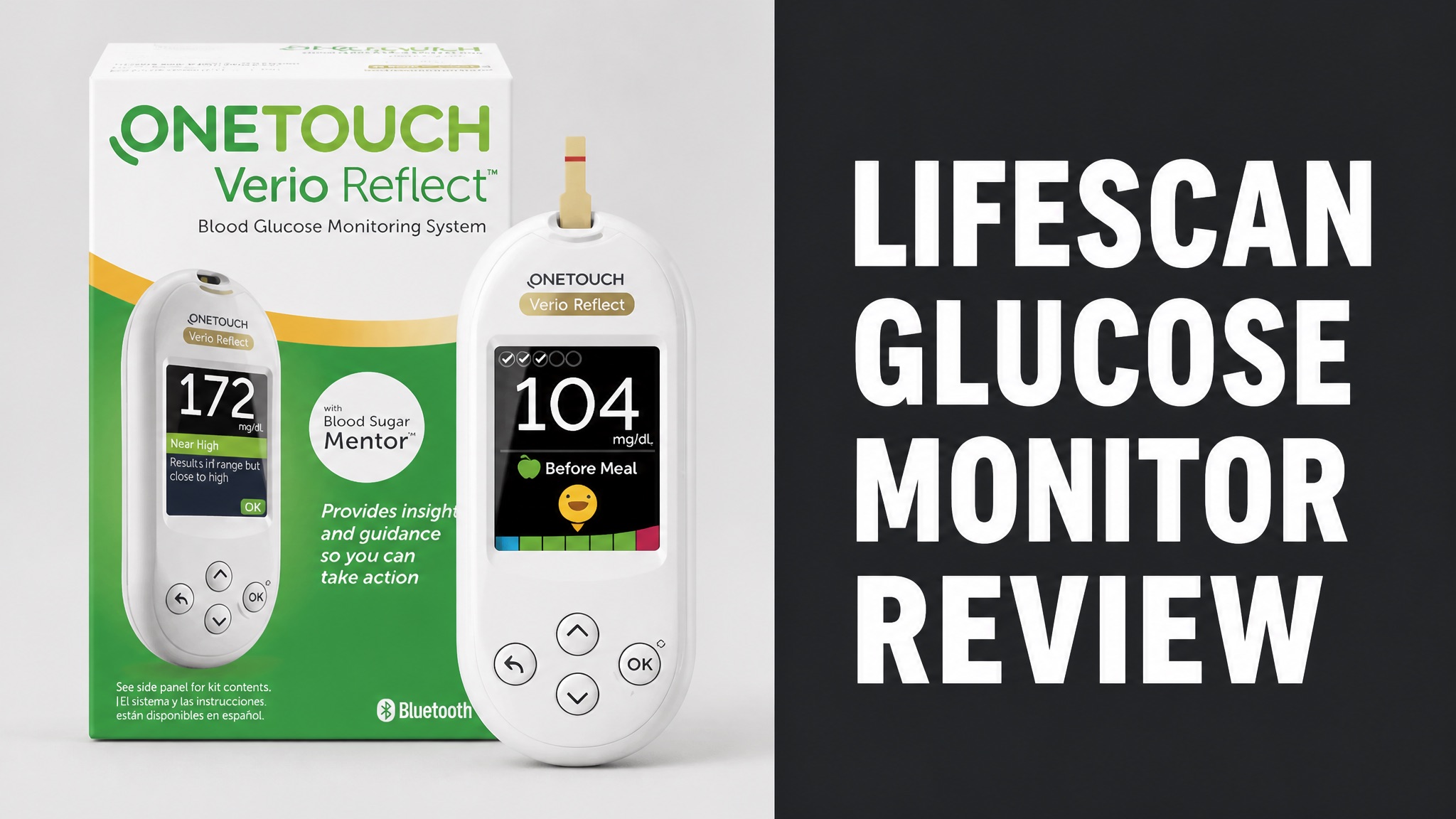
LifeScan makes blood glucose meters sold under the OneTouch brand, and more than 20 million people use them worldwide. The company began in 1981 in Malvern, Pennsylvania. It filed for Chapter 11 in 2025 and emerged that December under new owners, with far less debt and a fresh start.
OneTouch meters read blood sugar in about 5 seconds and show each result in color. The Reveal app logs readings on your phone. Newer models meet ISO accuracy rules, while older Verio and Ultra 2 meters missed an independent test. Strips drive the real cost, and user reviews stay mixed on service, error messages and the ongoing supply expense.
This guide explains how the meters work, what users say, how safe they are, and what they cost. You will also see where to buy one and how the brand compares with other meters and CGMs. Read on to decide with confidence whether a OneTouch meter fits your daily routine and your monthly budget.
What Is a LifeScan Glucose Monitor?
LifeScan glucose monitors are blood glucose meters made by LifeScan and sold under the OneTouch brand. Here’s the thing: the company started in 1981 and sits in Malvern, Pennsylvania. Johnson & Johnson bought it in 1986. Each meter checks blood sugar from a small fingertip drop on a test strip. People with diabetes use these meters daily at home.
More than 20 million people use OneTouch products worldwide, according to LifeScan. The line includes the Ultra and Verio families for home use. Short answer: these are classic finger-stick meters, not wearable sensors.
LifeScan Snapshot:
| Fact | Detail |
|---|---|
| Founded | 1981 |
| Headquarters | Malvern, Pennsylvania |
| Main brand | OneTouch |
| Home meter families | Ultra and Verio |
Who Owns LifeScan Today?
Creditors now control LifeScan after a 2025 bankruptcy restructuring. Johnson & Johnson sold the business to Platinum Equity in 2018. LifeScan then filed for Chapter 11 on July 15, 2025. It emerged on December 8, 2025 as LifeScan Enterprises LLC. Wikipedia names Canyon Partners and Brigade Capital Management as the parents, and debt fell in the process.
Does that mean the meters disappear? Not at all. The restructuring cut the company’s debt. Strips, meters and lancets still sell through the OneTouch shop.
How Does a LifeScan Glucose Monitor Work?
A LifeScan meter measures glucose in a fresh blood drop through an electrochemical test strip. You insert the strip and touch the drop to its edge. The result appears in about 5 seconds. The Verio Reflect needs only 0.4 microliters of blood. The Reflect reads from 20 to 600 mg/dL, which covers the range most people with diabetes see in daily life.
Early OneTouch strips changed color with glucose level. Later, the technology moved to electrochemistry. To be clear, modern Verio strips need no coding. The Reflect reads from 20 to 600 mg/dL.
Testing Steps:
- Wash and dry your hands.
- Insert a test strip into the meter.
- Prick your fingertip with a lancing device.
- Touch the blood drop to the side of the strip.
- Read the result and log it in the app.
What Does ColorSure Technology Do?
ColorSure technology shows whether a reading is low, high, or inside your personal range. OneTouch calls it the Dynamic Range Indicator. Colors make a raw number easier to judge at a glance, especially during a busy day. The feature targets people who find numbers alone confusing. Think newly diagnosed users, older adults and busy caregivers.
The Verio Reflect adds Blood Sugar Mentor coaching messages. What’s more, OneTouch cites a 2017 study of 128 people with diabetes in support of its A1c claims. That evidence comes from the maker.
What Features Do OneTouch Meters Have?
OneTouch meters combine color range feedback, Bluetooth syncing, and tiny blood samples in one device. In fact, the Verio Reflect pairs with the OneTouch Reveal app by Bluetooth. Readings sync to a phone automatically, so manual logbooks become optional. Strips need no coding, which removes a common source of testing mistakes for new users.
Is the display easy to read? Yes. MDS Diabetes calls the Reflect screen bright and clear, which helps older adults and anyone with weaker eyesight.
Key Features:
- ColorSure range indicator
- Bluetooth sync to the Reveal app
- 0.4 microliter blood sample
- Results in about 5 seconds
- No coding for test strips
What Does the OneTouch Reveal App Do?
The OneTouch Reveal app logs meter readings and displays glucose trends on your phone. Users can share the data with a doctor or care team. Caregivers also gain a clear view of a family member’s patterns. Each fingerstick becomes a record, so patterns across meals and days show up without a paper logbook. Doctors can review them with you.
LifeScan reports that a study in Diabetes Therapy tracked people with type 2 diabetes. They improved glycemic control with one to two checks per day. And it gets better: another study covered over 144,000 users.
Is a LifeScan Glucose Monitor Accurate?
Yes. The OneTouch Verio Reflect meets the ISO 15197:2013 accuracy standard for blood glucose monitoring systems. Its readings track closely with laboratory reference values in clinical testing. Older OneTouch models tell a more mixed story in independent testing. Check the independent scores below, because older models differ from newer ones.
Independent testing is the tougher check. The Diabetes Technology Society tested 18 popular meters in over 1,000 people. Passing meant results within 15% or 15 mg/dL of lab values in over 95% of trials.
Independent Accuracy Scores:
| Meter | Score | Result |
|---|---|---|
| Contour Next | 100% | Passed |
| Accu-Chek Aviva Plus | 98% | Passed |
| OneTouch Verio | 92% | Failed |
| OneTouch Ultra 2 | 90% | Failed |
How Did OneTouch Meters Score in Independent Tests?
The OneTouch Verio and Ultra 2 both missed the Diabetes Technology Society passing mark in an 18-meter study. The Verio scored 92% and the Ultra 2 scored 90%. Only six of the 18 meters passed the 95% bar overall. Passing needed results within 15% of the lab value in over 95% of trials. The study enrolled over 1,000 people at three study sites.
Should that scare you off? Not by itself. The study ran on older models, not the Reflect. Abbott funded it, yet the work ran independently, and its bar was stricter than FDA rules.
What Do LifeScan Glucose Monitor Reviews Say?
Reviews describe OneTouch meters as easy to use but costly to supply with strips. Praise centers on color feedback and app tracking. Complaints focus on strip expense and error messages. The picture is mixed, and that’s normal for a mass-market meter. Buyers rate the daily experience well and the ongoing supply cost lower, a pattern shared by most brands.
Customer service matters too. The Better Business Bureau lists four complaints against LifeScan over three years. None were filed in the last 12 months. The bottom line: complaint volume looks low.
What Do Users Like?
Users praise the simple interface, color range feedback, and automatic app logging. MDS Diabetes calls the Reflect a fit for newly diagnosed patients. One blogger liked the uncoded strips, AAA batteries, and side-fill design of the Verio. Reviewers also like the small blood sample, which makes each test feel less painful for daily testers.
Diabetes writer Adam Brown loved the Verio IQ pattern recognition. A low pattern means two or more lows within five days at a similar time. Pay attention to this: the meter flags the trend for you.
What Do Users Complain About?
Complaints center on strip cost, error messages, and slow support. A 2025 BBB complaint described error messages across four bottles of strips. The buyer also felt that troubleshooting wasted strips and dragged on. Repeated errors frustrate users most, since each failed strip means another expensive test, plus a second finger prick today.
LifeScan responded with a free replacement meter and extra strips. The customer accepted the fix. Another reviewer found the Verio big and clunky next to the older Ultra Mini. Size matters if you travel.
How Does LifeScan Compare With Other Options?
LifeScan meters pair strong app features with middle-of-the-pack independent accuracy scores. Contour Next scored 100% in the DTS study. Accu-Chek Aviva Plus hit 98%. Store brands matched up well too, with Walmart ReliOn Confirm and CVS Advanced both at 97%. Fewer testing details mean less guesswork for anyone choosing between brands today.
Now watch this: the bigger contrast is meter versus sensor. A continuous glucose monitor, or CGM, tracks glucose all day. A finger-stick meter gives one reading per test.
Meter vs CGM:
| Feature | Finger-Stick Meter | CGM |
|---|---|---|
| Reading frequency | One per test | Every 1 to 5 minutes |
| Body site | Fingertip | Upper arm or stomach |
| Trend direction | Number only | Number plus arrow |
| Wear time | None | 7 to 14 days per sensor |
Does LifeScan Offer a CGM?
Yes. LifeScan has announced a partnership with i-SENS to launch the OneTouch Continuous Glucose Monitoring System. The news appears on the LifeScan homepage. Product details were not available in the sources reviewed for this article. Treat any launch timing and pricing as unconfirmed until LifeScan publishes full specifications on its own site.
Why would that matter? CGM devices produce 288 to 1,440 readings per day. Arrows show where blood sugar is heading. That context helps prevent lows before activities like driving.
Is a LifeScan Glucose Monitor Safe and Legit?
Yes. LifeScan is a real manufacturer that has made OneTouch meters for decades under Johnson & Johnson and later owners. It rose to become the world’s leading producer of such systems in the early 1990s. Today the brand sells through its own shop. A long product history and real support lines separate it from the scam brands that flood online listings.
OneTouch states plainly that treatment decisions need your current reading and professional advice. The FDA agrees that meters help you spot dangerous highs and lows. So, use the meter as a tool, not a replacement for your doctor.
What Should You Check Before Using One?
The FDA lists accuracy, sample size, speed, and data storage as the main factors for choosing a meter. It also lists ease of use, size, cost, and manufacturer support. Large displays and spoken results help users with low vision. Pick a meter that fits your hands, your eyes and your budget before anything else, then compare features on top.
Never share a meter with another person. Some medications and supplements can interfere with results, too. Why does this matter? A wrong reading can lead to a wrong insulin decision, so ask your doctor.
How Much Does a LifeScan Glucose Monitor Cost?
LifeScan meters cost little upfront because manufacturers earn most of their money on test strips. One reviewer noted that makers often send free meters. The ongoing expense is strips and lancets. Exact prices vary by retailer, so check current listings. Treat any single price as a snapshot, since discounts and plan rules move often over the year.
OneTouch offers monthly or quarterly strip subscriptions to save money. MDS Diabetes warns that Verio strips can be costly without insurance coverage. Think of it this way: the meter is the razor, and the strips are the blades.
Is a LifeScan Glucose Monitor Worth the Price?
Yes. A OneTouch meter is worth the price when your plan covers strips and you value color feedback and app tracking. The low entry cost makes trying one easy. Strip spending decides the real value over a year. The question then shifts from the meter to the strips, which are the real recurring cost of testing for you. That cost repeats every month.
The reason is simple: you buy strips every month for as long as you test. Compare the per-strip price at each seller. And at the same time, confirm which strip type your meter needs.
Where Can You Buy a LifeScan Glucose Monitor?
LifeScan meters sell through the OneTouch shop, pharmacies, and online retailers. The OneTouch site promotes a new shop built around test strips, meters and lancets. Several pharmacy and medical supply sites also list the Ultra and Verio families. Buying direct keeps strip supplies fresh and lets you set up recurring orders so you never run out.
Marketplace listings need extra care. Check strip expiry dates and confirm the strips match your meter model. Here is what no one tells you: the wrong strip type gives errors or no reading.
Where to Shop:
- OneTouch shop at onetouch.com
- Walmart
- Online pharmacies such as J.D. Brown Pharmacy
- Medical supply stores such as Medical Supply Corner
- Marketplaces such as eBay
Does Insurance Cover LifeScan Meters?
Coverage depends on your plan, so confirm with your insurer before you buy strips. Many plans cover meters and strips for people with diabetes. Rules on brands and monthly strip limits differ from plan to plan. Call the number on your insurance card and ask about preferred brands and monthly strip limits before ordering. Plans differ widely.
Medicare data adds context. About 68% of Medicare mail orders for meters in 2016 went to models that missed the DTS standard. So, ask your doctor which covered meter performs best.
Is a LifeScan Glucose Monitor Worth It?
Yes. A LifeScan meter is worth it for people who want simple color feedback, app tracking, and a widely recognized brand. The Reflect suits newly diagnosed patients and caregivers. The caveats are strip cost, older-model accuracy scores, and the 2025 bankruptcy. Most buyers will find the trade-offs fair when strip costs stay in check for you.
Does the bankruptcy change the verdict? Not for everyday use. The company exited Chapter 11 in December 2025. Still, the restructuring is worth knowing about before you commit to a long strip subscription.
Best For:
- Newly diagnosed type 1 or type 2 patients
- Caregivers managing a family member’s diabetes
- People who share data with a care team
- Users who prefer color-coded results
Who Should Skip a LifeScan Meter?
Buyers who want the top independent accuracy scores or trend arrows should look elsewhere. Contour Next and Accu-Chek Aviva Plus outscored the OneTouch Verio in the DTS study. A CGM suits people who need constant readings. Anyone who tests rarely may prefer a cheaper brand, since strip savings add up over a year. Price each box first, then decide.
The OneTouch CGM is not yet reviewed here. The i-SENS partnership may change that. Bottom line: pick the device that fits your testing routine, then confirm accuracy data with your doctor.