
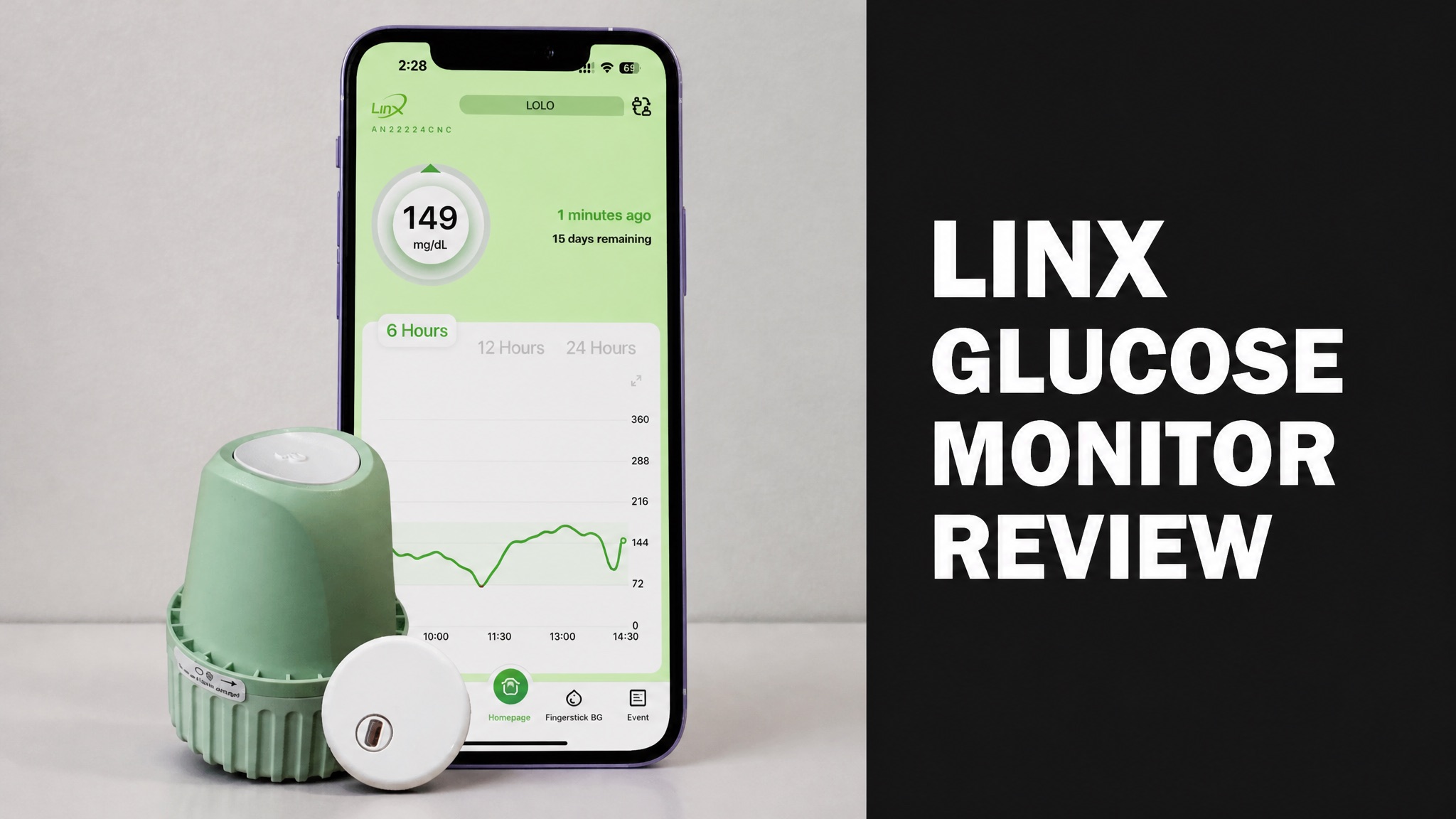
The LinX glucose monitor is a 15-day continuous glucose monitor (CGM) made by MicroTech Medical in Hangzhou, China. A small arm sensor sends a glucose reading to a phone app every minute. Buyers use it to skip routine fingersticks and watch daily glucose trends from a phone or watch.
The sensor weighs 2.16 g (0.08 ounces) and handles water well. It carries a CE mark and Chinese approval, but no FDA clearance. A real-world study of 75 young patients showed lower HbA1c. Prices start near $62 (USD) per sensor. The app is basic but works. Reviews praise the small size, the one-minute readings and the low price against big brands.
Here’s what matters for a skeptical buyer. Accuracy, user feedback, rival devices, safety and price all get a straight answer below. Read on to decide whether this budget CGM fits your needs, or whether a better-known brand is the safer call for your health, your doctor and your wallet.
What Is the LinX Glucose Monitor?
The LinX glucose monitor is a wearable CGM that tracks glucose under the skin and sends readings to a phone. To be clear, it is not a fingerstick meter. One sensor stays on the body for up to 15 days, then gets replaced. The sensor is an all-in-one unit, so no separate transmitter is needed. The app does the rest of the work, from alerts to trend graphs.
The system has two parts: the sensor with its applicator, and the LinX app. The sensor is an all-in-one unit, so no separate transmitter is needed. Its internal battery isn’t replaceable. Is that a problem? Not really, since the whole unit gets swapped every 15 days.
Who Makes the LinX CGM?
MicroTech Medical makes the LinX CGM at its Hangzhou, China base. Local distributors sell it under the LinX or AiDEX X name. The company also builds insulin patch pumps. Resellers in South Africa, New Zealand, Egypt and the Gulf run their own storefronts. Branding and packaging differ by country. Check the label for the maker’s name and the batch date.
In fact, the same maker sells the AiDEX line, so brand names overlap. Does that matter? Mostly no, because the hardware is the same family. Check that your seller ships a genuine, in-date sensor with a 16-month shelf life.
How Does the LinX Glucose Monitor Work?
The LinX CGM measures glucose in interstitial fluid through a tiny filament under the skin. It then sends the result by Bluetooth every minute. The app shows the current value, a trend line and alerts. Applying the sensor takes one click with the supplied applicator, and the app guides the pairing step by step. The sensor is factory calibrated, too.
After insertion, the sensor needs a 1 hour warm-up before the first reading. It is factory calibrated, so no fingerstick calibration is required. Calibration is still available in the app if readings drift from a meter.
Application Steps:
- Wash and dry the upper arm site, then let it dry fully.
- Pair the sensor with the LinX app and scan its code.
- Press the applicator once to insert the sensor.
- Wait 1 hour for warm-up before the first reading.
Here’s why that matters. Interstitial fluid lags blood glucose by a few minutes. The maker advises watching trends rather than a single number, and confirming with a meter when symptoms do not match.
How Accurate Is the LinX CGM?
The LinX CGM reports a mean absolute relative difference (MARD) of 8.66%, per the New Zealand distributor Intuitive Therapeutics. A lower MARD means closer agreement with lab values. Current fifth-generation CGMs fall between 9% and 11%, according to the Cureus study. The LinX figure therefore sits at the sharp end of the range. Treat it as a seller claim.
Here’s the catch: that figure comes from the seller side, not an independent lab test. Is that a red flag? Not by itself, but it needs caution. Users should verify with a quality meter when a reading feels wrong.
The sensor reads from 36 to 450 mg/dL (2.0 to 25.0 mmol/L). Values outside that window do not display as a number.
What Features Does the LinX CGM Include?
The LinX CGM packs a 15-day sensor, one-minute readings, six alarms and sharing in a 22 mm (0.87 inch) disc. The sensor is 4.22 mm (0.17 inches) thick and weighs 2.16 g. The makers call it one of the smallest CGM sensors sold. Its integrated design removes the need for a separate transmitter. The app adds a watch view for quick glances at your wrist.
The app supports iOS and Android and links to compatible smartwatches through the phone. Bluetooth range is about 2 to 4 meters (6.6 to 13 feet) in the South African FAQ. A Blue Circle review reported 10 to 15 meters (33 to 49 feet).
Key Specifications:
| Spec | Detail |
|---|---|
| Sensor life | 15 days |
| Size | 22 mm diameter, 4.22 mm thick |
| Weight | 2.16 g |
| Reading interval | Every 1 minute |
| Warm-up | 1 hour |
| Water rating | IP68 |
Sharing is a standout. The app lets you share live data with up to 20 followers, who also receive high and low alerts. Parents and caregivers get real peace of mind from that.
Is the LinX Sensor Waterproof?
Yes. The LinX sensor carries an IP68 rating, so it survives showers, swims and sweaty workouts. The South African FAQ allows depths up to 1.5 meters (4.9 feet) for 30 minutes. The maker’s own page lists 2 meters (6.6 feet) for 60 minutes. Water exposure is therefore a design strength, not a weak point. Dry the patch edges gently after each swim or shower.
The two figures differ, so follow the stricter one from your seller. The sensor doesn’t tolerate everything, though. Think of it this way: water is fine, scanners aren’t. Remove it before an MRI, CT scan or diathermy session.
What Do LinX CGM Reviews Say?
LinX reviews lean positive overall, with strong praise for price, size and one-minute readings. The basic app earns weaker marks. Seller pages show ratings near 4.9 out of 5, but those sit on store sites. Independent feedback is thinner and comes mostly from parents and clinic studies, so the picture is incomplete. Read both sides before you buy it.
Treat store stars with care. Why? Sellers control which reviews appear, so the reason is simple: bias. The sections below separate what real users like from what they report as problems.
What Do Users Praise?
Users praise the scan-free Bluetooth connection, the small size and the lower cost compared with Libre. Two fathers of children with type 1 diabetes wrote a review for Blue Circle. They liked readings every minute. Their older Libre sensor updated far less often and needed a manual phone scan each time. Kids hated fingerpricks, so parents liked that.
The same review praised the in-app calibration option and the customizable alerts. Followers receive alerts too, which parents rated highly. Water resistance and easy one-step application also earned credit.
Top Praise:
- Readings every minute without scanning
- Small, light sensor that stays discreet
- Lower price per sensor than major brands
- Live data sharing with followers
- Optional in-app calibration
What Are the Common Complaints?
Common complaints center on a basic app, limited reports and the lack of FDA clearance in the United States. The Blue Circle reviewers called the app functional but plain. They also wanted better reports, since the Ambulatory Glucose Profile used a mean line instead of bars. Pump users also note the missing integration. None of these block daily use.
Other limits are real. The sensor doesn’t work with insulin pumps. Bluetooth range depends on the model and obstacles. And what about accuracy? Readings can differ from a meter, so check symptoms first.
Top Complaints:
- Basic app with limited reporting
- No insulin pump integration
- No FDA clearance
- Bluetooth range varies by source
Does the LinX CGM Actually Improve Glucose Control?
Yes. The LinX CGM improved glycemic control in a 75-patient real-world study. Median HbA1c fell from 9.5% to 8.1% over three months. The study ran at Ain Shams University in Cairo and appeared in Cureus in 2025. All patients were youth with type 1 diabetes who used multiple daily injections. Patients wore it daily for 90 days under clinic follow-up.
Time in range (70 to 180 mg/dL) rose from 49.8% at 28 days to 60.0% at three months. Hypoglycemic events dropped sharply, and the Glycemia Risk Index fell 11.3 points.
Three-Month Study Results:
| Measure | Result |
|---|---|
| Median HbA1c | 9.5% down to 8.1% |
| Time in range | 49.8% up to 60.0% |
| Glycemia Risk Index | Down 11.3 points |
| Satisfaction (CGM-SAT) | 4.8 out of 5 |
The good news? The data are encouraging. But the study was single-center and single-arm, with no control group. It also covered youth only, so results for adults may differ.
How Satisfied Were Study Participants?
Participants rated the LinX system 4.8 out of 5 on the 44-item CGM-SAT questionnaire. Perceived benefits averaged 4.9, and reported hassles scored 4.6, where a higher number means fewer hassles. The authors linked higher satisfaction to better glucose control. The score covers all 75 patients after three months of use. That is a very high score, too.
So what does that mean for you? Comfort and trust drive daily use. A sensor people keep wearing delivers more data, and more data drives better decisions.
How Does the LinX CGM Compare to Libre and Dexcom?
The LinX CGM wins on size and price. FreeStyle Libre and Dexcom lead on regulatory clearance, app polish and ecosystem support. LinX reads every minute and lasts 15 days. Libre and Dexcom are better known. They have wider pharmacy and insurance access in the United States, which many buyers value. LinX also needs no NFC scan, unlike older Libre sensors.
Blue Circle noted that Libre needs an NFC phone, while LinX uses common Bluetooth. They also found Libre cost more per sensor in India. By comparison, LinX does not connect to insulin pumps.
Sensor Size Comparison:
| Device | Size (mm) |
|---|---|
| LinX | 22 diameter x 4.22 |
| Dexcom G7 | 24 x 27.3 x 4.6 |
| FreeStyle Libre 2 | 35 diameter x 5 |
| Guardian Connect 4 | 35 x 28 x 7 |
| Dexcom G6 | 46 x 30 x 15 |
Is LinX Smaller Than Other CGMs?
Yes. The LinX sensor is among the smallest on the market. It is thinner than Dexcom G7 and much smaller than Libre 2 or Dexcom G6. The table above comes from the South African LinX FAQ, so the maker’s side drew it up. Even so, the gap against Dexcom G6 is clear and large. Size claims should still be tested on your own arm at home, over several days of wear.
Small size matters for comfort. Why? A flat disc snags less on clothing. Several rivals, such as the iCan i6 and HiPPO H1, are close in size. Size alone does not set LinX apart.
Is the LinX CGM Safe and Legit?
Yes. The LinX CGM is a real medical device with Chinese NMPA approval and a CE mark. An established company makes it, and regional distributors sell it. The legitimacy gap is the United States, where no FDA clearance has been found. That gap matters for insurance and for some doctors, so check before buying. Ask your doctor first, and keep all paperwork.
Safety limits are spelled out. Avoid full-body x-ray or millimeter-wave scanners at airports. Do not wear the sensor during an MRI, CT scan or diathermy session.
The maker advises confirming with a fingerstick meter whenever symptoms do not match the reading. That rule applies to every CGM, and it is wise here too.
Is the LinX CGM FDA Approved?
No. The LinX CGM does not appear to be FDA approved, based on the independent Blue Circle review. The product page states approval from China’s NMPA and a CE mark instead. Sellers in the United States market it through channels like Amazon, so the listing alone does not prove clearance. Always verify before you buy. Ask the seller for written proof.
So what does that mean for you? Insurance coverage is unlikely in the United States. Talk with your doctor before relying on an unapproved device for insulin dosing. Pay attention to this: dosing errors carry real risk.
Who Should Avoid the LinX CGM?
Insulin pump users should avoid the LinX CGM, because it is a stand-alone system without pump links. The South African FAQ says so directly. Anyone needing an MRI, CT scan or diathermy must remove the sensor first. Those procedures can damage the device and hurt accuracy, so plan ahead with your care team. Pump users need a fully linked system instead.
The label lists adults aged 18 and older, though MicroTech lists 2+ years in its spec table. Parents of young children should ask a clinician first. Anyone who needs FDA-cleared hardware should look elsewhere.
How Much Does the LinX CGM Cost?
A single LinX sensor costs about $62 (USD) on the AiDEX X store. A pack of six runs $332 (USD). One sensor lasts 15 days. That works out to roughly $4.13 per day for a single sensor and $3.69 per day for the six-pack. The larger pack therefore saves about 11% per day over single sensors. Local prices differ by country, and shipping adds extra cost.
Prices vary by country. A Blue Circle review listed Rs 4,600 (about $55 USD) for one sensor in India, with discounts for larger orders. Shipping and import fees can add to the total.
Price Breakdown:
| Pack | Price (USD) | Per Day |
|---|---|---|
| 1 sensor (15 days) | $62 | $4.13 |
| 6 sensors (90 days) | $332 | $3.69 |
| India, single sensor | Rs 4,600 | Varies |
Is the LinX CGM Worth the Price?
Yes, for many buyers. The LinX CGM offers one-minute readings and a 15-day sensor at a lower per-day cost than most mainstream rivals. That claim rests on the seller prices above, so check current local prices before comparing. Cost per day is the fairest way to line up different pack sizes and brands. The saving is real for monthly buyers who order packs.
Value drops if you need pump integration, strong reporting or insurance coverage. Is cheaper always better? Not if the missing features cost you time or trust. To put it simply, price is only one input.
Where Can You Buy the LinX CGM?
You can buy the LinX CGM from regional distributor stores, the LinX brand sites and Amazon listings. MicroTech links to Amazon in the United States, the United Kingdom, Germany, Spain and Italy. Local resellers cover South Africa, New Zealand and Egypt. Prices and shipping terms change from one seller to the next. Compare shipping fees and return terms too.
Stick with authorized sellers. Why? Fake or expired sensors are a real risk with any medical device. Look for a clear return policy, an in-date batch and contact details that work.
Do You Need a Prescription for LinX?
No. The LinX CGM does not require a doctor’s prescription for at-home use, according to the maker’s own guide. Even so, the guide recommends using it under the guidance of a healthcare provider. Some storefronts still ask you to register an account first. The sensor counts as a medical device in most regions. Keep your invoice for replacements and returns.
Some storefronts still ask you to register an account, since it is a medical device. Expect to enter basic details before ordering. Keep your order records for replacements.
Should You Try the LinX Glucose Monitor?
Yes, if you want an affordable CGM and accept the trade-offs. The LinX CGM delivers solid readings, a small sensor and strong study results at a modest price. The biggest gaps are the basic app, no pump support and no FDA clearance. Weigh those three limits against the savings before you order a pack. Start with one sensor to test comfort, fit and the app.
Here is the part most people miss. Does a cheap CGM pay off? Only if you wear it consistently. The study participants did, and they scored it 4.8 out of 5.
Who Is the LinX CGM Best For?
The LinX CGM suits adults with type 1 or type 2 diabetes who want scan-free tracking without premium prices. It also helps parents who want remote alerts. Active users gain from the waterproof build. The sensor fits anyone who values small size, one-minute data and a lower cost per day over a polished app. It suits solo users and whole families alike.
Skip it if you use an insulin pump or need FDA-cleared gear. Talk to your doctor first. Bottom line: LinX is a solid budget pick, not a replacement for medical advice.
Best Fit:
- Adults with type 1 or insulin-treated type 2 diabetes
- Caregivers who need remote alerts
- Swimmers and active users
- Budget-conscious buyers outside the United States