
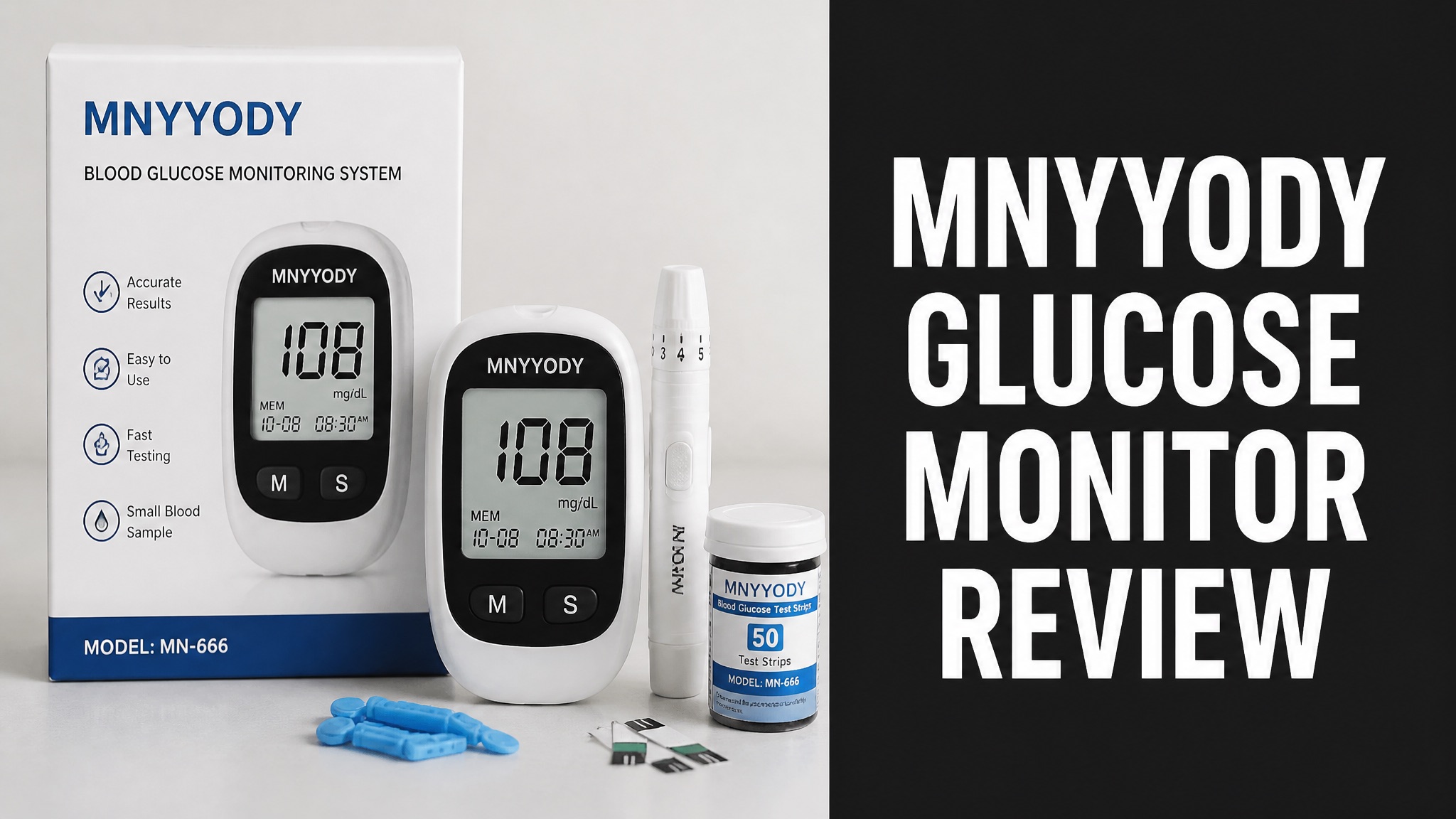
The Mnyyody glucose monitor is a gadget sold on mnyyody.com and promoted in ads as a painless blood sugar tracker. It claims readings without a needle or test strips. Buyers and scam checkers describe a very different story, so this review tests every claim against independent sources.
The device has no proof of accuracy, and health agencies say needle-free glucose readers are unreliable. A buyer reports receiving a pulse oximeter instead. ScamAdviser gives the store a trust score of 0. Safety risks, pricing and legitimacy all point the same way. Approved alternatives exist, and pharmacies stock them at fair prices today.
Wrong glucose numbers drive wrong insulin choices, so the stakes are real. This guide covers how the device claims to work, what reviews say, what it costs and what to buy instead. Read on for the full verdict, plus clear steps for anyone who already ordered one and wants their money back.
What Is the Mnyyody Glucose Monitor?
The Mnyyody glucose monitor is a gadget sold on mnyyody.com and pushed in ads as a painless blood sugar tracker. Buyers see no clinic, no known manufacturer and no regulator listing. Scam checkers also file the site under shopping stores, not under medical device makers. Reviewers treat the offer as a likely scam, not a real medical tool. Facts are thin.
The ads promise a one-time purchase with no test strips. They also claim fast readings of blood sugar, blood pressure, oxygen and heart rate. Here’s the thing: no approved glucose device bundles all of that without a needle or a blood drop.
Claims in the Ads:
- Zero extra costs and no test strips
- 3-second instant results
- Blood sugar, blood pressure, oxygen and heart rate tracking
- 14-day risk-free trial
- Upgraded 10-year warranty for early orders
The brand has almost no history. The domain mnyyody.com was registered on 2025-08-15, according to ScamAdviser. That’s roughly one year of existence, with owner details hidden in the WHOIS record. Is that a track record? Hardly.
Who Sells the Mnyyody Glucose Monitor?
The seller is an unnamed operator behind the mnyyody.com online store. The site shows no company registration, no street address and no named owner. A generic email and contact form are the only support channels reported by MalwareTips. Buyers can’t tell who holds their money or who answers a complaint. That anonymity is a serious warning sign. Be wary.
The store’s domain registrar is a Chinese provider, and its name servers sit in China, Hong Kong and Singapore. That alone proves nothing. Still, it matches the overseas pattern that buyers describe in refund complaints.
How Does the Mnyyody Glucose Monitor Work?
The Mnyyody glucose monitor claims to read blood sugar through the skin with light or a sensor, without a needle. The ads give no technical detail, no study and no clinical trial. So the real method is unknown. No independent lab has tested the device in any source reviewed. The ads say it reads sugar through the skin. Medical sources call that unsolved.
Optical sensing is a real research idea. A device shines light through the skin and reads the signal that bounces back. In plain English: it tries to spot glucose from light alone. Researchers say that is extremely hard to do reliably.
How Optical Sensing Is Meant to Work:
- The device shines light through the skin
- Glucose reflects the light in a specific pattern
- The sensor reads the returned signal
- Software converts the signal into a glucose number
Dr. David Klonoff of the Diabetes Research Institute explains the core problem. The glucose signal is small, and other molecules produce similar interfering noise. Is that solved? Not yet, according to diaTribe.
Can Any Device Read Glucose Without Piercing the Skin?
No. Diabetes Victoria states that no device can accurately measure glucose without piercing the skin. The charity calls ads for skin-surface glucose watches and gadgets a scam. Approved options are finger-prick meters and continuous monitors with a sensor under the skin. The charity’s advice is plain. Check any odd device with a diabetes educator first.
Belgium’s medicines agency, the FAMHP, says the same. It reports no legal, reliable non-invasive glucose meter on the European market. None carries a valid four-digit CE mark, so these devices can’t be sold legally in Europe.
Does the Mnyyody Glucose Monitor Actually Work?
No. The Mnyyody glucose monitor has no proof that it measures blood sugar accurately. No clinical study, no regulator approval and no independent test supports the ad claims. Every health body reviewed says needle-free glucose readers are unreliable. So any number on its screen can’t be trusted. Treat any number on its screen as decoration, not as advice.
Ad Claims vs Evidence:
| Claim | Evidence Found | Verdict |
|---|---|---|
| Needle-free glucose readings | Health agencies say none is reliable | Unproven |
| Hospital-grade precision | No clinical test published | Unproven |
| Blood pressure tracking | No validation found | Unproven |
| Glucose device received | Buyer reports a pulse oximeter | Mismatch |
One buyer’s report adds to the doubt. The BBB Scam Tracker lists a July 21, 2026 complaint. The buyer ordered two units and says a pulse oximeter arrived instead. So even the product isn’t what the ad showed.
Worth knowing: the ad promised glucose, blood pressure and oxygen readings from one gadget. A pulse oximeter only reads pulse and oxygen. Does that sound like one glucose monitor? No. That mismatch is what the complaint flags.
How Accurate Are Non-Invasive Glucose Monitors?
Non-invasive glucose monitors fail accuracy standards in published testing. A 2024 study in the Indian Journal of Endocrinology and Metabolism tested the InCheck optical device in a hospital. Its readings did not follow the recommended ISO guidelines. Lab glucose tests were the benchmark. Accuracy is the core question, and published tests disappoint.
The study’s author, Himel Mondal, concluded that the optical sensor needs redesign. That’s a named, tested device with real data. The Mnyyody monitor has no data at all. If the tested device missed the standard, an untested one is a gamble.
What Do Mnyyody Reviews Say?
Mnyyody reviews are overwhelmingly negative and describe a scam pattern. Buyers report orders that never arrive or arrive as cheap substitutes. Refund requests stall, and returns are demanded overseas. ScamAdviser found no reviews on common review sites, while a Facebook post calls the glucose monitor a scam. Positive reviews are hard to find or verify.
Trustpilot hosts a customer service page for mnyyody.com. It could not be loaded during research, so its star rating isn’t quoted here. Check it yourself before any purchase. Is a clean record proof of safety? No.
What Do Buyers Report?
Buyers report non-delivery, wrong items and refund runarounds. The BBB complaint describes paying $49.98 (USD) for two units and getting a pulse oximeter. The buyer disputed the charge with their bank, which credited the amount back temporarily. Their accounts follow one story. The ad promised a health gadget, and reality fell short. The pattern repeats.
MalwareTips adds that refunds are often delayed, partial or tied to returns shipped to China. Shipping costs would fall on the customer. In practice, that makes a refund unlikely, which is the whole point of the setup.
What Do Scam Checkers Say?
ScamAdviser gives mnyyody.com a trust score of 0 and rates it very likely unsafe. The checker notes overlap with known scam sites, no reviews on common platforms and hidden WHOIS data. Gridinsoft has also flagged the site as potentially malicious. Those flags come from automated checks, not angry customers. Independent tools all reach the same warning.
In fairness, the site has a valid SSL certificate, and DNSFilter treats it as safe. But a basic domain-validated certificate is free. Scammers use them too. So the padlock icon says little about honesty.
Is the Mnyyody Glucose Monitor Safe?
No. The Mnyyody glucose monitor is unsafe to use for managing diabetes. Wrong readings can trigger wrong insulin or diet choices. The FAMHP warns that unreliable non-invasive meters are potentially dangerous. Add the payment risk from a flagged store, and the safety picture is poor. Treat the device as high risk for anyone who relies on glucose numbers.
Safety Risks:
| Risk | What Happens | Source |
|---|---|---|
| Wrong glucose reading | Incorrect insulin or diet choice | FAMHP |
| Payment fraud | Card charged, no usable item | BBB Scam Tracker |
| Data exposure | Personal data given to unknown seller | ScamAdviser |
| No regulation | No CE mark or approval | FAMHP |
There’s also a data angle. Ordering means handing over card details and personal information to an anonymous operator. Can the bank help? Possibly, but a chargeback isn’t guaranteed to succeed.
What Are the Risks of Wrong Readings?
Wrong readings can push people with diabetes into dangerous decisions. The FAMHP names two outcomes. An overestimate may lead to too much insulin and low blood sugar (hypoglycemia). An underestimate may lead to too little insulin and high blood sugar (hyperglycemia). Users trust a screen number, so a fake figure can steer real treatment. That’s the risk.
Long-term, repeated high blood sugar harms the eyes, kidneys and heart. Is a fake reading harmless? Far from it. Short answer: if you have diabetes, keep using your approved meter or sensor and ignore any needle-free number.
Is Mnyyody Legit?
No. Mnyyody shows too many scam signs to count as a legitimate retailer. The domain is about one year old, owner details are hidden, and the trust score is 0. MalwareTips calls the store a likely fraud. Complaints describe non-delivery and wrong items. Several independent sources agree on that verdict. Scam trackers and buyer complaints point the same way.
Legitimacy Checklist:
- Named company and address: missing
- Working phone support: missing
- Independent reviews: none found
- Medical approval: none
- Domain age: about one year
Legit sellers are easy to verify. They list a company name, address and working phone. They also carry reviews from several independent sites. Does Mnyyody offer any of that? Not according to the sources.
What Red Flags Does the Site Show?
The site matches the standard fake-store checklist. MalwareTips lists copied legal pages, no real support, hidden ownership and implausible discounts. Product photos and descriptions look lifted from other retailers. On-site reviews can’t be verified. One sign alone proves little. A cluster is telling. Here, most items on the fake shop checklist appear.
The ads add pressure. Countdown timers, low-stock banners and ‘next 20 orders’ offers push fast decisions. And here’s the kicker: real stores don’t need fake urgency to sell a medical device.
How Much Does the Mnyyody Glucose Monitor Cost?
The Mnyyody glucose monitor sells for about $25 (USD) per unit, based on one buyer’s report. The BBB complaint lists $49.98 for two units. The ad stresses no ongoing costs. Official prices for the product could not be verified, because the store’s pages offer no trusted pricing history. Treat the price as unverified, as no official list price exists online.
Price Reality Check:
| Item | Price Signal | Value |
|---|---|---|
| Mnyyody monitor (2 units) | $49.98 (USD) reported | Unproven device |
| Approved finger-prick meter | Sold in pharmacies | Regulated device |
| Approved CGM | Sold by approved makers | Regulated device |
Compare that with approved options. A real continuous glucose monitor costs far more, and meters need strips. But low price isn’t a bargain when the device can’t measure glucose. Is a cheap failure a deal? No. In fact, a $25 device that fails is money wasted.
Is the Price Real?
No. The advertised price looks like bait, not a genuine deal. MalwareTips warns that a $300 product listed at $49.99 should raise suspicion. Deep discounts of up to 90 percent are a classic lure. The money is collected, then the item stalls or never matches. Cheap pricing is part of the pitch, not a gift. Real devices rarely sell at throwaway prices.
The ad also offers a 14-day risk-free trial. Sounds safe, right? In reality, refund routes reported by buyers are blocked or require costly overseas returns.
What Should You Buy Instead?
Approved glucose monitors come in two types that regulators recognize. Diabetes Victoria names blood glucose meters with a lancing device and continuous glucose monitors with a sensor under the skin. Both are the only TGA-approved options in Australia. Similar rules apply elsewhere. Neither option is needle-free, but both are well proven and regulated.
How to Check a Glucose Device:
- Look for a regulator approval such as FDA clearance or a CE mark
- Search the device in an official database
- Buy from a pharmacy or approved maker
- Ask a diabetes educator before ordering
In Europe, check for a four-digit CE mark. The FAMHP also suggests searching the Eudamed database. For the US, look for FDA clearance. Ask a diabetes educator or doctor if you’re unsure about any device.
Where Should You Buy a Glucose Monitor?
Pharmacies are the best place to buy glucose monitoring products, according to Diabetes Victoria. Diabetes educators sometimes provide a free meter. You can also buy continuous monitors directly from approved companies. Trusted sellers give you a returns route and a real address. A pharmacist can also confirm that a meter and its test strips match up.
Avoid social media ads and unknown stores. Why use a card or PayPal? Those routes are traceable. MalwareTips advises that bank transfers and crypto leave buyers with little recourse.
Is the Mnyyody Glucose Monitor Worth It?
No. The Mnyyody glucose monitor is not worth buying under any circumstances reviewed. The glucose claims are unproven, the store scores 0 on trust, and a buyer reports getting the wrong product. Bottom line: skip it, and use a regulated meter instead. Skipping it protects both your money and your health, and regulated options are easy to find in stores.
Final Verdict Summary:
- Accuracy: unproven
- Safety: poor
- Legitimacy: very doubtful
- Value: none
- Better option: approved meter or CGM
The good news? Real alternatives exist, and many are covered by insurance or health programs. A diabetes educator can guide you toward one. That route costs more upfront but protects your health.
What if You Already Ordered?
Buyers who already ordered should contact their bank or card issuer right away. Report the charge as disputed and keep the order email and screenshots. The BBB complaint shows a bank can credit a disputed amount while the claim is reviewed. Speed matters because bank dispute windows are limited. Act now instead of waiting for a parcel that may never come.
Also file a report with BBB Scam Tracker or your local consumer agency. Do not rely on the device for any glucose decision. And if you’ve entered card details, watch your statements for further charges.