
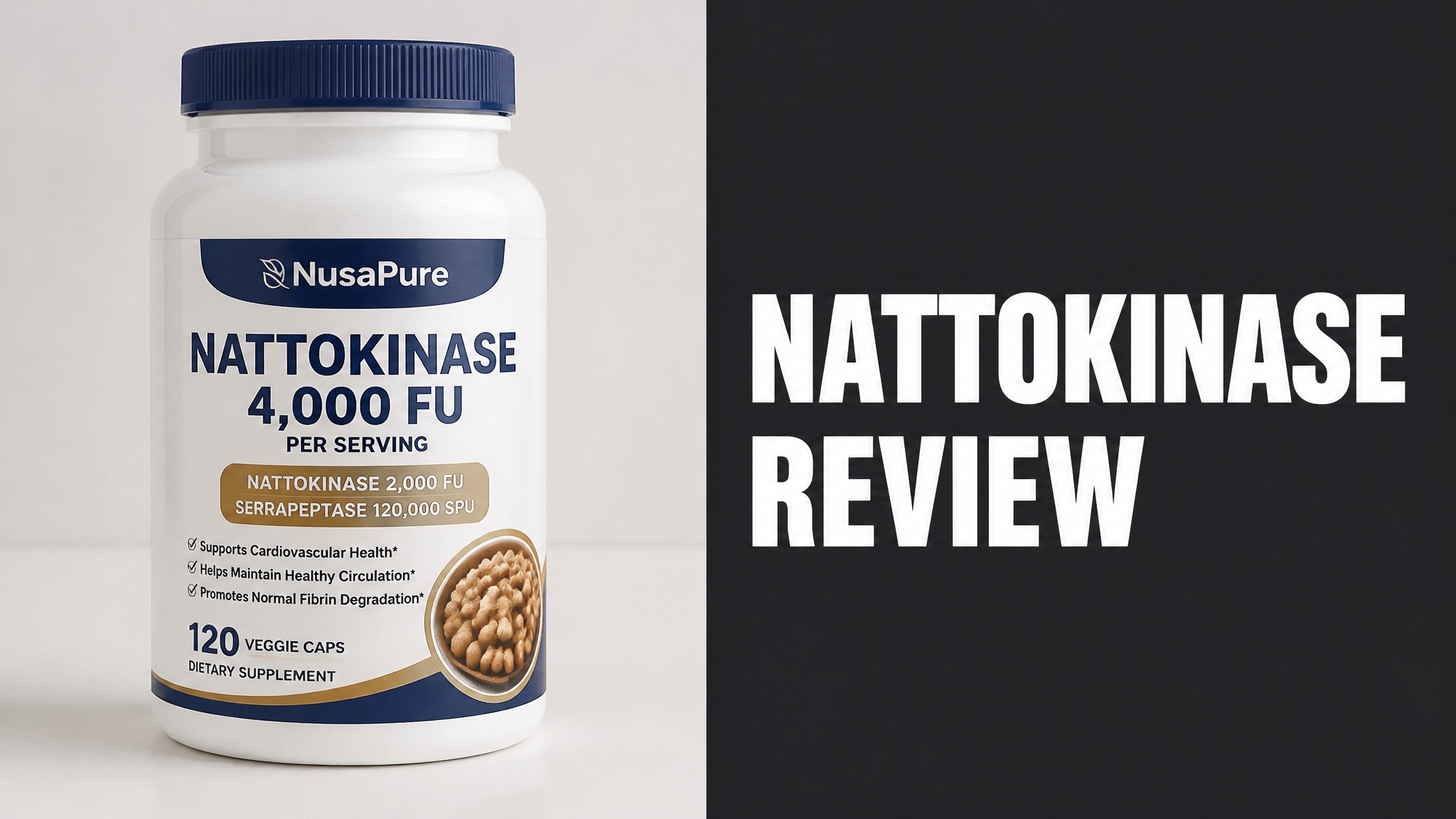
Nattokinase is a natural enzyme that forms when Bacillus subtilis ferments boiled soybeans into natto. Makers sell it in capsules and powders for heart and circulation support. WebMD says very few studies exist, so the evidence is still early. Supplements fall under FDA dietary rules.
The enzyme breaks down fibrin, the protein mesh inside clots. Blood pressure shows the best evidence, while heart and brain claims remain unproven. Reviews praise lower readings but report headaches and palpitations. Blood thinners raise bleeding risk. ConsumerLab found label errors in three of eight products tested in 2025.
Dosage, long-term safety and cost all shape the final verdict. Each section ahead answers one buyer question with sourced facts. Readers will learn who needs to avoid it, what a fair price looks like and when a doctor visit matters. Every claim below traces back to a named source.
What Is Nattokinase?
Nattokinase is a natural enzyme that Bacillus subtilis bacteria produce while fermenting boiled soybeans into natto. Natto is a traditional Japanese food. Makers extract the enzyme into capsules, tablets and powders for people who can’t stand the taste of natto. Most users take it for heart health and circulation, and research on that use is still early.
The soybeans don’t contain the enzyme. Fermentation creates it. In fact, RxList says you won’t find nattokinase in any soy food other than natto. So, what is it used for? Mostly cardiovascular support and circulation.
Dr. Hiroyuki Sumi, a University of Chicago researcher, discovered the enzyme. Today, supplements sit under FDA dietary supplement rules, not drug rules. The rules make manufacturers responsible for safety and correct labeling.
Quick Facts:
- Source: fermented soybeans (natto)
- Producing bacterium: Bacillus subtilis
- Common forms: capsules, tablets and powder
- Main use: cardiovascular and circulation support
Where Does Nattokinase Come From?
Nattokinase comes from natto, a dish made by fermenting soaked, cooked soybeans with Bacillus subtilis for up to a day. The natto then ages in the refrigerator for up to a week. The aging step gives natto its famous sticky texture. Researchers first found the enzyme in natto, and no other soy food contains it in meaningful amounts. Research continues.
Natto has served as a folk remedy for heart and circulatory disease for hundreds of years. Is it safe as food? Yes. WebMD calls nattokinase safe when eaten as food. Long-term supplement safety still needs more study.
How Does Nattokinase Work?
Nattokinase works by breaking down fibrin, the protein mesh that holds clots together. The enzyme also frees the body’s own clot-dissolving pathway. Lab work shows it inactivates PAI, a key inhibitor of tPA. Blood then clots less easily. Both actions explain why the enzyme draws so much attention from heart health researchers. Evidence quality matters here.
Here’s the thing: those findings come from test tubes and animals. Nattokinase reduced platelet aggregation and clot formation in a dose-dependent way. Memorial Sloan Kettering stresses that human studies are limited.
Verywell Health adds that nattokinase has antiplatelet and anticoagulant effects. Researchers think these effects may slow atherosclerosis, the hardening of arteries. But not every study agrees, so the picture stays incomplete.
How It Works:
- Bacillus subtilis ferments boiled soybeans into natto.
- The fermentation releases the nattokinase enzyme.
- The enzyme inactivates PAI, which frees tPA to dissolve clots.
- Nattokinase also cleaves fibrin directly.
Does Nattokinase Break Down Blood Clots?
Yes. Nattokinase degrades fibrin in lab and animal studies, which gives it real clot-dissolving potential. Human proof is thinner, though. WebMD notes that very few studies exist, so the anti-clot claim is early evidence rather than a proven treatment. Anyone considering it for clot prevention needs to understand that gap. Evidence quality matters here.
One study tested Flite Tabs, a blend of 150 mg of nattokinase and pycnogenol, on long flights. Clot risk dropped. Still, RxList rates the evidence for deep vein thrombosis as insufficient.
Here’s the catch. Nattokinase can theoretically dislodge an existing clot and trigger a stroke. Memorial Sloan Kettering advises people with a history of deep vein thrombosis to avoid it.
What Are the Benefits of Nattokinase?
The best-supported benefit of nattokinase is a modest drop in blood pressure. Early signals exist for heart, artery and brain support. WebMD says very few studies exist. More research is needed to confirm both the benefits and the risks. Claims range from clot prevention to brain protection, but the proof differs sharply by claim. Research continues.
Verywell Health lists four heart effects: lower blood pressure, lower cholesterol, fewer clots and slower atherosclerosis. Do all trials agree? No. A small trial found no benefit for preventing heart disease in people without cardiovascular conditions.
Evidence by Benefit:
| Benefit | Evidence Level | Source |
|---|---|---|
| High blood pressure | Possibly effective | RxList |
| Deep vein thrombosis | Insufficient evidence | RxList |
| Cholesterol | Mixed results | Verywell Health |
| Alzheimer’s disease | Animal studies only | Memorial Sloan Kettering |
Does Nattokinase Lower Blood Pressure?
Yes. Nattokinase lowers blood pressure modestly, and RxList rates it possibly effective for high blood pressure. Research found that daily use for 8 weeks reduced readings in people with hypertension. A randomized trial also showed drops in prehypertensive patients. The change is small for most people, not dramatic. Context matters. Caution applies.
Verywell Health notes the effect looks stronger in people assigned male at birth. Does that settle the question? Not quite. Examine lists the usual dose at 100 mg (2,000 FU) daily, and results still vary by product.
Reviewers report big drops too. One WebMD user went from 151/101 to 121/76 within days. To be clear, those are personal accounts, not trial data.
Does Nattokinase Support Heart and Brain Health?
No. Nattokinase has not been proven to protect the heart or brain in humans, although early research looks promising. A long-term study of low-risk adults found no effect on subclinical atherosclerosis progression. Animal work on Alzheimer’s plaques remains unconfirmed in people. The gap matters for anyone expecting disease prevention from a capsule.
Animal studies show nattokinase can break down amyloid fibrils linked to Alzheimer’s and Parkinson’s disease. Memorial Sloan Kettering states that human studies have not been conducted. Large placebo-controlled trials are still missing.
A small study found that nattokinase plus standard care aided stroke rehabilitation. After 60 days, participants showed better blood pressure and cholesterol control. Verywell Health calls the result promising but small.
What Do Nattokinase Reviews Say?
Nattokinase reviews are mostly positive, with 63% of Drugs.com reviewers reporting a positive experience. Reviewers mainly praise blood pressure results. About 25% of Drugs.com reviewers report a negative experience, and most of those complaints describe side effects. Reading both sides gives a realistic picture of what daily users actually experience.
User reviews are anecdotes, not clinical evidence. Self-reported results lack controls and lab confirmation. So why read them? Positive and negative reports cluster around the same few effects, and the patterns are useful.
Review Snapshot:
| Source | Result | Detail |
|---|---|---|
| Drugs.com | 63% positive | 25% negative |
| WebMD reviewer | 151/101 to 121/76 | Blood pressure, third day |
| WebMD reviewer | Cholesterol 5.3 to 4.6 | Three months of use |
| Drugs.com reviewer | Palpitations | Episodes of about 30 minutes |
What Do Positive Reviews Say?
Positive reviewers mostly report lower blood pressure, steadier circulation and reduced cholesterol after weeks of daily use. One WebMD reviewer saw cholesterol fall from 5.3 to 4.6 over three months. Another dropped from 134/85 to 122/74 in 14 days. Energy, stamina and leg pain relief appear in a handful of reviews too. Evidence quality matters here.
A Drugs.com reviewer took 400 mg daily for nine months after a pulmonary embolism. No further clots followed. Another reported normal readings after four weeks. Still, these are individual stories.
What Are the Common Complaints?
Negative reviewers report headaches, dizziness, palpitations, diarrhea and shipping problems more than anything else. One WebMD reviewer woke on the floor after palpitations and sweating. Another blamed maltodextrin in a tablet for aches and sharp headaches. Those complaints deserve attention before anyone buys a first bottle. Evidence quality matters here.
One Drugs.com reviewer described extreme diarrhea and dehydration within six days. Another stopped over recurring palpitations. The good news? Several reviewers say symptoms faded after they stopped.
Some complaints involve sellers, not the enzyme. Two WebMD reviewers said their orders never arrived. Shipping failures say nothing about nattokinase itself.
What Are the Side Effects of Nattokinase?
The main side effect risk of nattokinase is increased bleeding and bruising, especially when combined with blood-thinning drugs. Memorial Sloan Kettering also lists allergic reactions in people allergic to natto. WebMD says long-term supplement safety still needs more study. Those risks make a doctor conversation essential before starting any dose.
Reported cases are serious. One elderly woman died of internal bleeding after taking over-the-counter nattokinase. A patient who swapped warfarin for it needed a repeat valve replacement. Bottom line: self-substitution is dangerous.
Reviewers add milder effects, such as headache and dizziness. Do trials quantify them? The sources reviewed here do not. Those reports come from user reviews, so frequency stays unknown.
Reported Side Effects:
- Bleeding and bruising
- Allergic reactions in people allergic to natto
- Headaches and dizziness
- Palpitations
- Diarrhea
- Stroke from a dislodged clot (theoretical)
Who Should Avoid Nattokinase?
People with clotting disorders, bleeding disorders or a history of deep vein thrombosis need a doctor’s approval before using nattokinase. Doctors also don’t recommend it for children or for pregnant and breastfeeding women. The safety evidence simply isn’t there. Several groups carry higher risk, and a few of them are easy to overlook. Context matters.
Surgery changes the picture too. Nattokinase thins blood, so doctors may ask patients to stop before a procedure. A natto allergy is another blocker, because the supplement can trigger reactions.
Does Nattokinase Interact With Blood Thinners?
Yes. Nattokinase can raise bleeding risk when combined with warfarin, aspirin, ibuprofen and other anticoagulant or antiplatelet drugs. WebMD and Memorial Sloan Kettering both flag the interaction. Excess bleeding and bruising are the main concern. The combination is the single most important safety warning on the topic. Evidence quality matters here.
Raw natto adds a second problem. Natto contains high vitamin K levels that can interfere with warfarin. Is vitamin K the same as nattokinase? No. Vitamin K is a nutrient and nattokinase is an enzyme.
Doctors can check interactions only if patients disclose every supplement, natural or not. WebMD stresses this step. Disclosure also covers blood pressure medication.
What Is the Right Nattokinase Dosage?
The most common nattokinase dose is 100 mg (2,000 fibrinolytic units) taken by mouth daily. The European Food Safety Authority reports no adverse effects at this dose. WebMD adds that no set dosage exists, since quality varies widely between makers. Quality differs a lot by maker. Does the label tell the truth? Not always. Evidence quality matters here.
Higher doses show no reported harm in limited research. People in China took 540 mg (10,800 FU) daily for a year. US adults took 552 mg daily for four weeks. Those are small studies, so caution still applies.
Natto itself also works as a source. Anti-clotting effects appeared with 12 grams (0.42 ounces) of natto daily over two weeks. In plain English: that’s food, not a supplement dose.
Dose Reference:
| Dose | Duration | Source |
|---|---|---|
| 100 mg (2,000 FU) | Daily | EFSA, via Examine |
| 540 mg (10,800 FU) | One year | Study in China |
| 552 mg | Four weeks | Study in US adults |
| 12 g (0.42 oz) natto | Two weeks | Examine |
Is Nattokinase Safe Long Term?
No. Nattokinase supplements lack proven long-term safety data, according to WebMD, which asks for more studies on repeated use. Natto as food is safe. Supplement quality varies, and manufacturers carry responsibility for safety and labeling under FDA supplement rules. The gap in long-term data is the main reason doctors urge caution. Context matters.
The longest reported use is one year at 540 mg (10,800 FU) daily without reported adverse effects. That’s encouraging. But one small study doesn’t settle long-term safety for everyone.
Are Nattokinase Supplements Accurately Labeled?
Nattokinase supplements don’t always match their labels, according to ConsumerLab testing of eight products released in November 2025. Only five delivered enzyme activity within an acceptable margin. Two delivered far less than claimed, and one delivered substantially more. Label accuracy affects both results and safety for every buyer. Context matters.
One supplement delivered less than half its listed activity. Another reached only 82%. One product provided nearly 60% more than labeled. Why does overage matter? Excess raises side effect risk and makes dosing unpredictable.
ConsumerLab tested Allergy Research Group, Arthur Andrew Medical, Doctor’s Best, Double Wood, NOW, Nutricost, Pure Encapsulations and Toku Flow. Full results require a membership. ConsumerLab also named a Top Pick that passed testing.
ConsumerLab Findings:
| Metric | Result |
|---|---|
| Products tested | 8 |
| Within acceptable margin | 5 |
| Lowest potency | Under 50% of label |
| Highest potency | Nearly 160% of label |
How Much Does Nattokinase Cost?
Nattokinase pricing varies more than ten-fold, from $0.10 to $1.17 for the same amount of enzyme activity, according to ConsumerLab. The spread covers the eight tested products. A bigger price tag doesn’t guarantee a better product. Price alone says very little about what a bottle actually delivers. Independent testing and medical advice both apply.
ConsumerLab president Dr. Tod Cooperman says a higher price doesn’t mean better quality. So, compare cost per unit of enzyme activity, not cost per bottle. Approved products at reasonable doses offered the best value.
Is Nattokinase Worth It?
Yes. Nattokinase is worth considering for modest blood pressure support when a doctor approves it and the product passes independent testing. The evidence is early, the risks are real, and the label accuracy problem is documented. Conditions matter here. Short answer: it can be, under the right conditions and with proper guidance. Research continues.
Bottom line: benefits look modest, human data is limited, and bleeding risk is serious for anyone on blood thinners. Short answer: it’s a maybe-supplement, not a miracle. Buyers who pick tested products and start at 100 mg (2,000 FU) face fewer surprises.
Should You Talk to a Doctor First?
Yes. Nattokinase interacts with common drugs and carries bleeding risk, so a doctor visit comes before the first capsule. WebMD and Memorial Sloan Kettering both give this advice. Surgery plans, medications and allergies all change the answer. Physicians can weigh these factors against a full medical history. Context matters. Results differ by person.
Memorial Sloan Kettering adds that nattokinase is promoted as a cancer treatment, but human data is lacking. One patient lost an arm after injecting an oral enzyme supplement containing serrapeptase and nattokinase. Oral supplements are meant for swallowing only.