
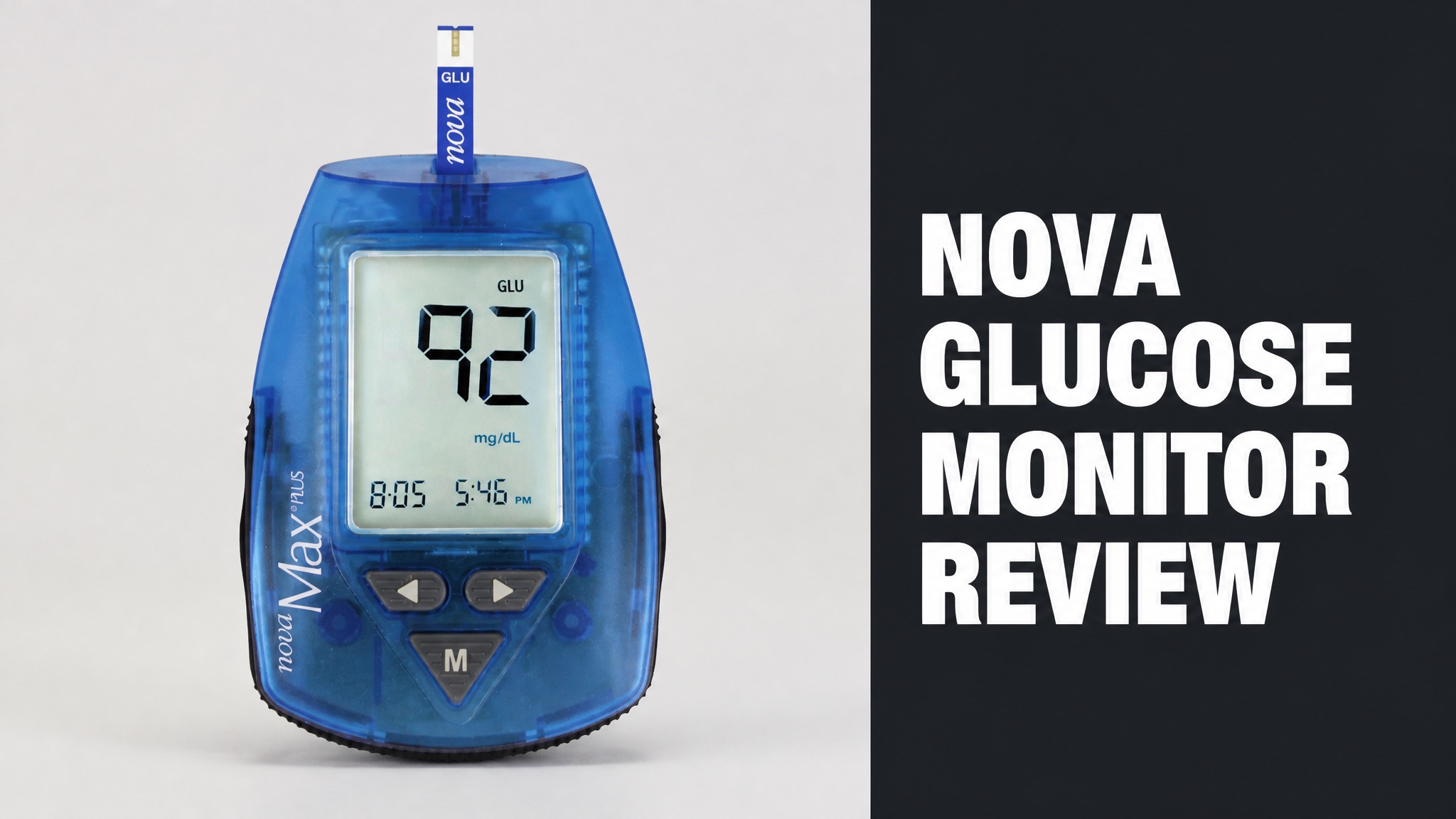
The Nova glucose monitor is a fingerstick blood glucose meter from Nova Biomedical. The company sells StatStrip meters for hospitals and Nova Max Plus for home glucose and ketone testing. Each meter reads one drop of blood on a strip. None is a continuous monitor. Hospitals and home users buy different models.
Strip chemistry corrects hematocrit and several interferences. Clinical studies show mixed accuracy results across patient groups. The FDA approved StatStrip for all hospitalized patients in 2014. A 2024 software correction hit hospital meters. Reviews come mostly from clinical sources. Pricing stays unpublished. Reviewers praise the strip chemistry.
The big picture is simple. Nova offers strong measurement technology with thin consumer feedback. Nova Biomedical publishes detailed specs, yet consumer ratings are missing. Read on to learn how the meters work, what they cost, which risks apply and who should pick another option.
What Is the Nova Glucose Monitor?
The Nova glucose monitor is a fingerstick blood glucose meter made by Nova Biomedical of Waltham, Massachusetts. The brand covers two lines. StatStrip meters serve hospitals and clinics. Nova Max Plus serves people with diabetes at home and tests glucose and ketones. Nova Biomedical describes the meters as accurate tools for self-monitoring and professional testing.
Here’s the thing: the name confuses buyers. Nova sells several meters, not one device. Which one matters? That depends on the setting. Hospitals pick StatStrip, while home users pick Nova Max Plus.
Main Nova Meters:
- StatStrip Glucose Hospital Meter with connectivity
- StatStrip Xpress2 without barcoding or connectivity
- Nova Max Plus for home glucose and ketone testing
Is It a Continuous Glucose Monitor?
No. The Nova glucose monitor is not a continuous glucose monitor and gives one reading per fingerstick. Nothing is worn on the skin. No sensor stays in the body. Each test uses a fresh strip. AJMC calls StatStrip continuous, but the product pages describe strip-based testing. Nothing is implanted. Every reading starts with a new strip and a fresh blood drop.
Short answer: you test when you choose to. Does that limit the data? Yes, because overnight trends stay hidden. Anyone needing alarms or trend arrows needs a true CGM instead.
How Does the Nova Glucose Monitor Work?
The Nova glucose monitor measures glucose through an electrochemical biosensor on a disposable test strip. Blood enters the strip, and glucose reacts with an enzyme. That reaction creates a small electrical current. The meter converts the current into a glucose number in mg/dL or mmol/L. The Xpress reads the reaction in about six seconds.
Here’s why the enzyme matters. Nova Max Plus uses a glucose oxidase biosensor. Why care? Some enzymes react to maltose and other sugars. In 2009 the FDA warned about GDH-PQQ strips after 13 patient deaths.
What Is Multi-Well Strip Technology?
Multi-Well strip technology uses four measuring wells to correct common interferences in a blood sample. Nova says the StatStrip system corrects hematocrit. It also corrects acetaminophen, uric acid and ascorbic acid (vitamin C) interference. It eliminates oxygen, maltose, galactose and xylose interference. Hematocrit is the share of red cells in blood.
In plain English, the strip checks the sample from several angles. The result? A steadier reading when blood is thick, thin or loaded with other compounds. StatStrip Xpress needs 1.2 microliters of blood and six seconds.
What the Strip Corrects:
- Hematocrit levels
- Acetaminophen, uric acid and vitamin C
- Oxygen interference
- Maltose, galactose and xylose
What Features Does the Nova Glucose Monitor Have?
The Nova glucose monitor offers fast testing, small samples and error-reduction features across its meter range. Nova Max Plus tests glucose in 5 seconds and ketones in 10 seconds. It needs 0.3 microliters of blood for glucose. StatStrip Xpress2 takes 6 seconds and 1.2 microliters. Max Plus also shows plasma values in mmol/L and mg/dL for every test result.
Now, watch this: ketone strips need no coding, and Max Plus detects the strip type automatically. Why does that matter? Coding mistakes cause wrong readings. StatStrip Xpress also needs no calibration codes.
What Are the Nova Max Plus Specs?
Nova Max Plus weighs 75 grams (2.65 ounces) and stores 400 results. It measures 91.4 by 58.4 by 22.9 millimeters (3.6 by 2.3 by 0.9 inches). The battery lasts about 1,000 tests. A low battery warning appears at about 20 tests. The sample type is capillary whole blood. Results display as plasma values in mmol/L and mg/dL. Data leaves the meter through a USB cable.
Here is the kicker: the working range is wide. The meter runs from 14 to 40 degrees Celsius (57 to 104 degrees Fahrenheit). It works up to 3,000 meters (10,000 feet). Does that cover travel? For most trips, yes.
Nova Max Plus Specs:
| Spec | Value |
|---|---|
| Glucose test time | 5 seconds |
| Ketone test time | 10 seconds |
| Glucose sample | 0.3 microliters |
| Glucose range | 1.1 to 33.3 mmol/L (19.8 to 599.9 mg/dL) |
| Hematocrit range | 25% to 60% |
| Memory | 400 results |
What Are the Benefits of the Nova Glucose Monitor?
The Nova glucose monitor delivers fast, low-volume testing and, on Max Plus, dual glucose and ketone checks. Nova lists a tiny sample, an ultra-small lancet and error-reduction safeguards. The goal is less pain and fewer testing mistakes. The meter also fits a pocket. Nova Biomedical positions Max Plus as dependable for daily self-monitoring by people with diabetes.
And it gets better for ketone users. Most meters check glucose only. Is a second device needed? Not with Max Plus, since one meter covers both tests.
Main Benefits:
- Dual glucose and ketone testing
- Tiny blood sample
- Ultra-small lancet for less pain
- Fast results in seconds
- Compact and portable design
Does It Give Accurate Results?
Yes. Independent studies show the Nova StatStrip performs well in several clinical settings. Medaval gives the technology a one-star recommendation. It lists three passed validation studies. They cover general adults, neonates and simulated high altitude. LabCompare, a supplier listing, adds that the chemistry agrees well with central laboratory methods.
But accuracy is not perfect. Gijzen’s ICU study failed ISO 15197:2003. Karon’s operating room study failed CLSI 2013 for capillary and arterial samples. So context matters. Critical care targets are demanding.
Also worth knowing: Cho and colleagues found no maltose interference. High vitamin C at 30 mg/dL caused occasional malfunctions. Nova lists Max Plus imprecision at 6% or 0.3 mmol/L (1.74 mg/dL), whichever is greater.
Does It Test Ketones?
Yes. Nova Max Plus tests both blood glucose and beta-ketone levels from one meter. The ketone range is 0.1 to 8.0 mmol/L (0.58 to 46.48 mg/dL). Ketone tests take 10 seconds and use 0.8 microliters of blood. StatStrip Xpress2 tests glucose only. Ketone testing uses a separate strip that needs no coding. The meter reports results in mmol/L and mg/dL.
Why does this matter? Diabetic ketoacidosis carries a 2% to 10% mortality rate, per Nova. The ADA advises ketone tests on sick days. Test also when glucose exceeds 250 to 300 mg/dL (13.9 to 16.7 mmol/L).
What Do Nova Glucose Monitor Reviews Say?
Nova glucose monitor reviews come mostly from clinical studies, not consumer star ratings. LabCompare shows no user reviews yet for StatStrip Xpress2. The strongest evidence is peer-reviewed accuracy data from hospitals. Professional evaluations are the main review source. Published studies cover neonates, adults and critically ill hospital patients.
To be clear, that gap matters. Where do home users look? The ADA consumer guide lists Nova Max Plus. Retail reviews are hard to find.
Review Sources:
| Source | Type | Finding |
|---|---|---|
| Medaval | Independent rating | One-star recommendation |
| AJMC | Trade report | FDA approval for all hospitalized patients |
| LabCompare | User reviews | None posted |
| FDA | Regulator | 2024 software correction |
What Do Reviewers Praise?
Clinical reviewers praise the interference correction and the range of patient types. AJMC reports accuracy across cardiopulmonary disease, renal disease, surgery and trauma. The meter uses arterial or venous whole blood from neonates to adults. AJMC also notes that the meter corrects for interference and hematocrit levels. Those traits fit varied patients.
Bottom line: reviewers like the strip chemistry. Do they mention speed? Yes. StatStrip Xpress analyzes a sample in six seconds.
What Are the Common Complaints?
The main complaints are failed accuracy studies in intensive care and operating rooms, plus a 2024 software defect. Medaval notes failed protocols in both settings. The FDA placed the defect in its most serious recall class. Medaval also flags that the clinical validation is older and used older protocols. A third complaint is limited public pricing.
The bad news? Price and consumer reviews are hard to find. Nova lists no public price. LabCompare shows ‘Inquire’ instead.
How Does the Nova Glucose Monitor Compare?
The Nova glucose monitor competes with Accu-Chek Performa, Contour TS, OneTouch Ultra2 and Optium Xceed. AJMC lists those meters as common alternatives. It says they vary in accuracy, error messages and hematocrit influence. Nova corrects hematocrit, which is its main selling point. Reviewers cite that correction as the strongest argument for the Nova system.
In fact, head-to-head data is limited. Does that mean Nova wins? Not automatically. Gijzen’s ICU study compared five meters, and Nova failed ISO 15197:2003 there.
Nova StatStrip vs Nova Max Plus?
Nova StatStrip Xpress2 targets hospitals, while Nova Max Plus targets people managing diabetes at home. Max Plus adds ketone testing. StatStrip Xpress2 tests glucose only. Both store 400 results. StatStrip Xpress2 is CLIA-waived and comes in a vial of 25 strips. Max Plus ships strips in a 50 count vial or box. Strip packaging differs by model.
The Max Plus needs a much smaller sample. Does smaller mean better? For comfort, yes. For critical care, only StatStrip carries the FDA hospital clearance.
StatStrip Xpress2 vs Max Plus:
| Feature | StatStrip Xpress2 | Nova Max Plus |
|---|---|---|
| Setting | Hospital and professional | Home |
| Tests | Glucose | Glucose and ketone |
| Test time | 6 seconds | 5 seconds (glucose) |
| Sample size | 1.2 microliters | 0.3 microliters (glucose) |
| Memory | 400 tests | 400 results |
Is the Nova Glucose Monitor Safe?
Yes. The Nova glucose monitor is considered safe when used as directed, with one notable 2024 software correction. The FDA approved StatStrip for all hospitalized patients in 2014. No injuries or deaths were reported from the defect. Follow the strip and control solution instructions. Medaval and the FDA supply the main safety evidence. AJMC adds approval history.
To be clear, the home Max Plus was not named in the recall. Which meters were? Only StatStrip hospital meters.
Was the Nova StatStrip Recalled?
Yes. Nova Biomedical issued a software correction for StatStrip hospital meters on November 20, 2024. The FDA classed it as its most serious recall type. Affected software ran from v0.0.13.10 to v0.0.13.44. The fix is v0.0.13.45 or above. The FDA says the action corrects devices and does not remove them from use. Nova or a local dealer performs the update.
Let me explain: the cause was narrow. An operator opened Review Results during wireless transmission. Wrong values could then reach the hospital record. The meters stayed in use after the update.
Recall Facts:
| Detail | Fact |
|---|---|
| First notice | November 20, 2024 |
| Revised notice | December 16, 2024 |
| Affected software | v0.0.13.10 to v0.0.13.44 |
| Fixed software | v0.0.13.45 or above |
| Injuries reported | None |
Is It FDA Approved?
Yes. The FDA approved the StatStrip Glucose Hospital Meter System for all hospitalized patients on September 24, 2014. AJMC reports the system was first approved in 2006. The 2014 decision extended use to critically ill patients. AJMC says multiple studies back accuracy across many medical conditions. Approval covers adults, children and neonates.
LabCompare lists Xpress2 as CLIA-waived. What about Max Plus? The sources reviewed give no FDA statement for it. Ask Nova before buying.
Where Can You Buy the Nova Glucose Monitor?
The Nova glucose monitor is sold through Nova Biomedical and its authorized dealers. The company site lists Nova Max Plus with strip, lancet and accessory part numbers. StatStrip meters are installed by Nova or a local distributor, per the FDA notice. Home buyers should contact Nova Biomedical or a dealer for a current quote and strip supply.
Here’s what to know: Nova Max glucose strips (part 43437) come in a 50 count box. Ketone strips (part 53493) come as 10 count. Sure Flex lancets (part 48738) come in 100 count.
How Much Does It Cost?
Nova Biomedical does not publish a price for its meters on the pages reviewed. LabCompare shows the StatStrip Xpress2 price as Inquire. The catalog number is 56510. Buyers need a quote from Nova or a dealer. Nova Biomedical sells meter, strip and lancet parts separately. Each part has its own catalog number. The Max Plus data upload cable is part 44477.
The bad news? That makes price comparison hard. Does it hurt home buyers? Yes, because strip costs drive long-term spending.
Ask Your Dealer For:
- Meter price
- Price per 50 glucose strips
- Ketone strip price
- Lancet price
Is the Nova Glucose Monitor Worth It?
Yes. The Nova glucose monitor is worth it for people who need ketone testing or lab-quality strip chemistry. Max Plus combines both tests with a 0.3 microliter sample. Clinical studies back the StatStrip chemistry. Weak spots are unpublished pricing and failed critical care studies. The sources reviewed list no retail price for Nova Max Plus either.
Bottom line: good meter, thin consumer data. Should you buy? Yes, if the quote is fair and your doctor agrees. Otherwise compare Accu-Chek and Contour first.
Who Should Skip It?
People who want trend arrows and alarms need a continuous glucose monitor instead of this fingerstick meter. Nova’s ultra-small lancet reduces discomfort but does not remove the prick. Each reading needs a fresh blood drop and a new strip. Anyone avoiding fingersticks also falls in this group. Continuous monitors read glucose through a sensor worn on the body.
Think of it this way: a fingerstick shows one moment. Do you need overnight data? Then a CGM fits better.