
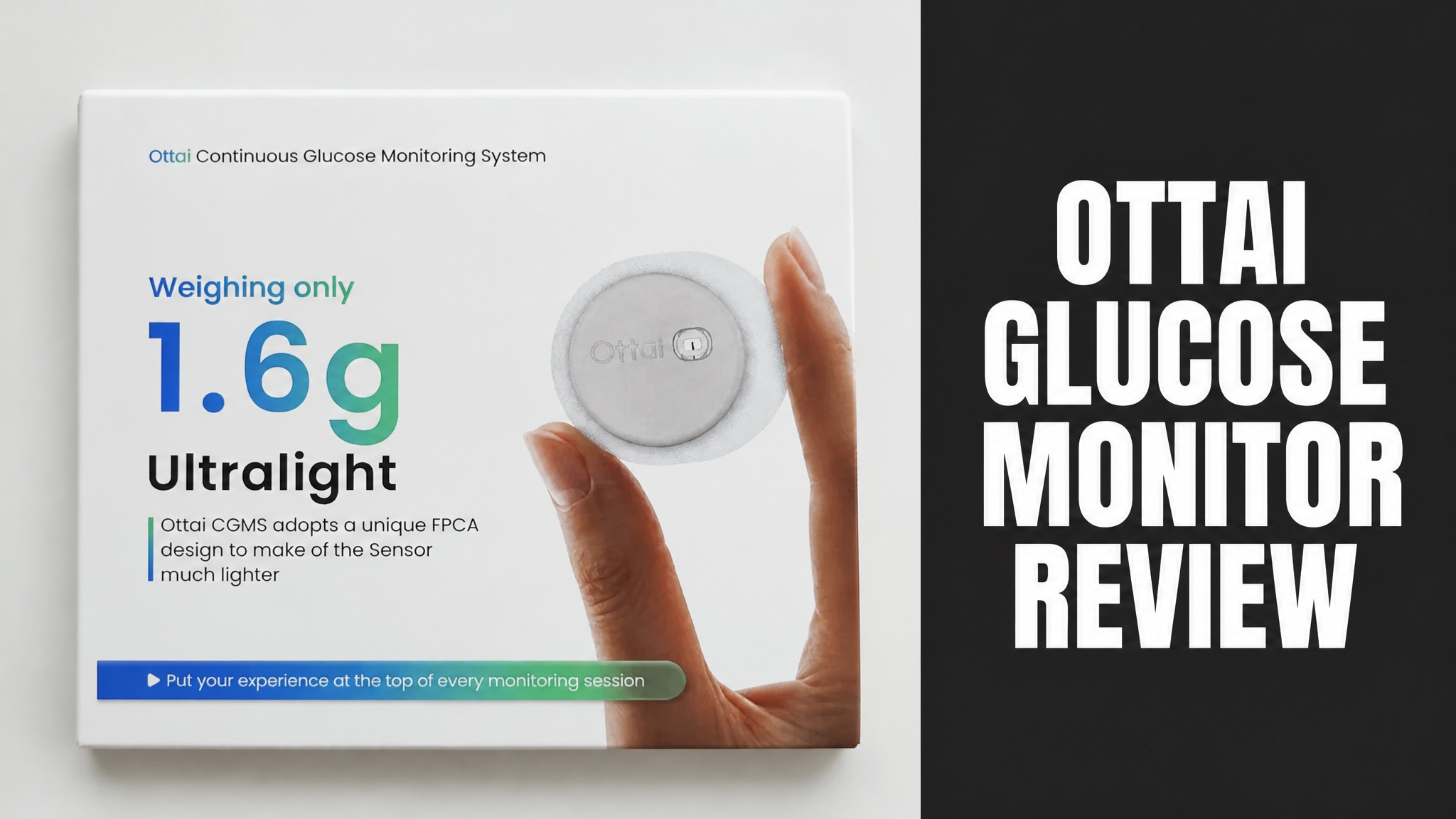
The Ottai glucose monitor is a continuous glucose monitor (CGM) made by Ottai Medical, a company that operates mainly in China. It sends readings to a phone every 5 minutes for 14 days. Buyers want to know if the low price hides a trade-off.
The sensor weighs 1.6 grams (0.06 ounces) and warms up in 30 minutes. Its reported MARD is 8.11%. Users praise the app and the food insights. Others report readings that run low and support that feels automated. Price sits near $55 in many deals.
The verdict depends on what you value most. Accuracy, cost and service all pull in different directions. The sections below cover how the sensor works, what real users report, how it compares with the FreeStyle Libre 2 and whether it deserves your money.
What Is the Ottai Glucose Monitor?
The Ottai CGM is a compact, low-profile device worn on the arm that tracks glucose in real time with minimal intrusion. It reads glucose in the fluid beneath the skin and sends the data to a smartphone or smartwatch. No separate receiver exists.
Here’s the thing: a CGM is not a finger-prick meter. A meter gives one snapshot. A CGM draws a continuous curve through the day, so you see when glucose spikes, dips and settles. That curve is the whole point.
Ottai Medical makes the system. A diabetes technology newsletter lists the company as operating mainly in China and expanding into niche UK markets. The brand also sells through its own site and through marketplaces.
Who Is the Ottai CGM For?
The Ottai CGM suits people with type 1 or type 2 diabetes, athletes, health-conscious users, caregivers and pregnant women. The brand lists each group on its product page. Diabetes patients use it to keep glucose stable and fine-tune insulin.
Who Benefits Most:
- People with type 1 or type 2 diabetes
- Active individuals and athletes
- Health-conscious people without diabetes
- Parents and caregivers monitoring remotely
- Pregnant women
To be clear, the brand’s own page makes these claims. Medical advice still comes from your doctor. Ottai states its blog content is informational only and not medical advice.
How Does the Ottai CGM Work?
The Ottai CGM measures glucose in the interstitial fluid under the skin through a sensor that you apply with an applicator. The sensor sends readings by Bluetooth to an app. The system has three parts, and each one has a job.
System Components:
- Sensor that reads glucose in interstitial fluid
- Applicator that places the sensor on the arm
- Receiver, which is your smartphone or smartwatch
Does that sound complicated? Not really. The app displays a glucose card, a trend graph and daily reports. Historical data stays saved when the sensor expires and you replace it.
How Long Does an Ottai Sensor Last?
An Ottai sensor lasts 14 days of continuous monitoring, plus an extra 24-hour grace period. The grace period gives you time to prepare and swap the sensor. The FreeStyle Libre 2 also lasts 14 days but offers no grace window.
One reviewer on ProductReview.com.au says the adhesive held well during moderate weight training. Another reports the application was fast and barely noticeable.
How Fast Does the Ottai Sensor Warm Up?
The Ottai sensor needs up to 30 minutes from insertion to the first reading. Ottai says that is the shortest warm-up of any CGM. The FreeStyle Libre 2 needs 60 minutes, so Ottai cuts the wait in half.
The app also sends an alert when the sensor is ready. In fact, that short wait makes swapping sensors far less annoying.
What Are the Main Features of the Ottai CGM?
The Ottai CGM combines a tiny sensor, 5-minute automatic updates, AI-driven insights and a share app for up to 99 people. Readings reach your phone without scanning. A 24-hour trend view sits beside a 3-day comparison.
Key Specifications:
| Feature | Ottai CGM |
|---|---|
| Sensor size | 3.5 mm (0.14 inches) high, 24 mm (0.94 inches) wide |
| Weight | 1.6 g (0.06 ounces) |
| Reading interval | Every 5 minutes |
| Wear time | 14 days plus 24-hour grace period |
| Water resistance | 2 meters (6.6 feet) for 30 minutes |
The app also has a voice activity log. One reviewer calls it useful for quick meal, medicine and exercise entries. Here’s the part most people miss: Ottai’s app is built with AI, while the Libre 2 app offers no AI insights.
Does Ottai Have Smart Alerts?
Yes. The Ottai CGM sends high and low glucose alarms plus a Rapid Drop/Rise Alert every 30 minutes. That alert fires when glucose moves faster than 0.17 mmol/L (3.06 mg/dL) per minute. It warns you before a high or low arrives.
The Libre 2 only alerts you once you hit the threshold. What’s more, Ottai lets you customize alert ranges. Its Share app also sends hypoglycemia and hyperglycemia notices to caregivers.
Is the Ottai Sensor Waterproof?
Yes. The Ottai sensor withstands submersion up to 2 meters (6.6 feet) for 30 minutes. You can swim or bathe while wearing it. The Libre 2 handles only 1 meter (3.3 feet) for the same duration.
The sensor is also 67% smaller and 68% lighter than the Libre 2, according to Ottai. Those figures come from the brand, not from an independent lab.
How Accurate Is the Ottai CGM?
The Ottai CGM reports an accuracy of 8.11% MARD, but user results vary from near-perfect to 2 mmol/L low. Lab claims and real-life experience do not fully match. Treat the brand number as a starting point.
Accuracy also changes with wear time. One reviewer says the sensor becomes accurate after the first 1 to 2 days and improves as you keep wearing it. That reviewer measured about 0.4 mmol/L (7 mg/dL) difference from a finger-prick meter.
Reported Accuracy Data:
| Source | Result |
|---|---|
| Ottai brand claim | MARD of 8.11% |
| Verified reviewer (June 2026) | About 0.4 mmol/L (7 mg/dL) difference from a meter |
| Reviewer in New South Wales | Reads 2 mmol/L (36 mg/dL) lower than a finger prick |
| Reviewer in the Australian Capital Territory | Two sensors failed to work |
What Is the Ottai MARD Score?
MARD means Mean Absolute Relative Difference. A lower MARD means higher accuracy. Ottai lists 8.11% against 9.2% for the Libre 2. Most CGMs report a MARD under 10%, but that number does not tell the whole story.
So what does that mean for you? Check the first two days against a finger-prick meter. Ottai’s own FAQ admits readings do not always match meter results.
What Do Ottai Reviews Say?
Ottai reviews split between happy long-term users and frustrated buyers who report failed sensors or delivery trouble. ProductReview.com.au shows 2.5 out of 5 from 4 reviews. A shop listing shows 4.6 out of 5, but that page is a promotional store listing.
The sample is small. Does that mean the score is wrong? Not necessarily, but four reviews cannot settle the question. Trustpilot also lists Ottai, and the page was not readable during this research.
What Do Users Like About Ottai?
Happy users praise the app, the small sensor and the low price. One reviewer on their third sensor calls the app the best glucose monitoring interface they have used. Food insight is the biggest win.
Common Praise:
- Readings every 5 minutes for 14 days without finger pricks
- Coin-sized sensor smaller than a Dexcom G7
- Real-time view of how foods change blood sugar
- Price about half of the Libre 2
One user almost cut out boiled rice after seeing the spike. Another found substitute foods that reduce spikes.
What Are the Common Ottai Complaints?
Unhappy users report sensors that did not work, readings that run low and customer service that feels automated. One buyer tried 2 sensors and says neither worked. The same buyer says support is highly AI-driven and hard to use.
Common Complaints:
- Sensors that failed to produce readings
- Readings 2 mmol/L (36 mg/dL) below a finger prick
- Chat support that only reaches a bot
- Order tracking showing an exception error with no delivery date
The bottom line: service risk is real. Buy from a seller with a clear return policy.
How Does Ottai Compare With FreeStyle Libre 2?
Ottai beats the FreeStyle Libre 2 on warm-up, automatic updates, trend history, size and price, according to Ottai’s own comparison. Note the source. The brand wrote that comparison, so treat it with care. Independent tests would be stronger evidence.
Ottai vs FreeStyle Libre 2:
| Feature | Ottai CGM | FreeStyle Libre 2 |
|---|---|---|
| MARD | 8.11% | 9.2% |
| Warm-up | 30 minutes | 60 minutes |
| Updates | Automatic every 5 minutes | Scan required |
| Trend history | 24 hours | 8 hours |
| Water resistance | 2 meters (6.6 feet) | 1 meter (3.3 feet) |
| Weight | 1.6 g (0.06 ounces) | 5 g (0.18 ounces) |
Smartwatch support is another gap. Ottai connects to Apple Watch and Samsung watches. The Libre 2 offers no direct-to-watch link.
Which Costs Less, Ottai or Libre 2?
Ottai costs less. In Australia most patients pay AUD $55 for a first Ottai sensor, against $100 or more for the Libre 2. That applies to buyers not eligible for the NDSS subsidy.
One reviewer calls Ottai about half the price of the Libre 2. Cheaper is not automatically better. Still, the gap is large.
Is the Ottai CGM Legit and Safe?
Yes. Ottai is a real operating company with a live website, a user guide, an app and a support policy. Real people also report using the sensor for months. However, support quality and accuracy draw complaints.
The brand’s FAQ states that issues from improper use may not be covered by its after-sales policy. Read that policy before you buy.
Is Ottai FDA Approved?
No source reviewed confirms FDA clearance. The research found no FDA approval claim for the Ottai CGM. Ottai also does not list a regulatory status on its main product page.
So check before you buy. Ask the seller for certification in your country. Do not use any CGM as the sole basis for insulin decisions without your doctor’s approval.
How Much Does the Ottai CGM Cost?
The Ottai CGM costs roughly $55 to $60 per sensor in promotional deals, but some buyers paid far more. A two-box set listed at $55.61 on a store page. Reviewers paid $58 and about AUD $54 on deals.
Reported Prices:
| Source | Price |
|---|---|
| Store listing, 2-box set | $55.61 |
| Verified reviewer, June 2026 | $58 |
| Australian first-sensor price | AUD $55 |
| Reviewer purchase, September 2026 | $99 |
| Reviewer purchase, October 2026 | $188 |
Prices vary by country, bundle size and seller. The $188 purchase likely covered several sensors, though the review does not say.
Is the Ottai CGM Worth the Price?
Yes, for budget buyers who accept some risk. The low price makes continuous monitoring accessible to people who cannot afford premium brands. One reviewer calls it the cheapest option available.
Is it a bargain if the sensor fails? No. Two bad sensors erase the savings, so keep your order records.
Should You Buy the Ottai Glucose Monitor?
Buy it if you want an affordable CGM with a strong app and can verify readings against a meter. Skip it if you need regulatory certainty or guaranteed fast support. Think of it as a budget tool that needs checking.
The good news? The upside is real. Food spike insights changed eating habits for two reviewers. Check readings for the first two days, and keep a finger-prick meter handy.
Where Can You Buy the Ottai CGM?
You can buy Ottai on the official Ottai website and through marketplaces such as Shopee and AliDeals-style store listings. The official site has a buy page and a track-order page. Marketplace deals can undercut it.
Short answer: choose a seller with clear returns. One buyer waited weeks with no delivery date. Pay with a method that protects you.