
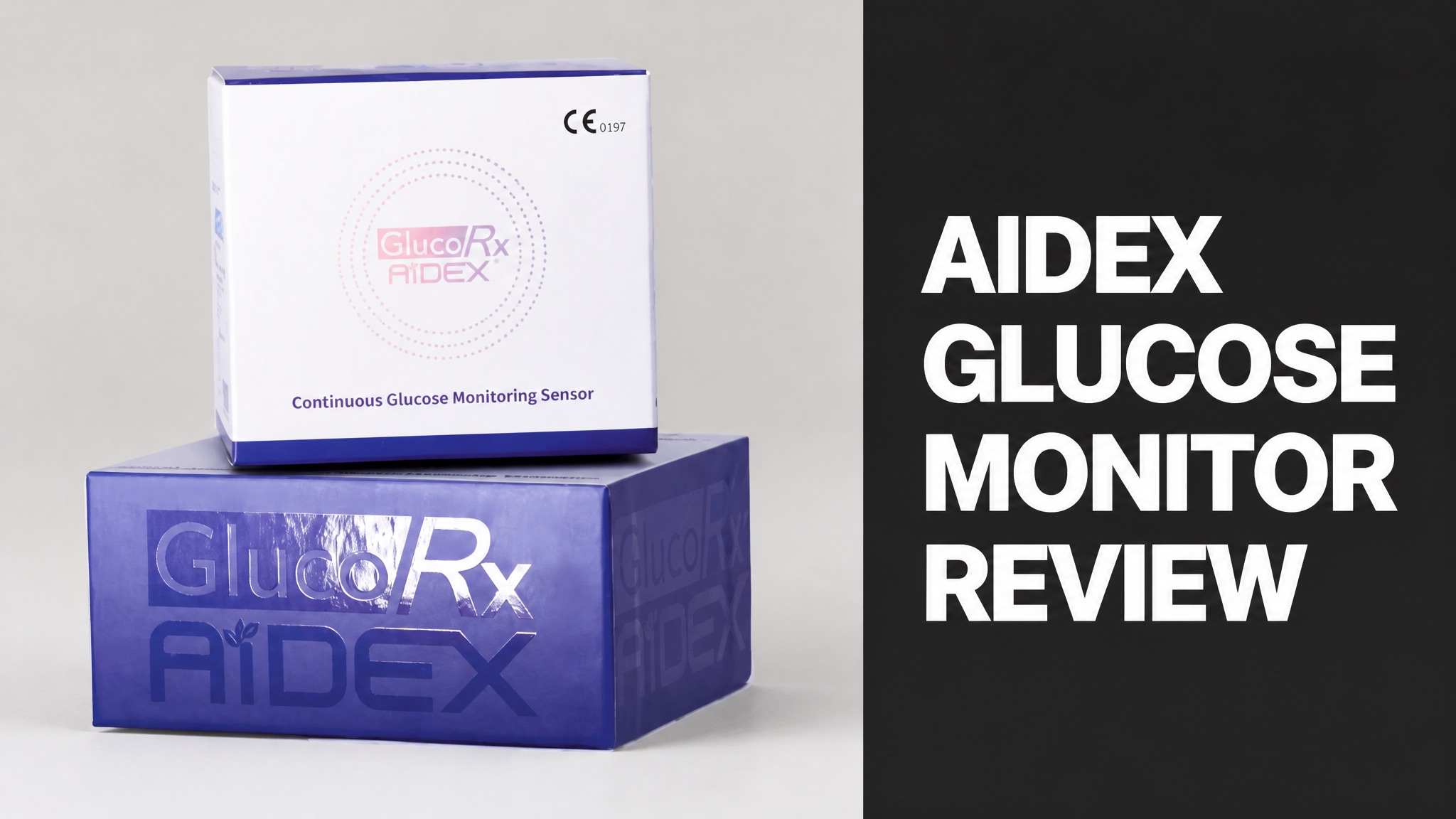
The Aidex glucose monitor is a continuous glucose monitoring system from Microtech Medical in China. The system sells in the UK as GlucoRx Aidex. A body-worn sensor sends readings to a phone app every five minutes for up to 14 days. Distributors also sell it in New Zealand and South Africa.
Aidex works through a small sensor, a reusable transmitter and a smartphone app. Real-time alerts, a 14-day wear time and a low price drive its appeal. Clinical trial data shows a MARD of 9.08%, but independent testing found a wider error range. The UK starter kit costs £99.85 (roughly $125 USD) excluding VAT. Alerts cover highs, lows and fast changes.
Reviews split between budget users who praise the trend data and critics who question accuracy. The guide covers how Aidex works, what it costs, who should avoid it and whether the price is worth it. Read on to decide if the trade-offs fit your needs and budget before you buy.
What Is the Aidex Glucose Monitor?
The Aidex glucose monitor is a continuous glucose monitoring system built by Microtech Medical in Hangzhou, China. In the UK it sells as GlucoRx Aidex. A body-worn sensor sends a reading to a phone app every five minutes. Short answer: it replaces constant fingersticks with a live glucose trend line. Both iOS and Android phones can run the free app.
The system is approved for ages 14 and older. Is it a brand new product? Not really. The main clinical study appeared in 2021. Distributors now sell the system in the UK, New Zealand and South Africa.
How Does Aidex Work?
Aidex measures glucose in the fluid under the skin with a glucose-oxidase electrochemical sensor. The sensor clips onto a reusable transmitter. The transmitter sends data through Bluetooth to a smartphone app every five minutes, so users see trends without scanning. The app also stores history, so users review glucose patterns over several days and weeks.
A 60-minute warm-up follows every new sensor. No readings appear during that hour. The maker aims for factory calibration, and fingerstick calibration is still advised when the app and a meter disagree.
What Does the Aidex System Include?
The Aidex starter kit includes one reusable transmitter and two 14-day sensors for a month of wear. GlucoRx lists the kit at £99.85 (roughly $125 USD) excluding VAT. Users also need an iPhone 6 or newer, or a compatible Android phone. The kit covers the hardware. The app, the cloud portal and the alerts come free of charge with the system after setup.
The wearable parts measure 36 mm by 22 mm by 8 mm (1.4 by 0.9 by 0.3 inches). Sensors apply to the arm or abdomen in one action. And the transmitter lasts four years, according to the distributors.
Aidex Specifications:
| Feature | Detail |
|---|---|
| Sensor life | 14 days |
| Warm-up | 60 minutes |
| Reading interval | 5 minutes |
| Transmitter life | 4 years |
| Sensing range | 36 to 450 mg/dL (2.0 to 25.0 mmol/L) |
| Minimum age | 14 years |
What Are the Benefits of Aidex?
The main benefits of Aidex are a low price, a long sensor life and real-time Bluetooth alerts without scanning. The sensor tracks glucose day and night. Users spot rising and falling trends early and act before readings reach a dangerous range. Pricing also undercuts rival CGM brands. Reviewers on both sides of the accuracy debate agree on that last point.
Maker materials add six customizable alerts and data sharing with family or clinicians. In fact, the benefits are real. The open question is accuracy, and later sections cover that.
Main Benefits:
- Low upfront and ongoing cost
- 14-day sensor life
- Real-time high and low alerts
- Bluetooth data without scanning
- Reusable transmitter with a four-year life
Does Aidex Show Glucose in Real Time?
Yes. Aidex sends a new glucose reading to the app every five minutes through Bluetooth. The app displays the current value, a trend arrow and a history graph. Users do not scan the sensor to see a number, unlike flash systems. Real-time delivery also powers the alert system, which warns users about fast drops or climbs before they cross a threshold.
Alerts cover high glucose, low glucose and rate of change. Data also syncs to a cloud portal. So caregivers can check numbers remotely when the phone has a connection.
Is Aidex Water Resistant?
Yes. The sensor and transmitter carry an IPX7 rating for up to 1 metre (3.3 feet) of water for 30 minutes. Showering and light exercise are fine. Longer immersion is not advised, according to the GlucoRx instructions. Users can wear the sensor in the shower and during workouts. The transmitter stays attached during both, so daily routines carry on.
Maker marketing mentions swimming. The distributor limit is stricter. Which one wins? The rating on the distributor page is the safer guide for long swims.
How Accurate Is Aidex?
Aidex accuracy depends heavily on which study a reader trusts. The maker-backed trial reported a MARD of 9.08% against venous blood. An independent single-user test measured 15.1% against fingersticks. Lower MARD means closer agreement with reference values, so that gap matters for insulin dosing. Reviewers also compare its results with the Dexcom G6 sensor.
Here’s the thing: MARD alone hides risk. Error grids and hypo detection matter as well. The next sections show where Aidex held up and where it slipped.
Does Aidex Match the Clinical Trial Claims?
No. Independent testing did not reproduce the 9.08% MARD from the maker-backed trial. Blogger Diabettech wore Aidex beside a Dexcom G6 for 14 days and logged 112 fingersticks. Aidex scored 15.1%, against 9.2% for the G6 within its official life. The gap between the two results is large enough to affect treatment choices, so buyers should weigh both numbers.
The trial enrolled 120 people at 4 sites. Was the sample fair? Critics say it leaned toward type 2 users who do not take insulin. Distributor Homemed counters that 88.7% of participants had type 2 diabetes on insulin.
The alliance FIND left Aidex out of its ACCEDE project over how the MARD was obtained. The trial also reported 98.69% accurate readings on error grid analysis, close to the 98.96% for Abbott Libre.
Aidex Accuracy Figures:
| Source | MARD | Reference |
|---|---|---|
| Microtech trial | 9.08% | Venous blood |
| Microtech trial | 10.1% | Fingersticks |
| Diabettech test, Aidex | 15.1% | Fingersticks |
| Diabettech test, Dexcom G6 (10 days) | 9.2% | Fingersticks |
| Diabettech test, Dexcom G6 (14 days) | 11.6% | Fingersticks |
Does Aidex Miss Low Glucose Readings?
Yes, at times. Diabettech reported that Aidex missed a high proportion of low glucose events during testing. The test captured only a small number of lows, so the sample is thin. Still, the finding fits a wider error spread seen on the consensus error grid. Missed lows carry the highest risk, because a low left untreated can turn serious extremely fast.
The sensor also took about a third of its life to settle near a lower error range. To be clear, early readings varied the most. Calibration guidance was unclear, and entering a fingerstick made values jump to the typed number.
What Do Aidex Reviews Say?
Aidex reviews split between pleased budget users and critics who focus on accuracy and guidance. Community posts praise the price and the trend view. Independent testers criticize sticking power, instructions and error spread. Both groups agree the device is cheap. Many posts come from distributor communities, so readers should weigh the source of each post.
So what does that mean for you? Match the review to the use case. Trend tracking tolerates more error than insulin dosing does.
What Do Users Like About Aidex?
Users like the price, the easy setup and the trend view. One South African user, Chris Macdonald, called it a fantastic product after six sensors. He said it did everything his Dexcom did. Another user, Lesinda, found accuracy on point against her meter. Several community members describe the price as the deciding factor in their decision to switch.
Emily Steyn gave a balanced view. No CGM is flawless, she wrote, and the value is seeing trends. Why keep paying for one? A rising or falling arrow lets her act before a fingerstick confirms the problem.
Pros:
- Low cost compared with rival CGMs
- Real-time Bluetooth readings
- 14-day sensor life
- Useful trend arrows and alerts
What Are Common Complaints About Aidex?
Complaints center on accuracy, adhesive strength and unclear calibration advice. Diabettech described a lack of stickiness and uneven instructions. The Aidex error spread was wider than the Dexcom G6 in the same test. Reviewers also flagged missed lows. Failures, inconsistent values and slow settling appear across several accounts, and each erodes trust.
The bad news? The risks stack up for insulin users. Unclear calibration steps, slow settling and missed lows all raise the stakes. Reviewers called the sensor unsafe for dosing or for driving checks.
Cons:
- Wider error spread than Dexcom G6 in an independent test
- Missed a high share of lows
- Weak adhesive in early use
- Unclear calibration guidance
How Does Aidex Compare to Dexcom and FreeStyle Libre?
Aidex trades accuracy evidence for a lower price against Dexcom G6 and FreeStyle Libre. The maker trial put it level with Libre on error grid agreement. The independent test placed it behind the G6. Price is the clear Aidex win. Buyers who rank low price first lean toward Aidex. Buyers who rank proven accuracy first lean toward the established brands.
By comparison, Aidex lasts 14 days against 10 for the G6. Does that extra time help? Only if the readings stay trustworthy through the full wear period.
Aidex vs Dexcom G6:
| Metric | Aidex | Dexcom G6 |
|---|---|---|
| Official sensor life | 14 days | 10 days |
| MARD in Diabettech test | 15.1% | 9.2% |
| MARD with G6 stretched to 14 days | 15.1% | 11.6% |
Is Aidex Cheaper Than Dexcom?
Yes. Aidex ranks among the cheapest CGM systems in the UK and New Zealand. Diabettech called it one of the cheapest on the UK market. The New Zealand distributor calls it the most affordable CGM there. The lower sensor and transmitter cost is the main reason users try it. Distributors in both countries market that price as the headline selling point.
The saving has a catch. Diabettech argued that hidden costs of poor accuracy could outweigh the lower price. And a user who double-checks every reading with fingersticks pays for both systems.
Is Aidex Safe?
Yes. Aidex works safely for trend tracking when users confirm important readings with a blood glucose meter. The UK lists it on the NHS prescription tariff. Critics counter that the error range makes it risky for insulin dosing and driving checks. Both views deserve weight. The NHS prescription tariff in the UK lists the system as an available sensor.
The distributor guidance is clear. If results do not match symptoms, use a meter for treatment decisions. Pay attention to this: that rule applies to every CGM, and it matters most here.
Who Should Avoid Aidex?
People who dose insulin straight from CGM numbers should avoid relying on Aidex alone. Diabettech called it unsafe for dosing and for pre-drive checks. Users under 14 fall outside the approved age range. Anyone who needs dependable low alerts should also take care. Parents of very young children should also pick a system approved for that age group.
Who Should Be Cautious:
- Insulin users who dose from CGM readings alone
- Drivers who check levels before a trip
- Anyone under 14 years old
- People who need reliable hypo detection
How Much Does Aidex Cost?
A UK Aidex starter kit costs £99.85 (roughly $125 USD) excluding VAT for one transmitter and two sensors. People with diabetes are exempt from VAT, so the checkout price drops. Standard delivery on single sensors adds £4.95. Subscriptions remove reorder hassle. Prices change by region, so buyers should confirm the current listed figure at final checkout.
GlucoRx runs repeat plans with sensors every 4, 12 or 48 weeks. The transmitter is not included in any plan. In plain English: buy the kit once, then subscribe for sensors.
GlucoRx Aidex Subscription Plans:
| Plan | Sensors | Delivery |
|---|---|---|
| 4 week | 2 sensors | Every 4 weeks |
| 12 week | 6 sensors | Every 12 weeks |
| 48 week | 24 sensors | 6 sensors every 12 weeks |
Is Aidex Worth the Price?
No, not for dosing decisions. Aidex delivers low-cost trend data but cannot yet match rival accuracy in independent testing. Diabettech concluded the sensor is not worth the money. The low price only pays off when a user accepts wider error. Value depends on the use case, since trend tracking needs far less precision. Dosing decisions need much more.
For trend watching, though, the math changes. A person who wants to see how food affects glucose may find the price fair. That’s the best-case use.
Where to Buy Aidex?
Aidex sells through GlucoRx in the UK, Intuitive Therapeutics in New Zealand and Homemed in South Africa. The maker also runs its own store at aidexcgm.com with free shipping on orders of $200 or more. Marketplace listings exist, though buyers should check authenticity first. Local distributors also handle support, which matters for sensor replacements.
GlucoRx offers free next working day delivery on the starter kit. Buyers in the UK can choose VAT exemption at checkout. Android users should check the phone compatibility list before ordering.
Is Aidex Legit?
Yes. Aidex is a real medical device from Microtech Medical with a peer-reviewed clinical study behind it. The study appeared in the Journal of Diabetes Science and Technology in 2021. Distributors in three countries sell it, and the UK lists it on the NHS tariff. Distributors in the UK, New Zealand and South Africa all sell it through official channels.
Legit does not mean flawless. Accuracy debates continue among advocates and clinicians. And the maker-sponsored data differs from independent results.
Should You Try Aidex?
Aidex suits budget-focused users who want trend data and will verify key readings with a meter. The low cost and 14-day sensors are real advantages. Accuracy concerns are real too. The decision depends on how a user plans to act on the numbers. A trial run with fingerstick checks gives the clearest answer. Compare readings against a quality meter at first.
Bottom line: Aidex works as a trend tool, not as a dosing tool. Start with the starter kit and compare readings against fingersticks. Does it track your meter closely? Keep going. If not, switch.
Who Is Aidex Best For?
Aidex fits people who track food responses and glucose trends without strict insulin dosing needs. Type 2 users not on insulin match the profile of the maker trial. The price also helps those without CGM funding or coverage. Cost-conscious adults who accept some error and confirm readings with a meter get the most from the system. Budget matters here.
Anyone on insulin should talk to a clinician first. In fact, the safest approach is a side-by-side trial against a meter. Look at how often the readings drift and decide from there.