
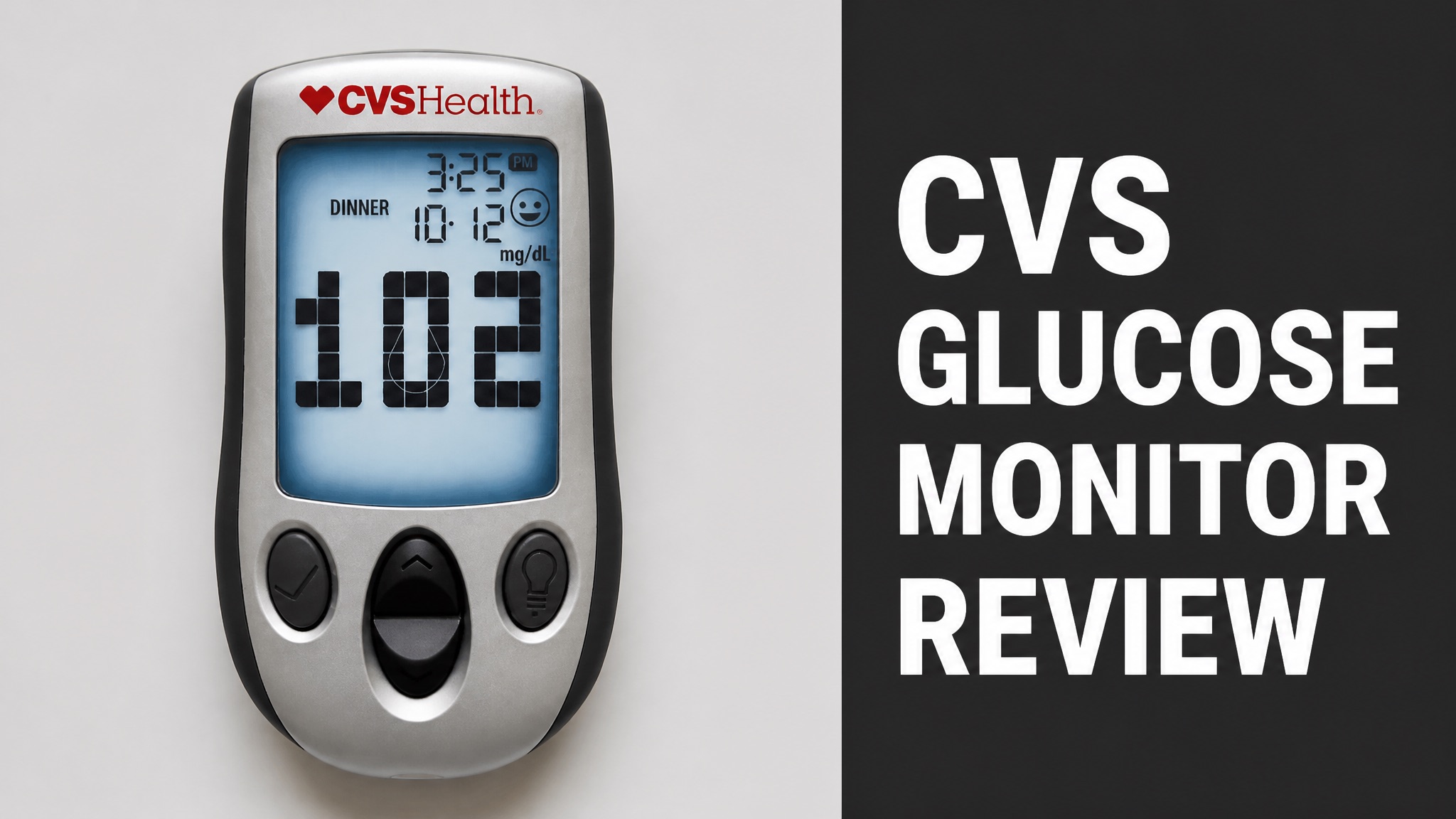
The CVS glucose monitor is the CVS Health Advanced Glucose Meter, a store-brand fingerstick meter sold by CVS Pharmacy. AgaMatrix reportedly makes it. The meter reads glucose from a 0.5 microliter blood drop in about 6 seconds and needs no strip coding. Test strips are bought separately.
Independent ratings and user comparisons place its accuracy below name brands. Reviews run from 3.3 to 5 stars across platforms. Medaval gives 2 stars. Buyers praise the price and the large display. Critics report readings 15 to 40 mg/dL (0.8 to 2.2 mmol/L) off from OneTouch or Accu-Chek. The meter costs roughly $10 to $20 (USD), and strips run extra.
The meter works as a budget backup, not a main tool for insulin dosing. This review covers features, accuracy checks, safety rules, costs, rival meters, and where to buy. Readers get the facts needed to decide with confidence before spending a dollar. Read on for clear, sourced answers.
What Is the CVS Glucose Monitor?
The CVS glucose monitor is the CVS Health Advanced Glucose Meter, a store-brand fingerstick meter sold by CVS Pharmacy. The device reads glucose from a small blood drop placed on a test strip. AgaMatrix reportedly makes it for CVS. The FDA calls this device type a blood glucose meter, and home users run it with separate test strips. Stores shelve it openly.
In plain English: the meter is a fingerstick device, not a wearable sensor. Does that matter? Yes, because fingerstick meters and continuous monitors work in very different ways.
The kit targets people who track glucose at home. The FDA says people with diabetes need to monitor their levels to manage the condition well.
Quick Facts:
- Product: CVS Health Advanced Glucose Meter
- Type: fingerstick meter that uses test strips
- Maker: AgaMatrix, as an OEM supplier
- Typical price: $10 to $20 (USD)
What Does the CVS Glucose Monitor Include?
The standard kit bundles a lancing device, a carrying case, batteries, and starter lancets. Test strips are sold separately in their own boxes. Contents can differ by retailer, so check the box before buying. Buyers who skip that check sometimes discover a missing piece only after getting home. Lancets wear out, so spare packs belong on the shopping list.
Strips are the real ongoing expense. One forum member listed strips at about 28 cents (USD 0.28) each next to a $9.99 meter. Does the low meter price tell the whole story? No, because strips drive the long-term cost.
How Does the CVS Glucose Monitor Work?
The meter measures glucose from a tiny blood sample placed on a test strip. The FDA describes the test system as a handheld meter plus strips. A result appears on the display in about 6 seconds. Each test needs only 0.5 microliters (0.0005 milliliters) of blood. The strip does the chemical work, and the meter reads the outcome. Results show in seconds.
To be clear, the strips need no coding. Why does that matter? Some meters demand a code entry for every new vial. The CVS meter skips that step.
How a Test Works:
- Wash and dry the hands before every test.
- Insert a new test strip into the meter.
- Prick the fingertip with the lancing device.
- Touch the blood drop to the edge of the strip.
- Read the result on the display after about 6 seconds.
How Do You Use the CVS Glucose Monitor?
Users follow the manual that ships with the meter and the instructions printed on the strip vial. The FDA says clean hands and close attention to the instructions both affect accuracy. Skipping the manual is the fastest way to a bad reading. The routine takes a minute, and the habit protects every later result. Read every step before the very first test.
The FDA also advises control solution tests. Run one with each new strip container, after a drop, and after odd results. The result must land inside the range printed on the vial label.
Storage matters too. Here’s why: improperly stored meters and strips give less accurate results. Follow the manufacturer’s storage rules for both.
What Features Does the CVS Glucose Monitor Have?
The meter offers a 6-second result, a 0.5 microliter sample, and a large display. Its strips need no coding at all. Reviewers also credit the simple operation. Memory holds up to 1,865 results, though that figure varies slightly by model and version. Those basics cover most home testing needs. Few extras appear, which keeps the device light and cheap.
Feature Snapshot:
| Feature | Spec |
|---|---|
| Test time | 6 seconds |
| Sample size | 0.5 microliters |
| Coding | None required |
| Memory | Up to 1,865 results |
| Display | Large and readable |
Does the meter connect to a phone? One version appears to, since a Reddit thread in r/prediabetes discusses a CVS Bluetooth glucose meter. Buyers need to confirm the model on the box.
Does the CVS Glucose Monitor Need Coding?
No. The test strips require no coding, so there’s no code chip or code number to enter before a test. New users save a step. The result is a simpler routine for occasional testers. Some meters need a code set for each new vial. A wrong code skews every result. CVS strips remove that risk. Fewer steps mean fewer chances for error. Beginners benefit most.
The convenience cuts steps. Does it improve accuracy? Not on its own. The FDA says strip quality and testing technique matter far more.
Is the CVS Glucose Monitor Accurate?
No. The CVS glucose monitor falls short of name-brand accuracy in independent ratings and in user comparisons against other meters. Medaval gives it a 2-star clinical validation rating. Users also report readings 15 to 40 mg/dL (0.8 to 2.2 mmol/L) off from OneTouch or Accu-Chek. Both signals point toward caution before relying on any single reading.
Accuracy Evidence:
| Source | Finding |
|---|---|
| Medaval | 2-star clinical validation rating |
| Community reports | 15 to 40 mg/dL higher than OneTouch or Accu-Chek |
| Keto forum user | About 30 mg/dL lower than Precision Xtra |
| Borrowed third meter | Agreed with Precision Xtra |
The direction of the error varies. Some users report high readings and one reports low. What does that tell buyers? The error looks unpredictable. A steady bias would be easier to live with.
Does the CVS Glucose Monitor Read Too High?
Yes. Some users report the meter reads 15 to 40 mg/dL (0.8 to 2.2 mmol/L) higher than OneTouch or Accu-Chek monitors. Those reports come from community discussions, not lab trials. The pattern still deserves attention, because a consistent high bias would hide real changes in glucose levels. Doctors rely on meter data, so a skewed meter misleads care.
But the picture isn’t uniform. One keto forum user saw readings in the low 70s to mid 80s mg/dL. A Precision Xtra showed about 30 points higher. In fact, that CVS meter read low.
How Can You Check the CVS Glucose Monitor’s Accuracy?
The FDA lists three checks: control solution tests, the meter’s electronic self-check, and a comparison with a laboratory result. Each check catches a different problem. Control solutions test the strips, the self-check tests the hardware, and the lab test confirms real-world accuracy. Together they give a clear picture of meter health. Each takes minutes.
The reason is simple: a lab comparison is the strongest test. Take the meter to a provider appointment and have blood tested by a laboratory method. Matching values mean the meter and the technique both work.
Reference ranges help with context. The American Diabetes Association puts fasting glucose for adults without diabetes below 100 mg/dL (5.6 mmol/L). Two hours after meals, the figure is below 140 mg/dL (7.8 mmol/L).
What Do CVS Glucose Monitor Reviews Say?
Reviews land at mixed to positive, with ratings from roughly 3.3 to 5 stars depending on the platform. Buyers praise the price and the simple operation. Critics point to accuracy and consistency. One review aggregator, medic.hrt.org, lists zero user ratings so far. Star counts therefore vary a lot by where a buyer looks. Check several sources first.
Review Snapshot:
| Theme | Verdict |
|---|---|
| Price | Praised |
| Ease of use | Praised |
| Kit contents | Praised |
| Accuracy | Criticized |
| Consistency | Criticized |
What Do Users Like About the CVS Glucose Monitor?
Users like the low price, the large display, and the simple operation that needs no strip coding. Retail reviews repeat these points often. Ease of use is the most common compliment. Buyers describe the meter as easy to read and quick to learn, even for first-time testers. Reviewers rarely complain about the display or the buttons. Simplicity wins fans.
The bundle gets praise too. Buyers value the included lancing device, carrying case, batteries, and starter lancets. And the $10 to $20 (USD) price makes it a popular backup meter.
What Are the Common CVS Glucose Monitor Complaints?
The top complaint is accuracy variance against name-brand meters such as OneTouch and Accu-Chek. Users describe gaps of 15 to 40 mg/dL (0.8 to 2.2 mmol/L). The gap shakes trust in any single reading. Consistency is the second complaint, because repeat tests on the same meter do not always agree. Reviewers label the meter a backup, not a primary tool.
Reviewers also push alternatives. Healthcare forums frequently recommend higher-ranked meters such as the Contour Next. The good news? Those meters are easy to find at most pharmacies.
What’s more, one buyer dropped the CVS meter after a head-to-head test. A Precision Xtra and a third borrowed meter both disagreed with it. Trust ended there.
How Does the CVS Glucose Monitor Compare to Name Brands?
The CVS glucose monitor wins on price and loses on its reputation for accuracy against major name brands. Forum users trust OneTouch, Accu-Chek, and Precision Xtra more. Reviewers frequently recommend the Contour Next. Cheap alternatives such as the ReliOn Premier also exist, so the CVS price edge is smaller than it looks. Strip prices matter just as much.
Meter Comparison:
| Meter | Buyer Sentiment |
|---|---|
| CVS Advanced | Cheap, mixed accuracy reports |
| OneTouch | Used as a reference by forum users |
| Accu-Chek | Used as a reference by forum users |
| Precision Xtra | Better reputation for accuracy |
| Contour Next | Frequently recommended by reviewers |
| ReliOn Premier | Walmart budget option near $9 (USD) |
How Does the CVS Glucose Monitor Compare to Precision Xtra?
The Precision Xtra earned forum trust after a direct head-to-head test against the CVS meter. The CVS meter showed the low 70s to mid 80s mg/dL. The Xtra read about 30 points higher. A borrowed third meter sided with the Xtra, so the buyer concluded that the CVS unit read too low. Commenters backed that conclusion. The test shows why a second meter helps.
Commenters advised sticking with the Xtra for its reputation. They also advised using one meter consistently. Why? Trends stay reliable even when absolute numbers drift.
Another commenter offered a practical trick. Test glucose before and after a plasma lab draw. Then add or subtract a few points mentally for the home meter.
Is the CVS Glucose Monitor Safe?
Yes. The CVS glucose monitor is safe to use as a single-patient device when users follow the FDA’s handling rules. Fingerstick meters carry known risks that simple habits control. The FDA flags bloodborne pathogen spread from shared meters as one key hazard. The bigger risk is a wrong number, not the device itself. Careful handling keeps the risk low.
FDA Safety Rules:
- Never share the meter with another person
- Use only new strips authorized for sale in the United States
- Store the meter and strips per the manufacturer’s rules
- Wash and dry the hands before testing
- Check the manual for operating temperature and humidity
A reading that’s 15 to 40 mg/dL (0.8 to 2.2 mmol/L) off can mislead decisions. Does that matter for someone on insulin? Absolutely, and that is why accuracy outweighs price.
Who Should Avoid the CVS Glucose Monitor?
People who dose insulin from meter readings need the most accurate meter available, so a provider’s recommendation comes first. The accuracy reports make the CVS model a weak fit for that job. A name-brand meter lowers the risk, and a provider can name the best option for each patient. Anyone with anemia or dehydration needs extra caution as well, per FDA.
The FDA lists conditions that distort results on any meter. Severe dehydration, anemia, extreme hematocrit, and high uric acid conditions such as gout all matter. Vitamin C and acetaminophen can interfere too.
Alternate site readings need care. The FDA says never use them to calibrate a continuous glucose monitor or to calculate insulin doses. Use the fingertip when sick, stressed, or after eating.
How Much Does the CVS Glucose Monitor Cost?
The meter costs roughly $10 to $20 (USD) at most retailers, with one forum poster citing $9.99. The same 2023 post listed strips at about 28 cents (USD 0.28) each. Prices change often, so confirm them at the shelf before buying. Strip costs add up fast for daily testers. Budget buyers feel the strip price most. Compare the price per test strip, too.
Price Snapshot:
| Item | Reported Price (USD) |
|---|---|
| CVS Advanced meter | $10 to $20 |
| CVS strips (forum report) | About $0.28 each |
| ReliOn Premier meter | About $9 |
| ReliOn Premier strips | $17.88 per 100 ($0.18 each) |
Is the CVS Glucose Monitor Worth the Price?
Yes. For $10 to $20 (USD), the meter works as a budget backup but not as a main tool. The low cost suits occasional checks and travel. Daily dosing decisions deserve a better-rated meter. The value holds only when the buyer treats the numbers as a rough guide and confirms them elsewhere. Spare meters really earn their keep in glove boxes and travel kits.
Cheap strips only help if readings are trustworthy. Is a saved dollar worth a wrong number? Rarely, for daily dosing. But for a spare meter in a travel bag, the math works.
Where Can You Buy the CVS Glucose Monitor?
CVS sells the meter in its stores and online at CVS.com, with listings on Amazon, eBay, Instacart, and Uber Eats. Store shelves let buyers check the box contents first. Online listings often show the exact kit. Delivery apps add convenience, though prices on third-party platforms can differ from the store shelf. Both routes work well for most buyers.
CVS also sells True Metrix Cash test strips in a 100-count pack. Those strips belong to a separate strip line. So buyers must match the strips to the meter model before checkout.
Does CVS Offer Savings for People With Diabetes?
Yes. CVS has offered the ExtraCare Advantage for Diabetes program through its free mobile app. A 2013 Diabetes Health report said the program offers savings on testing supplies, glucose test strips, and meters. Terms have likely changed since then, so verify current details in the app before counting on any discount. Ask a pharmacist about current offers.
Watch out for resale listings. Why? The FDA warns against pre-owned strips or strips not authorized for sale in the United States. Buy strips new, from a trusted seller.
Should You Buy the CVS Glucose Monitor?
Yes. The CVS glucose monitor works as a cheap backup or occasional-check meter for budget shoppers. The price is hard to beat. Accuracy reports are the weak point. Bottom line: buy it as a spare, and check it against a name brand or a lab result. Rely on it alone only after that comparison passes. Spare meters cost little. The meter fits that role well.
The decision comes down to use. What does the meter need to do? If the answer is daily insulin dosing, a higher-ranked option is the safer pick.
Who Is the CVS Glucose Monitor Best For?
Budget shoppers get the most value from the meter as a secondary device for occasional checks. The large display and no-coding strips make it easy for beginners. A travel bag or glovebox is a good home for it. Losing it costs little. Replacement costs stay low. Travelers and households wanting a spare can use it for quick second opinions. Skip daily use.
People managing diabetes with insulin do better with a higher-ranked meter and a provider’s advice. And anyone who buys the CVS model benefits from a lab comparison at the next appointment.