
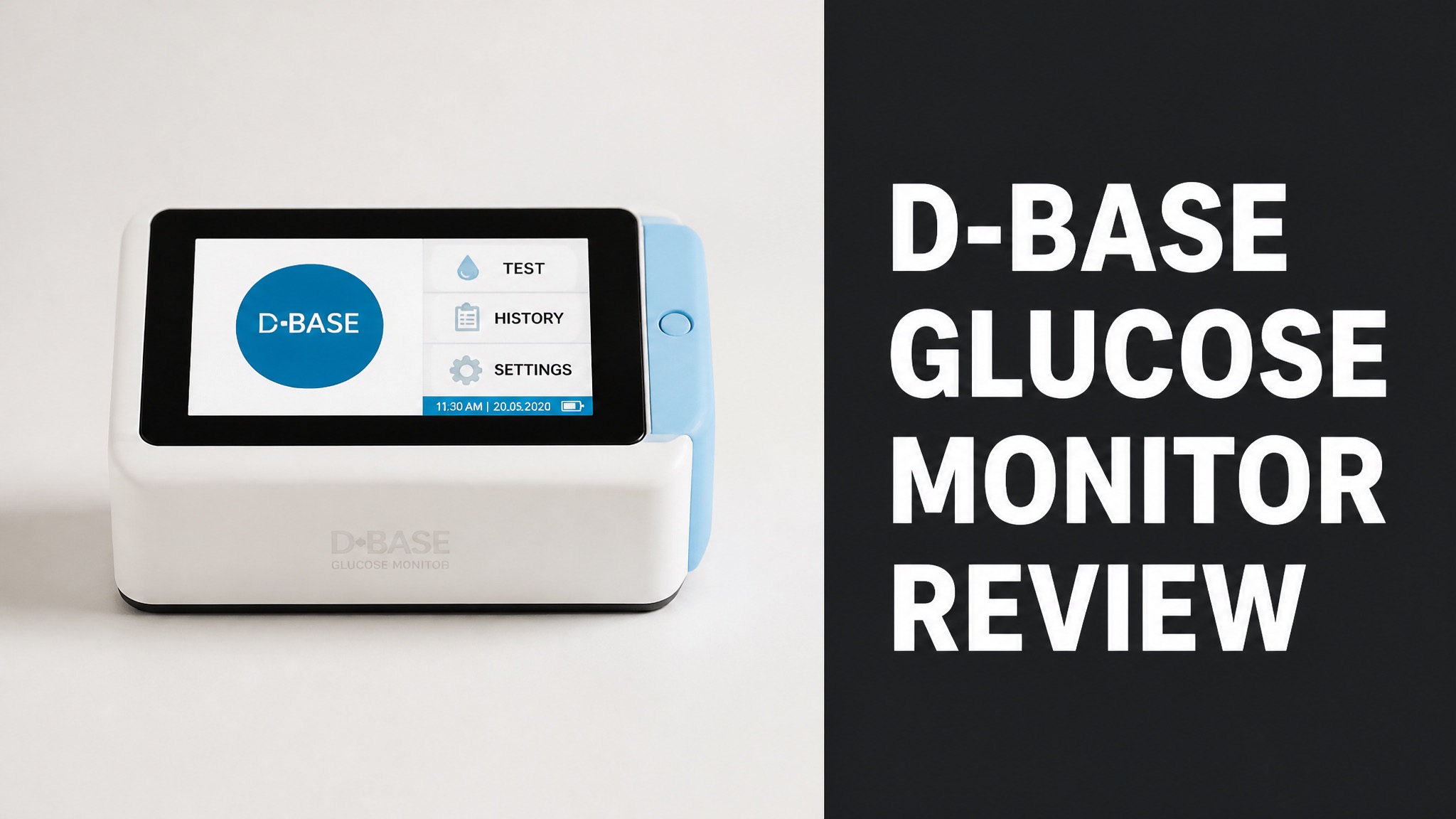
The D-Base is a non-invasive glucose meter from the Berlin company DiaMonTech. It reads glucose through the skin with a mid-infrared laser, so no blood is needed. The shoebox-sized desktop unit earned CE approval as a medical device in 2019 and targets clinics.
The device works by firing laser pulses into the skin and detecting the tiny heat that glucose releases. A 100-volunteer study reported strong accuracy, with 98.8 percent of readings in the top two error grid zones. Safety looks sound, since the laser is weak and nothing enters the body.
Still, the D-Base is not a home product, and DiaMonTech publishes no price. The handheld D-Pocket and the smartwatch D-Sensor remain in development. Read on to see how the D-Base works, how accurate it is, and who should care.
What Is the D-Base Glucose Monitor?
The D-Base is a non-invasive blood glucose meter built by DiaMonTech AG in Berlin. The desktop device is about the size of a shoebox. It reads glucose through the skin with an infrared laser. No needle or blood drop is needed, and the device earned CE approval as a medical device in 2019.
To be clear, this is not a pocket gadget. The D-Base is the first step in a three-device line. DiaMonTech built it for clinics and diabetologists, who use it to validate the technology before smaller models reach patients.
D-Base Specifications:
| Spec | Detail |
|---|---|
| Maker | DiaMonTech AG, Berlin |
| Type | Desktop, non-invasive |
| Size | About a shoebox |
| Light source | Quantum cascade laser, 8 to 11 micrometers |
| Approval | CE medical device, 2019 |
| Measurement time | About 30 seconds |
Who Makes the D-Base?
DiaMonTech AG developed the D-Base after years of research at Goethe University Frankfurt. The company was founded in 2015 and is based in Berlin. Its team spans eight nationalities, from physicists to data scientists, and Samsung Venture Investment is among its backers.
What’s more, the company won the 2025 health-i Allstar Award from Techniker Krankenkasse and Handelsblatt. Thorsten Lubinski serves as CEO and co-founder. He and Werner Mäntele co-authored the main validation study.
Who Can Use the D-Base?
Clinics and diabetologists are the intended users of the D-Base. DiaMonTech describes it as a device for several people in a clinical setting. Home users are not the target. The pocket-sized D-Pocket is the model meant for personal use, and it remains in development.
So can you put one on your kitchen counter? Not really. The shoebox size and clinical focus make the D-Base a validation tool, not a daily companion for people managing diabetes at home.
How Does the D-Base Work?
The D-Base measures glucose by shining infrared laser pulses into the skin and detecting the tiny heat they create. Glucose molecules in the skin fluid absorb the light and warm slightly. A red test laser then picks up that heat, and the device calculates a glucose value from it.
Here’s why skin fluid matters. Glucose in tears, saliva and sweat doesn’t track blood levels well. But interstitial fluid (ISF) at well-supplied skin sites matches blood glucose closely. The D-Base targets that fluid at the finger, thumb or wrist.
Measurement Steps:
- A quantum cascade laser sends infrared pulses between 8 and 11 micrometers into the skin.
- Glucose molecules in the interstitial fluid absorb the energy and release a little heat.
- The heat creates a thermal lens in the sensor element.
- A red laser beam bends as it crosses that lens.
- A photodiode measures the bend, and the device calculates the glucose concentration.
What Laser Does the D-Base Use?
The D-Base uses a tunable quantum cascade laser that emits mid-infrared light between 8 and 11 micrometers. That range holds the ‘glucose fingerprint,’ a strong absorption pattern from the molecule’s chemical bonds. The beam penetrates roughly 60 to 100 micrometers (0.06 to 0.1 millimeters) into the skin.
Only a few manufacturers make tunable lasers like this. And size is the catch. Shrinking the laser for a handheld model without changing the beam’s properties is the hardest engineering job DiaMonTech faces.
How Long Does a Measurement Take?
A single D-Base reading takes about 30 seconds in the validation study. The time depends on how many infrared spectra the device averages. Volunteers placed a finger on the sensor, and the device needed no blood sample or skin puncture to produce a value.
Why does speed matter? Fast, painless checks mean people test more often. Diabetologists cited in the study say one to two tests per day are far too few to manage highs and lows.
Is the D-Base Accurate?
Yes. The D-Base placed 98.8 percent of readings in Zones A and B of the consensus error grid in a 100-volunteer study. Those zones mark the highest accuracy tier. Less than 1 percent of readings fell in Zone C, and none landed in Zone D or E, per the 2020 paper.
To put it simply, the mean difference from a clinical reference meter was 12.1 percent. The median was 6.5 percent. An improved algorithm lifted Zones A and B to 99.1 percent and trimmed the mean difference to 11.3 percent.
Accuracy Results:
| Metric | Full data set | Improved algorithm |
|---|---|---|
| Zones A and B | 98.8% | 99.1% |
| Mean difference | 12.1% | 11.3% |
| Median difference | 6.5% | 6.4% |
What Did the 100-Volunteer Study Find?
The study tested the D-Base prototype on 100 volunteers, 41 with diabetes and 59 without. Researchers tracked each person’s glucose every five minutes for about two hours. They collected 2,379 pairs of non-invasive and finger-prick readings across 50 to 350 mg/dL (2.8 to 19.4 mmol/L).
Here is the kicker: the team saw no significant delay between skin glucose and capillary blood glucose. The reference was a HemoCue finger-prick analyzer with a specified error of 4.3 mg/dL. Each volunteer’s readings also relied on a dedicated machine-learning model, which is a limit worth knowing.
How Does It Compare to Other Non-Invasive Monitors?
Next to the InCheck, the D-Base performs far better in published accuracy testing. A 2024 study of 1,223 samples found only 18.5 percent of InCheck readings met ISO 15197:2013 criteria. Just 67.25 percent landed in consensus error grid Zones A and B.
To be clear, the two studies used different methods. The InCheck relies on photoplethysmography (PPG) light sensing, not infrared lasers. It was also tested in a hospital, while the D-Base ran a controlled volunteer protocol. Treat this as a rough comparison.
Is the D-Base Safe?
Yes. The D-Base uses a low-power laser rated at a few milliwatts that volunteers could not feel. The beam reaches only about 100 micrometers into the skin. The study reported no skin irritation, and the device has carried CE approval as a medical device since 2019.
The good news? Nothing enters the body. There’s no needle, no sensor wire and no adhesive patch. That avoids the skin irritation some people get from continuous glucose monitors (CGMs), which the study authors call mechanically sensitive.
Safety Features:
- No blood sample needed
- No needle or implanted sensor
- Laser power of a few milliwatts
- Penetration limited to about 100 micrometers
- CE approval as a medical device since 2019
Does the D-Base Laser Hurt or Irritate Skin?
No. The laser produces no sensation and caused no skin irritation in the study volunteers. Its power sits at a few milliwatts, and it penetrates up to 100 micrometers (0.1 millimeters). Volunteers used a finger, thumb, ball of the hand or wrist on the sensor.
What about the pain? Finger pricks were the painful part. The study used pricks only for reference readings, and the team widened the measuring intervals later in each session to reduce pricking pain.
What Is the Difference Between D-Base, D-Pocket and D-Sensor?
DiaMonTech builds three devices on one laser-based glucose technology, and only the D-Base is a clinical unit today. The D-Pocket and D-Sensor are both still in development. Each model targets a different user and a different size, from a lab bench to a wrist.
Think of it this way: the D-Base proves the science, the D-Pocket brings it to your hand, and the D-Sensor aims for a smartwatch. The company also offers Diamoki, an app that tracks glucose, blood pressure, diet, activity, weight and medication.
DiaMonTech Device Lineup:
| Device | Form | Status |
|---|---|---|
| D-Base | Desktop, shoebox size | CE approved in 2019, clinical use |
| D-Pocket | Handheld, press a finger | In development |
| D-Sensor | Mini-sensor for smart watches | In development |
What Wearable Version Is Coming?
The D-Sensor is a small sensor DiaMonTech is developing with Samsung for use in smart watches. The company says continuous, painless glucose tracking matters beyond diabetes, including life sciences applications. No launch date appears on the company’s site.
Is a launch near? Nobody can say. Both the D-Pocket and D-Sensor carry an ‘in development’ label, and shrinking the laser without losing beam quality remains the stated challenge.
How Much Does the D-Base Cost?
DiaMonTech does not publish a price for the D-Base on its website or in the sources reviewed. The device targets clinics rather than retail shoppers, so the practical step is to contact the company directly for a quote. Treat any consumer price you see online with caution.
For context, a CGM sensor runs up to two weeks and uses an ultrathin needle. A desktop clinical unit sits in a different cost category. Direct price comparison isn’t possible without a published figure.
Key Buying Facts:
- Consumer sales: none announced
- Target user: clinics and diabetologists
- Price: not published
- Home-use model: D-Pocket, in development
- Wearable model: D-Sensor, in development
Where Can You Buy the D-Base?
Regular retailers do not stock the D-Base. The company website at diamontech.de is the official starting point. The sources reviewed show no listing on Amazon or in pharmacies, which fits a device built for clinical validation.
Here is the part most people miss: many ‘non-invasive glucose monitors’ sold online use PPG light sensors. The InCheck study found one such device missed ISO accuracy criteria. Verify the maker before you pay.
What Is the Final Verdict on the D-Base?
The D-Base is a credible, well-tested technology that is not yet a home product. Its 98.8 percent Zone A and B result is strong, and the team published it in a peer-reviewed journal. Clinics gain the most from it today.
Bottom line: watch the D-Pocket. That handheld model is the one aimed at personal use. Until it launches, a CGM or fingerstick meter remains the practical choice for daily glucose management.