
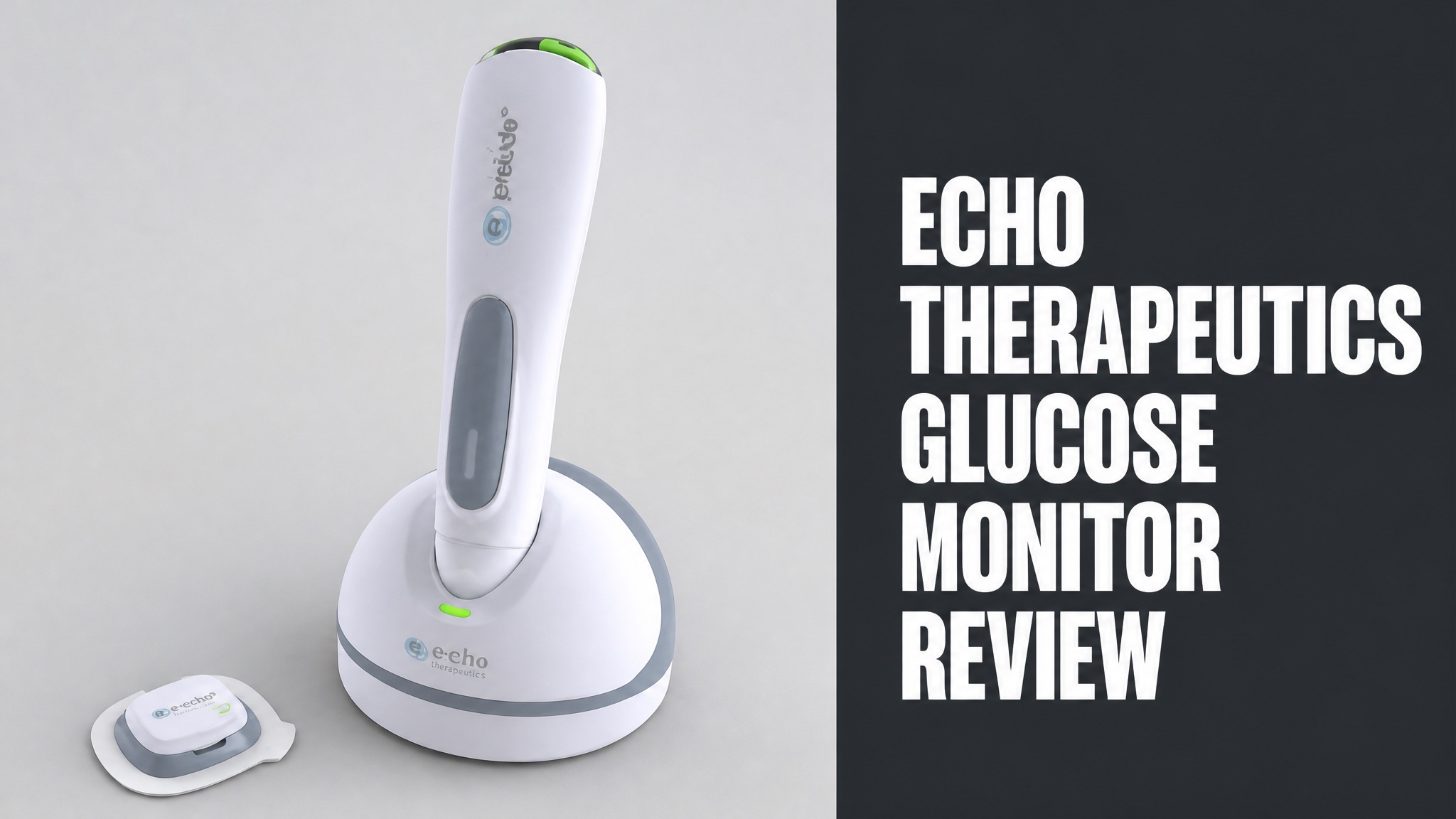
The Echo Therapeutics glucose monitor is the Symphony system, a needle-free device that reads glucose through the skin. Echo Therapeutics developed it in Philadelphia for hospitals and diabetes care. Clinical trials tested the device in surgical patients, but it never launched.
Symphony measures interstitial glucose after a skin prep device removes dead skin. A biosensor then reports a reading every minute. A 2012 ICU study showed a 9.0% error rate. Short wear time and a bulky transmitter held it back. Rivals like Dexcom already offered seven days of wear on approved sensors.
No FDA clearance has been publicly granted, and no price exists. Shoppers cannot buy the device today. Read on to see how the trials, drawbacks, approval status and costs compare, and which approved glucose monitors make the better choice.
What Is the Echo Therapeutics Glucose Monitor?
The Echo Therapeutics glucose monitor is the Symphony tCGM System, a wireless device that reads glucose through the skin. Echo Therapeutics built the system in Philadelphia for continuous glucose monitoring. A biosensor sits on a prepared patch of skin and never pierces it. The company aimed the product at hospitals and at people with diabetes.
The system has two parts. In fact, the Prelude SkinPrep device prepares the skin first. Then the Symphony biosensor sends readings wirelessly to a remote monitor. Why two devices? The skin prep is what lets the sensor read glucose without a needle.
Core Components:
- Prelude SkinPrep skin permeation device
- Symphony disposable biosensor patch
- Wireless remote glucose monitor
Who Is Behind Echo Therapeutics?
Echo Therapeutics is a medical device company headquartered in Philadelphia, Pennsylvania. The firm has pursued continuous glucose monitoring as its core technology since its founding in the early 2000s. Symphony is its primary and only publicly disclosed development program. Financing rounds and leadership changes shaped its history along the way.
Patrick T. Mooney, M.D., served as Chairman and CEO during the main clinical studies. The bad news? Echo’s stock fell 95% over two years by late 2013. Robert Doman then became executive chairman and interim CEO.
In December 2013, Echo signed a 10-year license with Medical Technologies Innovation Asia for greater China. What’s more, the deal and a Platinum-Montaur investment brought a cash infusion of nearly $10 million (USD).
How Does the Echo Glucose Monitor Work?
The Symphony monitor measures interstitial glucose through the skin after a device removes the outer layer of dead skin. A biosensor then sits only microns from the capillary bed. Readings travel wirelessly to a monitor. The monitor tracks trends and sounds an alarm when glucose leaves a personal target range. The whole process takes minutes.
Here’s why placement matters: interstitial fluid carries glucose from the blood into surrounding tissue. The sensor sits close to that source. Does closeness equal accuracy? Echo argued yes, since the sensor sits near the blood vessels.
Application Steps:
- Place the SkinPrep device against the skin through the hole in the sensor adhesive.
- Run the 10 to 20 second skin abrasion.
- Attach the biosensor to the permeated site.
- Wait one hour for the sensor to prime.
- Read glucose values on the wireless monitor.
What Does the Skin Prep Device Do?
The Prelude SkinPrep removes about 0.015 mm (1.5 microns) of the outer skin layer in 10 to 20 seconds. The stratum corneum is the barrier that blocks glucose from reaching a surface sensor. The abrasion is so shallow that it is not even visible on the skin. Removing the layer lets the sensor measure interstitial glucose.
The device senses hydration as it works. Dead skin holds about 10 percent water, while live skin holds roughly 80 percent. Does it grind too deep? According to reporting from a visit to Echo, it stops once fresh skin is reached.
How Often Does the Monitor Report Glucose?
Symphony delivers a new glucose reading every minute to its remote monitor. The bedside display shows past and current values on a graph, similar to a CGM receiver but larger. Nurses can set a custom glucose target. Alarms sound, both visual and audible, when a patient drifts outside that range. Clinicians read trends on a bedside screen without drawing blood.
Warm-up is the catch. To be clear, pilot studies reported that transdermal monitors usually needed one hour of warm-up. Some datasets also used single or multiple calibrations against reference blood glucose values.
Does the Echo Glucose Monitor Actually Work?
Yes. In trials, Symphony produced accurate readings, though the system never reached the market. Echo reported a 9.0% error rate in a 2012 intensive care study. Trial success and commercial success are two different things. No FDA clearance appears in public reporting for the device, and no home version shipped. Accuracy claims come from company-reported trials.
Short answer: the technology worked in controlled settings. But did independent labs confirm it? Echo employees co-authored the 2008 pilot paper, so outside replication matters for any buyer weighing these numbers.
How Accurate Was the Echo Monitor in Hospital Trials?
The 2012 Thomas Jefferson University Hospital study reported a mean absolute relative difference (MARD) of 9.0%. Researchers paired over 1,200 Symphony readings from 15 surgical patients with reference blood samples. Of those readings, 98.9% fell in clinically accurate zone A. Another 0.3% were benign errors. Combined, 99.2% of readings landed in zones A and B.
The good news? No adverse events came from the skin prep or the biosensor. Jeffrey I. Joseph, D.O., led the study. Glucose values ranged from 74 to 272 mg/dL (4.1 to 15.1 mmol/L).
Trial Results:
| Study | Setting | Subjects | Zone A |
|---|---|---|---|
| 2008 Study I | Outpatients with diabetes | 10 | 89.6% |
| 2008 Study II | Cardiac surgery | 8 | 86.4% |
| 2008 Study III | Healthy volunteers | 6 | 89.9% |
| 2012 ICU study | Major surgery patients | 15 | 98.9% |
What Are the Drawbacks of the Echo Glucose Monitor?
Symphony carried three main drawbacks in tested form: short sensor life, a bulky transmitter and a narrow approval request. Journalist Catherine Price, who has Type 1 diabetes, raised each concern after visiting Echo. The sensor works only on fresh skin. That skin begins to die off within about three days. Price also noted that Echo knew these limits well.
Echo sought approval for only 24 hours of wear. Dexcom already held approval for seven days. In plain English, a one-day sensor cannot compete with a monitor many users wear much longer.
Main Drawbacks:
- Sensor works only while touching fresh skin
- Approval sought for just 24 hours of wear
- Large skin-mounted transmitter
- One hour of warm-up before readings
Is the Echo Glucose Monitor Safe?
Yes. Within the trial record, Symphony reported no adverse events from the skin prep or biosensor in the 2012 ICU study. Study physicians and nurses found the system easy to apply in critical care. No consumer version shipped, so home-use safety data does not exist. Long-term skin effects remain unstudied. Hospital staff reported easy application.
The needle-free design matters in hospitals. Fewer puncture wounds mean less infection exposure for immune-compromised patients. By comparison, a study of an approved needle-type monitor reported minor bleeding. That study also saw a 17% malfunction rate (7 of 41 devices).
How Does the Echo Glucose Monitor Compare With Dexcom and Medtronic?
Symphony differs from Dexcom and Medtronic monitors because it never punctures the skin. Those rivals use a sensor inserted under the skin. Echo’s design reads glucose through a prepared skin layer instead. Wear time is where the comparison turns. Rival sensors last days longer than the one-day approval Echo sought. Needle-free wear is the core pitch.
Here’s the kicker: Dexcom reads acetaminophen (Tylenol) as glucose and gives falsely high results. That interference limits routine ICU use. Does Symphony avoid it? The sources reviewed do not say.
Symphony vs Dexcom G4:
| Feature | Symphony | Dexcom G4 |
|---|---|---|
| Skin puncture | None | Yes |
| Wear time | 24 hours sought | 7 days approved |
| Tylenol interference | Not reported | Yes |
| Market status | Never launched | On the market |
Why Did Echo Target Hospitals First?
Echo aimed Symphony at hospitals first because tight glucose control in intensive care is linked to better outcomes. A 2001 study of 1,548 patients linked tight control to 32 percent lower mortality. The target range was 80 to 110 mg/dl (4.4 to 6.1 mmol/L). Ranges like that need frequent checks.
The 2009 NICE-SUGAR trial found a 2.6 percent higher absolute risk of death at 90 days under tight targets. Why? Hypoglycemia is the likely cause. Continuous monitoring exists to catch lows early.
Hospital checks usually happen once every several hours. For example, a patient can sit high or low for hours unnoticed. Two or more readings above 180 mg/dl (10 mmol/L) link to a two-fold rise in stay cost.
Is the Echo Glucose Monitor Approved, and Can You Buy It?
No. The Symphony system has not received FDA marketing clearance based on publicly available information. Echo pursued the FDA device pathway and a European CE Mark for hospital use. No source reviewed lists a retail version, so shoppers cannot order Symphony from a store or pharmacy today. Hospitals and patients alike have no way to buy it.
Accuracy in the low glucose range remains the central FDA challenge, according to The Pharma Letter. Its latest confirmed news is a June 2024 appointment of Alan Schoenbart as CFO. Did a launch follow? No product launch appears in that update.
Regulatory Milestones:
- CE Mark clinical trial started for hospital use
- China license signed with MTIA in December 2013
- FDA marketing clearance not granted publicly
- Retail sales not reported
How Much Does the Echo Glucose Monitor Cost?
Symphony has no public price because the system never reached the market. Echo said it hoped to price its sensors below the hospital sensors then available. Sensor cost was a stated selling point of the design. No list price appears in any source reviewed for this article, so any figure online is a guess. Treat any quoted number with suspicion.
Basic testing gives a cost reference. Think of it this way: the Diathrive subscription service lists test strips from $8 per month (USD). That covers one check a day. Approved meters cost far less than a prototype.
Should You Wait for the Echo Glucose Monitor?
No. Shoppers cannot buy Symphony today, so approved CGMs from Dexcom, Medtronic or Abbott are the practical choice. Echo’s research still matters. Pilot studies showed that skin abrasion matched ultrasound skin permeation. The 2012 ICU data showed a 9.0% error rate, which is a strong result for an unreleased device. Waiting makes little sense.
Bottom line: the technology earned strong trial numbers and real clinical interest. But is that enough? Short wear time, a bulky transmitter and no approval keep the Echo Therapeutics glucose monitor off shelves.