
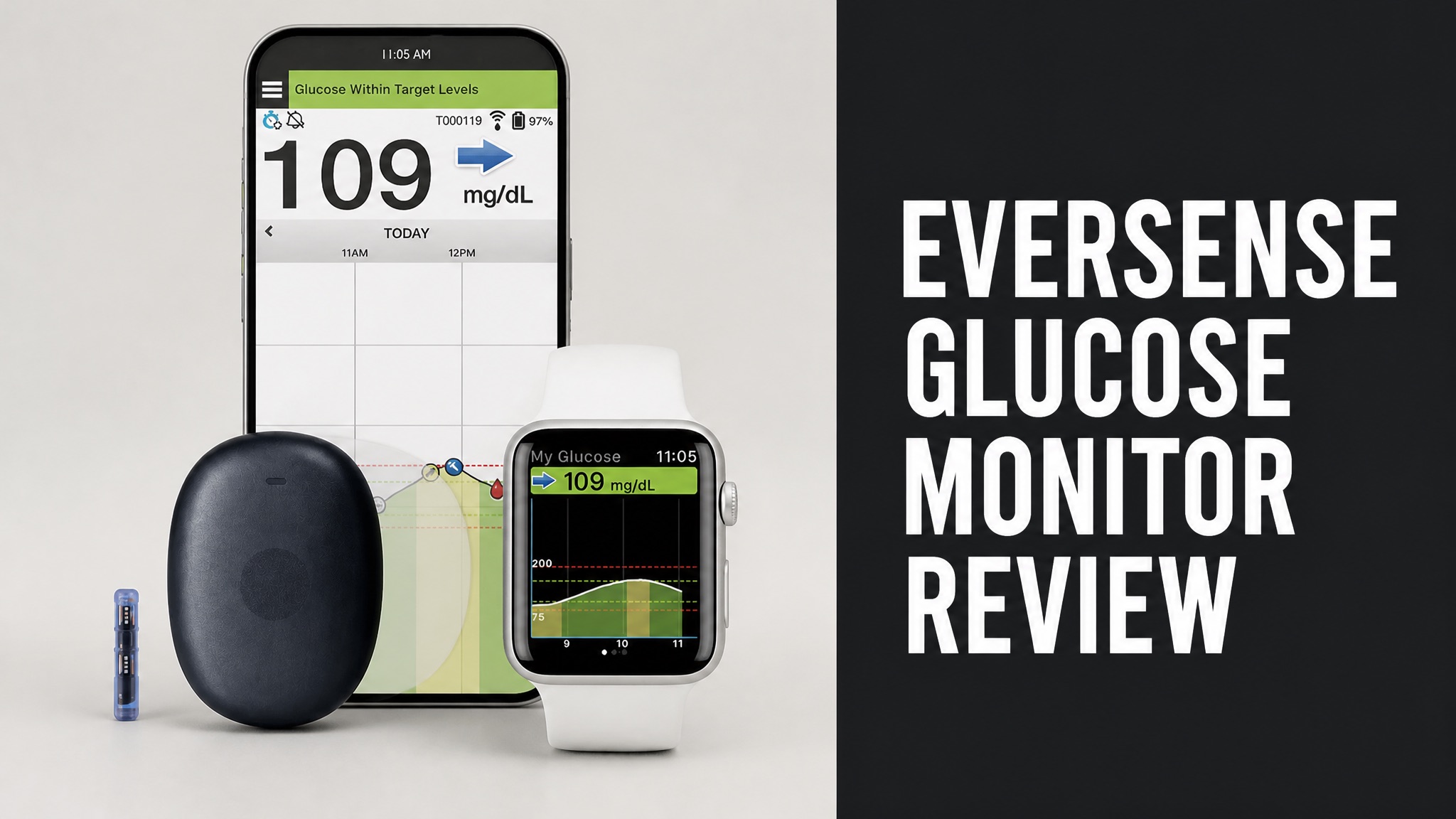
The Eversense glucose monitor is an implantable continuous glucose monitor for adults with diabetes. A small sensor sits under the upper arm skin and lasts up to a year. A removable transmitter sends readings to a phone app. Senseonics makes the system, and Ascensia Diabetes Care distributes it.
The FDA approved the system for adults aged 18 and older. A sensor reads glucose through a fluorescent coating. The transmitter sends results every five minutes. Reviewers praise the accuracy and the quiet vibration alerts. Daily charging and weekly fingersticks draw the main complaints. Insurance often covers the cost. Doctors set the alert limits.
Eversense also stacks up well against Dexcom on sensor life, though Dexcom wins on simple setup. Costs run from $199 (USD) with coverage to several thousand without it. The sections below explain who benefits most and who needs to look elsewhere. Read on for the full verdict and clear next steps.
What Is the Eversense Glucose Monitor?
The Eversense glucose monitor is the only implantable continuous glucose monitor (CGM) sold in the US for adults with diabetes. A tiny sensor sits under the skin of the upper arm. A removable transmitter on top sends readings to a phone app every five minutes. Senseonics makes it, and Ascensia Diabetes Care distributes it. Doctors prescribe it often.
In fact, two versions exist. The Eversense E3 lasts 180 days. The newer Eversense 365 lasts up to a year. Most traditional CGM sensors wear out in 7 to 15 days. So what does that gap look like? The table below shows it.
Sensor life compared:
| Model | Sensor Life | Calibration |
|---|---|---|
| Eversense E3 | 180 days | Daily after day 21 |
| Eversense 365 | Up to 365 days | Weekly after day 13 |
| Dexcom G7 | 10 to 15 days | Factory-calibrated |
Is Eversense FDA Approved?
Yes. The Eversense system holds FDA approval for adults aged 18 and older with diabetes. The agency approved the E3 version on March 29, 2023. Eversense 365 followed with clearance as an integrated CGM, so it can connect to compatible insulin pumps. Both versions are prescription devices. Only a doctor can order the system for a patient, after an exam.
The FDA also lets users replace fingersticks with E3 readings for treatment decisions. Doctors use the trends to time insulin and carbohydrates. Here’s the thing: the 2023 approval cut calibration to one per day more than 99% of the time.
How Does the Eversense Glucose Monitor Work?
The Eversense sensor measures glucose by reading light from a fluorescent coating on its surface. The coating glows in proportion to the sugar in the fluid under the skin. The system converts that light into a glucose number. The transmitter then sends the value to the app every five minutes. Bluetooth carries it, so no separate receiver is needed.
Here’s why that matters. The app compares each reading against alert limits you set. The app warns about highs and lows before they arrive. The phone must stay on, with Bluetooth and notifications enabled, for the app alerts to work.
What Are the Parts of the Eversense System?
The Eversense system has three parts: an implanted sensor, a smart transmitter and a mobile app. The sensor is about the size of two Tic-Tacs stacked together. The transmitter sits on the skin over the sensor. The app shows glucose charts, trends and alerts on iOS, Android and Apple Watch. Each part has a clear job, and all three work together daily.
System parts:
- Implanted sensor under the upper arm skin
- Rechargeable, removable smart transmitter
- Silicone adhesive patch changed daily
- Mobile app with alerts and trend graphs
To be clear, the transmitter needs charging. Charging takes 5 to 10 minutes. Dr. Steve Edelman reports the transmitter lasting about two days, although daily charging is the recommendation.
How Is the Eversense Sensor Inserted?
A trained healthcare provider places the Eversense sensor through a small cut in the back of the upper arm. The provider numbs the skin first. The visit takes about 5 to 10 minutes. Strong bandage strips cover the cut, and stitches are usually unnecessary. Removal at the end of the sensor life follows the same short process. Arms alternate each time.
Recovery is simple. Keep the site clean and dry for five days. Is the procedure scary? Reviewers describe it as quick and nearly painless. Think of it as a minor in-office procedure, much like a contraceptive implant.
What Are the Benefits of the Eversense Glucose Monitor?
The Eversense monitor offers three main benefits: a year-long sensor, removable wear and on-body vibration alerts. One insertion replaces dozens of short-term sensor changes. The transmitter comes off for showers or charging without wasting the sensor. Vibration alerts buzz on the arm when glucose runs high or low, even when the phone sits out of reach.
Main benefits:
- One sensor change per year
- Removable transmitter with no wasted sensor
- Silent vibration alerts for highs and lows
- Gentle silicone adhesive changed daily
- Compatibility with the twiist pump
And it gets better. Vibration patterns differ for highs and lows. Users learn the code over time. Prefer sound? Phone alarms stay available as a backup.
Does Eversense Deliver Accurate Readings?
Yes. The Eversense system delivers accuracy that reviewers rate above many short-term CGMs. Dr. Steve Edelman reports a typical 5 to 10% difference from a glucose meter. A user on The Diabetes Link says their old CGMs sometimes missed by 100 mg/dL. Eversense readings finally earned their trust, and they moved to an insulin pump with full confidence.
The maker also claims almost no false lows from sleeping on the arm. Does that hold up? Users on Reddit and review sites repeat it often. Still, calibration with fingersticks keeps the readings on track.
Does Eversense Cause Skin Irritation?
No. The Eversense system causes little skin irritation because the sensor sits under the skin and the adhesive is gentle. The silicone patch changes daily, which lets the skin rest and get cleaned. One user reports that site irritation vanished after switching. Insertion happens once a year, so the site heals fully between sensors. Skin gets a real break.
By comparison, short-term CGMs press adhesive onto skin for 10 to 15 days. Some wearers see inflamed sites by day ten. Does that happen here? Not often, since the sensor sits under the skin.
What Do Eversense Glucose Monitor Reviews Say?
Eversense reviews are generally positive, with praise for accuracy, comfort and the long sensor life. Doctors and long-term users both back it. Dr. Edelman calls it one choice among several excellent CGMs. He notes that preference decides which system fits best. Complaints focus on calibration, charging and the insertion visit. Opinions stay balanced.
Bottom line: most reviewers would keep it. One user with eight months of use says they never considered going back. Another reports a faulty first sensor that the company replaced for free. The trade makes sense.
What Do Users Like About Eversense?
Users praise the removable transmitter, the vibration alerts and the lack of sensor changes. One reviewer travels without packing sensors. Another says the alerts help keep time in range and improve year after year. Fewer false alarms also mean quieter nights and less stress. The buzz feels calmer than phone alarms. Another calls the system life changing.
Here’s what no one tells you. The year-long sensor also cuts insurance paperwork. Users deal with one order a year instead of constant refills. The convenience adds up fast.
What Are the Common Eversense Complaints?
Common complaints center on daily charging, fingerstick calibration and the in-office insertion visit. The transmitter is also the largest among CGMs. A power button can switch off by accident. One user dislikes the micro USB charger. Another had a faulty sensor that gave false zero readings three times. The maker replaced that faulty sensor for free.
Common drawbacks:
- Daily transmitter charging
- Weekly fingerstick calibration after day 13
- Trained provider needed for insertion and removal
- No readings while the transmitter is off
- Transmitter removal needed before an MRI
The good news? Customer service replaced the faulty sensor at no charge. Most other complaints are minor.
How Does Eversense Compare to Dexcom?
Eversense and Dexcom differ mainly in sensor life, insertion method and calibration. Eversense 365 lasts up to a year and needs a provider visit. Dexcom G7 sensors last 10 or 15 days, and users insert them at home. Dexcom comes factory-calibrated, while Eversense needs fingerstick calibration. Both read glucose every five minutes. Pick by lifestyle.
Eversense 365 vs Dexcom G7:
| Feature | Eversense 365 | Dexcom G7 |
|---|---|---|
| Sensor life | Up to 1 year | 10 or 15 days |
| Insertion | By a provider | At home |
| Warm-up | 24 hours yearly | 30 to 60 minutes |
| Calibration | Required | Factory-calibrated |
| Ages | 18 and older | 2+ (10 Day model) |
Dr. Edelman puts it plainly: it comes down to personal preference. Both are excellent systems.
Which Is Easier to Start, Eversense or Dexcom?
Dexcom is easier to start because users insert it at home and skip calibration. Warm-up lasts up to 30 minutes for the G7 10 Day. The 15 Day takes up to one hour. Eversense needs a clinic visit and a 24-hour warm-up. Setup also includes four calibrations in the first day. Dexcom skips these steps entirely, which makes the start much smoother for new users.
So is Eversense harder? Only at the start. After that, the schedule drops to one weekly fingerstick and one sensor change a year. Parents also note an age limit: Eversense is cleared for adults only.
What Are the Eversense Side Effects and Risks?
The main Eversense risks come from the insertion procedure, not from the glucose readings. The site can become infected, and the sensor may then need removal. Scar tissue can form at the placement site. Approved placement stays limited to the upper arm. Keeping the wound dry and clean for five days lowers the risk. Early care protects the site well.
Key risks:
- Infection at the insertion site
- Scar tissue formation
- False high readings from IV mannitol or sorbitol
- Sensor faults needing early replacement
To put it simply, the FDA flags sugar alcohols given by IV or dialysis. Does sorbitol in diet sweeteners matter? No. Those levels don’t affect results.
Who Should Avoid Eversense?
People who cannot tolerate the steroid dexamethasone need to skip Eversense, per the FDA label. The sensor releases a small steroid dose to limit inflammation. Children under 18 are also outside the cleared age range. Frequent MRI patients face extra steps, because the transmitter must come off before each scan. Check with a radiologist before booking.
Pay attention to this: the sensor itself stays in during an MRI. Only the transmitter comes off. The transmitter goes back on right after the scan.
How Much Does the Eversense Glucose Monitor Cost?
Eversense 365 pricing depends on insurance, and the maker has not published a firm list price. Type1Strong estimates E3 costs at about $2,700 (USD) a year for the sensor and $700 for the transmitter. Insertion runs near $450 and removal near $100. Commercial insurance patients may pay as little as $199 for a full year. Coverage drives the final price.
Estimated E3 costs:
| Item | Estimated Cost |
|---|---|
| Sensor (annual) | $2,700 (USD) |
| Transmitter | $700 (USD) |
| Insertion visit | $450 (USD) |
| Removal visit | $100 (USD) |
Those figures apply without coverage. Is that the price most people pay? No. Most plans change the math completely.
Does Insurance Cover Eversense?
Yes. Most commercial plans cover Eversense 365 for people who use insulin. Covered carriers include Aetna, Cigna, Humana, United Healthcare and most Blue Cross Blue Shield plans. Medicare also covers it. Medicaid and MediCal do not. The maker offers pre-qualification to check coverage before the first appointment, and its team helps with insurance claims.
What’s more, the PASS program lets qualified users get the sensor and transmitter for $199 (USD). Ask your provider about coverage for the insertion visit too.
Is Eversense Worth the Price?
Yes, for the right user. Eversense delivers value to people who struggle with short-term CGM accuracy, skin irritation or sensor failures. Insured users can pay as little as $199 a year. At that price, one annual sensor beats dozens of replacements. Without coverage, the cost rises fast, and cheaper options may fit better. Check your plan details first.
Is it for everyone? Not quite. People happy with Dexcom or FreeStyle Libre gain less. Those who hate fingersticks or clinic visits need to weigh that first.
Where to Buy the Eversense Glucose Monitor?
Eversense is available only with a prescription and a provider-placed sensor, not off the shelf. Patients start on the maker’s website with a pre-qualification form. A representative then calls or texts to confirm insurance and schedule placement. Ascensia Diabetes Care and Senseonics both handle distribution. GEM Edwards Pharmacy also supplies it.
Here’s the process in plain English. Ask your doctor for a prescription. Check coverage. Book the insertion visit. Then wait 24 hours for warm-up before the first calibrations.
How Do You Get Started With Eversense?
Getting started takes a prescription, an insurance check and one short insertion visit. The maker’s pre-qualification form speeds up the first step. An Eversense expert then reaches out to schedule the visit. Insulin users are the main target group. Many plans require insulin use for coverage. The maker’s team guides each step for every new patient.
Getting started steps:
- Talk to your doctor about Eversense
- Submit the pre-qualification form
- Confirm insurance coverage
- Book the sensor placement visit
- Complete warm-up and calibrations
Is the Eversense Glucose Monitor Worth It?
Yes. The Eversense glucose monitor is worth it for insulin users who want accuracy, fewer sensor changes and quiet alerts. The long sensor life saves time and hassle. Insurance often makes the price manageable. Daily charging and weekly fingersticks remain the main trade-offs. Reviewers who switched rarely go back. The year-long sensor is the main draw.
So what’s the verdict? Pick Eversense if short-term CGMs irritate your skin or fail early. Choose Dexcom if you want zero clinic visits and no calibration. Either way, don’t skip the talk with your doctor.
Who Is Eversense Best For?
Eversense suits adults on insulin who want fewer sensor changes and more reliable alerts. Dr. Edelman says it helps people with type 1 and type 2 diabetes who need frequent readings. Good candidates have skin irritation, false lows or noisy alarms with their current CGM. They also accept a yearly clinic visit. Fingerstick checks must feel acceptable.
Look at it this way. One insertion a year frees up mental space. The user who switched says their diabetes has never been better.