
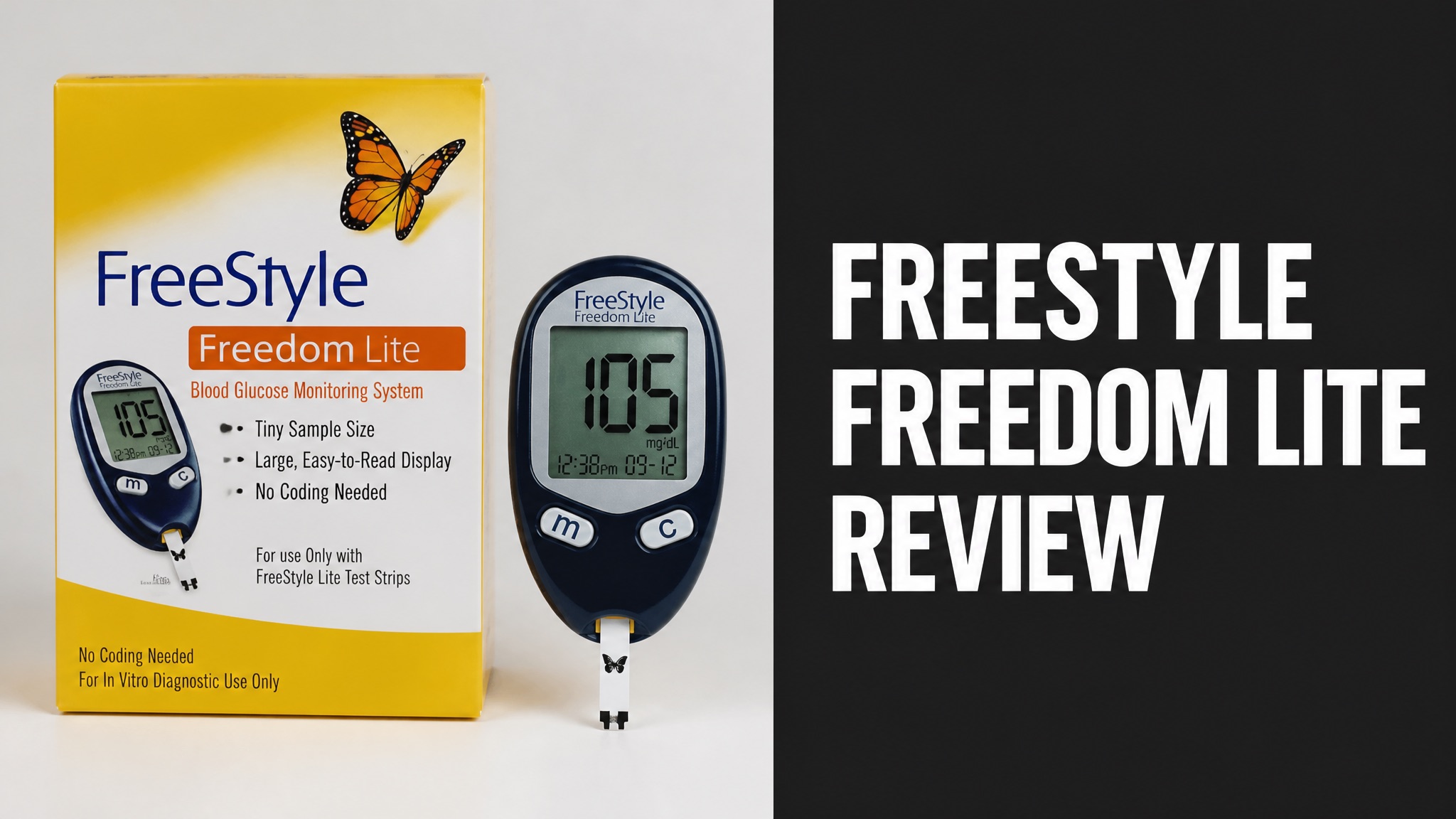
The Freestyle Freedom Lite glucose monitor is a compact Abbott blood glucose meter that tests a tiny fingerstick sample in about five seconds. Launched in 2008, it works only with FreeStyle Lite strips and needs no coding. Many buyers ask if it still holds up today for daily home testing.
The meter needs just 0.3 microliters of blood. Strips beat the 15 percent accuracy benchmark 96 percent of the time. The kit costs about $20 to $26. Strips cost far more over time. Reviews average 4.6 stars on Amazon. Insurance coverage depends on the plan. The tiny sample and simple routine make daily checks easy for most new users. Overall it suits light testers.
This review breaks down how the meter works, what it includes and what users praise or dislike. It compares the meter with the FreeStyle Lite and the Libre CGM, then covers safety, cost and buying options. You will see whether it fits your testing habits, budget and long-term monitoring needs.
What Is the Freestyle Freedom Lite Glucose Monitor?
The Freestyle Freedom Lite is a pocket-sized blood glucose meter from Abbott that reads sugar from one fingerstick drop. The system arrived in 2008 as a slimmer version of the FreeStyle Lite meter. It reads only FreeStyle Lite test strips. A result appears in about five seconds, which keeps daily checks quick and simple. Setup takes only a few minutes.
To be clear, this device is a meter, not a continuous glucose monitor. It measures one drop at one moment. Who is it built for? People who test a few times a day and want a simple routine.
Abbott pitches it as a simple, accurate meter with a large numeric display. The ADCES danatech database confirms the large display, plus reminder alarms and beeps that guide each test step.
Does the Freestyle Freedom Lite Need Coding?
No. The meter needs no coding because Abbott precodes it for FreeStyle Lite strips at the factory. A 2008 paper by Abbott scientist Shridhara Alva explains that controlled strip chemistry removes the old lot-code step. Users simply insert a strip and test. That change makes the daily routine faster and less error-prone. Setup is quick for new users.
Here’s why that matters. A wrong code once skewed readings for careless users. Skipping that step removes one common source of error. Why does that matter? Fewer manual steps mean fewer mistakes.
How Does the Freestyle Freedom Lite Work?
The Freestyle Freedom Lite measures glucose with strips that use coulometry, a method that counts electrical charge. You insert a FreeStyle Lite strip, touch the blood drop to its tip, and the meter shows a number. The whole test takes around five seconds. The reaction produces a charge that the meter converts into a glucose value. It takes mere seconds.
The ZipWik tab on the strip pulls blood in by itself. In fact, the meter also gives you 60 seconds to reapply blood if the first drop falls short.
Here’s the part most people miss: coulometry is less sensitive to temperature and hematocrit. That helps the readings stay steady in real-world conditions.
Basic Test Steps:
- Wash and dry your hands fully.
- Insert a FreeStyle Lite test strip into the meter.
- Lance the side of your fingertip with a fresh lancet.
- Touch the blood drop to the tip of the strip.
- Read the result and record it in your log.
How Accurate Is the Freestyle Freedom Lite?
The Freestyle Freedom Lite delivers strong accuracy, and its strips beat a key industry benchmark in published testing. A 2018 Diabetes Technology Society study of 18 meter brands placed FreeStyle Lite strips in the top five. They hit the 15 percent or 15 mg/dL mark 96 percent of the time. Abbott reports similar results in its own work. Real use may vary.
Abbott’s own study tested 512 fingertip readings against a lab analyzer. Results showed an r-squared of 0.98 and a mean absolute residual of 5.2 percent. Linearity held from 20 to 500 mg/dL (1.1 to 27.8 mmol/L).
Does that mean every reading is perfect? Not at all. Dirty fingers, extreme heat and old strips can still skew results.
What Features Does the Freestyle Freedom Lite Have?
The Freestyle Freedom Lite packs a large display, 400-result memory, four alarms and a tiny sample size. The meter measures 2.0 by 3.3 by 0.63 inches (5.1 by 8.4 by 1.6 cm). It fits easily in a pocket or purse. The CR2032 lithium battery lasts up to 1,000 tests, according to Healthline’s guide to the meter. Alarms remind you when it is time to test.
The CR2032 lithium battery lasts up to 1,000 tests, according to Healthline. Data can move to Abbott’s LibreView software for reports. The meter has no Bluetooth and no smartphone app.
Key Specifications:
| Feature | Detail |
|---|---|
| Test time | About 5 seconds |
| Blood sample | 0.3 microliters (300 nanoliters) |
| Memory | 400 results |
| Battery | One CR2032 lithium |
| Bluetooth | No |
What Comes in the Freestyle Freedom Lite Kit?
The retail kit includes the meter, battery, lancing device, lancets, strips, control solution, log book and case. Online Medical Supply lists the same contents, with 10 lancets and 10 test strips. Abbott also adds a limited lifetime warranty on the meter. That is a fair perk at this price, though buyers must stock extra strips soon. Plan ahead for strips.
The kit holds a quick reference guide as well. Buyers still need to stock extra strips right away, since 10 strips go fast.
What Are the Benefits of the Freestyle Freedom Lite?
The Freestyle Freedom Lite offers three core benefits: a tiny blood sample, no coding and an easy-to-read display. Abbott calls the sample size the world’s smallest. That means less pain and fewer failed tests for people who dislike deep lancing. The large numbers also help users with weaker eyesight read results at a glance. Comfort keeps people testing.
And it gets better. The meter allows alternate-site testing on the upper arms, forearms, hands, thighs and calves. Abbott still advises fingertips when you suspect low blood sugar. Is the arm less reliable? Abbott simply wants the fastest signal during a low.
Main Benefits:
- Tiny 0.3 microliter blood sample
- No coding needed for test strips
- Large, easy-to-read numeric display
- Alternate-site testing on arms and thighs
- 60 seconds to reapply blood to a strip
Does the Freestyle Freedom Lite Work With Small Blood Drops?
Yes. The meter works with just 0.3 microliters of blood, which Abbott calls the smallest sample among leading meters. By comparison, OneTouch Verio strips need 0.4 microliters and Contour Next strips need 0.6. A smaller drop means shallower lancing and less discomfort. Fewer users face the frustration of an error from too little blood. Comfort improves.
Think of it this way: a weak first drop doesn’t ruin the test. The 60-second reapply window gives you a second shot on the same strip. Is that a big deal? For nervous testers, absolutely.
What Do Freestyle Freedom Lite Reviews Say?
Freestyle Freedom Lite reviews are mostly positive. The meter averages 4.6 stars on Amazon and the strips average 4.7. Healthline reports that the strips have more than 4,700 Amazon reviews. Users like the simplicity of the system. Some reviewers still question accuracy and price, which shapes the balanced view below. Scores come from retail pages.
Praise vs Complaints:
| Praise | Complaint |
|---|---|
| Needs very little blood | Strips cost more than rivals |
| Display is clear to see | Strips are thin and hard to handle |
| Easy for new users | Some report inaccurate readings |
What Do Users Praise About the Freestyle Freedom Lite?
Users praise the meter for its tiny sample, clear screen and beginner-friendly setup. One Amazon reviewer quoted by Healthline calls it very easy to use, even for a newbie. Another says the display is clear to see and accurate. Those comments match the features Abbott highlights in its own marketing for the meter. Praise centers on ease and comfort.
The strips earn praise too. Reviewers like the ZipWik tab, which works from either side of the strip. That helps left-handed and right-handed testers alike.
What Do Users Complain About With the Freestyle Freedom Lite?
Users complain most about strip cost, thin strips that are hard to insert and occasional readings they consider off. Healthline lists the lightweight strip design as a handling issue. Medical News Today notes that some customers claim the strips and meters are not accurate. Others find the price of strips higher than competing brands. Costs add up fast.
The bad news? Lab-grade accuracy still depends on technique. Is the meter at fault? Rarely. Soiled fingers and expired strips cause many of the readings people call wrong.
How Does the Freestyle Freedom Lite Compare With Its Alternatives?
The Freestyle Freedom Lite competes with the FreeStyle Lite, the Libre CGM and rival strips like OneTouch Verio. Each option trades price, features and convenience differently. The right pick depends on how often you test and how much data you want. The table below shows how the strip systems compare on price and sample size. Each suits a different user.
Strip Comparison:
| Feature | FreeStyle Lite | OneTouch Verio | Contour Next |
|---|---|---|---|
| Price | $46.99 (100 count) | Around $60 (90 count) | Around $135 (100 count) |
| Sample size | 0.3 mcl | 0.4 mcl | 0.6 mcl |
| Coding | No | Yes | No |
| Result time | 5 seconds | 5 seconds | 5 seconds |
Freestyle Freedom Lite vs Freestyle Lite: What Is the Difference?
The Freedom Lite is a slimmer variant with a larger display. The standard FreeStyle Lite adds a backlight and port light. Healthline reports that the Freedom model skips both lights. In return, its battery lasts up to 1,000 tests, versus about 500 for the standard meter. Both models run on the same FreeStyle Lite strips. Choose by your own needs.
Both meters use the same FreeStyle Lite strips. So which one wins? Night testers prefer the lights, and travelers prefer the smaller body.
Freestyle Freedom Lite vs Freestyle Libre: Which Is Better?
The Libre is a continuous glucose monitor with a sensor worn on the upper arm for up to 14 days. It tracks trends without routine fingersticks. The Freedom Lite is a manual meter that costs far less upfront and needs no sensor. RapidRxUSA says the Libre suits people who want a fuller picture of their glucose patterns. It fits heavy testers and data fans.
Short answer: pick the Libre for constant data and the Freedom Lite for occasional checks. RapidRxUSA also notes the Lite suits people who test only a few times daily.
Is the Freestyle Freedom Lite Safe and Who Should Avoid It?
Yes. The Freestyle Freedom Lite is a safe home meter when you follow Abbott’s instructions and use only compatible strips. It is for in vitro diagnostic use only. Store it between 40 and 86 degrees Fahrenheit (4 to 30 degrees Celsius). The meter can’t diagnose diabetes or set treatment, so involve your care team in every decision. Read the manual first.
The meter doesn’t diagnose diabetes. It also can’t set your treatment. Talk to your care team before changing insulin based on a single number.
Who Should Look Elsewhere:
- People who want continuous alerts and trend arrows
- Users who need Bluetooth or smartphone syncing
- Anyone who struggles to handle very thin strips
- Patients needing a meter covered by Medicare
Has the Freestyle Freedom Lite Been Recalled?
No recall of the Freedom Lite itself appears in the sources reviewed. However, FreeStyle products have faced several FDA-flagged recalls, including a large 2014 recall of the FreeStyle and FreeStyle Flash lines. Healthline raises that history as a reason for caution. Older articles online can make the issue look current when it is not. Check lot numbers.
The takeaway is simple. Check the lot number on your strips against Abbott’s current notices before you rely on them.
How Much Does the Freestyle Freedom Lite Cost?
The Freestyle Freedom Lite costs about $20 to $26 for the meter. Strips run $30 to nearly $100 per vial. HealthWarehouse lists the kit at $23.34, and ADCES lists the meter at $20.99. Healthline gives strip prices per 50-count vial. Amazon sits at the low end. CVS and Walgreens sit at the high end. Prices shift. Strips matter more than the meter over time.
Here’s the kicker: the meter is cheap, but strips are the real cost. Medical News Today lists FreeStyle Lite strips at $46.99 for 100.
Price Snapshot:
| Item | Typical Price |
|---|---|
| Freedom Lite meter | $20 to $26 |
| HealthWarehouse kit | $23.34 |
| Strips, 100 count | $46.99 |
| Strips, 50 count (Amazon to CVS) | $30 to nearly $100 |
Is the Freestyle Freedom Lite Worth the Price?
Yes. The meter is worth the price for occasional testers. The upfront cost is low and the accuracy record is strong. Heavy testers should watch strip costs closely. Over a year, strips can cost many times more than the meter itself. Buyers who test once or twice a day get the best value from this simple system. Light testers save the most money.
The Freestyle Promise Program can soften that blow. Abbott gives a free meter and lower copays on strips through the program, per Medical News Today.
Where Can You Buy the Freestyle Freedom Lite?
You can buy the Freestyle Freedom Lite at most pharmacies, big retailers and online stores such as Amazon and HealthWarehouse. Listings also appear at Walgreens, QFC, Walmart and Carewell. Stock and prices vary by seller, so compare before you order. Check that any strips you buy are the FreeStyle Lite type, not another Abbott line. Compare prices first.
Where to Look:
- Amazon for the meter and strips
- Walgreens and QFC in store or online
- HealthWarehouse and Carewell for kits
- Abbott’s own site for official products
Does Insurance Cover the Freestyle Freedom Lite?
Sometimes. Coverage depends on your plan, and the ADCES database lists the meter as not covered by Medicare. Healthline notes that only certain strip brands qualify under many plans. Call your insurer and ask how many strips per day it pays for. Also ask whether the Freestyle Promise Program applies to your plan. Coverage rules differ by plan and state.
Bottom line: confirm coverage before buying strips in bulk. Otherwise the cash price could surprise you. Why risk it? A quick call settles the question.
Is the Freestyle Freedom Lite Worth It?
Yes. The Freestyle Freedom Lite is worth buying if you want a cheap, simple meter. It suits people who test a few times daily. The tiny sample, no-coding setup and 5-second result make daily checks painless. Strip cost is the main drawback. Buyers who need alerts or an app should compare other tools first. Look at long-term strip spending before buying.
So what does that mean for you? Buy it for basic monitoring and travel. Look elsewhere for alerts, apps or constant tracking.
Should You Choose a CGM Instead of the Freestyle Freedom Lite?
It depends. A CGM suits people who need constant data, trend alerts or fewer fingersticks, while a meter suits occasional checks. Medical News Today notes that a healthcare professional may recommend a CGM instead of a meter. Ask your care team first. Cost, comfort with wearing a sensor and insurance coverage all shape the right answer. Ask before you buy.
Many CGM users still keep a meter handy. Why? It confirms readings when symptoms don’t match the sensor.