
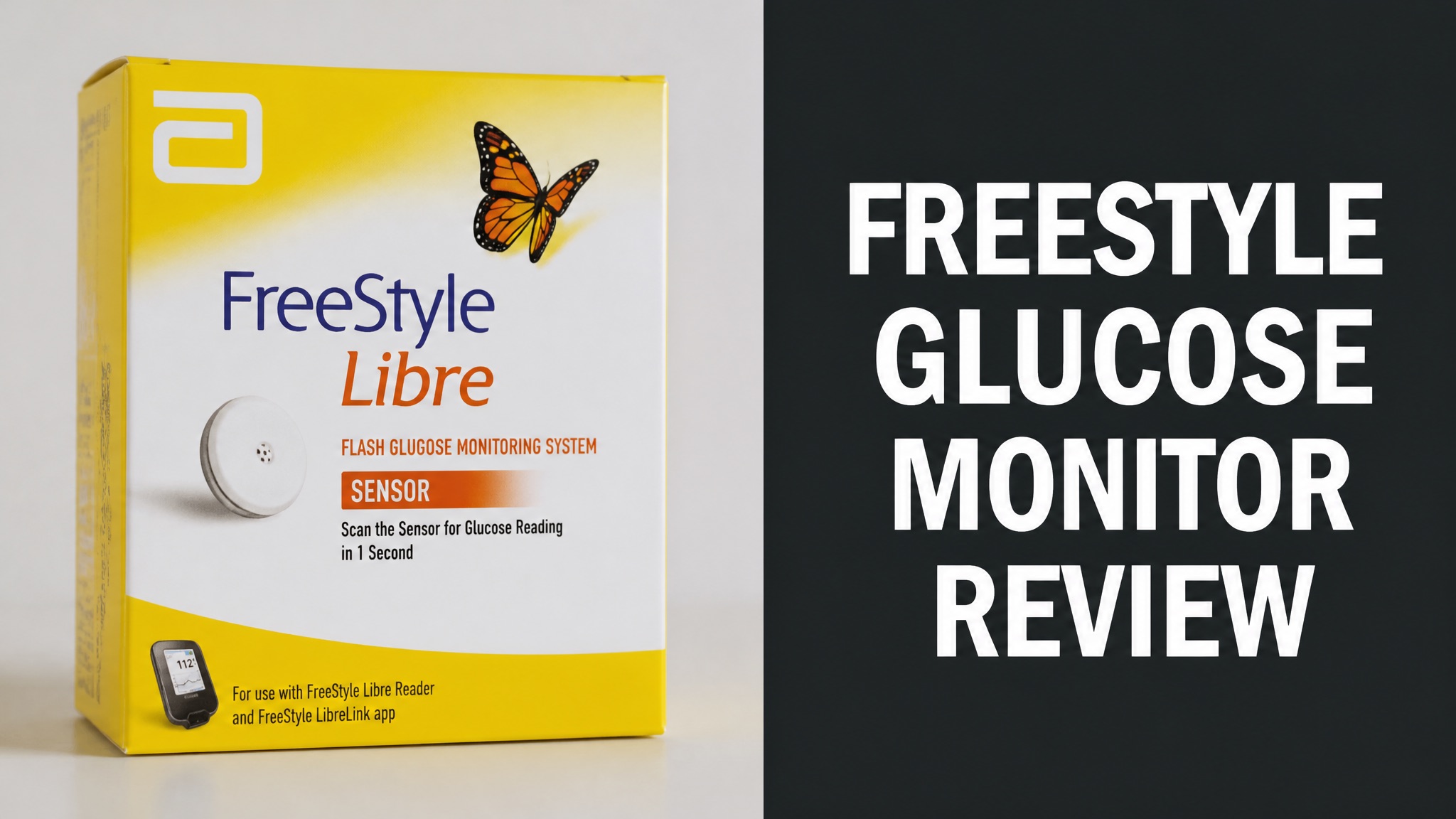
The FreeStyle glucose monitor is Abbott’s line of continuous glucose monitors and fingerstick meters for people with diabetes. Libre sensors read glucose through a tiny filament in the upper arm. Millions of users now rely on them daily, and prescriptions keep growing each year.
Libre 3 Plus streams readings every minute and lasts up to 15 days. Accuracy ranges from 7.9% to 9.2% MARD across models. Reviews are mixed on customer support. The FDA flagged Libre 3 sensors in 2025. Sensors cost about $215 to $250 monthly without insurance, roughly half of Dexcom. Prescriptions are required.
The full review covers how the sensors work, what users say, safety recalls and costs. Each answer helps buyers decide whether Libre fits their budget and needs. Keep reading to find the right model and avoid costly buying mistakes before ordering.
What Is the FreeStyle Glucose Monitor?
The FreeStyle glucose monitor is a family of Abbott devices that help people with diabetes track blood sugar. The range covers wearable FreeStyle Libre sensors and older FreeStyle Lite fingerstick meters. Libre sensors sit on the upper arm and read glucose in the fluid under the skin. Abbott makes both types, so buyers must pick the right one. Choose wisely.
In fact, Abbott launched the first Libre system in the US in 2017. The FDA called it the first CGM that needed no fingerstick testing. So, the brand now mostly means continuous glucose monitors (CGMs). Fingerstick meters remain a cheap backup. Why keep one? It’s the quickest way to double-check a strange number.
Which FreeStyle Models Exist?
Abbott sells three Libre lines today, called Libre 14 Day, Libre 2 and Libre 3. Each line has an original sensor and a newer Plus sensor. Abbott is phasing out the originals. Eventually, only the Plus versions will remain on shelves for buyers. Wear time varies from 14 to 15 days. Reading style varies too, from scanning to constant streaming. Choose well.
Age limits differ by model. The Libre 14 Day system suits adults only. The Libre 2 Plus and Libre 3 Plus sensors suit kids aged 2 and up. Original Libre 2 and 3 sensors start at age 4.
Libre Models Compared:
| Model | Sensor Life | Reading Style |
|---|---|---|
| Libre 14 Day | 14 days | Scan every 15 minutes |
| Libre 2 Plus | 15 days | Scan or alarms |
| Libre 3 Plus | 15 days | Streams every minute |
How Does the FreeStyle Glucose Monitor Work?
A FreeStyle Libre sensor measures glucose in the interstitial fluid through a tiny filament placed just under the skin. The wearer applies it to the back of the upper arm. The sensor sends readings to a phone app or reader. Fingersticks are not part of normal use. The design suits daily wear on the go. No lancets are involved. Warm-up lasts an hour.
Libre 3 Plus streams a new reading to a smartphone every minute. Libre 2 gives a reading every minute too, but the wearer scans to see it. Warm-up takes 60 minutes after insertion. Readings pause until then.
Setup Steps:
- Clean the back of the upper arm and let it dry.
- Press the applicator onto the skin to insert the filament.
- Pair the sensor with the Libre app or reader.
- Wait 60 minutes for the warm-up to finish.
How Accurate Is the FreeStyle Glucose Monitor?
Accuracy depends on the model, with Libre 3 Plus rated at 7.9% MARD and Libre 2 at 9.2%. MARD measures average error against lab readings, so lower is better. GlucoseIntel calls Libre 3 Plus the most accurate consumer CGM of 2026. Readings still need a sanity check in some situations. Individual results vary by wearer and activity. Always read trends.
Lag matters here. Why? Interstitial fluid is slower than blood. Interstitial fluid trails blood sugar by 5 to 15 minutes. Readings can drift by 10 to 20 mg/dL during fast changes. So, confirm odd numbers with a fingerstick before dosing insulin. That advice is standard.
What Are the Benefits of FreeStyle Libre?
FreeStyle Libre gives users constant glucose data without the pain of repeated fingersticks. The wearable sensor stays on through showers, swimming and workouts. Trend arrows show where glucose is heading. Users and doctors then adjust insulin, meals and activity with better information. Better data then guides food and activity choices every day. Better.
The good news? Research backs the idea. Drugwatch notes that real-world data link Libre use to less time in hypoglycemia and fewer DKA events. Many patients also see modest A1C drops. Results vary by person, of course. Does every user see big A1C drops? No, but many see steady gains.
Main Benefits:
- No routine fingersticks
- Water-resistant sensor for bathing and swimming
- Data sharing with caregivers through LibreLinkUp
- Optional high and low glucose alarms
- Reports for doctors through LibreView
Does FreeStyle Libre Replace Fingersticks?
Yes. FreeStyle Libre replaces routine fingersticks for most daily glucose checks. The sensor is factory-calibrated, so no calibration pricks are needed. Abbott still advises a fingerstick when symptoms don’t match the sensor number. Safety comes first. Abbott still advises a backup meter for urgent symptoms. Most days need none. Keep one anyway. Safe.
Think of it this way: the sensor reads fluid, while a meter reads blood. Those two can disagree during rapid swings. A quick prick settles the doubt. Most users need far fewer pricks than before.
What Do FreeStyle Libre Reviews Say?
Reviews of FreeStyle Libre are mixed, with strong praise for comfort and sharp criticism of reliability and support. Clinical sites rate the sensors well. Consumer review pages for Abbott score far lower. Customer service drives most of the anger. Buyers should read both types of feedback before ordering sensors. Read both sides before ordering sensors.
Medical News Today reports Abbott holds 1.3 out of 5 stars on Trustpilot. Reviewers there gave 82% of ratings one star. Only 5% of 1,180 reviews gave four or five stars. To be clear, those numbers cover the company, not one sensor.
Review Snapshot:
| Source | Score | Main Theme |
|---|---|---|
| GlucoseIntel (Libre 2) | 4.4 out of 5 | Low cost, reliable |
| Trustpilot (Abbott) | 1.3 out of 5 | Poor customer service |
| BBB (Abbott) | 1.07 out of 5 | Incorrect readings |
What Do Users Praise?
Users praise the painless application, discreet size and freedom from fingersticks. Type Strong lists easy self-application and uninterrupted sleep as top wins. Real-time numbers prompt quick fixes. Many wearers say control improved after switching from a meter. Ease of use ranks first on nearly every list. Pain-free wear follows close behind. Cheers.
Discretion counts too. A quick scan with a phone looks like checking a text. Nobody notices. Here’s the thing: that privacy keeps people wearing it. Wearers can also decorate sensors with stickers. Small touches, but they help people stick with the habit.
What Do Users Complain About?
Complaints center on dead sensors, lost signals, skin reactions and weak customer service. Type Strong reports adhesive rashes and sensors that fall off or catch on clothing. Some users receive faulty sensors out of the box. Replacement can be slow. Quality control varies by batch, according to user reports across forums and review pages. Expect delays.
Insurance gaps annoy buyers as well. Some plans cover Libre only for insulin users. Sensors also cannot be recalibrated. Is that a dealbreaker? For many, no, but a bad sensor must go back to Abbott for replacement.
FreeStyle Libre vs Dexcom: Which Is Better?
Neither is better for everyone, because each wins on different features. Libre costs less and streams to phones every minute on Libre 3. Dexcom updates every 5 minutes but offers customizable alerts and AI food logging on G7. Pump support differs by sensor. Doctors often decide based on insurance, age and pump needs. Compare costs and features first.
GoodRx lists the key gaps. Dexcom G7 10-day sensors warm up in 30 minutes. Libre needs 1 hour. Libre 14 Day has no alerts, which raises risk for people with hypoglycemia unawareness. Libre 2 alerts can be silenced.
Libre vs Dexcom:
| Feature | Libre 3 Plus | Dexcom G7 |
|---|---|---|
| Sensor life | Up to 15 days | 10 or 15 days |
| Reading interval | Every 1 minute | Every 5 minutes |
| Warm-up | 1 hour | 30 minutes to 1 hour |
| Monthly sensor cost | About $250 | About $488 to $520 |
Which Sensor Lasts Longer?
The two brands tie at 15 days on their longest sensors. Libre 3 Plus and Libre 2 Plus last up to 15 days. Dexcom G7 15-day sensors match that. The shorter Dexcom G6 and G7 10-day versions last 10 days, which means more changes. Choose based on age clearance, price and phone support. Cost often decides the matter. Always confirm clearance. Cost decides.
Age rules matter before wear time does. Dexcom G7 15-day sensors are cleared for adults 18 and older. Libre 3 Plus covers kids from age 2. Parents should check clearance first.
Is the FreeStyle Glucose Monitor Safe?
Yes. The FreeStyle Libre is an FDA-cleared system, but certain Libre 3 lots carry serious recall risks. Doctors prescribe it widely. Accuracy can drop in the first 12 hours of wear. Vitamin C and poor storage temperatures can also skew results. Report any sensor fault to Abbott and your doctor promptly. Report any fault to Abbott. Stay alert.
Storage matters. Keep sensor kits between 36 and 82 degrees Fahrenheit (2 to 28 degrees Celsius). Skin reactions and signal loss also occur. Here is what no one tells you: a fingerstick is the safety net.
Known Limitations:
- Lower accuracy during the first 12 hours of wear
- Interference from vitamin C
- Skin irritation from the adhesive
- Sensor signal loss
- Storage outside the safe temperature range
Has FreeStyle Libre Been Recalled?
Yes. Abbott has recalled Libre 3 sensors, and the FDA issued an Early Alert in November 2025. The alert covered Libre 3 and Libre 3 Plus sensors giving falsely low readings. About 3 million US devices were involved. Check lot numbers on Abbott’s site. Affected users should stop using flagged lots and request replacements. Treat alerts seriously. Stay alert.
Abbott recalled a small batch in July 2024 for falsely high readings. Drugwatch counts 736 serious injuries and seven deaths worldwide in the 2025 issue. In early 2026, the FDA sent Abbott a warning letter after an inspection.
How Much Does the FreeStyle Glucose Monitor Cost?
Costs run about $215 to $250 per month for sensors without insurance, based on GoodRx averages. Libre 3 Plus sensors average $250.35 for two (one month). Libre 2 Plus averages $241.30. A reader adds $108 to $120, or the free app replaces it. Prices shift by pharmacy, plan and coupon, so compare several sellers. Coupons and savings cards can cut that further.
Insurance changes everything. GlucoseIntel puts insured Libre 2 costs at $15 to $30 per month. Medicare Part B covers eligible insulin users. Abbott says private plans typically pay up to $60 a month for sensors.
Monthly Sensor Costs Without Insurance:
| Sensor | Supply | Average Cost |
|---|---|---|
| Libre 3 Plus | 2 sensors | $250.35 |
| Libre 2 Plus | 2 sensors | $241.30 |
| Libre 14 Day | 2 sensors | About $215 |
Is the FreeStyle Glucose Monitor Worth the Price?
Yes. The FreeStyle Libre offers strong value because it costs roughly half of Dexcom for similar wear time. Buyers save most with insurance. Cash payers still pay far less than the $1,200 to $3,600 yearly range for CGMs overall. Savings programs from GoodRx and Abbott help further. Insurance coverage tips the balance further. Savings cards cut costs more. Great.
Value depends on need. A person on insulin gets the most from alerts and trends. A casual wellness user pays out of pocket with no coverage. Does that still make sense? Only with a clear goal. It’s that simple.
Where Can You Buy the FreeStyle Glucose Monitor?
Buyers can get FreeStyle Libre sensors from pharmacies, Abbott’s site and online retailers with a prescription. Walgreens and Walmart list Libre products. Abbott’s free trial program lets eligible buyers test a sensor first. Prescription rules apply in the US. Always confirm the model before checkout. Check the model first. Refills are easy to schedule.
Fingerstick meters differ. FreeStyle Lite meters and strips sit on pharmacy shelves and need no prescription. They suit people who only test occasionally. Pricing runs far lower than CGMs. Bottom line: pick the tool that matches how often you test.
Do You Need a Prescription for FreeStyle Libre?
Yes. A doctor must prescribe every FreeStyle Libre CGM system sold in the US. GoodRx confirms that all Libre and Dexcom systems require one. Ask a doctor about Libre 3 Plus. Abbott offers a discussion guide for that visit. Insurers need it on file. Call the plan first. Telehealth visits can also issue them. Ask the doctor which model fits your needs and age.
Insurers often want proof of insulin use. Medicare Part B asks for a valid prescription from the treating physician. Gather those papers before the pharmacy visit. It speeds approval.