
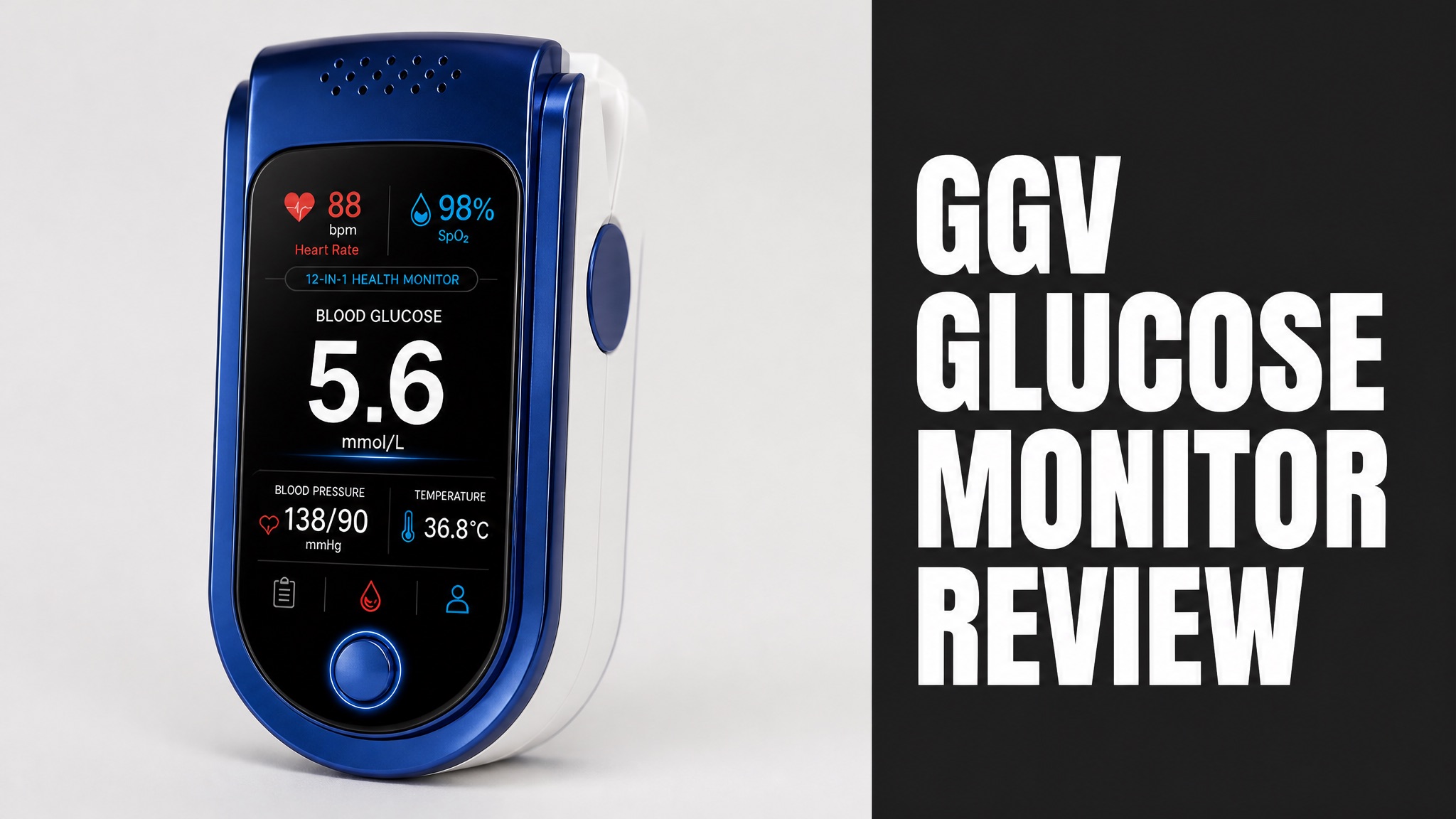
The GGV Advanced Non-Invasive Glucose Monitor is a needle-free gadget sold online as a daily health tracker. The listing prices it from $23.99 to $54.99 (USD). Buyers want to know whether it truly measures blood sugar or only sells a promise. The answer matters.
The product page offers no accuracy data and no FDA clearance. Customer reviews of GGV storefronts report wrong items and misleading claims. Real meters use blood samples on test strips. Continuous monitors read fluid under the skin. The GGV device matches neither method in any documented way. Evidence for its glucose claims is simply absent.
The verdict is clear and the reasons are specific. This review covers the features, reviews, legitimacy, cost and safer alternatives. Readers will learn who should avoid the device and what to buy instead for dependable glucose data. Each section stays within the available evidence.
What Is the GGV Glucose Monitor?
The GGV Advanced Non-Invasive Glucose Monitor is a needle-free gadget sold as a daily health tracker for glucose-related wellness trends. In fact, the listing never calls it a medical device. The brand name is GGV, and the price range runs from $23.99 to $54.99 (USD). Beyond that, the page promises very little of substance for any buyer to weigh up.
The product page describes a personal tracking format built for repeated routine use. To be clear, the listing offers no setup guide, no sensor specs and no accuracy figures. The wording stays vague on purpose.
Key facts from the listing:
- Brand: GGV
- Product name: Advanced Non-Invasive Glucose Monitor
- Category: daily health tracker
- Format: needle-free wellness trend monitoring
- Price range: $23.99 to $54.99 (USD)
Is the GGV Glucose Monitor Really Non-Invasive?
Yes. The product page presents the device as non-invasive and needle-free, with no finger-prick sampling involved. The listing uses the phrases daily health tracker and needle-free wellness trend monitoring device to describe its role. Marketing language is the only support offered. Marketing language is the only support offered, and no test data backs it.
Here’s the catch. Non-invasive does not equal medically validated. Glucose meters cleared by the FDA use a blood sample on a test strip. The page shows no technology that replaces that step.
How Does a Glucose Monitor Work?
A standard glucose meter measures sugar in a small blood sample placed on a disposable test strip. The FDA explains that chemicals on the strip react with glucose. The meter then reads that reaction with electricity or light and reports milligrams per deciliter (mg/dL). Every step needs real sensing hardware, and the GGV page never describes any of it.
A continuous glucose monitor works differently. The Associated Press describes a small patch, about the size of two stacked quarters, on the upper arm or stomach. A tiny sensor reads glucose in fluid under the skin every few minutes.
Method comparison:
| Method | Sample | Reading Speed |
|---|---|---|
| Glucose meter | Blood drop on a test strip | On demand |
| Continuous monitor | Fluid under the skin | Every few minutes |
| GGV monitor | Not disclosed | Not disclosed |
Does the GGV Glucose Monitor Work?
No. No clinical data or FDA clearance supports the claim that the GGV monitor measures blood glucose accurately. A search summary for GGV reviews notes that unverified budget gadgets of this type fail standard accuracy tests. Independent proof simply doesn’t exist, so the claim stays unverified today. Buyers can’t verify any single reading at all, even once.
Why does that matter? Accuracy is the whole point of a glucose device. The FDA lists accuracy as the first factor when choosing a monitor. A device without published accuracy data can’t meet that bar.
What Do GGV Glucose Monitor Reviews Say?
Customer reviews of GGV-branded storefronts lean heavily negative, with buyers describing the items as misleading or fraudulent. A search summary of Trustpilot pages reports severe dissatisfaction. Reviewers say the product matched neither the listing nor the expected function. Reviewers say the product matched neither the listing nor the expected function.
No verified positive reviews of the glucose function turned up in the research. Bottom line: buyer praise for accuracy is missing. That absence matters more than any single complaint.
Review patterns found:
- Wrong item delivered
- Product described as misleading
- No medical accuracy or approval
- No independent test results
What Are the Common GGV Glucose Monitor Complaints?
The most common complaint is receiving a different product than the glucose monitor ordered. Buyers reported getting a pulse rate monitor or a small projection light instead. In plain English, some customers never got a glucose device. Others describe the wait and the refund hassle that followed once the wrong parcel arrived, which erodes trust fast.
A second complaint covers medical reliability. Non-invasive gadgets from unverified stores lack FDA approval for medical use. Does a low price offset that risk? Not when the readings could guide health choices.
Is the GGV Glucose Monitor Legit?
No. Available evidence does not establish the GGV glucose monitor as a legitimate medical product. The listing calls it a wellness tracker, which sidesteps medical claims. Add the delivery complaints, and the legitimacy picture looks weak at best, with no proof to offset it. Reviewers also say the listing doesn’t match what arrives, so trust erodes quickly.
The store does offer standard pages. Those include shipping, refund, privacy and terms policies. But policies are not proof of performance. Plenty of questionable stores publish the same pages.
Legitimacy checklist:
| Signal | GGV Status |
|---|---|
| FDA clearance listed | Not found |
| Accuracy data published | Not found |
| Clinical studies cited | Not found |
| Store policy pages | Present |
| Delivery complaints | Reported |
Is the GGV Glucose Monitor FDA Approved?
No. The research found no FDA approval or clearance listed for the GGV Advanced Non-Invasive Glucose Monitor. The listing positions the product as a wellness tracker. That framing lets sellers skip medical device review, which explains the missing paperwork and the vague specs. Real clearance would show a number buyers could check with the agency today.
Here’s what real approval looks like. The AP reports the FDA approved the first over-the-counter continuous monitors only recently. Those products cost about $100 a month (USD). GGV’s price tag is far lower.
How Much Does the GGV Glucose Monitor Cost?
The GGV monitor costs between $23.99 and $54.99 (USD), with bundle discounts for multiple units. The listing shows a 72 percent discount banner. Bundle options include buy one, buy two as most popular, and buy three as best value for shoppers. The seller markets it as an everyday bargain, but cheap pricing alone says nothing about accuracy or safety.
Shipping is described as worldwide. The store also advertises secure checkout and a money back guarantee on eligible orders. To be clear, those are the seller’s own claims. No independent source confirmed them.
Pricing snapshot:
| Option | Price (USD) |
|---|---|
| GGV monitor, low end | $23.99 |
| GGV monitor, high end | $54.99 |
| Over-the-counter CGM, monthly | About $100 |
Is the GGV Glucose Monitor Worth the Price?
No. A low price delivers no value when the device cannot show verified glucose readings. Even $23.99 (USD) is wasted on a gadget without accuracy data. Cheap and useless costs more than expensive and reliable, since the money buys no usable data at all. Money spent on unverified readings buys false confidence, and false confidence is the real cost here.
Think of it this way: a basic FDA-regulated meter with strips gives measurable results. The FDA stresses using strips authorized for sale in the United States. An unproven tracker offers no such guarantee.
What Are the Alternatives to the GGV Glucose Monitor?
Real alternatives fall into two groups: FDA-regulated blood glucose meters and continuous glucose monitors. Both have documented performance. Dexcom and Abbott’s FreeStyle appeared among top search results for continuous monitoring. Both are established medical brands. Doctors can point buyers to either option, and both come with clear instructions.
The AP notes continuous monitors have existed since the late 1990s. For decades, only people with diabetes used them. Today, over-the-counter versions serve curious consumers too.
Alternative options:
- FDA-regulated glucose meter with test strips
- Over-the-counter continuous glucose monitor
- Prescription continuous glucose monitor
- Lab blood test ordered by a doctor
Which Is Better: a CGM or a Finger-Prick Meter?
A continuous monitor tracks glucose trends through the day, while a finger-prick meter gives single readings on demand. The AP says continuous devices let users see how food and activity affect blood sugar in near real time. Meters cost less upfront, while monitors run about $100 a month (USD) over the counter. Both need a provider’s guidance for proper use.
Both options carry limits. Former FDA commissioner David Kessler told the AP that these devices can’t diagnose or treat disease. He added that no one knows what’s optimal in people without diabetes.
Who Should Avoid the GGV Glucose Monitor?
People with diabetes need to avoid relying on the GGV monitor for any treatment decision. The FDA states that readings guide insulin and medication adjustments. A wrong number can push a dose in the wrong direction. The stakes are simply too high for guesswork. Medication choices rely on dependable numbers, and unverified gadgets can’t supply them.
Prediabetic buyers and people with risk factors face the same problem. The AP lists obesity, prediabetes and family history as risk factors. Those groups need accurate data, not an unverified gadget.
Groups to steer clear:
- People using insulin or diabetes medication
- People with prediabetes or a family history
- Anyone seeking a diagnosis
- Buyers who need a reliable return process
Where Should You Buy a Glucose Monitor?
Buyers get the safest results from pharmacies, official brand stores and doctor recommendations. The FDA advises using only strips authorized for sale in the United States. It warns against previously owned or unauthorized strips. The same caution applies to unknown online storefronts. Official stores give buyers a clear path to support and returns.
Ask a health care provider first. The FDA recommends this step before choosing a device. A provider can match a meter to specific needs and check the results against a laboratory test.
Should You Buy the GGV Glucose Monitor?
No. Buyers gain nothing from a glucose gadget that lacks FDA clearance, accuracy data and trustworthy reviews. Delivery complaints, missing approval and vague specs all weigh against the purchase. So what’s the verdict? Skip it. The listing admits the product is only a wellness tracker, not a medical tool for health decisions and care of any kind.
The GGV listing admits its own limits by calling the device a wellness tracker. Short answer: it’s not a medical tool. Anyone curious about blood sugar deserves a tool with proof behind it.
Verdict summary:
- No FDA approval found
- No accuracy data published
- Negative customer reviews reported
- Better options exist at modest cost
What Should You Do Instead of Buying the GGV Glucose Monitor?
Buyers do best by talking to a doctor and choosing an FDA-regulated meter or continuous monitor. The FDA suggests comparing a home meter against a lab test at the next appointment. Matching values confirm the device works well, which no GGV buyer can check without a reference. The FDA also says to ask a provider about medications that interfere with results.
For curious non-diabetic users, the AP suggests asking a simple question first. What will the data actually tell you? That motive check saves money and avoids false confidence in unproven numbers.