
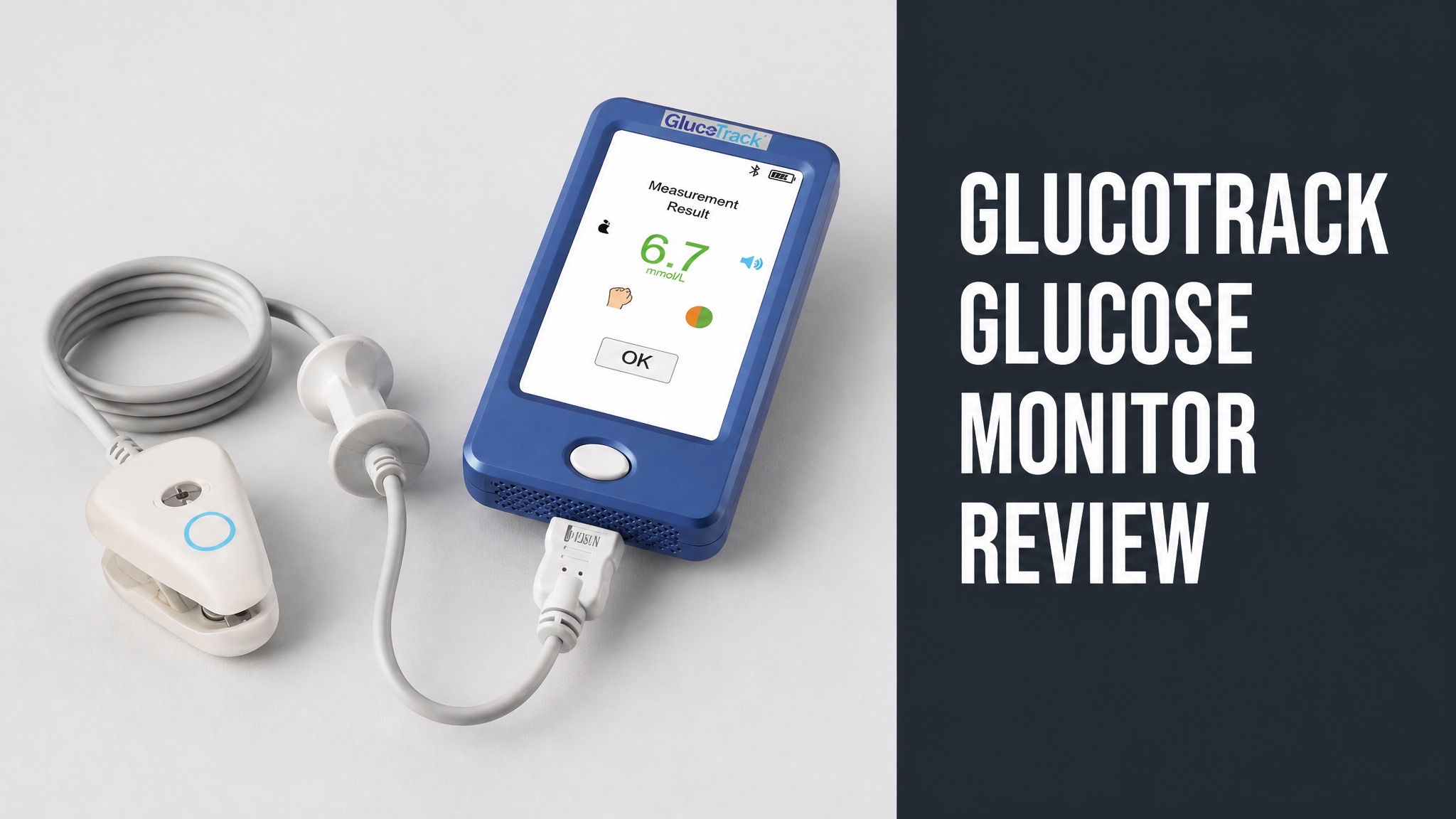
GlucoTrack is a glucose monitoring brand with a non-invasive ear clip and an implantable blood glucose monitor in development. The ear clip is CE-marked for adults with type 2 diabetes or pre-diabetes. The implant targets three years of continuous readings.
The ear clip reads three tissue sensors and stores 1,000 readings. The implant measures blood directly and reached a 7.7% MARD in human trials. Safety data comes from small studies. FDA approval is still pending for the implant. Dexcom and Abbott lead the wearable market. Pricing and buying options remain limited.
Independent proof is thinner than the marketing suggests. Buyers face an unapproved implant, a niche ear clip, and a reported price near $2,000. The sections below cover how each device works, what reviews say, and whether GlucoTrack is worth it.
What Is GlucoTrack Glucose Monitor?
GlucoTrack is a glucose monitor brand that covers two separate devices from related companies. The first is a CE-marked, non-invasive ear clip for adults with type 2 diabetes or pre-diabetes. The second is an implantable blood glucose monitor that is still in development.
Here’s the thing: the two get mixed up online. The ear clip has a user base and a reported price. The implant is investigational, and news coverage mostly describes it. Why does that matter? Buyers need to know which device they’re researching.
GlucoTrack Devices Compared:
| Device | Type | Status |
|---|---|---|
| Ear clip | Non-invasive spot checks | CE-marked |
| Implantable CBGM | Three-year implant | Investigational |
| Strips and lancets | Not used by the ear clip | No strip cost |
Is GlucoTrack Non-Invasive?
Yes. The ear clip measures glucose without needles, blood, or finger pricks. The maker calls the system pain-free and needle-free. The user attaches a personalized clip to the earlobe, and the processing unit shows a spot reading within seconds.
Is the implant non-invasive too? No. Glucotrack’s implantable monitor sits in a vein after a medical procedure. Only the ear clip avoids the body entirely.
What Is the GlucoTrack Implantable CBGM?
The implantable CBGM is a long-term blood glucose monitor designed for three years of continuous use. Glucotrack, Inc. built the system with no on-body external component. Traditional CGMs read interstitial fluid. The CBGM reads glucose directly from the blood.
The sensor lead sits in the vasculature. In the first human study, the lead went into the subclavian vein through a percutaneous procedure. Cirtec Medical was selected in February 2024 to manufacture the system.
In plain English: real-time blood readings avoid the lag of interstitial measurements. Senseonics currently makes the only long-term implantable CGM on the market, and that device lasts one year.
How Does GlucoTrack Work?
GlucoTrack works by combining three independent sensors that read physiological changes in earlobe tissue. The sensors use ultrasound, electromagnetic, and thermal signals. The processing unit converts those signals into a glucose value for the user.
To be clear, tissue glucose is not blood glucose. The maker says the two values correlate, but the link varies from person to person. That’s why the clip is personalized to earlobe dimensions.
Sensor Types:
- Ultrasound sensor for tissue changes
- Electromagnetic sensor for tissue properties
- Thermal sensor for temperature shifts
How Does the Ear Clip Get Personalized?
The ear clip is adjusted to each user’s earlobe dimensions through a guided setup. A step-by-step wizard walks the user through the process at home in a few minutes. Voice instructions support each step.
Does the setup need strips or lancets? No. The ear clip system uses neither. The user repeats spot checks with the same personalized clip.
How Does the Implantable CBGM Measure Glucose?
The implantable CBGM measures glucose directly in the blood through an intravascular sensing lead. The lead connects to an electronics assembly. Allowed patent claims cover electrode configurations, lead-based sensing structures, and implantation methods.
The system needs a once-only calibration event, according to a February 2024 company release. After that, the sensor reads continuously. Does the user wear anything? No. The design has no on-body component.
What Are the GlucoTrack Features?
The ear clip system offers unlimited measurements and stores up to 1,000 readings in the device. The unit also estimates HbA1c and uses a wizard-based graphic interface. Users can log in to a personal web area to review results and trends.
In fact, the cost model is the selling point. Strips and lancets add no incremental cost. Why does that matter? Unlimited tests mean more frequent checks, and the maker says that broadens the picture of a glucose profile.
Main Features:
- Stores up to 1,000 measurements
- Unlimited measurements
- HbA1c estimation
- Voice instructions
- Personal web area
Does GlucoTrack Connect to a Phone?
Yes. GlucoTrack Connects sends glucose readings to smart devices through the GlucoTrack Link wireless accessory. The app highlights readings within, above, and below the target range. Users can save, share, and print up to 6 reports.
The app adds customized measurement reminders and high and low alerts. Remote access to the personal area is included. The Link accessory is reserved through the maker by contact form.
Does GlucoTrack Actually Work?
Yes. For the implant, GlucoTrack has published accuracy data there, while ear clip proof comes mainly from maker claims and user testimonials. The implant reached a 7.7% MARD in its first human trial, per an AInvest report. The ear clip site calls its results clinically proven.
Bottom line: the evidence differs by device. Is that a problem? For buyers, yes. The implant has peer-reviewed support. The ear clip’s independent evidence is thin in the sources reviewed.
Evidence by Device:
- Implant: 7.7% MARD in the first human trial
- Implant: 99% data capture rate
- Implant: no device-related adverse events
- Ear clip: maker-reported clinical proof
How Accurate Is the GlucoTrack CBGM?
The CBGM reached a 7.7% MARD and a 99% data capture rate in its 2025 human trial. No device-related adverse events occurred. MARD is the average gap between sensor and reference readings. A lower number means better accuracy.
A peer-reviewed study in the Journal of Diabetes Research, shared in April 2026, reported long-term accuracy. The results aligned with earlier human trials. The earlier six-person, four-day study tested safety, not accuracy.
What Do GlucoTrack Reviews Say?
GlucoTrack reviews are positive on the maker’s own page and thin in independent sources. Testimonials praise comfort, testing frequency, and HbA1c improvement. Reddit threads exist, including one asking about a $2000 prick-free device.
For example, a 63-year-old user with type 2 diabetes said readings tracked his food and alcohol choices. Another user reported an HbA1c below 6% for the first time in 5 years.
Are these controlled data? No. They are testimonials on the maker’s site. The good news? Users describe the clip as comfortable. The bad news? Independent complaint data is hard to find.
Is GlucoTrack FDA Approved?
No. The implant is not FDA approved and remains in clinical development. The ear clip carries a CE mark. No FDA clearance for the ear clip appears in the sources reviewed. Buyers in the United States need to treat availability with care.
The company planned an FDA IDE submission in Q4 2025 and a US pilot study in 2026. Is an IDE the same as approval? No. An IDE allows clinical testing. Approval comes later.
Regulatory Milestones:
- CE mark for the ear clip
- ISO 13485 certification for the company
- First in-human implant study completed
- FDA IDE submission planned for Q4 2025
- Multicenter feasibility study in Australia
Is the GlucoTrack Implant Safe?
Yes. The first human study established safety of placing, using, and removing the CBGM sensor lead. Six participants with diabetes used the system for four days in hospital. The study did not test sensor accuracy.
Here is the kicker: four days in six patients is a small sample. Long-term safety needs larger trials. Later human trials reported no serious adverse events, according to the company.
Who Should Avoid GlucoTrack?
The ear clip is intended for adults 18 years and older with type 2 diabetes or pre-diabetes. Children and people outside that group fall beyond the stated use. Insulin users who need exact readings need a doctor’s confirmation first.
The implant is not available to the public. Only clinical study participants receive it. Anyone seeking a ready-to-use device needs an FDA-cleared CGM instead.
How Does GlucoTrack Compare to Dexcom and Abbott?
GlucoTrack competes with Dexcom G7 and Abbott FreeStyle Libre 3 Plus, which dominate the CGM market. Those rivals use wearable sensors that read interstitial fluid. An AInvest report describes them as leaders in AI integration and insulin pump partnerships.
Think of it this way: scale matters. AInvest cites Dexcom near $25 billion in value and Abbott near $200 billion. Glucotrack’s market cap was $3.27 million. Does the gap matter? Yes, because partnerships and funding drive adoption.
Device Comparison:
| Device | Type | Key Trait |
|---|---|---|
| GlucoTrack ear clip | Non-invasive spot check | Unlimited tests |
| GlucoTrack CBGM | Implant | Three-year design |
| Senseonics Eversense | Implant | One-year life |
| Dexcom G7 and Libre 3 Plus | Wearable CGM | Market leaders |
Is GlucoTrack Worth the Price?
No. The ear clip carries a reported price near $2,000, and independent proof is thin. That figure comes from a Reddit thread title, not an official price list. Buyers need to confirm the current price with the maker.
What’s more, the savings are real in one way. The ear clip needs no strips or lancets. Frequent testers avoid the recurring strip cost. Unlimited tests carry no incremental charge.
Where Can You Buy GlucoTrack?
GlucoTrack ear clips are sold through the maker, Integrity Applications, which invites buyers to make contact. The product page offers a contact form to reserve the Link accessory or request more information. No public checkout appears on that page.
Can the implant be bought? No. The implant is an investigational device in clinical development. Cirtec Medical will handle clinical and commercial manufacturing when the time comes.
Is GlucoTrack Worth It?
No. For now, GlucoTrack is a promising technology with limited proof for buyers. The ear clip delivers painless spot checks. The implant is still unapproved. Pay attention to this: neither device has strong independent evidence yet.
So who is it for? Adults with type 2 diabetes who want needle-free spot checks and accept the evidence gap. Everyone else needs an FDA-cleared CGM.
Investors face a separate question. The company reported an $11.6 million net loss in H1 2025 and no revenue. Financial risk affects how soon the implant reaches the market.