
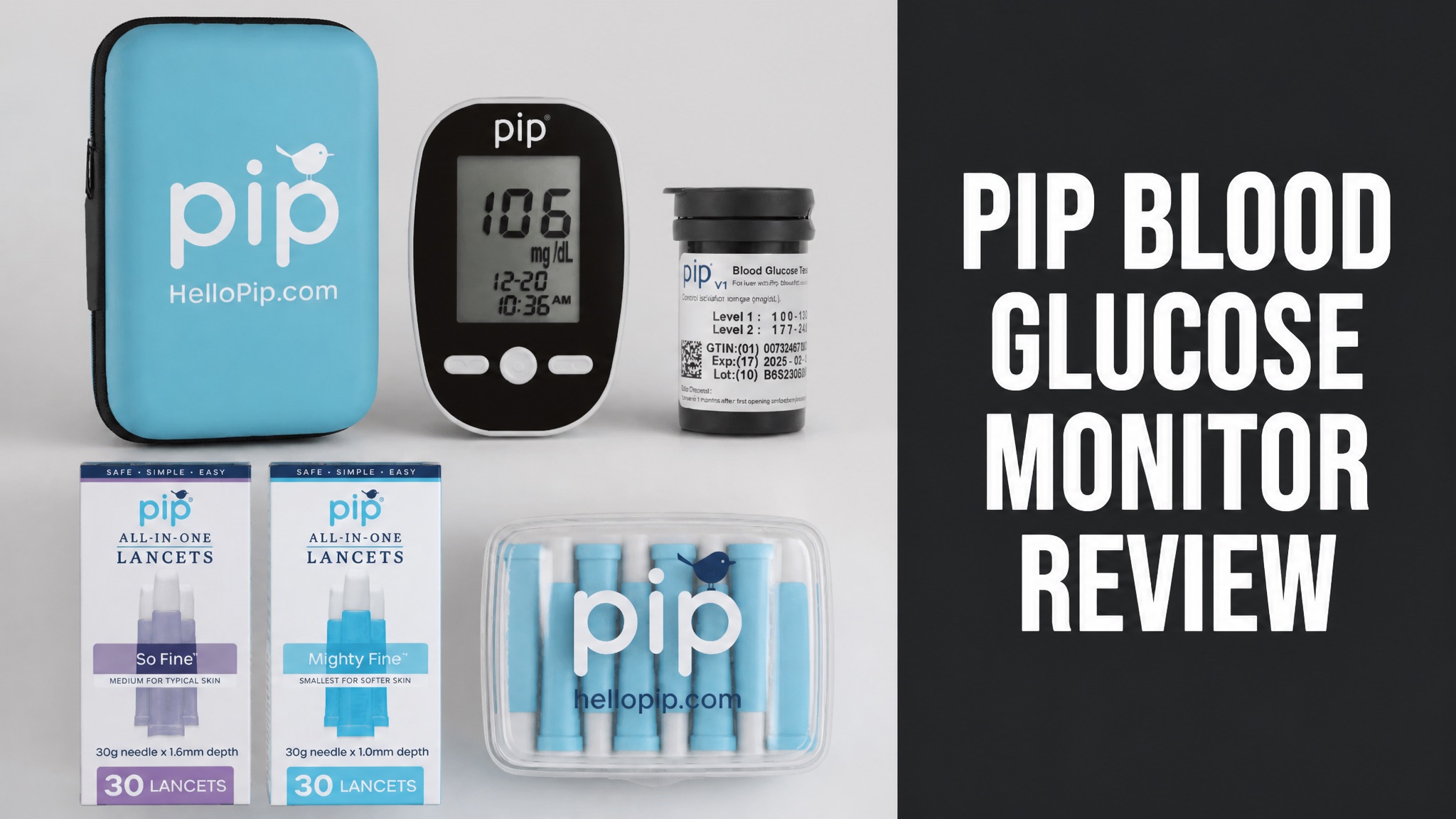
The Pip blood glucose monitor is a finger-stick meter kit from Pip Diabetes. It ships with a V1 meter, strips, preloaded lancets, control solution and a carry case. The starter kit costs from $29.99 (USD).
Pip lancets hold 2,784 reviews on the brand store. Amazon shoppers rate the kit 4.5 stars across 347 ratings. They praise painless testing and the compact size. Accuracy opinions are mixed, and the V1 strips work only with the V1 meter.
No independent accuracy study turned up in the sources checked. Still, the price is low and the setup is simple. Read on to see how the kit works, what users report, how it compares and who should pick another tool.
What Is the Pip Blood Glucose Monitor?
The Pip blood glucose monitor is a finger-stick glucose meter sold by Pip Diabetes as a starter kit. The kit pairs the Pip V1 meter with test strips and preloaded safety lancets for home use. Pip also sells the lancets on their own. The brand aims the kit at adults who test blood sugar at home every day.
The meter reads capillary whole blood from a fingertip. In fact, MDS Diabetes lists the V1 strips as single-use electrochemical strips for adults with diabetes. Each strip slides straight into the meter to start a test.
The kit isn’t a wearable sensor. To be clear, every reading needs a fresh blood drop. Is that a drawback? Only if continuous tracking matters more than a low entry price.
Core Facts:
- Maker: Pip Diabetes
- Test type: finger-stick blood sample
- Sample type: capillary whole blood
- Coding: not required
- Starting price: $29.99 (USD)
What Comes in the Pip Kit?
The Pip starter kit bundles every item needed to start testing at home. Pip lists a glucose meter, test strips, diabetes lancets, control solution and a carry case in the box. The 50 count kit holds 50 test strips and 60 lancets. A 100 count version exists through resellers like GoSupps. Nothing else is needed on day one.
Pip also sells a case pack of 20 starter kits for $420 (USD). That bulk option targets clinics and programs rather than single users. Alcohol prep pads cost $5.99 (USD) for 200 and sit outside the kit.
How Does the Pip Meter Work?
The Pip meter measures blood glucose through an electrochemical test strip. A fingertip blood drop touches the strip, and the meter converts the reaction into a glucose number on the screen. Amazon’s Pip listing says the kit needs no lancing device. The strip design supports direct insertion for quick test starts.
Setup is short. The meter needs no manual coding, so users skip the code chip step. And the control solution lets users check meter and strip performance whenever a result looks odd.
Basic Test Steps:
- Wash and dry the hands.
- Insert a test strip into the meter.
- Press the preloaded lancet against the side of the fingertip.
- Touch the blood drop to the strip.
- Read the result on the screen.
How Do Pip Preloaded Lancets Work?
Pip lancets work as all-in-one units with the needle sealed inside a safety body. Each lancet carries a clean needle, so users never load or unload a separate lancing device. Pip’s blog says three factors set pain levels: needle gauge, needle depth and spring vibration. Pip says it tuned all three.
The needle stays hidden before and after use. Here’s the thing: a hidden needle lowers the dread many people feel before a stick. One lancet serves one test, and then it goes in the trash.
What Are the Pip Meter Features?
The Pip meter offers a short list of practical features aimed at easy daily testing. Retail listings name no coding, a small sample, quick results and a travel case. A Google shopping summary cites a 0.8 µL sample and about 6 seconds per result. Those figures come from retailer summaries.
The same summary lists a CR2032 coin cell battery. Worth knowing: Pip does not bill insurance directly. Pip products are typically FSA and HSA eligible, and MDS Diabetes lists the strips that way.
Key Specs:
| Feature | Detail |
|---|---|
| Sample size | 0.8 µL |
| Result time | About 6 seconds |
| Battery | CR2032 coin cell |
| Coding | None |
| Lancing device | Not needed |
Does the Pip Meter Deliver Painless Testing?
Yes. The Pip lancets get a strong painless rating from buyers. Amazon’s review summary counts 28 mentions of pain-free testing, and Pip’s lancet page shows 2,784 reviews. Pain still varies from person to person. Skin thickness and stick location change the feeling, so results differ by user.
Pip’s blog adds tips that help any lancet. Stick the side of the fingertip, because it holds fewer nerve endings. Rotate fingers each time. And use a fresh lancet, since a reused needle dulls and hurts more.
Is the Pip Monitor Accurate?
No clear verdict exists. Pip’s accuracy draws mixed opinions from buyers. Amazon’s summary lists 35 accuracy mentions, and it says some customers report inaccurate readings. No independent lab study appeared in the sources checked. One MDS Diabetes buyer says the strips stayed within range of lab results.
So what should users do? Run the control solution, and compare the meter with a lab result or a second meter. Is that extra work? Yes, but it protects treatment decisions.
What Do Pip Monitor Reviews Say?
Pip reviews lean positive on comfort, size and value. Amazon shows a 4.5 star average from 347 ratings. The review summary calls the kit great with no pain. The same summary admits opinions on accuracy are mixed. That split shapes the whole review picture.
Reddit threads and Facebook groups also discuss Pip lancets. The Pip store’s meter kit shows 64 reviews. Pip’s own site hosts that count, so treat it as brand-reported feedback.
What Do Users Like?
Users praise the Pip kit for quality, value, painless pricks and portability. Amazon’s review tags count 83 quality mentions, 37 value mentions and 28 pain-free mentions. Shoppers also like that the device fits in a purse. One customer notes the kit holds two needle sizes.
Top Praise:
- Quality: 83 mentions
- Value for money: 37 mentions
- Pain-free testing: 28 mentions
- Portability: 23 mentions
- Compact size: 16 mentions
What Are the Common Complaints?
Complaints center on accuracy doubts and supply limits. Amazon’s summary says some buyers see inaccurate readings, and the V1 strips fit only the V1 meter. Both eBay kit listings also show the item as sold out. Stock can disappear at third-party sellers.
One more catch: resellers add shipping. A GoSupps order carries a $19.99 (USD) fee, and an eBay listing adds $20.97 (USD) shipping plus import fees. The Pip store avoids that gap for US buyers.
How Does Pip Compare With Other Meters?
Pip competes on price and ease rather than data features. Pip V1 strips cost $26.99 (USD) per 100 on MDS Diabetes, near the budget end. Accu-Chek Guide strips cost $50.25 (USD) per 100 there. Contour Next strips cost $34.99 (USD) per 70.
Strip Price Comparison:
| Strips | Count | Price |
|---|---|---|
| Trueness | 100 | $23.99 |
| Pip V1 | 100 | $26.99 |
| Embrace | 100 | $27.99 |
| Accu-Chek Guide | 100 | $50.25 |
Pip vs CGM Systems?
Pip and a continuous glucose monitor solve different problems. A CGM sensor reads skin fluid every 5 to 15 minutes. The Pip meter reads one blood drop per test. Pip’s blog says sensors last 7 to 14 days. Implanted versions run up to 90 days.
The same blog notes that type 2 diabetics often test one to four times daily. For them, a meter may be enough. CGM users still need occasional fingersticks to confirm readings.
Is the Pip Monitor Safe and Legit?
Yes. Pip is a real operating brand with an official store, a blog and thousands of lancet reviews. Multiple retailers carry the kit, including Amazon, eBay and MDS Diabetes. The sources checked did not state FDA clearance details for the meter. Check Pip’s packaging or support for current regulatory status.
MDS Diabetes says the strips suit adults with type 1 or type 2 diabetes. Store strips per the maker’s guidelines. Single-use strips and lancets keep contamination risk low.
Who Should Avoid the Pip Monitor?
Some users need a different tool than the Pip meter. People who want automatic trend data, alarms or app syncing fit a CGM better. Buyers who want strips from many brands also face a lock-in problem, since V1 strips fit only the V1 meter.
Anyone who needs lab-grade confidence should confirm readings with a clinician. The Pip blog itself tells users to discuss treatment goals with a health care provider first.
How Much Does the Pip Monitor Cost?
The Pip monitor kit starts at $29.99 (USD) for the 50 count starter set on the Pip store. eBay lists the same kit at $29.99 (USD) before shipping. Pip lancets cost $13.99 (USD) per 100. Control solution costs $5.99 (USD).
Pip Price List:
| Item | Price |
|---|---|
| Starter kit (50 strips, 60 lancets) | From $29.99 |
| All-in-one lancets, 100 ct | $13.99 |
| Control solution | $5.99 |
| Alcohol prep pads, 200 ct | $5.99 |
| V1 test strips, 100 ct (MDS) | $26.99 |
Are Pip Test Strips Worth the Price?
Yes. Pip V1 strips sit in the low-to-middle price range for a 100 count pack. MDS Diabetes sells them for $26.99 (USD) one time or $24.29 (USD) monthly on AutoShip, a 10 percent saving. That works out to about 27 cents per strip at the one-time price.
Strip cost drives long-term spend, not the meter. Why? A daily tester uses far more strips than meters. So compare strip price per test before buying any kit.
Where to Buy the Pip Monitor?
Buyers can order the Pip monitor kit from the Pip store, Amazon, eBay and select diabetes suppliers. Amazon lists the 50 strip kit with an Amazon’s Choice tag. MDS Diabetes sells the V1 strips, and GoSupps lists a 100 count travel kit. Walmart also carries the Pip brand.
Watch the seller. The bottom line: stick with the Pip store, Amazon or a known supplier. Third-party listings add fees and risk expired strips.
Is the Pip Blood Glucose Monitor Worth It?
Yes. The Pip kit is worth buying for casual home testers who want a cheap, painless, all-in-one setup. A $29.99 (USD) starting price, preloaded lancets and strong buyer comfort ratings back that call. Accuracy remains the open question. Buyers should verify readings against a lab or a second meter.
Skip it if continuous data matters. Short answer: choose Pip for simplicity and a low price, and choose a CGM for trends. The good news? The low cost makes a test run a small risk.