
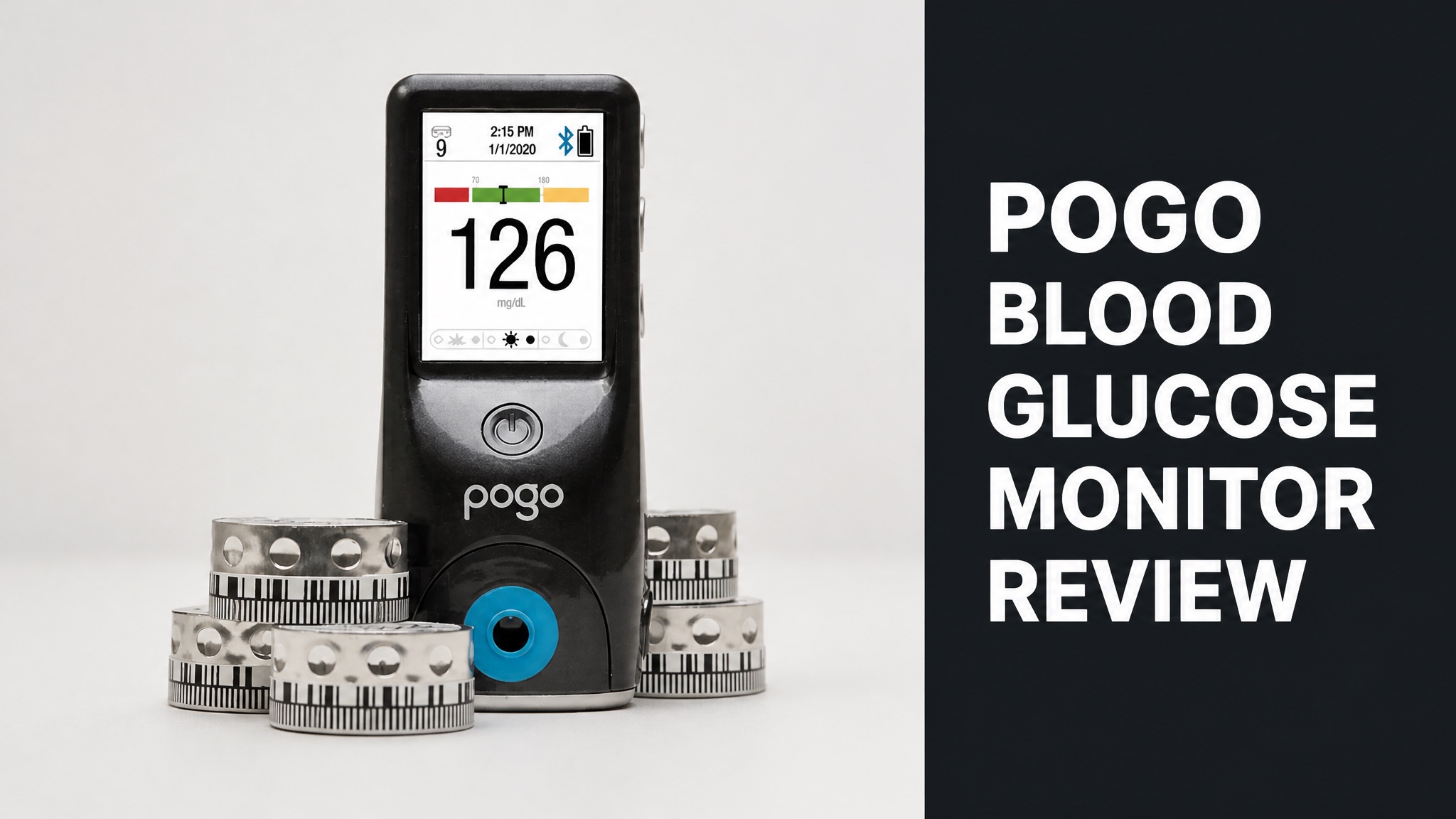
The Pogo blood glucose monitor is an automatic one-step meter from Intuity Medical. It lances the finger, collects blood and reads glucose with one press. The FDA cleared the system in April 2016, and US sales began in November 2021.
The meter uses ten-test cartridges and reads a tiny 0.25 microliter sample. Results sync by Bluetooth to a free app. Reviews praise its speed and discretion. Users question its cost per test. Betachek says Pogo is discontinued, and rivals like the C50 hold 50 tests per pack.
Pogo is a clever design with real supply risk. Below, the review covers specs, pricing, complaints, comparisons and a clear verdict on whether the monitor is worth buying today.
What Is the Pogo Blood Glucose Monitor?
The Pogo blood glucose monitor is an automatic one-step meter that lances, collects blood and reads glucose with one press. Intuity Medical built it around a 10-test cartridge. Each cartridge holds the lancets and test strips, so users carry only the monitor. The system targets people who test often and want fewer supplies to manage.
The device is indicated for adults and adolescents aged 13 and older. The design targets people who test often and dislike handling strips. In fact, Intuity calls the category automatic blood glucose monitoring, or ABGM.
Who Makes the Pogo Monitor?
Intuity Medical makes the Pogo monitor at its base in Fremont, California. The company calls itself a commercial-stage medical technology and digital health firm. Daniel Einhorn, MD, chairs its Scientific Advisory Board, and Emory Anderson was CEO at launch. The firm focuses on tools that make life with diabetes easier.
The FDA cleared the system in April 2016. US sales began in November 2021. That’s a five-year gap. Why the wait? The sources reviewed give no reason for the delay, but the timeline is worth knowing.
How Does the Pogo Monitor Work?
The Pogo monitor runs a full test from one press of the finger on its test port. The user loads a cartridge and turns the meter on. The device then lances the finger, collects blood and starts a four-second countdown before it shows a result. The user doesn’t load a strip or cock a lancing pen. The cartridge handles both jobs inside the device.
Traditional meters can need 15 or more steps per test. Does that matter? Yes. Fewer steps mean less friction, and the company argues that people test more when the process is simple.
What Is in a Pogo Cartridge?
A Pogo cartridge packs ten lancets and ten test strips into one sealed unit. Betachek describes each test as using a spring-loaded hollow needle. The monitor advances to a fresh test after every use, so no loose strip is ever touched. Each cartridge is a sealed plastic unit that clicks into the meter. The meter then steps through the ten tests one at a time.
Once all ten tests are used, the user discards the whole cartridge. Used lancets and strips stay inside it. Does that help? To be clear, the design removes sharps handling between tests.
What Are the Pogo Monitor Specs?
The Pogo monitor is a pocket-sized meter that weighs 3.4 ounces (96 grams) with batteries. Medical Device Network lists its size at 4 by 2 by 1.5 inches (10 by 5 by 3.8 centimeters). The meter stores 500 test results and syncs by Bluetooth. The unit runs on batteries and fits in a pocket.
Pogo Monitor Specs:
| Spec | Detail |
|---|---|
| Sample size | 0.25 microliters (250 nanoliters) |
| Test time | Four-second countdown |
| Memory | 500 results |
| Operating range | 50 to 104 F (10 to 40 C) |
| Batteries | Two AAA alkaline |
The blood sample is tiny. Is it painless? Notebookcheck says no. Even so, a small sample keeps the discomfort low.
What Are the Benefits of the Pogo Monitor?
The Pogo monitor offers three main benefits: speed, discretion and a simple testing routine. Intuity says users can test at a restaurant table, on a train or at the gym. The only item to carry is the monitor itself. Dr. Einhorn said testing is often complicated, intrusive and hard to carry. Pogo was designed to remove those three barriers.
Main Benefits:
- One-press testing with no separate strips or lancets
- Quick result after a four-second countdown
- Free Patterns app with Bluetooth sync
- Cartridges that hold ten tests each
Does the Pogo Monitor Make Testing Easier?
Yes. The Pogo monitor cuts the testing routine down to loading a cartridge and pressing a button. A forum user in January 2024 praised the all-in-one unit. The reason is simple: the learning curve was almost zero. The feedback matches the maker’s claim of a simple routine. The all-in-one cartridge also removes the need to open and match separate supplies.
Not everyone agrees, though. A moderator on the Diabetes Forum UK called it an unnecessary gimmick. Her point was that the hard part of testing is getting blood out of the finger. Pogo doesn’t change that.
What Do Pogo Monitor Reviews Say?
Pogo monitor reviews praise the convenience but question the price. Few independent lab tests exist in the sources reviewed. Most coverage comes from press releases and retailer pages. Real user feedback is thin. Should buyers trust it? Read it with care. Mixed opinions show up across forums and retail pages. Convenience is high, and so is the price.
Review Summary:
| Source | Main Point |
|---|---|
| Link4Nutrition | Two easy steps: peel and insert |
| Woman’s World | One-button reading, handy but no CGM replacement |
| Diabetes Forum UK | Convenient, but costly and possibly a gimmick |
| Family Care DME | No customer reviews posted yet |
What Do Pogo Users Like?
Users like the all-in-one design and the speed of a single-press test. Dietitian Kirsten Angell, RD, LD, CDCES, summed it up as no lancing device and no test strips. She called the process plain and simple. Here’s the thing: that is rare praise for a glucose meter. The sources reviewed stress the peel-and-insert cartridge swap. Testing in public also becomes quicker and more discreet.
Woman’s World also liked the idea. The outlet said the device makes keeping an eye on blood sugar easier. But here’s what no one tells you: Pogo doesn’t replace a continuous monitor that is worn at all times.
What Are the Common Complaints About Pogo?
The top complaint is cost, since the Pogo price sits close to a Libre CGM in the US. A forum member made that comparison. Another member added that a person would need serious issues with a CGM to pick Pogo instead. Buyers would be paying a premium for convenience. For daily testers, the cartridge cost is the main barrier to buying the system.
What’s more, size is the second gripe. One user said it looks quite big to carry for an occasional check. Shelf life is a third issue, because a loaded cartridge expires after 10 days.
Is the Pogo Monitor Accurate?
Yes. The Pogo monitor meets the FDA accuracy requirements for blood glucose meters, according to its maker. It needs only a small sample of 0.25 microliters. The sources reviewed contain no independent head-to-head accuracy study. The claim rests on the company and the FDA clearance, so readers should treat it with care.
Does that settle it? Not fully. Short answer: the data is thin. Betachek says its own C50 meets the ISO 15197:2015 standard. Without a matching independent test for Pogo, buyers can’t compare the two on accuracy.
Is the Pogo Monitor FDA Cleared?
Yes. The Pogo monitor is FDA cleared, with clearance for marketing granted in April 2016. Medical Device Network confirms the date. Intuity markets the system as the first and only FDA-cleared ABGM built on 10-test cartridge technology. The company also states that the system meets FDA accuracy requirements. A buyer can verify clearance in FDA device databases.
Is clearance a blanket endorsement? No. The system is for adults and adolescents aged 13 and older. Children under 13 fall outside the indication. Talk to a doctor before changing any testing routine.
How Does the Pogo Monitor Compare to Alternatives?
The Pogo monitor competes with cassette meters like the Accu-Check Mobile and Betachek C50. Notebookcheck names the Accu-Check Mobile, which uses a 50-test cassette. The big difference? Pogo cartridges hold only ten tests each. Each of those rivals still needs a lancing step, but they cost less per test. Pogo wins only on how few steps a test takes.
A CGM is a different class. The sensor reads glucose all day from the skin. Pogo still needs a finger press for every reading. So it complements a CGM rather than replacing one.
Pogo vs Betachek C50: Which Is Cheaper?
The Betachek C50 is typically cheaper because its cost per test is lower. Betachek published the comparison and notes that Pogo has been discontinued. Its C50 cassette holds 50 tests, against 10 for a Pogo cartridge. The C50 also keeps a cassette fresh for 90 days after loading. A Pogo cartridge expires after only 10 days once it is loaded.
Pogo vs Betachek C50:
| Feature | Pogo | Betachek C50 |
|---|---|---|
| Tests per pack | 10 | 50 |
| Test steps | Press finger on meter | Prick finger, apply blood drop |
| Expiry after loading | 10 days | 90 days |
| Battery | Two AAA alkaline | One 2032 coin cell |
| Cost per test | Higher | Lower |
How Much Does the Pogo Monitor Cost?
The Pogo monitor cost $68 for the reusable meter at launch, plus $32 for a five-cartridge pack. The pack gives 50 tests. Woman’s World reported the same figures. A larger bundle of 250 tests listed at $160 on the company site. Cartridge costs are the real expense over time. They’re a recurring bill, because every single test uses up one cartridge slot.
Pogo Pricing:
| Item | Price (USD) |
|---|---|
| Monitor | $68 |
| 5 cartridges (50 tests) | $32 |
| 10 cartridges (100 tests) | $64 |
| 25 cartridges (250 tests) | $160 |
| Monitor, Family Care DME listing | $118.49 |
Insurance didn’t cover Pogo when Link4Nutrition wrote about it. FSA and HSA funds did apply. Prices may differ today, since the product is discontinued.
Is the Pogo Monitor Worth the Price?
No. The Pogo monitor costs more per test than most cassette and strip meters. At $0.64 per test, 50 tests run $32. The cost adds up fast for someone testing four times a day, since a pack lasts about 12 days. Price is the sharpest criticism in every review found. A cheaper strip meter delivers the same basic glucose number for a fraction of the cost.
Bottom line: the money buys convenience, not better data. Is that a fair trade? For most people, no. The forum member who first asked about Pogo decided to stay with his Dario or Accu-Chek meter.
Where to Buy the Pogo Monitor?
Pogo monitors were sold at Walgreens, select CVS Pharmacy stores and the company’s own online store. They were available over the counter or with a prescription. Kroger Health pharmacies also carried the system, according to BioSpace. Stock now depends on leftover inventory and third-party sellers, so availability varies by week.
Where Pogo Was Sold:
- Walgreens stores across the US
- CVS Pharmacy locations in select regions
- Kroger Health pharmacies
- The online Pogo store at presspogo.com
- Third-party sellers such as Family Care DME
Is the Pogo Monitor Discontinued?
Yes. Betachek states that Pogo has been discontinued, and it frames its C50 as an alternative. A Reddit thread titled Closing? Why?? asks about Intuity Medical, the maker of Pogo. The sources reviewed give no full explanation. Intuity Medical’s own channels would be the place to confirm the status. Retail pages can show stale listings long after sales stop.
Why does that matter? Buyers can’t count on refills. Cartridges may become hard to find. And app support could end. Check supply before paying for a meter you can’t refill.
Should You Buy the Pogo Monitor?
No. Most buyers should skip the Pogo monitor because it is discontinued and costly per test. The concept is clever, and the one-press test works as promised. But supply risk and price outweigh the convenience for nearly every type of buyer, from new testers to long-time users. Shoppers who still want one should confirm cartridge supply before buying the meter.
Verdict Summary:
- Strength: one-press, strip-free testing
- Strength: FDA clearance and Bluetooth app sync
- Weakness: high cost per test
- Weakness: discontinued, so refills are uncertain
Who Should Skip the Pogo Monitor?
Budget-minded testers should skip Pogo and pick a cassette or strip meter instead. Anyone testing several times a day will feel the cost quickly. The Betachek C50 and Accu-Check Mobile hold 50 tests per pack. Low-volume testers who value the one-press design may still enjoy it. Stock and refills are the risk to weigh first.
CGM users have another option. A CGM covers the daily trend, and a cheap strip meter handles the occasional check. In plain English: Pogo is a neat gadget with a shaky future.