
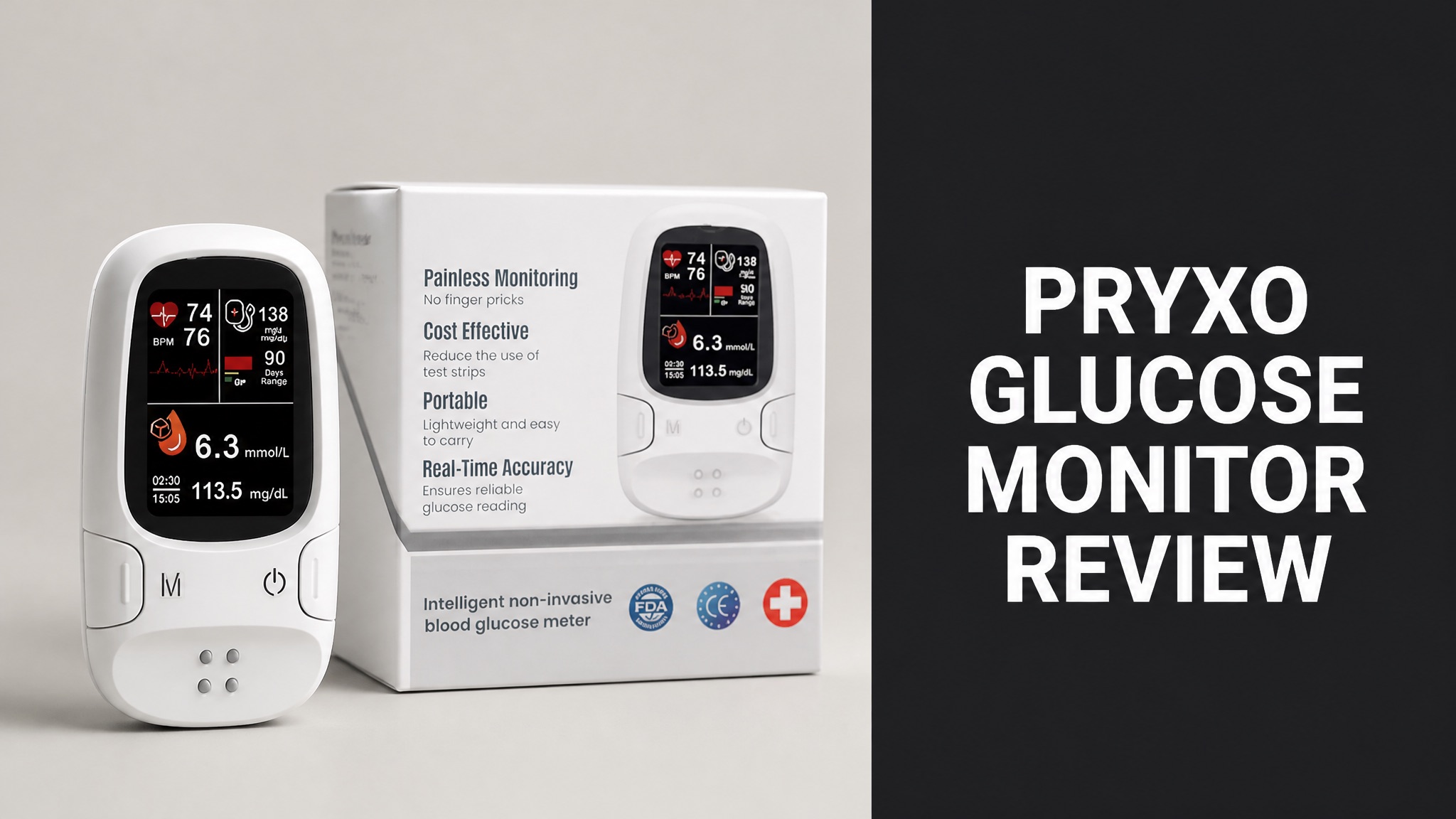
The Pryxo glucose monitor is a wrist band sold online as a needle-free blood sugar meter. The M9 model costs $18.90 to $40.90 (USD). Sellers claim light sensors read glucose through skin, but no regulator has cleared such a device. Ads push it hard on social media and dropshipping sites.
Independent investigators found no evidence that the band measures glucose. The FDA has never cleared an optical non-invasive monitor. The 99% accuracy claim has no published test. Seller testimonials look generic. Complaints cite missing support and ignored refunds. The design matches cheap pulse oximeters. The evidence points to a dropshipping scam.
The risk goes beyond wasted money, since wrong readings can trigger wrong medication choices. Read on for the evidence, the red flags, cleared alternatives and a refund plan for buyers who already ordered one today. The verdict at the end is clear and direct. Each section answers one buyer question.
What Is the Pryxo Glucose Monitor?
The Pryxo glucose monitor is a wrist band sold online as a needle-free blood sugar meter. The M9 model is listed by Techeaks Ltd. The seller claims light sensors read glucose through the skin. Short answer: no regulator has cleared that claim for any consumer device. Buyers meet it mostly through social media ads, video promos and dropshipping pages.
Pryxo targets people tired of finger pricks. The page promises no needles, no strips and no blood. Does a $18.90 band replace a lab-grade meter? Independent sources say no, and the sections below explain why.
The listing also stresses a 14-day battery and phone sync for family members. In fact, those traits describe a smart band. They say nothing about proven glucose accuracy.
What Does the Pryxo M9 Include?
The Pryxo M9 bundles an OLED band, voice alerts and a magnetic charging dock. The listing sells it in packs of one, two or four units. To be clear, the page names no test strips or lancets because none are claimed. Here are the advertised features: Pricing changes with the pack size. The seller also pushes bulk packs through steep discount banners.
Advertised Pryxo M9 Features:
| Feature | Seller Claim |
|---|---|
| Display | Ultra-bright OLED |
| Result time | 5 seconds |
| Battery | Up to 14 days |
| Alerts | Voice and vibration |
| Sharing | App sync to caregivers |
Every row in that table is a seller claim. No independent lab has verified a single one of them.
How Does the Pryxo Glucose Monitor Work?
The Pryxo band claims to shine infrared light into the wrist and analyze glucose molecules. The product page calls this Quantum-Scan Optoelectronics. A chip then filters motion noise and skin tone effects. Sounds advanced, right? The page offers no study, patent or lab report to back the wording. Sellers of similar bands use the same wording and diagrams.
The seller says one tap on the screen gives a result in 5 seconds. Bottom line: the process is described only in marketing language. Nothing in it can be checked by a buyer.
Can Light Really Measure Glucose Through Skin?
No. Optical glucose sensing remains an unsolved problem, and no cleared consumer device does it. Dr. David Klonoff of the Diabetes Research Institute states that the FDA has never cleared an optical non-invasive glucose monitor. The glucose signal is tiny compared with the surrounding noise. Other chemicals send similar signals, so isolating glucose is hard.
Dr. Klonoff adds that AI algorithms are improving signal isolation. Researchers still work on prototypes. Is that the same as a finished retail band? Not at all, because clinical proof is still missing.
Dr. Farah Khan of the University of Washington worries that optical methods may lack the precision patients need. What’s more, the diaTribe report says most past devices failed to work or never won approval.
How Optical Glucose Sensing Is Supposed To Work:
- A light beam passes through the skin.
- Blood components scatter and reflect the light.
- A sensor reads the returning signal.
- Software separates the glucose pattern from noise.
Does the Pryxo Glucose Monitor Work?
No. Independent investigators found no evidence that the Pryxo measures blood glucose at all. MalwareTips reports that the design matches cheap pulse oximeters that read heart rate and oxygen. No clinical data supports glucose readings. The listing itself shows zero customer reviews. Independent reviewers reached the same conclusion after checking claims.
A Belgian regulator, the FAMHP, has also warned that non-invasive glucose meters are unreliable and potentially dangerous. The warning covers the whole device category. Pryxo falls squarely inside it.
Is the Pryxo 99% Accurate?
No. The 99% accuracy claim has no published test behind it. The seller calls it clinical-grade and says it rivals blood-drawn meters. MalwareTips lists a 99.9% figure in the ads as well. Real home meters must meet ISO 15197:2013, which demands 95% of readings within set error limits. Pryxo shows none of that proof anywhere on its site, ads or packaging.
A 2024 study tested a different non-invasive monitor, the InCheck, on 1,223 samples. Only 18.5% of readings met ISO 15197:2013 criteria. Does that prove Pryxo fails? The result shows how hard the task is for even a studied device.
Pryxo Claims Versus Evidence:
| Claim | Evidence Found |
|---|---|
| 99% clinical accuracy | No published test |
| FDA certified | No FDA record found |
| No finger pricks | No cleared device does this |
| Used by 80,000 Americans | No proof offered |
The gap between claim and proof is wide. Every row lacks independent backing.
What Do Pryxo Reviews Say?
Pryxo reviews split into polished testimonials on seller pages and sharp warnings elsewhere. The official M9 page shows zero reviews. Marketing pages carry glowing quotes. Independent sites call the device a scam. Which side deserves more trust? The side with documented evidence. The gap between the two camps is huge, and proof sits with the critics.
Video reviewers on YouTube have also tested similar bands. Their titles ask whether the device is a miracle or a scam. The evidence leans heavily toward scam.
Are There Positive Pryxo Experiences?
Positive Pryxo experiences appear only on seller-controlled pages and social ads. MalwareTips calls those testimonials generic, with profile photos likely taken from stock libraries. Claims of 19,000 satisfied users have no proof. The reason is simple: no verified buyer data exists. Such praise can be written by anyone, so it carries little weight.
A pleasant wrist band is plausible. Good glucose readings are not. Pay attention to this: comfort and battery life say nothing about medical accuracy.
What Are the Most Common Pryxo Complaints?
The most common complaints center on fake claims, missing support and wrong or useless readings. MalwareTips describes bounced emails, dead phone lines and ignored refunds after purchase. Some buyers reportedly received a basic oximeter. Others got nothing at all. Here are the recurring issues: Complaints repeat across scam reports and video reviews alike.
Recurring Complaints:
- No glucose measurement ability
- Fake FDA certification claims
- Unreachable customer service
- Ignored refund requests
- Missing or delayed delivery
Support problems stack on top of the accuracy problem. A bad meter with no refund path is the worst combination.
Is the Pryxo Glucose Monitor Legit?
No. Pryxo shows nearly every marker of a dropshipping scam rather than a legitimate medical product. MalwareTips documents fake badges, false scarcity and rebranded hardware. The seller promises results that no cleared device delivers. Bottom line: treat the brand as unverified and unsafe for medical use. The pattern matches many similar gadget listings.
Legitimate meters carry traceable clearance numbers. Pryxo carries slogans. Can slogans replace a 510(k) record? No, and that difference matters.
Is the Pryxo Glucose Monitor FDA Approved?
No. The FDA hasn’t approved or cleared the Pryxo, and no public record exists. MalwareTips notes that the FDA doesn’t certify devices. The agency approves them through premarket approval or clears them through a 510(k) notice. Pryxo ads still say FDA certified, which is a false regulatory claim. Official device databases hold no matching listing.
Dr. Klonoff confirms that the FDA has never cleared an optical non-invasive glucose monitor. A band using that method cannot hold clearance today. Any badge claiming otherwise is decoration.
Is the Pryxo Just a Rebranded Pulse Oximeter?
The evidence points that way. MalwareTips found the design nearly identical to pulse oximeters costing under $2 (USD) on wholesale sites. Those devices measure heart rate and oxygen saturation. They don’t measure glucose. Repackaging them with a new label and bold claims is a classic dropshipping tactic. Listings across wholesale sites look the same.
Scam Red Flags:
- Fake FDA certification wording
- Inflated 51% discount timers
- Generic testimonials with stock photos
- No clinical proof of accuracy
- Unreachable support after purchase
Is the Pryxo Glucose Monitor Safe?
No. Relying on Pryxo readings creates real medical risk, even though the band itself is low-voltage electronics. Wrong numbers can hide dangerously high or low blood sugar. MalwareTips warns that users may take the wrong medication dose or skip needed treatment. The device isn’t safe as a diabetes tool. Blood sugar errors are never harmless to patients.
The AI-generated search overview and several video reviewers raise the same alarm. Does the risk apply only to diabetics? No, because anyone tracking glucose could be misled.
Who Should Avoid the Pryxo Glucose Monitor?
Anyone who makes medical decisions from glucose numbers should avoid the Pryxo entirely. People on insulin face the highest danger. A false reading can trigger a wrong dose. Caregivers who rely on remote sync face the same problem. Here’s who should stay away. Children and older adults who rely on helpers face extra risk from false glucose numbers at home.
Who Should Skip Pryxo:
- People with type 1 diabetes
- People with type 2 diabetes on medication
- Caregivers monitoring a relative remotely
- Anyone with prediabetes managing diet by numbers
Short answer: nobody should use it for medical decisions. Is curiosity a good reason to buy? Only when money is the sole risk, but patients risk their health.
How Much Does the Pryxo Glucose Monitor Cost?
The Pryxo M9 sells for $18.90 to $40.90 (USD) depending on the pack size. The listing offers one, two or four units. MalwareTips recorded a range of $18.22 to $36.34 on another version of the pitch. Heavy discounts of 51% are pushed with countdown timers. Buyers see a crossed-out price next to a lower one. Artificial urgency pushes buyers to checkout.
Low prices are part of the hook. A cheap price feels like a small risk. And that feeling drives impulse buys before any research happens.
Is the Pryxo Glucose Monitor Worth the Price?
No. Even at under $41 (USD), the Pryxo delivers no usable glucose data. A pulse oximeter costs about the same and does an honest job. Why pay for a false claim? The money buys a risk, not a measurement. The real cost is the health decision made on a bad number. Cheap devices that fail still waste money, and a refund can be hard to win from overseas sellers.
A basic fingerstick meter from a pharmacy is the better value. The meter is cleared, tested and supported.
Where Can You Buy the Pryxo Glucose Monitor?
The Pryxo sells through the official pryxo.net store and through social media ads. Amazon search pages show only generic prickless meters. Techeaks Ltd is named as the store owner. The page says orders process within 3-5 business days. Delivery problems are a recurring complaint. Shipping times may stretch, and no phone line is listed for order issues.
Chargeback rights matter here. Most card issuers allow disputes within 60-90 days, according to MalwareTips. Buyers should keep every receipt and screenshot.
What Are the Best Alternatives to the Pryxo Glucose Monitor?
Cleared fingerstick meters and wearable CGMs are the real alternatives to the Pryxo band. Dexcom Stelo and Abbott Lingo use small arm sensors. Traditional meters such as the Contour Next use a finger prick. Both groups carry clinical testing. Short answer: pick cleared tech, even if it stings. Prescription CGMs from Dexcom and Medtronic are also available.
Dexcom and Abbott sensors still use a tiny filament under the skin. In other words, even trusted brands aren’t fully needle-free.
Pryxo Versus Cleared Options:
| Option | Method | Cleared |
|---|---|---|
| Pryxo M9 | Claimed optical wrist scan | No |
| Dexcom Stelo | Arm sensor, 24/7 tracking | Yes |
| Abbott Lingo | Arm biosensor | Yes |
| Contour Next | Finger prick strips | Yes |
Pryxo vs Stelo and Lingo: Which Is Better?
Stelo and Lingo beat the Pryxo on proof, accuracy and accountability. Both come from established companies with clinical programs. Both track glucose all day through a painless upper-arm sensor. The Pryxo offers only a claim. And a claim has never kept anyone’s blood sugar in range. Pryxo has no equivalent record of testing, approval or published data.
Cost is higher for sensors, which are billed per month. Worth knowing: HSA and FSA funds often cover cleared products. Such coverage rarely applies to a scam device.
Should You Buy the Pryxo Glucose Monitor?
No. The Pryxo glucose monitor isn’t worth buying for any medical purpose. Evidence shows fake claims, no clearance and likely recycled hardware. Hope for a needle-free meter is real. But the science hasn’t delivered one yet. Here’s the thing: waiting is safer than guessing. Patience costs nothing, and a wrong glucose number can cost a great deal.
Researchers keep improving optical sensing. A cleared product may arrive someday. Until then, a fingerstick meter or CGM is the only reliable option.
What Should You Do If You Already Bought the Pryxo?
Buyers should stop using the device and start a refund claim immediately. Document every message with the seller. File a chargeback with the card issuer. MalwareTips lists the FTC, the FDA MedWatch program and the BBB as places to report. Follow these steps: Acting within 60-90 days of purchase gives buyers the best chance of a successful chargeback.
Action Steps:
- Stop using the device for glucose readings.
- Request a refund from the seller in writing.
- File a chargeback with the bank or card issuer.
- Report the seller to the FTC, FDA and BBB.
- Monitor card statements for extra charges.
The good news? Quick action often recovers the money. And a cleared meter costs little to replace.