
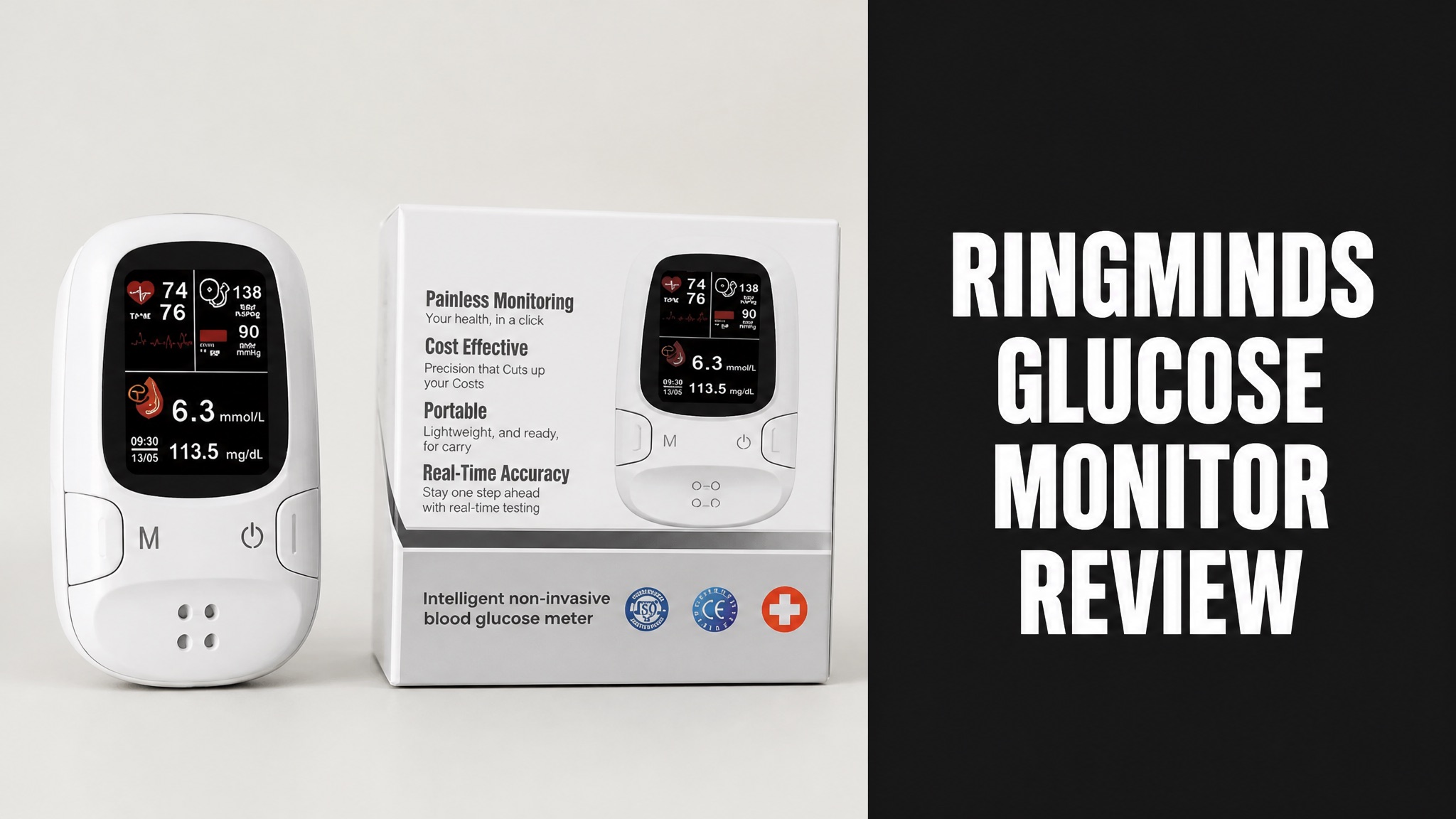
The Ringminds glucose monitor is a non-invasive smart meter sold through the ringminds.net web store. The seller claims it reads blood sugar without a finger prick. Regulators say no smart ring is authorized to do that, so the claim needs a hard look. Here’s what the evidence shows.
The pages promise 99.9% accuracy, big certifications and a 12-in-1 design. The FDA says rings do not test glucose directly. Belgium’s FAMHP found no reliable device in Europe. The testimonials cannot be verified, and the listings contradict each other on basic facts. Key claims fall apart on inspection. Check each claim before trusting any number.
The price runs from $16.95 to $40.95 (USD). The real cost is the risk of a wrong insulin dose. This review covers claims, evidence, pricing, safety and proven alternatives, so you can decide with facts and not with ads. Read on before you spend a cent. The full breakdown follows in the sections below.
What Is the Ringminds Glucose Monitor?
Ringminds is a non-invasive smart glucose meter sold through the ringminds.net online store. The seller markets a 12-in-1 device. It claims to read blood glucose, blood pressure, heart rate and blood oxygen. No finger prick or drop of blood is needed, according to the listing. The device is sold only through this seller’s own pages.
In short, the pitch is painless testing. The product page lists a price range of $18.95 to $36.95 (USD). Orders come in one, two or three pieces. The listing sits in a ‘Daily Deals’ category with a 50% discount badge.
Who Makes the Ringminds Glucose Monitor?
The Ringminds website credits ‘Advanced Canadian Technology’ but names no manufacturer, street address or company registration. Buyers cannot tell who builds the device. They also cannot tell who services it or who answers for a faulty reading. That gap alone is a red flag for any medical product. Real device makers publish this basic information.
In fact, the pages disagree on the developer. One listing credits ‘Ringminds HealthCare’, while a sister page on zenoraus.com credits ‘Bayera HealthCare’. Same device, two company names.
Another listing says a Dr. Elizabeth joined Johns Hopkins, Massachusetts General Hospital and UCSF on the research. So does any paper back that up? The page cites no study, trial or named publication.
How Does the Ringminds Glucose Monitor Work?
The Ringminds meter claims to estimate glucose by sending light through the fingertip and reading the returned signal. A sister page says a laser with a 650 nm wavelength and 5 mW output hits the finger. Then the ‘Lambert-Beer’ algorithm converts the result into a number. No independent lab has tested that process. Claims alone prove nothing here.
Here’s the catch. The main page describes ‘infrared spectral sensing’ and photon chips. Another listing describes a wearable biosensor that pairs with a smartphone NFC module. Two different technologies are claimed for one product, and neither is independently documented.
Bluetooth sync is also advertised for trend reports and sharing data with doctors. Does an app make the reading more accurate? Not at all. The app only displays whatever number the sensor produces.
How the Seller Describes the Technology:
- Infrared spectral sensing with photon chips
- Laser light at 650 nm and 5 mW
- Wearable NFC biosensor paired with a smartphone
- Bluetooth sync to a mobile app
Does the Ringminds Glucose Monitor Really Measure Blood Sugar?
No. The Ringminds meter has no regulator-reviewed evidence that it measures blood glucose. The FDA states that smartwatches and smart rings with this claim ‘do not directly test blood glucose levels’. The warning covers every brand, so Ringminds is included by definition. Independent testing is also missing. Claims alone are not proof.
Belgium’s FAMHP agrees. Researchers are working on needle-free sensing, but none has managed it reliably yet. In online reviews, users confirm that the values do not match their invasive glucose meters.
Harvard Health, in a piece by Heidi Godman and reviewed by Dr. Anthony Komaroff, repeats the point. Using these gadgets could produce inaccurate blood sugar readings, which is dangerous for people managing diabetes.
What Features Does the Ringminds Glucose Monitor Claim?
The Ringminds listings promise a long feature list, from pain-free testing to 99.9% accuracy and a 12-in-1 health dashboard. Extra claims include a mobile app, six display modes, voice broadcasts and four interface languages: English, German, French and Spanish. None of these features is backed by a cited study. Each feature sounds impressive on paper.
The table below puts the headline claims next to what the pages actually show. Let me break that down:
| Claim | Where Made | Evidence Shown |
|---|---|---|
| 99.9% accuracy | Main product page | None cited |
| 3x more accurate than test strips | Main product page | No study named |
| Health Canada, ISO 13485, CE, TÜV SÜD | Main product page | No certificate numbers |
| FDA and EU CE certified | Second listing | Contradicted by the FDA |
| Save up to 90% yearly | Main product page | No calculation given |
Bottom line: every headline claim lacks a source. One listing even states an accuracy of 99.996458415%. Why would a consumer meter quote nine decimal places? Because a precise-looking number sounds scientific, not because anyone measured it.
What Do Ringminds Glucose Monitor Reviews Say?
Independent reviews treat the Ringminds glucose monitor as unproven or a possible scam. A Reddit r/diabetes thread asks whether Ringminds is ‘witchcraft or real technology’. Several YouTube reviews carry titles that ask if it is legit or a scam. No verified buyer review supports the seller’s claims. The doubt is consistent across platforms.
The seller’s own pages tell another story. Both product listings show ‘Reviews (0)’ and ‘There are no reviews yet.’ So where does the praise come from? The pages quote it themselves. One claim reads ‘99.5% of Reviewers Recommends This Product’.
The same page boasts ‘18653 sold in last 72 hours’. Yet zero reviews exist. To be clear, those two claims cannot both be true, and the counters look like pressure tactics, not data.
Common Complaints:
- No FDA authorization or valid CE mark
- Readings that don’t match finger-prick meters
- Zero verified buyer reviews on the seller’s site
- Conflicting certification and company claims
Are the Ringminds Testimonials Genuine?
No. The testimonials carry no surname, photo, date or link that a reader could verify. The page quotes ‘Jennifer, age 55, from Florida’ and ‘Mark, 61 years old, from Ohio’. It says nothing else about either person, so nobody can confirm they exist. Real reviews usually include more detail. Nothing ties them to a real buyer.
The page also quotes an endocrinologist, ‘Dr. John Mercer, M.D.’, with no clinic, license number or publication. Is he real? Nothing on the page proves it, and a medical endorsement needs more than a name.
Here’s the kicker: the same page shows no customer reviews at all. Glowing quotes sit above an empty review section. That mismatch is the strongest sign the testimonials are marketing copy.
Is the Ringminds Glucose Monitor FDA Approved?
No. The Ringminds meter has no FDA authorization, clearance or approval of any kind. The FDA safety communication, issued February 21, 2024, makes one point clear. The agency has not authorized any smartwatch or smart ring that measures or estimates blood glucose on its own. That status alone settles the approval question. The status is the same today.
A sister listing calls the device ‘FDA and EU CE certified’ anyway. That claim conflicts with the FDA notice. The notice applies to any smart ring that claims to measure glucose, regardless of manufacturer or brand.
Europe is no different. The FAMHP (October 20, 2025) says no non-invasive meter is recognised as a medical device there. None carries a valid four-digit CE mark, so none can be legally sold.
What Regulators and Experts Say:
| Source | Position |
|---|---|
| US FDA | No smart ring is authorized to measure glucose |
| Belgium FAMHP | No valid CE mark, unreliable and potentially dangerous |
| Harvard Health | Needle-free gadgets may give inaccurate readings |
| AARP | Advises against smartwatches and rings for glucose |
Are the Ringminds Certifications Real?
No. The listed certifications come without certificate numbers or any entry that a buyer can check in a public registry. The main page names Health Canada, ISO 13485 and GMP, CE and TÜV SÜD marks. It shows none of the paperwork behind them. A genuine certificate lists a number, an issuer and a date. Without them, the badges are only decoration.
The FAMHP gives a simple test. Look for a CE mark with a four-digit code, then search the Eudamed database with EMDN code W0201060102. A real glucose meter appears there. So does Ringminds? The pages never say.
The listing also garbles basic facts. It expands the ADA as the ‘American Diabetes Research and Support Agency’ and abbreviates it as FDA. Sloppy copy like that undermines every other claim on the page.
Is the Ringminds Glucose Monitor Safe?
No. The device poses a real safety risk for anyone who adjusts insulin or medication based on its readings. The FDA warns that a wrong reading can mean a wrong dose. Dangerously low glucose follows, with mental confusion, coma or even death within hours of the error. The same risk applies to any similar ring. Accuracy matters most when doses depend on it.
The risk runs both ways. If a reading is too high, too much insulin follows. If it’s too low, too little is given, and sustained high sugar damages the eyes, kidneys and heart over time.
Main Safety Risks:
- Wrong insulin or sulfonylurea dose
- Dangerously low blood sugar
- Untreated high blood sugar
- Long-term damage to eyes, kidneys and heart
Who Should Avoid the Ringminds Glucose Monitor?
Anyone with diabetes who relies on glucose readings for insulin or other medication should avoid the Ringminds device. The FDA names insulin and sulfonylureas specifically. Errors with those drugs can drop glucose to a dangerous level within hours, so a trustworthy reading matters. That includes people newly diagnosed. Caregivers should apply the same rule.
The irony? The seller targets exactly those groups. The listing pitches the meter to Type 1 and Type 2 patients. It also names pregnant women with gestational diabetes and elderly users. These are the people with the most to lose.
Don’t drop an approved meter or CGM for a trial. Talk to a doctor or pharmacist first, and ask which FDA-authorized device suits your needs.
How Much Does the Ringminds Glucose Monitor Cost?
The Ringminds meter costs between $18.95 and $36.95 (USD) on the main product page. A second listing shows $16.95 to $40.95 (USD) with a 54% discount badge. Both pages sell bundles of several units, so the final bill depends on the quantity chosen at checkout. Prices shift between listings. Discount badges inflate the apparent savings.
Free worldwide shipping applies to orders over $99. The site also advertises its own money-back guarantee. That promise comes from the same seller, so no independent party backs it.
Ringminds Pricing at a Glance:
| Item | Detail |
|---|---|
| Main listing price | $18.95 to $36.95 (USD) |
| Second listing price | $16.95 to $40.95 (USD) |
| Free shipping threshold | $99 (USD) |
| Bundle sizes | 1, 2, 3 or 4 pieces |
Is the Ringminds Glucose Monitor Worth the Price?
No. The Ringminds meter is not worth any price as a glucose tool, because the readings cannot be trusted. A cheap wrong number costs far more than a proven meter when it drives a medication decision. Savings on test strips mean nothing if the data is wrong. Price is not the real issue here. A wrong reading is the expensive part.
Look at the sales tactics. The page says ‘Limit one purchase per person’ and ‘The promotion ends in one month’. A sister page shows ‘7819 Viewing’. Urgency like that pushes a fast purchase, not a careful one.
Now here’s the thing: low price does not equal low risk. Is a $20 device a bargain if it hides a dangerous glucose swing? Clearly not, so the money is better spent on an authorized meter.
What Are the Safe Alternatives to the Ringminds Glucose Monitor?
Safe alternatives are finger-prick glucose meters and continuous glucose monitors (CGMs) that regulators have authorized. Harvard Health notes that a CGM uses tiny sensor wires that pierce the skin. The wires send data to a smartphone app throughout the day. Both options carry regulatory review. Both are available through pharmacies and doctors.
The FDA warning does not cover CGMs. It also separates fake needle-free devices from smartwatch apps that display data from FDA-authorized glucose sensors. The difference is the authorized sensor underneath.
How to Check Any Glucose Meter:
- Confirm FDA authorization, or a CE mark with a four-digit code in Europe.
- Search the device in the Eudamed database with EMDN code W0201060102.
- Ask a doctor or pharmacist whether the device is reliable.
- Report any problem to the FDA through the MedWatch form.
Should You Buy the Ringminds Glucose Monitor?
No. The verdict is clear: skip the Ringminds glucose monitor and use an authorized meter or CGM instead. No regulator authorizes it. Every claim on the seller’s pages lacks independent proof. The company is unnamed, and the certifications are unverifiable. Nothing on the pages changes that conclusion. The risk outweighs the low price.
The short answer? Accuracy is unproven. Pain-free testing sounds great, but only proven technology delivers it. That technology already exists in approved CGMs, which regulators have reviewed and which doctors can prescribe.
Pay attention to this: anyone harmed by an unauthorized device can report it to the FDA through MedWatch. Reports help regulators spot risky products and protect other people with diabetes.