
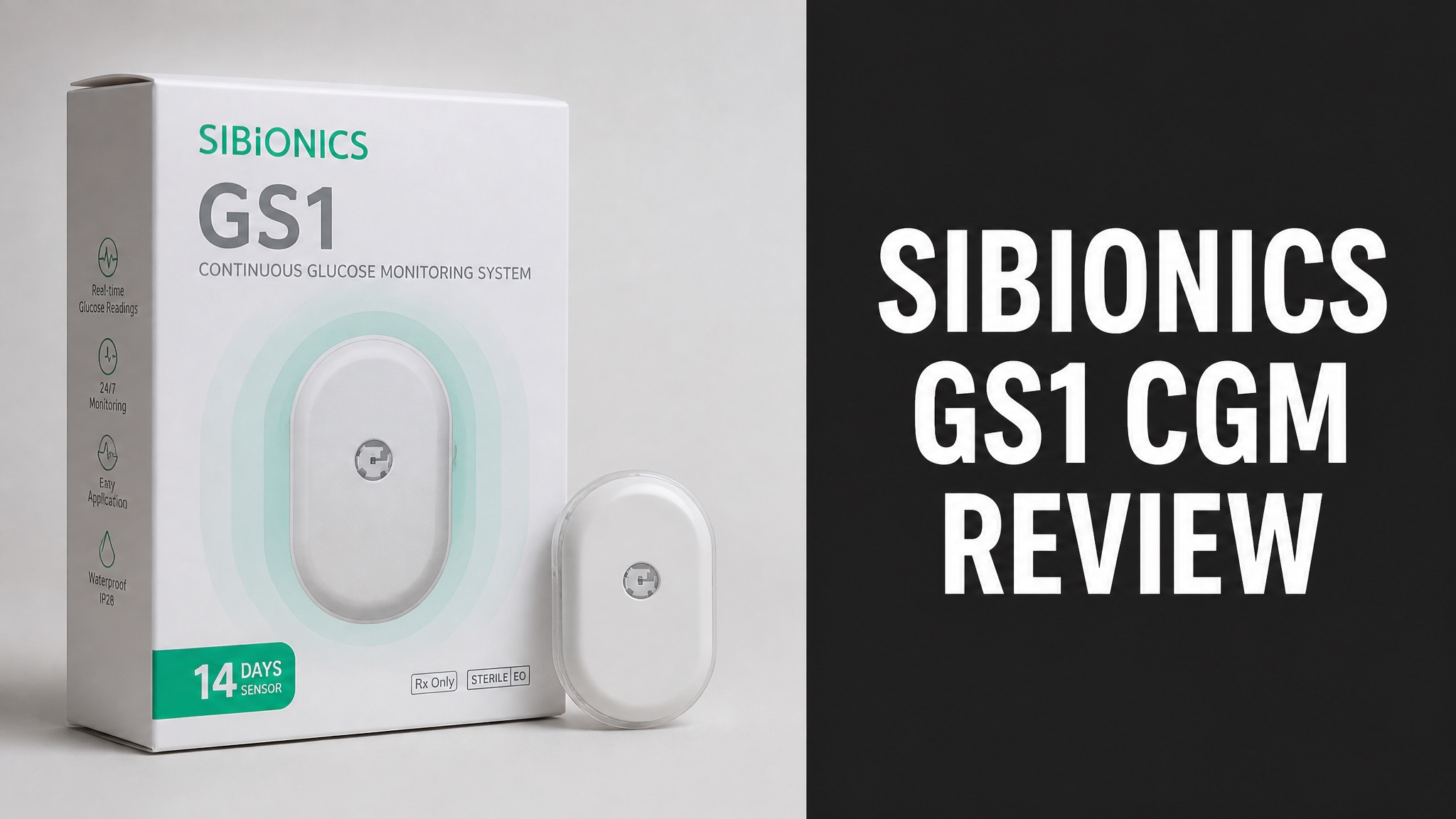
The SIBIONICS GS1 is a 14-day wearable continuous glucose monitor (CGM) that sends readings to a phone app. It needs no scanning and no calibration. Reviewers praise the price and comfort, while accuracy claims draw sharp debate.
The maker advertises an 8.83% MARD in adults. An independent test measured 13.5% against fingerpricks. Users like the app, the waterproof sensor and the low cost. Safety rules still require fingerpricks before insulin dosing. Price, features and limits all shape the verdict.
This review covers how the GS1 works, what it costs, how accurate it is and who should skip it. Each section uses published data, tester reports and user feedback. Read on to decide whether the GS1 earns a place on your arm.
What Is the SIBIONICS GS1 Continuous Glucose Monitor?
The SIBIONICS GS1 is a continuous glucose monitoring system that tracks interstitial fluid glucose for up to 14 days and sends readings to a smartphone app. The wearable sensor needs no calibration and no scanning. It targets people with type 1 or type 2 diabetes in select countries.
In fact, the system pairs a small sensor with a transmitter worn on the upper arm. The app shows trends, alarms and reports. SIBIONICS lists approved use from age 3 in select countries and age 18 and older elsewhere.
Who Makes the SIBIONICS GS1?
SIBIONICS is the company that develops and sells the GS1 through its own online store and partner retailers. The brand runs a research fund, a learning center and a community page. The GS1 received CE marking, which is why European social media ads for it spread widely.
Third-party shops also stock the sensor. Diapointshop, Amazon listings and regional pharmacies carry it. Buyers should check that a seller offers the same replacement policy as the maker.
How Does the SIBIONICS GS1 Work?
The GS1 measures glucose in the fluid under the skin and transmits a reading every 5 minutes over Bluetooth. That adds up to 288 readings per day. The app receives them without any scan. The sensor must stay within 6 meters (20 feet) of the phone.
Here’s the catch. A 60-minute warm-up applies when the sensor first pairs with the app. Pairing only works after the sensor sits on the arm, a detail the Medical Futurist reviewer found unclear at first.
GS1 Quick Specs:
| Feature | Detail |
|---|---|
| Sensor life | 14 days |
| Reading interval | Every 5 minutes |
| Calibration | Not required |
| Water rating | IP28 |
| Bluetooth range | 6 meters (20 feet) |
Does the SIBIONICS GS1 Need Calibration or Scanning?
No. The GS1 works without calibration and without scanning, since the sensor pushes data straight to the app. Setup took the Medical Futurist reviewer about one minute of registration. A QR code on the box connects the device.
Calibration-free also means users cannot correct a drifting sensor. Fingerpricks stay useful for checking a doubtful number. The maker itself says to test blood glucose when readings do not match symptoms.
What Are the Features of the SIBIONICS GS1?
The GS1 offers customizable alarms, exportable AGP reports, shareable real-time data and an IP28 waterproof sensor. The app stores the last 90 days of data. It runs on Android and Apple devices. Alarms can override Do Not Disturb mode on the phone.
Now, watch the water rating. IP28 means submersion to 1 meter (3.3 feet) for up to 30 minutes. The Medical Futurist reviewer showered daily and exercised about 10 times. The sensor stayed on for two weeks.
Main Features:
- 14-day continuous monitoring
- Customizable high and low alarms
- Exportable AGP reports
- Shareable real-time glucose data
- IP28 waterproof sensor
- No calibration and no scanning
Is the SIBIONICS GS1 Accurate?
Not fully. The GS1 carries an advertised 8.83% MARD in adults, yet independent testing and subgroup data show weaker results. MARD measures the average gap between sensor and reference values. Lower numbers mean better accuracy. Context matters, because the advertised figure blends several user groups.
Diabettech noted that users with type 1 diabetes on insulin showed a 9.15% MARD. Below 4.4 mmol/L (about 79 mg/dL), that group’s MARD reached 15.03%. The low range is where accuracy matters most.
The maker claims about 93 of 100 readings pass the 20/20 rule. In its words, a lab value of 100 mg/dL should read between 80 and 120 mg/dL.
Accuracy Figures:
| Source | MARD |
|---|---|
| SIBIONICS, adults | 8.83% |
| SIBIONICS, ages 3 to 17 | 8.7% |
| Type 1 on insulin, clinical trial | 9.15% |
| Type 1 below 4.4 mmol/L, trial | 15.03% |
| Diabettech n=1 vs fingerpricks | 13.5% |
Does the SIBIONICS GS1 Replace Fingerpricks?
No. The GS1 is not approved for making treatment decisions, so insulin dosing still requires a fingerprick. The user guide says high and low readings cannot be relied on alone. Diabettech called the no-fingerprick ads misleading on this point.
The Medical Futurist reviewer, Dr. Bertalan Mesko, could not confirm accuracy. He had no clinical comparison and said regulator cross-checks must fill that gap. He also saw no company trial data.
Why Do GS1 and Fingerprick Readings Differ?
The two methods test different fluids, so small differences are normal. The sensor reads interstitial fluid, which can lag blood by five to ten minutes. Fast glucose swings widen the gap. Readings settle once levels stabilize.
Other factors also matter. Sugar on the fingers can inflate a meter result. The first day of a new sensor tends to vary more. Sleeping on the arm can press the sensor and cause a false low.
What Do SIBIONICS GS1 Reviews Say?
Reviews split sharply between happy long-term users and critical technical testers. Users praise comfort, price and the app. Testers question accuracy and marketing claims. Both groups agree the 14-day wear time and waterproofing work as promised.
Here’s the thing. Reddit threads also include bad experiences, which fits the mixed picture. The brand’s Trustpilot page could not be read in this research, so review scores stay unverified here.
What Do Users Like About the SIBIONICS GS1?
Fans highlight reliable 14-day wear, easy setup and readings close to fingerpricks. One commenter on Diabettech reached a fourth sensor and said all four lasted the promised 14 days. Another called accuracy better than Libre v1.
Dr. Mesko found the app and registration smooth. He felt no pain, unlike with another sensor he tried. His readings looked consistent across exercise, meals and a long presentation.
What Are the Common Complaints About the SIBIONICS GS1?
Critics focus on accuracy gaps, lower-than-reference readings and social media claims that overstate approved use. Diabettech saw the GS1 read lower than the reference, and also lower than an expired Libre 2. That test is a single sample.
Other complaints are smaller. Some users report a 10 to 15 minute lag against fingerpricks. Dr. Mesko once got a false low alert while running. Data export is also limited to a PDF report.
Pros and Cons:
| Pros | Cons |
|---|---|
| 14-day sensor life | Accuracy debated |
| Calibration free | Not for insulin dosing |
| IP28 waterproof | PDF-only data export |
| Low cost | Lag versus fingerpricks |
How Does the SIBIONICS GS1 Compare to Other Options?
The GS1 works as a monitor only, so it competes with other CGMs and not with insulin pumps. A CGM never delivers insulin. It reports glucose so the wearer can react. Pumps like the MiniMed 780G adjust insulin automatically.
Bimedis compares the two. The GS1 lasts 14 days per sensor and needs no calibration. The MiniMed 780G uses a Guardian Sensor 4 with a 7 day life. The right pick depends on monitoring versus automation.
GS1 vs MiniMed 780G:
| Feature | SIBIONICS GS1 | MiniMed 780G |
|---|---|---|
| Insulin delivery | No | Automatic |
| Sensor life | 14 days | 7 days |
| Calibration | Not required | Not required |
| Data access | Smartphone | Pump screen and app |
Is the SIBIONICS GS1 Better Than Libre 2?
Not on accuracy, based on one test. Diabettech measured a 7.4% MARD for an expired Libre 2 against 13.5% for the GS1. Established brands with high-quality trials have matched their fingerprick comparisons. That pattern did not hold for the GS1 here.
The tester concluded he would not use the GS1. He cited trust in the sensor and the maker’s social media behavior. Price and availability remain the GS1’s stronger case.
Is the SIBIONICS GS1 Safe and Approved?
Yes, with limits. The GS1 carries CE marking in Europe and is approved for adults and children in select countries. The safety catch is use. Its guide warns against treatment decisions based on readings alone. Doctors should guide alarm settings.
Also, the maker advises a blood glucose test when a reading feels wrong. Symptoms of high or low glucose should never be ignored. Dr. Mesko urged readers to consult a healthcare provider first.
Who Should Avoid the SIBIONICS GS1?
People who dose insulin from sensor numbers should avoid relying on the GS1 alone. Diabettech argued its accuracy is too weak for that, especially in the low range. Fingerpricks stay necessary for those decisions.
Children under the approved age should not use it either. SIBIONICS sets age 3 or 18 depending on the country. Check country-specific indications with support@sibionics.com before buying.
How Much Does the SIBIONICS GS1 Cost?
A single GS1 sensor costs EUR 62.99 on the official store, with 10% off bundles of two or more units. Diabettech listed the UK face price at about GBP 56 (about USD 75). The tester called that expensive given cheaper rivals.
Dr. Mesko saw it differently. He called the GS1 the only globally available CGM he knew, at a far lower price than competitors. Discounts and bulk purchase pages change the real cost.
Is the SIBIONICS GS1 Worth the Price?
It depends. The GS1 is worth it for casual tracking and trend spotting, but weaker value for insulin users. A 14-day sensor cuts swap frequency. Waterproofing and a free app add convenience. Accuracy limits cap the value for treatment.
The maker backs each sensor with a free replacement or refund policy. It applies if performance deviates or the device malfunctions within its 14-day life.
Where to Buy the SIBIONICS GS1?
Buyers can order the GS1 from the official SIBIONICS store or from retailers such as Diapointshop and Amazon. The official store offers bundles, bulk purchase and the replacement policy. It lists units in mmol/L or mg/dL.
Be careful with resale listings. eBay and marketplace sellers may not honor the maker’s refund policy. Availability also varies by country, so confirm that the product is supported where you live.
Is the SIBIONICS GS1 Worth It?
Bottom line: the GS1 is a low-cost, comfortable, easy CGM that suits monitoring and trend awareness, not insulin dosing. The 14-day wear, waterproof build and app earn real praise. Accuracy results remain contested, and published data shows weak low-range performance.
So who should buy it? People who want glucose trends, diet insight or backup monitoring can benefit. Insulin users should check with a doctor first and keep a fingerprick meter ready.