
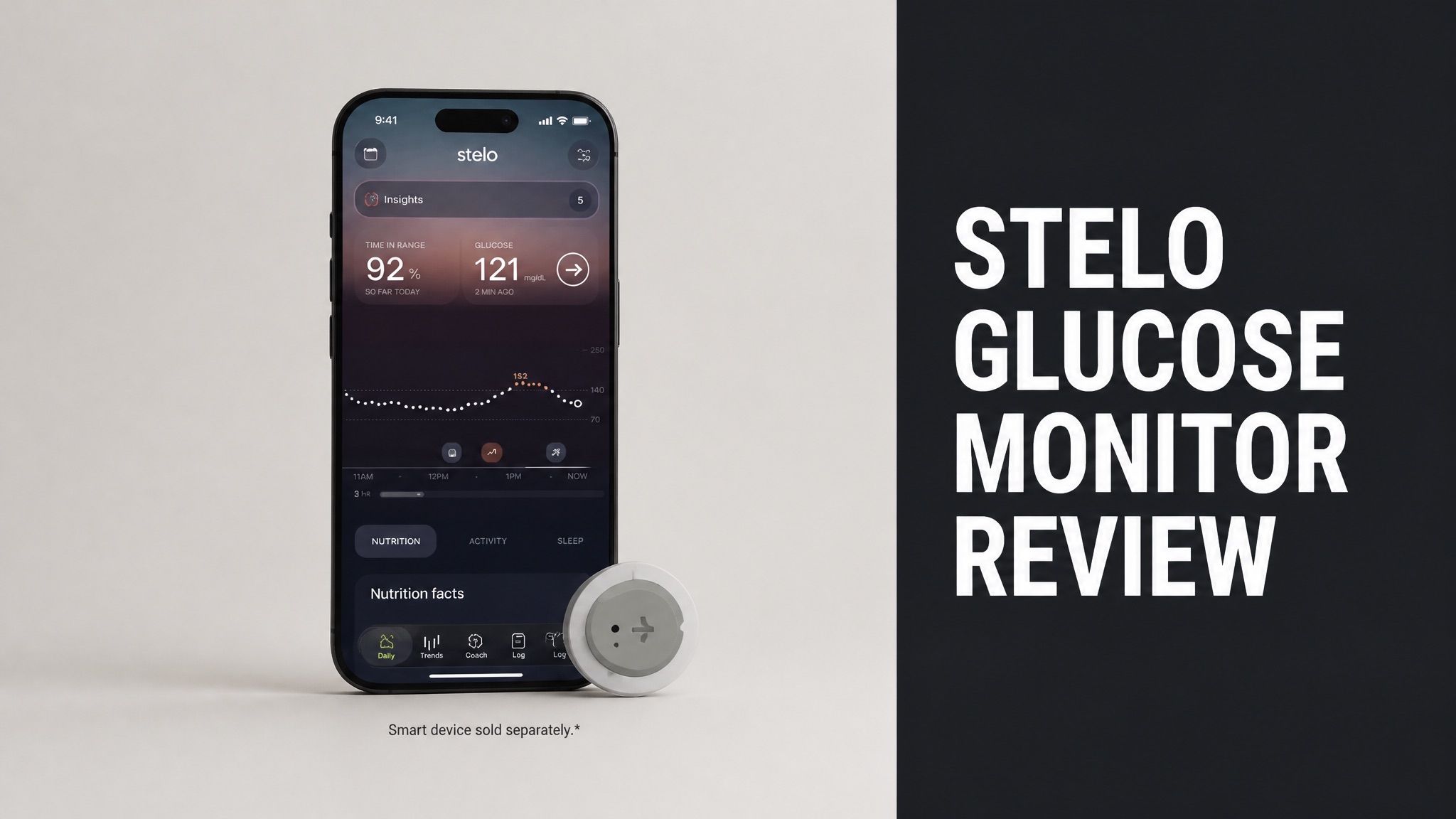
Stelo is a Dexcom wearable that tracks glucose day and night without a prescription. The FDA cleared it in 2024 as the first over-the-counter continuous glucose monitor in the United States. Adults 18 and older who skip insulin can buy it online. Dexcom built it for people who want awareness, not alarms.
The sensor lasts up to 15 days and sends readings to a phone app every 15 minutes. Reviewers praise the easy setup, the lower price and the food insights. They also flag the missing low-sugar alarms, the battery drain and the delayed spike alerts. Dexcom backs the accuracy claim with laboratory data. The picture is mostly positive for the right user.
So is it a smart buy or an expensive gadget? This review covers how Stelo works, what it costs and who should skip it. It also compares Stelo with Abbott Lingo and the Dexcom G7. Read on for a clear verdict.
What Is Stelo Glucose Monitor?
Stelo Glucose Monitor is a wearable biosensor from Dexcom that tracks glucose around the clock without a prescription. The FDA cleared it as the first over-the-counter continuous glucose monitor in the United States. Adults 18 and older who do not use insulin can buy it directly online. Dexcom sells it as a tool for awareness.
Dexcom launched the device in August 2024. In fact, the company built it on the same sensor technology as the prescription Dexcom G7. The Stelo app turns the raw numbers into simple graphs.
Stelo Key Facts:
| Detail | Stelo |
|---|---|
| Maker | Dexcom |
| Prescription | Not required |
| Age | 18 and older |
| Wear time | Up to 15 days |
| Reading updates | Every 15 minutes |
Who Is Stelo For?
Stelo suits adults with prediabetes, type 2 diabetes without insulin, and healthy people who want food insights. Dexcom designed it for people who need awareness rather than medical alerts. Anyone 18 or older, with or without diabetes, can wear it. Parents of younger users need a different device.
Why does the insulin line matter? Insulin can drop blood sugar to dangerous lows. Stelo has no low-glucose alarm, so Dexcom keeps it away from that group.
How Does Stelo Work?
Stelo reads glucose from the fluid under the skin through a thin filament and sends data to an app. The sensor checks glucose every 5 minutes. The app receives updates every 15 minutes. A 30-minute warm-up follows each new sensor. Then the graph appears on the phone.
To be clear, the device measures interstitial fluid, not blood. That is how every continuous monitor works. The app then shows trends, spikes and time in range.
How Do You Apply Stelo?
The applicator places the sensor on the back of the upper arm with one push. Reviewers at diaTribe and The Verge called the process easy and surprisingly painless. One diaTribe tester thought she had applied it wrong because it did not hurt. The app guides each step on screen.
Application Steps:
- Download the Stelo app and create an account.
- Clean the back of the upper arm and let it dry.
- Remove the applicator cap and press it against the skin.
- Push the button to place the sensor.
- Pair the sensor with the phone and wait 30 minutes.
How Long Does a Stelo Sensor Last?
Each Stelo sensor lasts up to 15 days, with a 12-hour grace period after the session ends. The grace period lets users apply a new sensor without a data gap. The sensor is waterproof and survives 8 feet (2.4 meters) of water for 24 hours. Showers and swims are fine.
Ted Eytan, MD, liked the adhesive overpatch. Here’s the thing: it held firm through daily life. He noted the expired sensor even takes effort to remove.
What Are the Benefits of Stelo?
Stelo delivers three main benefits: no prescription, lower cost than most monitors, and clear food and sleep feedback. Users see how meals, exercise, sleep and stress move glucose. diaTribe’s CEO said the data pushed him to change habits and spend more time in range. That feedback drives the appeal.
Main Benefits:
- Purchase without a doctor visit
- Lower price than prescription monitors
- Waterproof sensor with 15-day wear
- Spike alerts and a weekly spike report
- Food logging with photos
Does Stelo Help Track Food Spikes?
Yes. Stelo flags glucose spikes and shows which meals and habits caused them. Weekly spike reports count how many spikes happened and how severe they were. The Smart Food Log lets users snap a photo of a meal. Together, these tools link food to glucose. Users can then adjust the next meal.
The catch? The alerts arrive late. The Verge reviewer got spike notices 20 to 60 minutes after the event. Watching the live graph gives faster feedback.
Does Stelo Work With Other Apps?
Yes. Stelo syncs with Apple Health, Android health data and the Oura ring. It also works with an Apple Watch and the Nutrisense platform. Dexcom Clarity gives doctors a longer view of the data. Users can share a full report with a clinician. The app also pulls in exercise and sleep data.
Eytan called the Apple Health link a big plus over the Freestyle Libre. Readings and exercise data sit in one place. And that saves a lot of manual logging.
What Do Stelo Reviews Say?
Stelo reviews praise the easy setup, price and food insights, but criticize the missing low alarms and battery drain. Independent testers from diaTribe, The Verge and a private physician reached similar conclusions. Most call it a strong awareness tool rather than a medical one.
Overall, the sentiment is positive for the target group. Reviewers who expected medical-grade alerts were the least happy. Reviewers who wanted a habit tracker were the happiest.
What Do Users Like About Stelo?
Users like the painless application, the clear app and the motivation to change eating habits. One diaTribe tester found low glucose levels and realized she skipped meals and water. Another reviewer stopped a late-night sweet treat after seeing the crash. The data made the habit visible.
The good news? Many testers also like the stable adhesion. Short answer: the sensor stays on.
What Are the Common Complaints About Stelo?
Common complaints include no low-glucose alarms, delayed spike alerts, battery drain and no data access after a session. One diaTribe tester reported the sensor failing to connect. Another said the app drained the phone battery. These flaws do not break the product. They do limit it.
Top Complaints:
- No alarms for dangerous lows
- Spike alerts delayed up to 60 minutes
- Phone battery drain
- Connection problems on some sensors
- Limited access to past data
How Accurate Is Stelo?
Stelo is accurate in 93% of readings against a laboratory YSI blood glucose test, according to Dexcom. That figure uses the 20/20% YSI standard. A lab reading of 100 mg/dL (5.6 mmol/L) matches when Stelo reads 80 to 120 mg/dL (4.4 to 6.7 mmol/L).
A third-party comparison lists the Stelo MARD at 8.3%. Lower MARD means higher accuracy. By comparison, the same source lists the Abbott Lingo at 9.3%.
Accuracy Numbers:
| Metric | Value |
|---|---|
| Readings within 20/20% of lab test | 93% |
| Stelo MARD | 8.3% |
| Lingo MARD | 9.3% |
Does Stelo Match a Finger-Prick Meter?
No. Stelo can differ from a finger-prick meter because the two tools measure different fluids. Dexcom says each method has its own margin of error. The company calls a direct comparison unhelpful. A meter reads blood, while Stelo reads fluid between cells. Small gaps are normal.
So what does that mean for you? Treat Stelo as a trend tool. Expect a lag during fast changes, and confirm symptoms with a meter.
How Does Stelo Compare With Lingo and the Dexcom G7?
Stelo competes mainly with the Abbott Lingo, another over-the-counter monitor, and the prescription Dexcom G7. All three use a small sensor on the arm and a phone app. They differ in wear time, update speed, price and alarms. The table below sums up the main gaps at a glance.
Stelo vs Lingo vs G7:
| Feature | Stelo | Lingo | Dexcom G7 |
|---|---|---|---|
| Prescription | No | No | Yes |
| Wear time | 15 days | 14 days | 10 days |
| App update | 15 minutes | 1 minute | 5 minutes |
| Low alarms | No | No | Yes |
Stelo vs Abbott Lingo: Which Is Better?
Stelo wins on wear time and Android support, while Lingo wins on update speed and the entry price. Stelo lasts 15 days against 14 days for Lingo. Lingo refreshes every minute and costs $49 for a single sensor. Stelo costs $99 for two. Both skip low-sugar alarms.
The reason is simple: Stelo targets longer, steadier use. Lingo targets quick tests and coaching. Pick based on how you plan to wear it.
Stelo vs Dexcom G7: What Is the Difference?
The Dexcom G7 adds alarms and needs a prescription, while Stelo skips both. Stelo shares the G7 sensor technology but removes the safety alerts. That cut makes the over-the-counter sale possible. The G7 also updates the app every 5 minutes. Stelo updates every 15 minutes.
People who use insulin or face a risk of severe low blood sugar should avoid Stelo. Children under 18 are also outside the cleared group. These users need a monitor with alarms. A doctor can recommend a prescription device such as the Dexcom G7. Do not guess here.
Is Stelo Safe?
Yes. Stelo is safe for its intended group because the FDA cleared it for adults 18 and older without insulin use. Dexcom is an established medical device company. The risk lies in using it outside that group.
The missing low alarms matter most. Why? A person with severe lows would get no warning. That makes the device a poor fit for them.
Who Should Avoid Stelo?
People who use insulin or face a risk of severe low blood sugar should avoid Stelo. Children under 18 are also outside the cleared group. These users need a monitor with alarms. A doctor can recommend a prescription device such as the Dexcom G7. Do not guess here.
Skip Stelo If You:
- Take insulin
- Have a history of severe low blood sugar
- Are under 18
- Need alarms for dangerous lows
How Much Does Stelo Cost?
Stelo costs $99 for a one-time pack of two sensors, or $89 per month on a subscription. Each pack covers about 30 days. Dexcom also lists a 3-month subscription that saves 15%. The devices are HSA and FSA eligible. Insurance rarely covers monitors for people who skip insulin.
Stelo Purchase Options:
| Option | Price (USD) |
|---|---|
| One-time two-pack | $99 |
| Monthly subscription | $89 |
| 3-month subscription | 15% off |
Where to Buy Stelo?
Shoppers can buy Stelo on the official Stelo website and through select retailers such as Amazon. No prescription or doctor visit is needed. The order ships to the door. Subscribers get two sensors every month. Buyers who want a trial can pick the one-time pack.
Eytan liked the pause option. And you can cancel a subscription at any time. That suits people who want short, occasional trials.
Is Stelo Worth the Price?
Stelo delivers strong value for people who want food and habit insights at a lower cost than prescription monitors. The price is still real. Two sensors a month adds up to $1,068 (USD) a year on a subscription. A short trial costs far less.
Does it need to be a permanent habit? Not at all. Many users wear it for a month or two, learn their patterns and stop.
Should You Try Stelo?
Yes. Stelo is worth trying if you have prediabetes, type 2 diabetes without insulin, or a curiosity about food and glucose. The easy setup and clear data make it a strong first monitor. Skip it if you need alarms. Start with one pack, learn your patterns and then decide.
Bottom line: Stelo is a solid awareness tool at a fair price. Know its limits, and it earns the spot on your arm.