
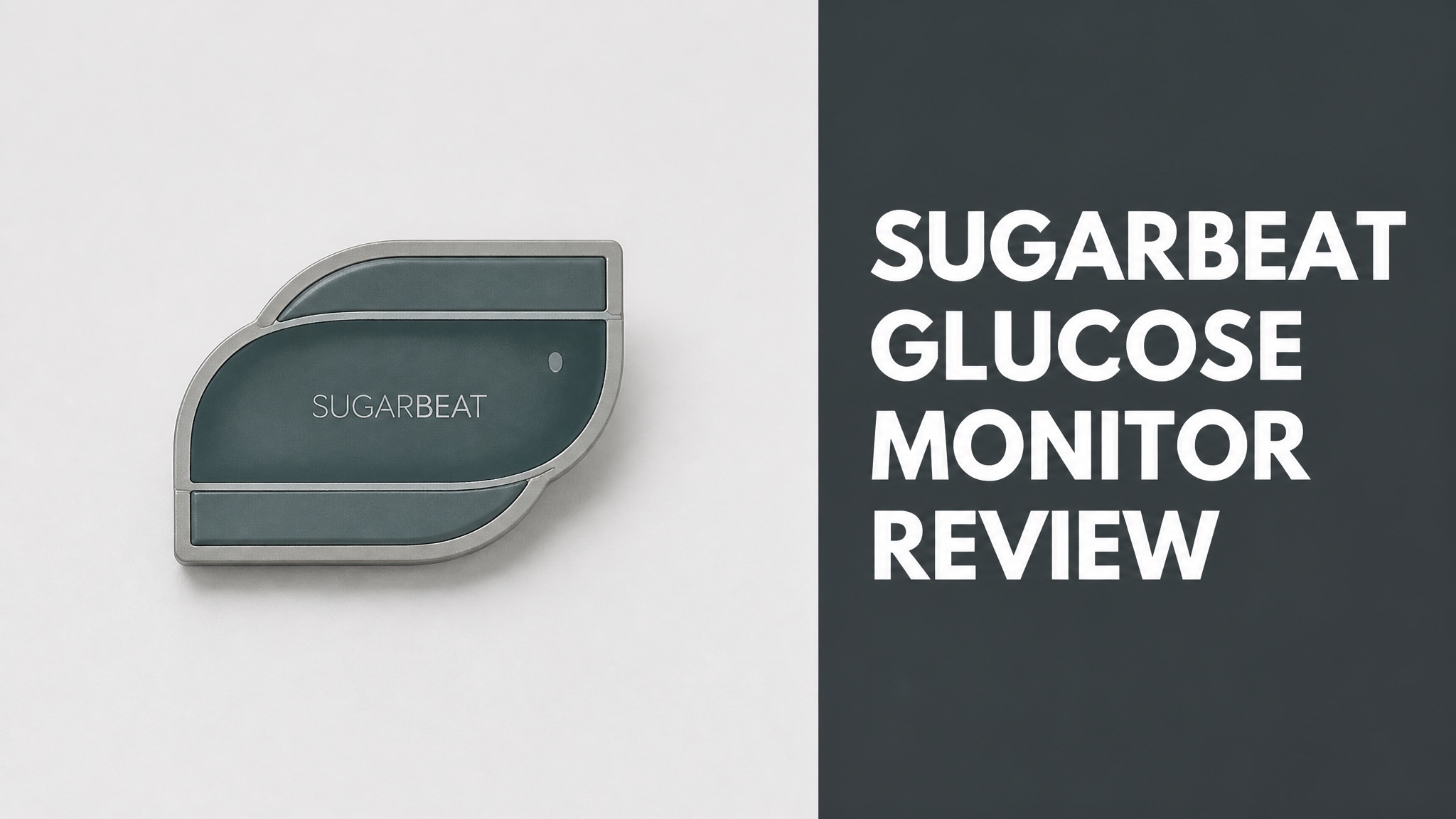
SugarBEAT is a needle-free continuous glucose monitor from Nemaura Medical in Loughborough, England. A disposable skin patch and a Bluetooth transmitter send glucose readings to a phone every 5 minutes. Regulators granted the CE mark in May 2019, and this review tests the claims behind the device.
The patch pulls glucose from the fluid under the skin with a mild current. Clinical trials report accuracy between 9.8% and 12.8% MARD. Wear time runs 14 to 24 hours per patch, and finger-prick calibration still applies. Independent reviews are scarce, pricing is unconfirmed, and FDA approval has not arrived. Those gaps shape the verdict. The picture is mixed.
The sections below cover how the device works, how accurate it is, and how it compares with Dexcom and Libre. Safety, cost, and availability follow. Read on to decide whether sugarBEAT earns a place on your arm. A longer-wear sensor may suit others better. Both outcomes are possible.
What Is sugarBEAT?
sugarBEAT is a non-invasive continuous glucose monitor built by Nemaura Medical for people with diabetes and pre-diabetes. The system pairs a disposable adhesive patch with a rechargeable Bluetooth transmitter and a smartphone app. Readings reach the phone every 5 minutes, and no needle enters the skin at any point in the process. The app tracks trends.
To be clear, the patch sits on top of the skin. The patch measures about 1 millimeter (0.04 inches) thick and conforms to the body. Wearers peel it off whenever they want, which sets the design apart from sensors worn for weeks.
Who Makes sugarBEAT?
Nemaura Medical develops sugarBEAT as its flagship wearable glucose product from its base in Loughborough, England. The company holds more than 30 issued and pending patents on the technology. CEO Dr. Faz Chowdhury has pitched the device at both the diabetes and pre-diabetes markets, plus the wider wearable health tech market. Its roots trace back to the UK.
In fact, Nemaura also sells proBEAT, a professional version aimed at people with type 2 diabetes. The company calls proBEAT a nonregulated product. Fred Schaesdau, a former Dexcom Germany general manager, advised the European launch.
Who Is sugarBEAT For?
The device targets people with type 1 diabetes, type 2 diabetes, and pre-diabetes. Wear on non-continuous days suits type 2 patients, who typically check blood sugar periodically rather than around the clock. Nemaura also courts health-conscious consumers in the wearable tech market, beyond the clinical diabetes audience. Each group uses the patch differently.
What about insulin users? They can use sugarBEAT adjunctively for insulin dosing, but only when a finger-stick reading has calibrated the patch first.
Target Users:
- Adults with type 1 diabetes
- Adults with type 2 diabetes
- People with pre-diabetes
- Health-conscious wearable tech buyers
How Does sugarBEAT Work?
The patch passes a mild electric current across the skin to draw glucose out of the interstitial fluid beneath it. Interstitial fluid sits just below the top layer of skin. The current is imperceptible, so the process is painless. A rechargeable transmitter then measures the glucose the patch collects from that fluid. Bluetooth then relays the result.
Here’s the thing: raw signal is not a glucose number. An algorithm converts the transmitter data into readings. The app also logs diet, exercise, medication, and mood, so wearers see what moves their levels.
Think of it this way: the app builds an Ambulatory Glucose Profile. Wearers share that report with a physician through the cloud. Nemaura also offers a stand-alone reader for people without a smartphone.
How Long Does a sugarBEAT Patch Last?
Each patch delivers readings for up to 24 hours after a 30 to 60 minute warm-up period. DocWire reported that figure at the 2019 CE mark. The 2023 coverage adds a catch, though. The Class IIb approval in Europe and Saudi Arabia covers only 14 hours. The label and the marketing claim differ by ten hours. Read the label first, then plan the day.
Why does the gap exist? Nemaura’s 2023 study aimed to extend approved wear to 24 hours. Until regulators agree, the 14-hour figure is the safe planning number.
Daily Wear Steps:
- Apply a fresh patch to the arm or abdomen.
- Attach the rechargeable transmitter to the patch.
- Wait 30 to 60 minutes for the warm-up.
- Calibrate with one finger-prick reading.
- Read glucose values in the app every 5 minutes.
Does sugarBEAT Need Finger-Prick Calibration?
Yes. The system requires a finger-prick test to calibrate the patch once it is applied to the skin. Desang Diabetes Services described the requirement as an old-fashioned finger prick once a day. The 11.92% MARD figure also came from single-point finger-stick calibration. The step is part of the design, not a bug. Auto-calibration is under study.
The good news? Nemaura is testing auto-calibration in the remaining cohorts of its 2023 study. Results will show whether the daily prick can disappear.
How Accurate Is sugarBEAT?
sugarBEAT posted a mean absolute relative difference (MARD) of 11.92% in its clinical trial for FDA submission. The trial enrolled 75 patients with type 1 and type 2 diabetes over 225 patient days. Catheter blood samples arrived every 15 minutes during 12-hour sessions on three non-consecutive days, a strict protocol. Values were checked against blood.
Why does MARD matter? Lower numbers mean readings sit closer to lab values. The trial produced over 12,000 paired data points, and researchers reported no adverse outcomes.
What Did the 100-Patient sugarBEAT Study Find?
The 2023 study reported a 9.8% MARD over 12 hours and a 12.8% MARD over 24 hours of sensor wear. Nemaura ran the 100-patient study in the Middle East, across four cohorts of men and women aged 18 to 75. Twenty patients had type 1 diabetes and the rest had type 2 diabetes. The cohorts also tested several skin application methods and auto-calibration options.
At 12 hours, 86% of paired points landed within 20/20 of the reference value. At 24 hours, that share fell to 76%. And here is the part most people miss: accuracy drops as wear time grows.
sugarBEAT Accuracy Results:
| Study | Wear Period | MARD |
|---|---|---|
| Early trial (75 patients) | 12 hours | 11.92% |
| 2023 cohort (25 patients) | 12 hours | 9.8% |
| 2023 cohort (1,379 paired points) | 24 hours | 12.8% |
What Do sugarBEAT Reviews Say?
Independent sugarBEAT reviews remain scarce, so most public opinion comes from press coverage and company trials. A FUDiabetes forum thread on needle-free CGMs drew 10 replies and 704 views by June 2019. Members mostly expressed curiosity rather than hands-on experience, and verified buyer ratings were not found in this research. Few users post accounts.
So what can a buyer trust? The trial data and regulator decisions carry the most weight. Verified buyer ratings were not found in this research.
What Do Users Like About sugarBEAT?
Praise centers on the painless, needle-free design and the freedom to choose which days to wear the patch. Nemaura says a lighter adhesive maximizes comfort. The company also says daily disposal reduces the skin irritation that sensors worn for weeks can cause. Those points come from the maker, not from independent testers. Independent proof is missing.
Pros:
- No needle or insertion
- Painless mild current
- Flexible wear days
- Readings every 5 minutes
- Planned low price
What Are the Common sugarBEAT Complaints?
Complaints focus on daily calibration, a long warm-up, and a short wear time compared with rival sensors. A GlucoMen Day sensor lasts 14 days and reports a value every minute. The sugarBEAT patch lasts one day at most. The difference matters for anyone who wants set-and-forget monitoring without daily steps. Each day repeats the same routine for wearers.
Cons:
- Daily finger-prick calibration
- 30 to 60 minute warm-up
- 14 to 24 hour patch life
- No FDA approval
- Limited availability
How Does sugarBEAT Compare to Dexcom and Libre?
sugarBEAT trades long wear time for a needle-free, flexible patch that comes off at will. Coverage names Abbott’s FreeStyle Libre 2, Dexcom’s G7, and Medtronic’s MiniMed 780G as the established rivals. Senseonics also gained approval for a 90-day system. Those devices target continuous, multi-day use rather than daily patches. Each rival has its own history.
By comparison, sugarBEAT reads every 5 minutes. GlucoMen Day reads every minute. Is faster always better? Not necessarily, since trend data matters more than raw frequency for many wearers.
Wear Time Comparison:
| Device | Maker | Wear Period |
|---|---|---|
| sugarBEAT | Nemaura Medical | 14 to 24 hours |
| GlucoMen Day | Menarini | 14 days |
| Senseonics system | Senseonics | 90 days |
What Is the Biggest sugarBEAT Advantage Over Rivals?
The biggest edge is that the patch sits on top of the skin and comes off at any time. Rival sensors insert into the skin and stay for days. A failed sugarBEAT patch costs one day of wear, not a week. Nemaura also said it plans to offer the lowest-priced CGM in the industry. Cost is the other pull for budget buyers. Price is unconfirmed. Cost is the other pull.
The bad news? The price claim has no confirmed number behind it yet.
Is sugarBEAT Safe?
Yes. The device recorded no device-related adverse events in its 75-patient clinical trial. The design avoids skin penetration entirely, and the mild current is not felt by the wearer. Regulators in Europe and Saudi Arabia have cleared the system for sale. Approval adds oversight beyond the maker’s own claims. Calibration still applies for dosing.
Safe for whom, though? Insulin users must calibrate with a finger stick first. Does skin irritation happen? Response differs by wearer, and no source quantifies irritation rates.
Does sugarBEAT Cause Side Effects?
No. Published coverage reports no side effects or adverse outcomes from the sugarBEAT clinical trials. What’s more, the disposable design limits long-term adhesive contact with one patch. Still, no study reviewed here followed wearers for months, so long-term skin effects remain unmeasured. Sensitive skin needs watching. No skin concerns surfaced.
Is sugarBEAT FDA Approved?
No. The sources reviewed show no FDA approval for sugarBEAT as a medical device in the United States. Nemaura submitted to the FDA in mid-2019, then refiled the following year with extra study data. In March 2020, FDA feedback placed the device into the wellness category. The company gave no timeline for any review. Europe approved it instead.
What does that mean? Europe holds the CE mark from May 2019, and Saudi Arabia granted SFDA approval. The US medical pathway has no timeline.
How Much Does sugarBEAT Cost?
sugarBEAT has no confirmed public price in any of the sources reviewed for this article. Nemaura’s Bashir Timol said in 2016 that final costs were not set. Buyers were expected to purchase packs of patches. Each patch lasts 24 hours, so cost scales with days worn. Final pricing stays unclear until Nemaura publishes a list. Pricing therefore stays unclear for now.
In fact, one analyst piece assumed $99 per device plus sensors. The figure is an assumption, not a price list.
Pricing Signals:
- Goal of the lowest-priced CGM
- Packs of daily disposable patches
- Analyst assumption of $99 per device
- Subscription wellness programs from Nemaura
Where Can You Buy sugarBEAT?
Availability centers on Europe and the Middle East, not on the United States market. Nemaura planned a UK and Germany launch through a European joint venture. Saudi Arabia approved the sensor as well. Check nemauramedical.com for the current sales status before ordering, since coverage of launch timing dates from 2019 to 2023. Stock levels vary by region.
Here is what no one tells you: a CE mark does not guarantee stock. Confirm a local supplier before planning around the device.
Is sugarBEAT Worth It?
Yes. sugarBEAT suits needle-averse adults who want flexible, short-term glucose tracking without an inserted sensor. The device delivers painless wear, 5-minute readings, and an app that links food, exercise, and mood to glucose. Buyers who want weeks of hands-off wear or a US medical clearance need a different system. The tradeoff is daily steps.
Bottom line: the evidence supports usable accuracy for one day of wear. Missing price data and US approval cap the recommendation.
Should You Try sugarBEAT?
Yes. A trial makes sense if you live in a market where sugarBEAT is sold and accept daily calibration. Speak with a physician first, particularly when insulin dosing is involved. Skip the device if you want the long wear of Dexcom or Libre sensors. One patch lasts a day at most, so costs add up. Neither price nor stock is confirmed in the sources reviewed.