
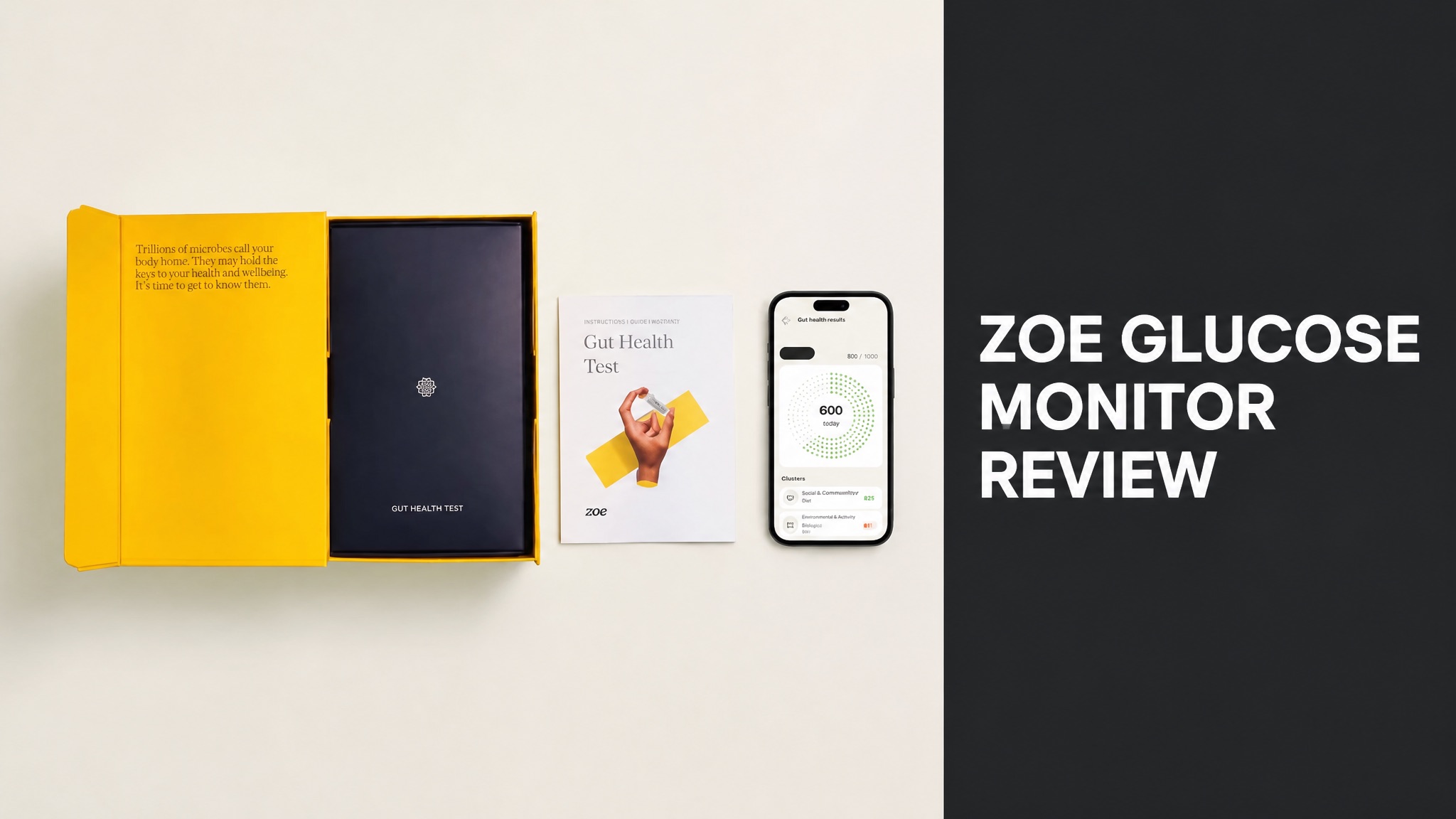
The ZOE glucose monitor was a 14-day arm sensor sold inside ZOE’s personalised nutrition kit. ZOE withdrew it in September 2025. Reviewers still debate whether the programme works without it, and buyers now face a very different product.
ZOE tracked blood sugar, blood fat and gut health to score foods. A 347-person trial found modest weight loss. Experts question the personalisation. Costs fell from £299.99 to £149 for the kit. The app alone now starts at £9.99 monthly. Some people should avoid it.
Reviews praise the education and criticise the logging. The science is stronger than before, but the benefit over standard advice looks small. Read on for the verdict, the costs, the risks and the free alternatives to ZOE.
What Is the ZOE Glucose Monitor?
The ZOE glucose monitor was a small sensor patch worn on the upper arm for 14 days. It formed one part of ZOE’s personalised nutrition programme. The sensor tracked blood sugar around the clock. ZOE then paired that data with stool and blood fat tests to score foods. Members logged every meal in the app to match food with glucose.
In fact, the patch was never sold alone. It came inside the ZOE test kit. Dr Tim Spector, a King’s College London scientist, fronts the brand, which launched in April 2022 and reached 130,000 subscribers.
Short answer: the monitor was a data tool, not a treatment. It showed how glucose rose after meals. ZOE’s app then turned those peaks into food scores for each member.
Is the ZOE Glucose Monitor Still Available?
No. ZOE withdrew the glucose monitor, the finger-prick blood fat test and the test cookies in September 2025. The relaunched kit contains only an at-home stool test for the gut microbiome. Several reviewers confirm the change. Customers who now visit the ZOE site will see an app and a gut test only, with no sensor in the box and no cookies to eat.
Here’s the thing: the app still scores food. But an algorithm now predicts blood sugar and blood fat responses. Dietitian Raquel Britzke notes that these responses are no longer measured on the member.
What’s more, the gut test is optional now. Which? reports that the app works without it. So anyone searching for a ZOE sensor today will find none to buy.
How Does the ZOE Glucose Monitor Work?
The ZOE glucose monitor measured glucose in the fluid under the skin through a tiny filament. The sensor then sent readings to the phone. The sensor ran on the LibreLink system. It logged levels for 14 days without finger pricks. The sensor ran on the LibreLink system. It logged levels for 14 days without finger pricks. Members never needed a finger prick.
Members also ate standard test muffins and cookies. These packed high fat and sugar into a fixed window. ZOE compared the glucose response with the wider ZOE population. Why use identical food? It makes results comparable between people.
Bottom line: the readings fed a personal food score. Foods scored from 0 to 100. ZOE wanted meals to land above 75, and reviewer Simon Dean hit 85 on a salmon dinner.
What Did the ZOE Test Kit Include?
The original ZOE kit bundled four tests that together measured blood sugar, blood fat and the gut microbiome. The box arrived by courier in several yellow packages. Testers followed a strict timetable on the main test day. Boxes arrived by courier in several small yellow packages. Members scanned each one to begin. Testers followed a strict timetable on test day.
Original ZOE Kit Contents:
- Glucose sensor worn for 14 days
- Finger-prick blood fat test
- Stool sample kit for the gut microbiome
- Blue test muffins and cookies
To be clear, the blue colour had a job. The dye tracked gut transit time. Reviewers described the cookies as very sweet, and Good Food testers called them ‘sweet polystyrene’.
What Are the Benefits of ZOE?
ZOE claims to improve long-term health by showing which foods suit each body and by scoring every meal. The app ranks meals and tracks plant variety against a target of 30 plants a week. Members also earn ‘beans’ toward a daily goal of 1,000. Members also earn ‘beans’ toward a daily goal of 1,000. The app also suggests swaps that lift each meal score.
Good Food rated the earlier kit 4.5 out of 5. Testers liked that no food was off limits. They also praised the app’s lessons and quizzes, which members can read as deeply as they wish.
Does ZOE Help You Lose Weight?
Yes, modestly. ZOE’s METHOD trial followed 347 adults for 18 weeks. The ZOE group lost 2.17 kg (4.8 lb) on average. The control group gained 0.30 kg (0.7 lb). Waist size fell 2.94 cm (1.2 inches) against 0.59 cm (0.2 inches). The control group gained 0.30 kg (0.7 lb). That gap is real but small. Waist size fell 2.94 cm (1.2 inches) against 0.59 cm (0.2 inches).
METHOD Trial Results:
| Measure | ZOE Group | Control Group |
|---|---|---|
| Weight change | -2.17 kg (-4.8 lb) | +0.30 kg (+0.7 lb) |
| Waist change | -2.94 cm (-1.2 in) | -0.59 cm (-0.2 in) |
| LDL cholesterol | No difference | No difference |
Now watch this: the control group only received leaflets and videos. Britzke argues that the comparison flatters the app. ZOE itself says members who followed advice closely lost 4.7% of body weight.
Does a Glucose Monitor Help Without Diabetes?
Not clearly. Oxford dietitian Nicola Guess says glucose in people without diabetes is a minuscule part of overall metabolic health. Her view is cited in The Guardian. Standard HbA1c blood tests diagnose diabetes, and a sensor can’t. Her view appears in The Guardian. She adds that bigger peaks don’t always mean worse health. Variation between people is large.
Is that the whole story? Not quite. Reviewer Tracy Griffen found it fascinating to watch her glucose react to a chippy supper. Seeing the curve changed habits, even if the medical value stayed unproven.
What Do ZOE Reviews Say?
ZOE reviews split sharply between users who love the education and experts who doubt the personalisation. Good Food, Earthy30 and several dietitians praise the app. Which? and The Guardian question whether the advice differs from standard guidance. Reviewers agree the app teaches well. The cost of the original kit made many people hesitate.
Review Verdicts:
| Source | Verdict |
|---|---|
| Good Food | 4.5 out of 5, pricey but well designed |
| Which? | Not convinced the advice was truly personalised |
| The Guardian | Benefits seem marginal against standard advice |
What Do Users Like About ZOE?
Users like the clear explanations of why each food affects blood sugar, blood fat and gut health. Reviewer Simon Dean said the app teaches the ‘why’ behind every score. He cut red meat and late-night alcohol after seeing his results. Many also enjoy the plant tracker and the simple food scores. The app also tracks plant variety and turns vague goals into numbers.
The good news? Diet change was the real win. Dean stopped ordering takeaways twice a week. He now cooks bean chilli with four or five legumes, which ZOE scores at 91 to 100.
What Are the Common Complaints About ZOE?
The top complaints centre on cost, strict test-day rules and slow meal logging. Good Food testers found barcode and AI logging inaccurate at times. Tracy Griffen felt queasy after eating 650 calories of cookie in eight minutes. Reviewers also dislike the fixed test-day timetable. Many also find the fixed schedule hard to fit around work.
The bad news? Dietitians also flag limits. Reema Pillai, writing for Dietitian Fit, notes the lack of personal coaching. She says long-term change needs human support, not just scores.
Who Should Avoid ZOE?
People with certain conditions should skip ZOE, based on the company’s own exclusion list. Anyone with an eating disorder is advised against the programme. Fibre advice can also trigger problems for people with gut disease. The brand also warns that fibre advice may upset existing gut problems, so a doctor’s view helps. Check with a doctor first.
ZOE Is Not Suitable For:
- People with an eating disorder
- People with an ileostomy or colostomy
- People undergoing chemotherapy
- People with gut disease who react badly to extra fibre
Worth knowing: the old test cookies contained gluten. They were unsuitable for coeliac disease. Anyone on diabetes medication should also check with a doctor first.
Is ZOE Legit?
Yes. ZOE is a real company that published a randomised controlled trial in Nature Medicine in 2024. Registered dietitians and Which? reviewed the product. Skeptics question the marketing, not the existence of the service. The brand also runs its own studies and reports about 30 peer-reviewed papers on its site, which adds weight.
So where’s the catch? Scientists say personalised nutrition is a young field. A Food Standards Agency report concluded the benefits seem somewhat marginal against what is already known about healthy eating.
How Much Does ZOE Cost?
ZOE now costs far less than it did when the glucose monitor was included. The original kit was priced at £299.99 (about $400 USD). Which? lists the current gut test kit at £149, and the app alone from £9.99 a month. Prices change with promotions, so buyers should check the live ZOE page before paying. Some plans start with a trial that renews on its own.
Current ZOE Pricing (Which?):
| Option | Price |
|---|---|
| Bundle: kit plus 12-month app | £268.88 |
| App only, 12 months | £9.99 per month (£119.88 total) |
| App only, 3 months | £24.99 per month (£74.97 total) |
| 7-day trial | £2.30, then renews to 12 months |
Watch the small print. All memberships bill in advance and renew automatically. Cancel before the trial ends if a 12-month plan isn’t wanted.
Is ZOE Worth the Price?
It depends on the goal. ZOE costs about £120 (about $160 USD) a year for the app, which is cheap if the habit change sticks. Which? points out that many ZOE tips are free. Those include 30 plants a week and fewer ultra-processed foods. Buyers who already eat well may see little change. The value depends on how much a daily score would shift real choices at home.
Why pay then? Some people need structure. A daily score and a streak can keep them logging. Others get nothing the free advice doesn’t already offer.
What Are the Alternatives to ZOE?
The main alternatives are over-the-counter continuous glucose monitors, one-to-one dietitian consultations and free diet changes. Levels is ZOE’s US equivalent, according to The Guardian. Dietitians say personal coaching adds accountability that an app lacks. Cheaper options exist too, and free guidance costs nothing at all. Costs vary widely.
By comparison, a consultation costs more per session. But the plan fits one person’s goals, portions and medical history. ZOE’s meal plan stays broad and skips precise portion sizes.
Can You Get the Same Results for Free?
Largely yes. Which? lists several ZOE-style habits that anyone can adopt without paying. The advice rests on plant variety, fibre, fermented foods and lifestyle basics. Newsletter tips from ZOE are free too. Paid tools add scoring and tracking. The free route needs more self-discipline. No app nudges the user each day, so motivation matters.
Free Habits Recommended by Which?:
- Eat 30 different plant foods a week
- Cut back on crisps, sugary drinks and snacks
- Add kefir, kimchi, yoghurt or cheese
- Sleep well, stay active and manage stress
Should You Try ZOE?
Try ZOE if daily food scoring and gut education would help build better habits. Skip it if a glucose sensor is the main draw, because that product is gone. The current app focuses on mindful eating, not glucose tracking. Older reviews describe a product that no longer exists. Buyers should check the live product page before paying.
In plain English: the ZOE glucose monitor review verdict is mixed. The science is better than it was, yet the personalisation is thinner. And the price is lower now, which makes a trial easier to justify.
Who Is ZOE Best For?
ZOE suits people who want structure, education and a plant-diversity target rather than a diagnosis. Beginners who feel lost in food advice get the most value. Those with medical conditions should talk to a doctor. It also fits people who enjoy tracking data and want a push toward more plants, more fibre and fewer processed snacks.
Look, the bottom line is simple. Take the 7-day trial if curious. Judge the app by whether logging meals feels doable, and cancel if it doesn’t.