
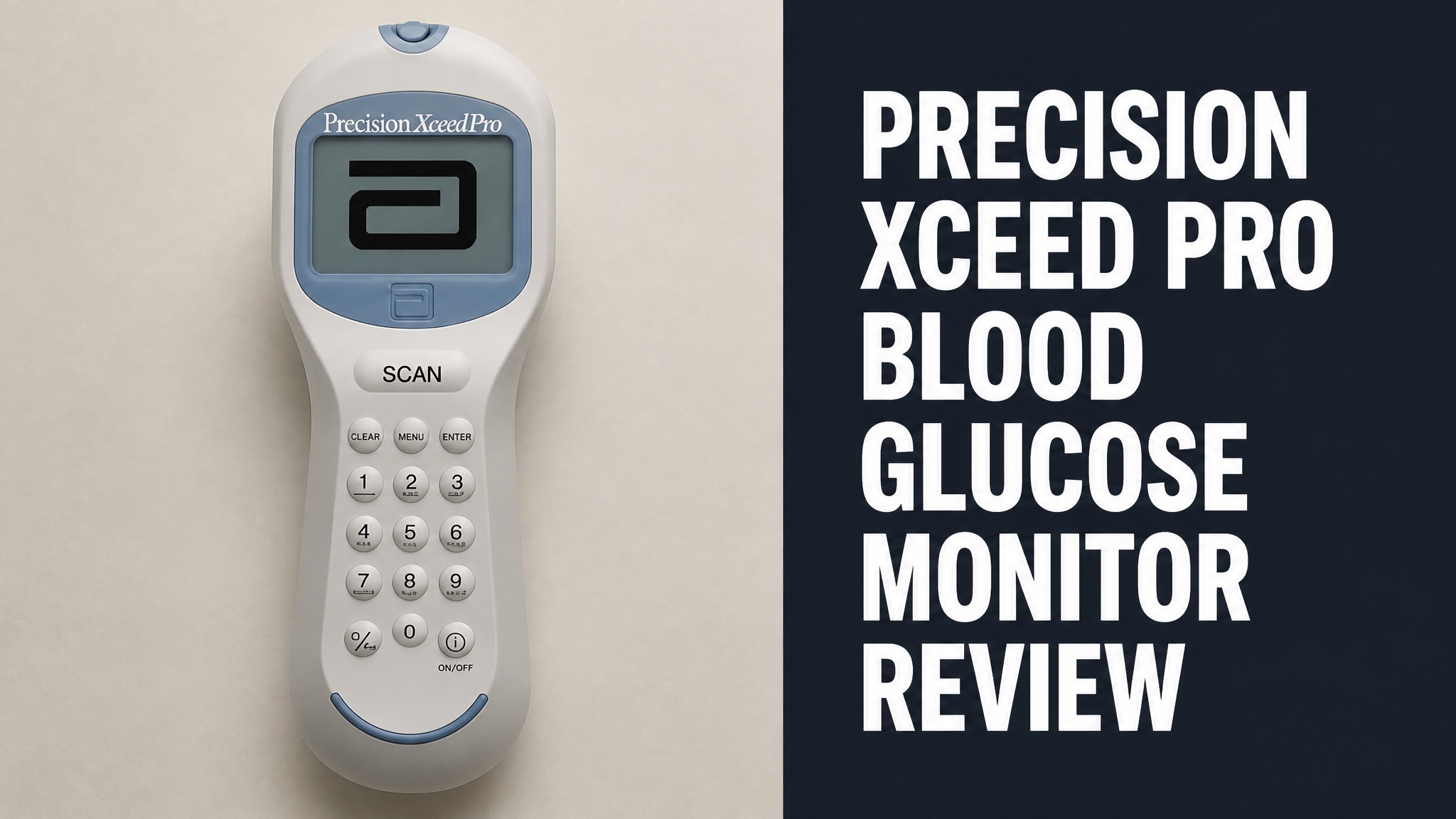
The Precision Xceed Pro is a professional blood glucose and beta-ketone meter made by Abbott Diabetes Care. Hospitals and clinics use it for bedside testing, not for home care. The review covers its design, accuracy, safety and price. The review also compares the meter with newer Abbott models.
The meter reads glucose from capillary, venous, arterial and neonatal blood. The meter also reads ketones. Its memory holds 2,500 patient results. Independent studies rate its accuracy as passing in general adults. Older tests show weak spots in neonates and with hematocrit swings. Read on for the details behind each claim, including studies, limits and costs.
Price is the other big factor. A single unit costs about $2,047 (USD). The sections below explain who needs it, where it falls short, and whether a newer Abbott meter suits your facility better. Each answer draws on Abbott documents, Medaval and published studies, so every claim has a source.
What Is the Precision Xceed Pro Blood Glucose Monitor?
The Precision Xceed Pro is a handheld whole-blood meter that measures glucose and beta-ketone levels at the point of care. Abbott built it for trained staff in hospitals and clinics, and the design does not target people testing at home. Abbott labels it an in vitro diagnostic device for monitoring only. Staff use it to track glucose control, not diagnose.
Abbott lists it as an in vitro diagnostic device. In plain English: it monitors glucose control. The device does not diagnose diabetes. Does that limit its use? Only for screening, since diagnosis still needs a lab test.
Who Makes the Precision Xceed Pro?
Abbott Diabetes Care Inc. manufactures the Precision Xceed Pro at its base in Alameda, California. The company belongs to Abbott, a global healthcare group that serves more than 150 countries. Abbott’s track record matters when a hospital audits its suppliers and checks who stands behind a device. Abbott also sells the FreeStyle line of meters worldwide.
Abbott’s later hospital meter is the FreeStyle Precision Pro. The Precision Pro received FDA clearance on July 25, 2013. Think of it this way: the Xceed Pro is the older generation, and the Precision Pro is its direct successor.
Who Is the Meter Designed For?
The Precision Xceed Pro is designed for professional use by certified operators rather than patients. Medaval, an independent device assessor, lists its primary use as professional. The meter takes finger samples and records single measurements only, one drop at a time each visit. Home users need a consumer meter instead, such as a basic fingerstick model.
The meter can lock out untrained users. Access then depends on operator certification. The good news? Facilities keep a clean audit trail of who ran each test.
Quick Facts:
- Manufacturer: Abbott Diabetes Care Inc.
- Primary use: professional, bedside testing
- Measures: blood glucose and beta-ketones
- Sample site: finger, plus venous, arterial and neonatal blood
- Memory: 2,500 patient results and 1,000 control results
How Does the Precision Xceed Pro Work?
The Precision Xceed Pro reads a small whole-blood sample on a dedicated electrochemical strip. The result then appears on the handheld display. Separate strips handle glucose and ketones. The operator picks the right strip, applies the blood and waits for the number on the screen. Results appear within seconds, and the memory logs each one for review.
Abbott’s current hospital line quotes a five-second glucose test. Pair that speed with barcode-based strip checks and the workflow stays quick. Why does speed matter? Nurses test dozens of patients per shift.
What Does the Meter Measure?
The meter measures D-glucose in capillary, venous, arterial and neonatal whole blood. The meter also measures beta-hydroxybutyrate in capillary and venous whole blood. Beta-hydroxybutyrate is the main ketone body, and its level signals ketoacidosis risk in people with diabetes who need close monitoring. Arterial and neonatal samples apply to glucose only.
A published ketone study reviewed the clinical utility of the Precision Xceed Pro ketone meter. For example, ketone testing at the bedside helps staff spot trouble before lab results come back.
Sample Types:
| Sample | Glucose | Ketone |
|---|---|---|
| Capillary | Yes | Yes |
| Venous | Yes | Yes |
| Arterial | Yes | No |
| Neonatal | Yes | No |
What Features Does the Precision Xceed Pro Have?
The Precision Xceed Pro combines a large results memory, operator lockout and dual glucose and ketone testing in one device. The unit stores 2,500 patient results and 1,000 control results. The listing also states that the meter is latex free, which suits strict hospital supply rules. Operators log in before each test, so every result has a named owner.
Control tests matter here. Quality control runs prove the meter and strips still work. And the 1,000-result control memory keeps those records on the device for audits.
Is the Precision Xceed Pro Accurate?
Yes. The Precision Xceed Pro passed a clinical validation study in a general population under the ISO 15197:2003 protocol. Medaval cites an ICU study by Gijzen and colleagues from 2012. To be clear, the evidence is older and uses an older standard, so recent proof is thin. Treat results as reliable for adults, and recheck any odd reading for the patient.
Medaval gives the meter a legacy approval for that reason. The Institute of Health Economics in Canada lists general use but notes no evidence was provided. So what does that mean for buyers? Accuracy is good, but not recently re-tested.
Does the Precision Xceed Pro Pass ISO 15197?
Yes. The meter passed ISO 15197:2003 in a general population in the Medaval assessment. The 2003 version of the standard is two decades old. The current ISO 15197:2013 is stricter, and Abbott’s newer Precision Pro meter claims to meet it in its own studies. Check the label before buying, since each unit ships with its own strip lot and manual notes.
Passing the old rule is still meaningful. Most glucose meters on hospital shelves earned the same clearance. At the same time, buyers who need the newer standard must check the specific device.
Accuracy Evidence:
| Study | Setting | Result |
|---|---|---|
| Gijzen et al., 2012 | Intensive care unit | ISO 15197:2003 pass |
| Diaw et al., 2013 | Neonatal intensive care | Fail in neonates |
| de Mol et al., 2010 | Simulated high altitude | Fail |
| Musholt et al., 2011 | Hematocrit variation | Unstable performance |
What Are the Accuracy Limits?
The meter shows weaker results with newborns, high altitude and unusual hematocrit levels. A 2013 study of three devices in a neonatal unit found the Precision Xceed family failed ISO 15197 for neonates. A 2010 chamber study also showed failures at simulated altitude. Staff must recheck those cases with a lab sample before acting on the number shown.
Hematocrit is the share of red cells in blood. Musholt’s team found unstable performance across hematocrit swings. The bad news? Sick patients often have abnormal hematocrit, so staff must confirm odd readings in the lab.
What Do Precision Xceed Pro Reviews Say?
Precision Xceed Pro reviews come mainly from clinical studies and device assessors rather than consumers. Grayline Medical lists no customer reviews for the meter. Hospitals buy through procurement, because hospitals buy through procurement, so star ratings are rare. Evidence therefore comes from labs and assessors, which is far stronger than opinions.
Instead, buyers lean on published evaluations. Medaval, SKUP in Norway and peer-reviewed ICU studies carry the weight. Is that a weakness? Not really, because lab-grade data beats anecdotes.
What Do Clinical Studies Show?
Clinical studies show a reliable meter in adult general-population testing and weaker results in special groups. The SKUP report from 2006 evaluated the home-use Precision Xceed with Precision Xtra Plus G3c strips. The meter passed ISO 15197:2003 with both staff and subject readings. Both readings passed the old standard, which supports adult testing.
In fact, the Gijzen ICU comparison also passed the Xceed Pro. The pattern is clear. General adult use works. Neonates and altitude do not.
How Does It Compare With the FreeStyle Precision Pro?
The FreeStyle Precision Pro improves on the Xceed Pro with wireless data, 2D barcodes and foil-wrapped strips. Abbott says it is the only inpatient system among top brands (LifeScan, Roche, Nova) with foil-wrapped strips for infection control. Hospitals value that a lot, and rightly so. Wireless links also feed hospital records, which cuts manual charting.
The newer meter also adds hematocrit compensation from 15% to 65% and a five-second test. The upgrade fixes the Xceed Pro’s weak spot. Is newer better here? Yes, if the budget allows.
Xceed Pro vs Precision Pro:
| Feature | Xceed Pro | Precision Pro |
|---|---|---|
| Wireless data | No | Dual-band |
| 2D barcode reader | No | Yes |
| Foil-wrapped strips | No | Yes |
| Hematocrit correction | Limited | 15% to 65% |
Is the Precision Xceed Pro Safe to Use?
Yes. The Precision Xceed Pro is safe for trained operators who follow the manual and clean the meter between patients. The listing marks it latex free. The FDA requires disinfection of such devices after every use, and the operator manual covers the cleaning steps in detail. Strict hygiene protects patients, and certified operators cut handling errors.
Blood-contact devices carry infection risk. For example, shared meters and open strip vials can spread pathogens. Studies cited by Abbott found 25.7% to 57.0% of vial strips were contaminated with bacteria.
Who Should Avoid the Precision Xceed Pro?
Home users and untrained staff need a different meter than the Precision Xceed Pro. The device targets professional settings, and its labeling does not support diagnosing diabetes. Neonatal units also need extra care, given the failed neonatal evaluation and the unstable hematocrit results. Lab confirmation protects those patients from a wrong dose decision.
The simple rule? Use certified operators only. And confirm unusual readings with a lab test.
Safe Use Checklist:
- Certify every operator before testing.
- Run control tests on schedule.
- Disinfect the meter after each patient.
- Confirm odd results with a lab sample.
How Much Does the Precision Xceed Pro Cost?
The Precision Xceed Pro costs $2,046.99 (USD) at Grayline Medical for the meter alone. The listing shows SKU 7090005 and says an order may take five to seven days to ship. Test strips cost extra, so the total then depends on testing volume and staff numbers. Used units on eBay cost less but carry risk, since age and calibration history are unknown.
The price is far above a home meter. Why so high? Professional-grade memory, lockout controls and dual testing add cost. Hospitals also pay for training and quality control supplies.
Where to Buy the Precision Xceed Pro?
Buyers can find the Precision Xceed Pro at medical supply stores like Grayline Medical and Medline. Grayline shows it in stock, with free shipping on orders over $100 (USD). Strips sell at specialist retailers such as HonestMed, and eBay also lists used units. Check the seller’s return terms first, and confirm the strip lot is current before paying.
Some items may need a business license. Grayline notes certain medical products require documentation. So, check requirements before ordering, and buy from sellers that supply Abbott strips.
Where Buyers Look:
- Grayline Medical for the meter
- Medline for hospital supply contracts
- HonestMed for test strips
- Abbott representatives for facility pricing
Is the Precision Xceed Pro Worth It?
Yes. The Precision Xceed Pro is worth buying for a clinic that needs dual glucose and ketone testing from one meter. The meter is not worth buying for home use or neonatal care. Bottom line: match the tool to the setting, and check the strip supply before ordering. Newer models cost more but add wireless data, so compare total cost against workflow savings.
Facilities that want wireless data look at the FreeStyle Precision Pro instead. Is the older meter a bad choice? No, but it is a dated one.
Is It Worth the Price?
Yes. The meter delivers solid value for small clinics at about $2,047 (USD) because it handles both glucose and ketones. Dedicated ketone meters add cost on top of a glucose meter. One device removes that duplicate purchase and trims training time for staff. Large hospitals may still prefer wireless models, since charting time adds up across many beds.
Larger hospitals gain more from newer models. The reason is simple: wireless uploads to medical records save staff time. Time saved often outweighs a higher sticker price.
Pros and Cons:
- Pro: tests glucose and ketones in one meter
- Pro: stores 2,500 patient results
- Pro: operator lockout for trained users only
- Con: older ISO 15197:2003 evidence
- Con: weak results in neonates and with hematocrit swings
- Con: no wireless or 2D barcode support